Fr. Marko Rupnik
(Image courtesy of the Diocese of Rome)
Vatican City, Jun 9, 2025 / 11:08 am (CNA).
The Vatican on Monday removed artwork by former Jesuit Father Marko Ivan Rupnik from its official websites.
Digital images of the Slovenian priest’s sacred art, which were frequently used by Vatican News to illustrate articles of the Church’s liturgical feast days, are no longer found on the digital news service.
Catholic writer Amy Welborn took to X to show screenshots of Vatican News’ “Memorial of the Blessed Virgin Mary, Mother of the Church” article before and after Rupnik’s accompanying artwork was removed from the website on June 9.
Rupnik, who was expelled by the Society of Jesus in June 2023 for his “stubborn refusal to observe the vow of obedience,” is accused by about two dozen women, mostly former nuns, of spiritual, psychological, and sexual abuse they allege has occurred over the past three decades.
The recent changes to the Vatican News and the Dicastery for Communication websites came soon after Pope Leo XIV met with members of the Pontifical Commission for the Protection of Minors on June 5.
Within the first week of his pontificate, Pope Leo XIV met with Cardinal Seán O’Malley, OFM, archbishop emeritus of Boston and president of the Pontifical Commission for the Protection of Minors, on May 14.
Several Church leaders and Catholic groups around the world have increasingly called for the removal of sacred art created by the former Jesuit.
If you value the news and views Catholic World Report provides, please consider donating to support our efforts. Your contribution will help us continue to make CWR available to all readers worldwide for free, without a subscription. Thank you for your generosity!
Click here for more information on donating to CWR. Click here to sign up for our newsletter.
Vatican City, Mar 22, 2021 / 05:30 am (CNA).- The restriction of private Masses in the upper side chapels of St. Peter’s Basilica went into force Monday.
The basilica was quiet on March 22 without the usual murmur of prayers in many languages be… […]
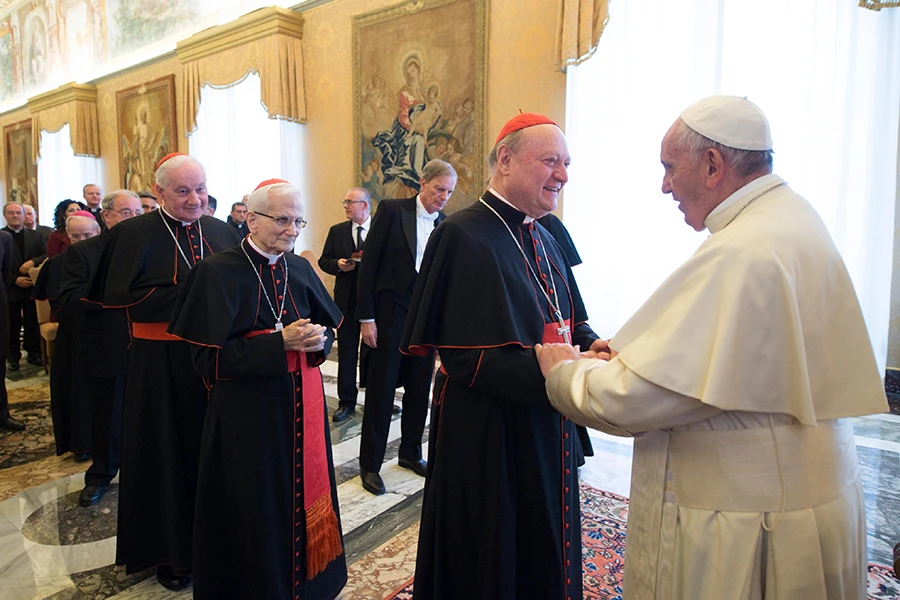
Vatican City, Jan 26, 2018 / 10:04 am (CNA/EWTN News).- Pope Francis met with the members of the Congregation for the Doctrine of the Faith Friday, affirming the dignity of every person and emphasizing the Church’s task of accompanying the ill and suffering, especially in the face of increasing support for euthanasia.
Pain, suffering, and the meaning of life and death are all problems the contemporary mind does not know how to face with hope, the Pope said Jan. 26, and therefore “this is one of the duties that the Church is called to render to contemporary man.”
“It is clear that where life is valid not for its dignity, but for its efficiency and productivity, [euthanasia] becomes possible. In this scenario it must be reiterated that human life, from conception to its natural end, has a dignity that renders it inviolable.”
Pope Francis met at the Vatican’s Clementine Hall with the members of the Congregation for the Doctrine of the Faith at the conclusion of their plenary session, praising their study of “the sensitive issues” surrounding the accompaniment of terminally ill patients.
Secularization and the emphasis on self-determination and personal autonomy have increased the demand for euthanasia, he noted, and many people believe that the “voluntary interruption of human existence [is] a choice of ‘civilization.’”
Therefore, authentic pastors have an opportunity to accompany people in difficult circumstances, with an accompaniment that does not “abandon man to himself, nor leave him in the grip of his disorientation and his errors, but with truth and mercy,” brings him back to the good, Francis said.
“Authentic pastoring therefore is every action aimed at taking man by the hand, when he has lost the sense of his dignity and his destiny, to lead him with confidence to rediscover the loving fatherhood of God, his good destiny and the ways to build a more human world.”
The Pope also expressed his appreciation for the congregation’s commitment to protecting the faith and the sanctity of the sacraments.
In particular, he pointed to their work examining cases concerning graviora delicta, external violations against faith and morals or in the celebration of the sacraments; and applications for the dissolution of the matrimonial bond in favor of the faith.
This is especially important today, he said, as man’s understanding of self becomes ever more fluid and changeable, influencing his existential and ethical choices.
“The man of today no longer knows who he is and, therefore, struggles to recognize how to act well.”
“In this sense, the task of your Congregation appears decisive in recalling the transcendent vocation of man and the indivisible connection of his reason with truth and goodness, which introduces faith in Jesus Christ,” he said.
“Nothing helps man to know himself and God’s plan for the world like the opening of reason to the light that comes from God.”
Pope Francis gives his message during the weekly general audience in the Vatican’s Paul VI Hall on Jan. 4, 2023 / Daniel Ibanez/CNA
Vatican City, Jan 4, 2023 / 02:30 am (CNA).
Benedict XVI “always wanted to accompany us in the encounter with Jesus,” Pope Francis said at the start of his weekly public audience on Wednesday.
The pope began his message Jan. 4 with a reference to his predecessor, Pope Emeritus Benedict XVI, who died on Dec. 31 at the age of 95. The body of Benedict XVI is lying in state in St. Peter’s Basilica Jan. 2-4, before his funeral on Jan. 5.
“Before beginning this catechesis,” Francis said in the Vatican’s Paul VI Hall, “I would like us to join with those here beside us who are paying their respects to Benedict XVI, and to turn my thoughts to him, a great master of catechesis.”
Catechesis means religious instruction or teaching.
“His acute and gentle thought was not self-referential, but ecclesial, because he always wanted to accompany us in the encounter with Jesus,” he said.
Pope Francis enters the Vatican’s Paul VI Hall on Jan. 4, 2023, at the start of his weekly public audience. Daniel Ibanez/CNA
“Jesus, Crucified and Risen, the Living One and the Lord, was the destination to which Pope Benedict led us, taking us by the hand,” the pope added. “May he help us rediscover in Christ the joy of believing and the hope of living.”
Pope Francis’ message on Wednesday was the final instruction in a series on the theme of discernment.
One of the important tools to support discernment, he said, is spiritual accompaniment, also called spiritual direction.
“It’s very important not to walk alone,” he underlined, encouraging Catholics to find a spiritual director, a lay person or a priest, who can help to “unmask misunderstandings, even grave ones, in our consideration of ourselves and our relationship with the Lord.”
The pope compared the experience of discernment without accompaniment to looking at yourself alone in a mirror: you can imagine things that are not there or see things in a distorted way.
“God’s grace in us always works on our nature. Thinking of a Gospel parable, we can always compare grace to the good seed and nature to the soil,” Francis said. “First of all, it is important to make ourselves known, without fear of sharing the most fragile aspects, where we find ourselves to be more sensitive, weak, or afraid of being judged.”
He emphasized that the person who accompanies us in our spiritual journey does not replace or substitute the Lord, but “walks alongside him or her, encouraging them to interpret what is stirring in their heart, the quintessential place where the Lord speaks.”
The Church commonly calls someone in this role a “spiritual director,” but Pope Francis said he prefers the name “spiritual companion.”
“Discernment is an art, an art that can be learned and which has its own rules,” he said. “If learned well, it enables spiritual experience to be lived in an ever more beautiful and orderly manner. Above all, discernment is a gift from God, which must always be asked for, without ever presuming to be expert and self-sufficient.”
The pope said the act of recounting our life, experiences, and spiritual searching in front of someone else can bring clarity.
It can also, he added, bring to light “the many thoughts that dwell within us, and which often unsettle us with their insistent refrains — how often, in dark times, have these thoughts come to us: ‘I have done everything wrong, I am worthless, no-one understands me, I will never succeed, I am destined for failure,’ and so on.”
“False and poisonous thoughts, that the exchange with another helps to unmask, so we can feel we are loved and valued by the Lord for what we are, capable of doing good things for him,” he said.
Let us pray, Francis concluded: “Lord, give me the grace to discern. In life’s moments, help me to know what I should do. And send me the people who can help me discern.”
Time for a clean sweep. Get the jackhammer. Pedestrian derivitive imagery without the genesis of authentic faith need be wiped from our shrines and churches.
Then, consequences for the perpetrator.
Br. Jacques,
The question of scandal is one additional to the quality of the art. I don’t believe in censoring art or music solely because of the sins of the artist/composer, but certainly when the alleged abuse is this disturbing & recent & when the art is so poor & cartoonish, I believe there’s good enough reason to.
I’m not so certain that censoring art for any reason is a good idea. That said, if I were the owner of any of Rupnick’s art (which the Church in various locales is), then it is fully within my purview to do with it whatever I please – including destroy it – for any reason of my choosing.
Shame and repentance are different phenomena. Shame can lead to repentance but it need not. He has brought dire consequences to his victims and scandal upon the Church of Christ. Given his public persona a public acknowledgement of his guilt by him is required.
Br. Jaques, you have an erroneous notion about the nature of shame. I am not talking about guilt for sin. You should read up on the psychological meaning of shame. You seem very quick to pounce.
Diogenes: my apologies, I was wrong I, lacked knowledge of the clinical meaning of shame. I did not mean to “pounce” , however just the opposite. I meant that we should withhold judgment of the man assuming that we don’t really know his inner makeup. We do know that he has caused much pain and it seems that public acknowledgement of this is certainly in order; but we don’t know why he did what he did. We can’t really walk in another man’s shoes.
I hear you, Br. Jaques. But as members of a Christian community we are expected to take note of a brother or sister’s observable behavior and when we feel it is warranted to provide counsel. How can we ever correct a brother if we don’t take notice of what they’re doing? That is not to say that we can ever judge the state of another’s soul. That alone belongs to God. In the case of Rupnick, his acts have caused a rupture in the Christian community and the rupture in most people is cause for their feeling (a)shamed. There have been no reports to my knowledge that he acknowledged publicly what he’s done. He seems to just move along as if nothing has happened.
Has he repented recently? Has he demonstrated any sense of guilt or shame to date? Has he offered to make restitution to those he harmed? If not, why not?
But what is the relationship between art and the one who created it? Is artwork good (intrinsically beautiful, inspiring etc.) as long as the creator is in good standing in society? Most people
agree that Michelangelo‘s Sistine chapel is beautiful and inspiring But what would happen if art historians suddenly found that he was the most reprobate character in history? Would we then paint them over and smash up all of his beautiful sculptures? Or would we refrain from doing so because those harmed were long gone and forgotten? I’m not saying that Rupnik’s art was either beautiful or inspiring ( quite the contrary : the little that I saw of it looked ugly to me). But prior to the public knowledge of his behavior, many Catholics liked and valued his work and placed them in Churches etc. What if Rupnik were the equivalent of a modern Michelangelo? Would we still be calling for the destruction of his work? But you may counter that his work was not as good as Michelangelo‘s, but that’s a matter of opinion and not easily proved. Now we get down to the character of the artist and the question is – can a bad man create good art? Can a non Christian create good Christian art? If Hitler, for instance, really was talented (he painted post cards) would we put his work in our Churches? If he did paint a beautiful painting and it was in a Church for years, much loved and valued and reproduced and insured for millions and we suddenly discovered that he was the artist what would we do?
I do not mean to make judgments here I just asking some questions. Why do we want to destroy the art simply because it was created by a sinful person? Would this art become more acceptable over time? If so why? Can evil create good ?
James Connor, my position is that whoever is the owner of the art has the right to do with it whatever he or she pleases. If I own the Mona Lisa and decide to set it afire, that is my prerogative. To do so would be stupid and an offense against cultural sensibilities but it’s still my prerogative.






A welcome report. Next is the mascot.
Time for a clean sweep. Get the jackhammer. Pedestrian derivitive imagery without the genesis of authentic faith need be wiped from our shrines and churches.
Then, consequences for the perpetrator.
Can a child conceived in sin become a saint?
Br. Jacques,
The question of scandal is one additional to the quality of the art. I don’t believe in censoring art or music solely because of the sins of the artist/composer, but certainly when the alleged abuse is this disturbing & recent & when the art is so poor & cartoonish, I believe there’s good enough reason to.
I’m not so certain that censoring art for any reason is a good idea. That said, if I were the owner of any of Rupnick’s art (which the Church in various locales is), then it is fully within my purview to do with it whatever I please – including destroy it – for any reason of my choosing.
I’ve concluded that Rupnick is incapable of feeling shame.
Then is he not human? No possibly of repentance?
Shame and repentance are different phenomena. Shame can lead to repentance but it need not. He has brought dire consequences to his victims and scandal upon the Church of Christ. Given his public persona a public acknowledgement of his guilt by him is required.
Br. Jaques, you have an erroneous notion about the nature of shame. I am not talking about guilt for sin. You should read up on the psychological meaning of shame. You seem very quick to pounce.
Diogenes: my apologies, I was wrong I, lacked knowledge of the clinical meaning of shame. I did not mean to “pounce” , however just the opposite. I meant that we should withhold judgment of the man assuming that we don’t really know his inner makeup. We do know that he has caused much pain and it seems that public acknowledgement of this is certainly in order; but we don’t know why he did what he did. We can’t really walk in another man’s shoes.
I hear you, Br. Jaques. But as members of a Christian community we are expected to take note of a brother or sister’s observable behavior and when we feel it is warranted to provide counsel. How can we ever correct a brother if we don’t take notice of what they’re doing? That is not to say that we can ever judge the state of another’s soul. That alone belongs to God. In the case of Rupnick, his acts have caused a rupture in the Christian community and the rupture in most people is cause for their feeling (a)shamed. There have been no reports to my knowledge that he acknowledged publicly what he’s done. He seems to just move along as if nothing has happened.
Has he repented recently? Has he demonstrated any sense of guilt or shame to date? Has he offered to make restitution to those he harmed? If not, why not?
Welcome news that the artwork was removed but the question is now “removed to where” and for “for what purpose?”
But what is the relationship between art and the one who created it? Is artwork good (intrinsically beautiful, inspiring etc.) as long as the creator is in good standing in society? Most people
agree that Michelangelo‘s Sistine chapel is beautiful and inspiring But what would happen if art historians suddenly found that he was the most reprobate character in history? Would we then paint them over and smash up all of his beautiful sculptures? Or would we refrain from doing so because those harmed were long gone and forgotten? I’m not saying that Rupnik’s art was either beautiful or inspiring ( quite the contrary : the little that I saw of it looked ugly to me). But prior to the public knowledge of his behavior, many Catholics liked and valued his work and placed them in Churches etc. What if Rupnik were the equivalent of a modern Michelangelo? Would we still be calling for the destruction of his work? But you may counter that his work was not as good as Michelangelo‘s, but that’s a matter of opinion and not easily proved. Now we get down to the character of the artist and the question is – can a bad man create good art? Can a non Christian create good Christian art? If Hitler, for instance, really was talented (he painted post cards) would we put his work in our Churches? If he did paint a beautiful painting and it was in a Church for years, much loved and valued and reproduced and insured for millions and we suddenly discovered that he was the artist what would we do?
I do not mean to make judgments here I just asking some questions. Why do we want to destroy the art simply because it was created by a sinful person? Would this art become more acceptable over time? If so why? Can evil create good ?
James, some good points and I partially agree with you, however I don’t think there are answers to your questions.
James Connor, my position is that whoever is the owner of the art has the right to do with it whatever he or she pleases. If I own the Mona Lisa and decide to set it afire, that is my prerogative. To do so would be stupid and an offense against cultural sensibilities but it’s still my prerogative.
Here’s the solution for Rupnik art:
Bury some samples of it inside the tomb of his papal benefactor the Pontiff Francis.
Then jackhammer the rest, and distribute the rubble to the Jesuits.
Now THAT’S a plan!
Thank you.😉