

The Carthusians are all but unknown—both inside and outside the Catholic Church—and they likely want to keep it that way. If anyone has heard of these sons of St. Bruno (their founder), it’s through Chartruese, the liqueur that sustains every single one of their monasteries. They were also the subject of a twenty-year-old documentary, “Into Great Silence,” which provided a small window into their religious life. It is a life quite close to the earliest form of communal monastic life, which first emerged in fourth-century Egypt. During most of the day, they live as hermits—praying and fasting continuously. They only come together to chant the Divine Office several times during the day. They also rise during the night to pray Matins (now known as the Office of Readings).
Despite this deep asceticism, the Carthusians have also produced fruit outside their monasteries. The first martyrs during the persecutions of King Henry VIII of England were a trio of Carthusian monks—St. John Houghton and two companions—who died mere days before Sts. John Fisher and Thomas More. The latter had the highest respect for the order, as he had spent some time with the monks in London before he got married.
One might also think that an order of semi-hermits wouldn’t have much time for intellectual output. However, they did produce a theological giant—Denis the Carthusian.
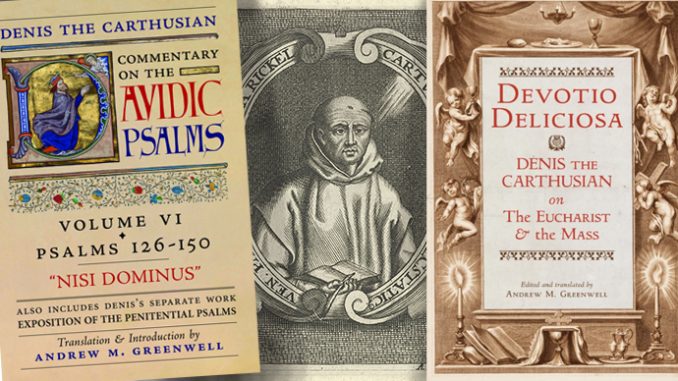
Andrew Greenwell, an attorney from Corpus Christi, Texas, has devoted much time in recent years to making this shining star better known. The final volume of his English translation of Denis’s Commentary on the Davidic Psalms is set for release in mid-September. Greenwell also translated and compiled Denis’s complete works on the Mass and the Eucharist into a separate volume.
Greenwell graciously answered questions about Denis and about himself via e-mail.
CWR: What was it about Denis that caused you to be so enthusiastic about him?
Andrew Greenwell: Denis is, to me, a perfect blend of the intellectual and scholastic rigor of St. Thomas Aquinas, combined with the contemplative silence and ascetically-pruned manner of life of St. Bruno, founder of the Carthusians. His love for the Scriptures drove him to write extensive commentaries on every book of the Old and New Testaments. And since knowledge of the Scriptures is knowledge of Christ, as St. Jerome says, it follows that Denis is a great repository of knowledge of our Lord. It is sort of a lectio divina on steroids and in slow motion.
His work is largely unknown because it is largely untranslated, and not because it should not be known. Thus, translating him into English unveils a lamp whose light has too long been shielded by a bushel basket. So I view my translation efforts as a sort of work of mercy.
CWR: Did you pray the psalms to any extent before taking up this large project?
Andrew Greenwell: Yes. Part of the reason I started with the Commentary on the Psalms was because I had been praying the Divine Office in Latin for some time, and wanted to enrich that practice. That’s the reason why I maintained the original Latin; along with the English Douay-Rheims translation of the Psalm itself; amongst the actual text of each commentary, so that those of my readers who happened also to be praying the Divine Office in Latin might incorporate its insights in their daily prayer.
CWR: Could you give a brief overview of the Carthusian’s life?
Andrew Greenwell: Denis (or Denys) de Leeuwen (or Leuwis) was born in 1402 in the Flemish town of Rijkel, near Liège in present-day Belgium. His intellectual and spiritual talents were recognized at an early age. And so, after attending schools in Sint-Truiden and Zwolle, he turned to the Carthusian Charterhouse at Roermond, in the Dutch province of Limburg, for admission as a postulant. But at 18, he was considered too young by the Carthusian prior. He followed the advice to bide time by enrolling at the University of Cologne, where he studied until his graduation in 1424. Upon his return to Roermond, he was admitted into the Carthusians. While there, he managed to write (among many other works) commentaries on every book of the Bible.
He was active in Church reform. He fought heresy and religious error. He even left his cloister in 1451 for seven months to travel with his friend, Cardinal Nicholas of Cusa, in efforts to reform the Church in Germany and the Low Countries. He died, in the odor of sanctity at age 69, in 1471.
Though not formally canonized or recognized as a Doctor of the Church, some of his devoted readers, such as St. Alphonsus Liguori, informally referred to him as the Doctor Ecstaticus—the “Ecstatic Doctor”.
CWR: What impact did Denis have during his lifetime and in the years immediately after? Why was he never canonized?
Andrew Greenwell: Denis had a great impact during his lifetime and posthumously. During his life, he maintained significant correspondence with ecclesiastics. Denis was a fixture of Catholic intellectual life until the late 1800s, when I suppose skepticism, biblical critical theory, and modernism deposed him.
In his The Autumn of the Middle Ages, the historian Johan Huizinga (1872-1945) noted that Denis the Carthusian was “the perfect type of the powerful religious enthusiast produced by the waning Middle Ages.” He concludes: “It is as if through him the entire stream of medieval theology flows once again.”
Although called blessed by those experts in the saints, the Bollandists, and, among others—by the likes of Sts. Alphonsus Liguori and Francis de Sales—Denis is not formally canonized, and probably will not be. As the saying goes: Cartusia sanctos facit, sed non patefacit. “The Charterhouse makes saints, but it does make them known.” The Bollandists, however, do give him a “feast day” of March 12, the day of his death.
CWR: Which saints and/or theologians influenced Denis the most?
Andrew Greenwell: (Pseudo)-Dionysius the Areopagite, the great 5th-century mystic, comes first. A close second is St. Thomas Aquinas, whom he considered his theological or scholastic master. Another is Blessed John of Ruysbroeck (1293-1381). Of course, sub silentio, an important one is St. Bruno himself.
Specifically, as it relates to the Commentary on the Psalms, however, I would underline St. Augustine of Hippo. Denis frequently turns to the Church Fathers’ masterly exposition on the Psalms, his Enarrationes in Psalmos.
CWR: What were his methods/approaches for analyzing each psalm?
Andrew Greenwell: Here, Denis was quite traditional. Following the example of St. Augustine, all his commentaries start with the literal intention of the sacred writers as a basic foundation. Specifically, the Psalms were interpreted from three other vantage points: the allegorical (Christological), the tropological (moral), and anagogical (involving the afterlife).
The most important principle for Denis was to spotlight “voices” in the Psalms. There is the voice about Christ; and the voice of Christ to us. Since Jesus prayed the Psalms, there is also the voice of Christ to the Father—which reveals the very mind and interior prayer life of Our Lord. Looked at in this way, the Psalms become almost another Gospel—since the Psalms reveal truths about Christ, His teachings, and His thoughts. Finally, there is the voice of the mystical body of Christ, the Church—who prays the Psalms with Her Head, to the blessed Trinity, which the Church does even to this day.
CWR: Did Denis primarily have theologians and the clergy in mind when he wrote about the Psalms; or are they accessible to devout lay Catholics as well?
Andrew Greenwell: I think that Denis, if he gave it any thought at all, expected his works to have a greater audience than just prelates, fellow religious, and theologians. His general aim was to “interpret Scripture with Scripture.” And yet Denis’s works can be a challenge for a reader with little experience in philosophy or theology or the Scriptures. I sought to remedy that by including significant footnotes in my translations of Denis the Carthusian to guide the theological beginner.
I have told readers personally that if you read through all six volumes of the Commentary on the Psalms, you will not only learn about the Psalms, but you will virtually go through the whole “Catechism” if you read the footnotes. The translation, it should be noted, is not for academia. The translation is for the Church.
CWR: You also translated all of his writings on the Mass and the Eucharist. What was your motivation for compiling those works?
Andrew Greenwell: I first encountered Denis the Carthusian’s works on the Eucharist and the Mass in reading Dr. Nicholas Gihr’s (1839-1924) book, The Holy Sacrifice of the Mass: Dogmatically, Liturgically, and Ascetically Explained. Excerpts (in Latin) from Denis’s works were peppered throughout this book. After reading these excerpts, I resolved to make these works available in English. They didn’t deserve to be kept under wraps.
The Psalms and the Mass are closely related. The Psalms—as the heart of the Divine Office, the Liturgy of the Hours—and the Mass/the Eucharist, the source and summit of our Christian life—are both elements of the vox Christi totius, the voice of the whole Christ, the Mystical Body, the prayer of the Church. In this way, the motivation is the same for both—to make Christ’s voice better known.
CWR: Since the Mass excerpts many of the Psalms throughout the liturgical year, does he “borrow” at all from his own commentaries?
Andrew Greenwell: Yes, there are instances where there is overlap between Mass and Psalter. From time to time in his Commentary on the Psalms, Denis will use the principle of lex orandi lex credendi, the law of prayer is the law of belief—to interpret the Psalms based on the Church’s use of the Psalms in her liturgy. For example, he anagogically interprets Psalm 15:10’s words—“Because you will not leave my soul in hell (inferno)”—that they do not refer to the Hell of the damned, but to Purgatory. In support of this, Denis notes that the Church uses the term inferno in the Offertory of the Requiem Mass, to refer to Purgatory, and not to the Hell of the damned.
CWR: Since some of the included works are sermons, how did Denis encourage the laity to deepen their devotion to the Blessed Sacrament?
Andrew Greenwell: Denis warns all his readers of the need to approach Mass and the Eucharist with great reverence and guarded care, with all deliberate frequency. This is even more important when it comes to consuming the Holy Eucharist, where unworthy reception makes one guilty of the grave sin of profanation of the Body and Blood of our Lord. (1 Cor. 11:27-29) Denis emphasizes the need for the interior man to match the exterior man. There must not be any disconnect. Our hearts should match our external actions.
Denis adopts a common, time-tried exercise to achieve this. In our examens of conscience, we must ask ourselves several things. Who is offering the Mass? Christ. What is being offered in the Mass? Christ. To whom is the Mass being offered? Christ. Why is the Mass being offered? For the propitiation of my sins. If we keep the answer to these questions at the forefront of our minds, we will eventually arrive at the “delicious devotion”, which is the height of devotion to the Eucharist.
CWR: Speaking of the laity, what suggestions do you have to lay readers about reading Denis?
Andrew Greenwell: It’s simple—read him. If you understand half of what he says, you are still better off than not having read him. Ask for his intercession while you read, that God may enlighten your mind and inflame your heart while reading.
CWR: Do you have any plans to translate other words of his?
Andrew Greenwell: Yes. I have translated his Commentary on the Song of Songs, which is quite lovely and filled with mystical depth. I have also translated Denis’s Monopanton (“One Out Of All”), which is a sort of quasi-concordance of St. Paul’s epistles, or, as Denis puts it, a “redaction of all the epistles of St. Paul into one.” This work—dedicated to Cardinal Nicholas of Cusa—takes all the verses of St. Paul’s epistles (including Hebrews, which Denis considered to be written by St. Paul) and places them under certain headings—such as “On Faith,” “On Hope,” “On Charity,” “On Patience and the Tribulations of the Just and the Elect,” and so forth.
Finally, I want to translate the works of Denis on the Blessed Virgin Mary and Denis’s Commentary on the Gospel of John. Thereafter, who knows?
If you value the news and views Catholic World Report provides, please consider donating to support our efforts. Your contribution will help us continue to make CWR available to all readers worldwide for free, without a subscription. Thank you for your generosity!
Click here for more information on donating to CWR. Click here to sign up for our newsletter.



Leave a Reply