

 By
Chinese and Catholic customs around death sit side by side and share “one attitude towards the dead,” according to a Singaporean priest.

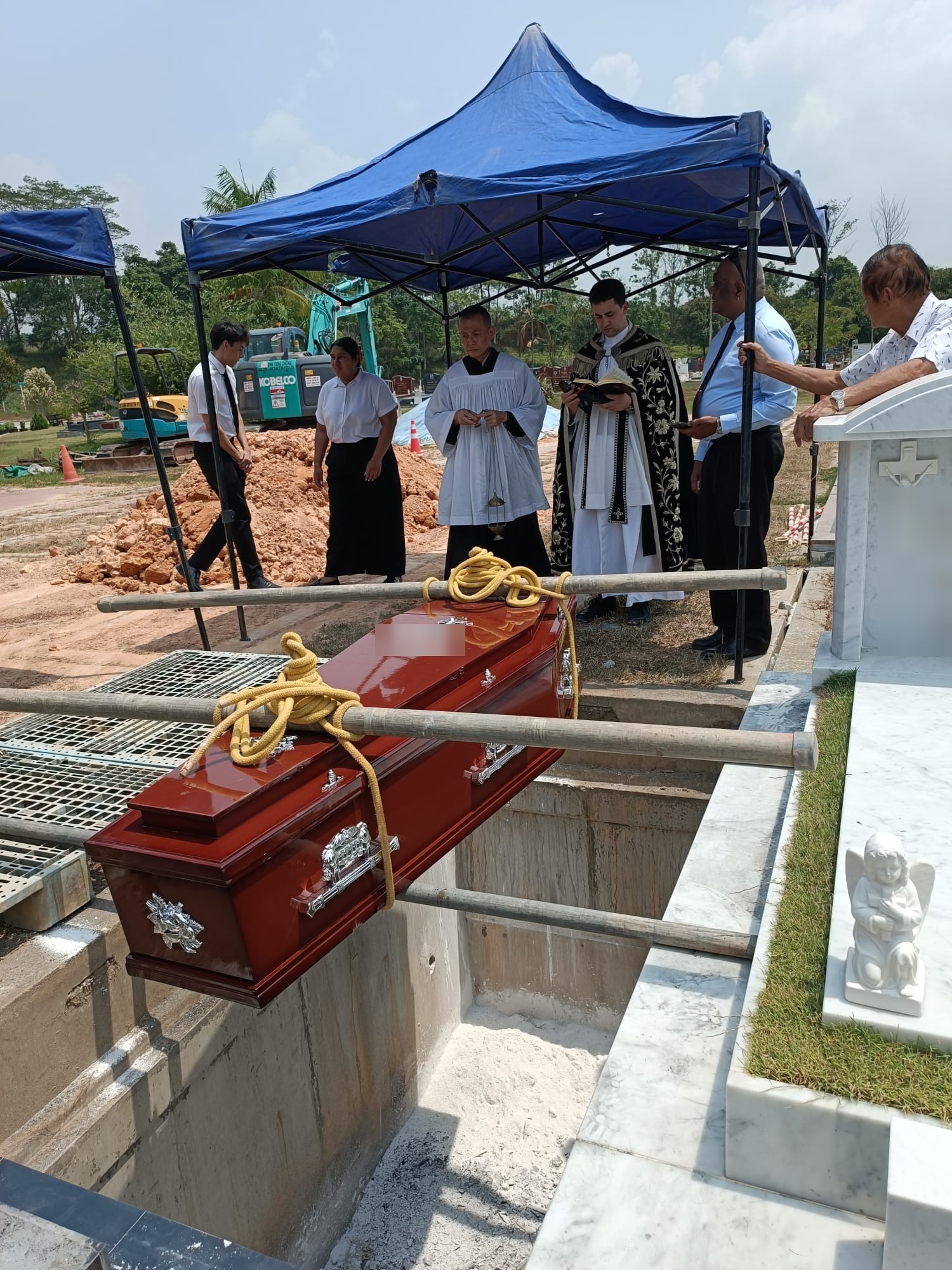
SINGAPORE — At some Catholic funeral wakes in Singapore, visitors are given red strings and invited to join in prayers for the souls of the dead. As they leave, they may be offered flower water to wash with, alongside holy water to sprinkle on the caskets.
Such wakes show how Chinese and Catholic customs around death sit side by side, said Bryan Goh, a historian at the National University of Singapore who studies the history of Christianity in insular Southeast Asia.
Catholics, he said, “find no problem offering joss-sticks at Taoist/Buddhist funeral wakes, focusing on the prayers they say in their heart rather than the form of the action.”
Clergy in Singapore did not see these customs as “something in dire need of correction,” Goh said, “mostly because they viewed certain actions and rituals as performance of filiality, rather than religiosity.”
‘Love transcends death’
Father John Chen, a priest of the Archdiocese of Singapore, told EWTN News that the Catholic faith and Chinese culture share one attitude toward the dead: “Love for our departed loved ones does not end with death. Indeed, love transcends death,” he said.
Students from Buddhist or Taoist families often ask him: “If my parents or grandparents are not Catholic, how can I show them respect without compromising my faith?”
Becoming Catholic means “discerning which cultural practices express values compatible with the Gospel and which may need to be reinterpreted or modified in the light of Christian faith,” he said.
Father Luke Zhang, of the Church of the Holy Trinity, a priest of the Congregation of the Disciples of the Lord, founded in China in 1928 by Archbishop Celso Costantini, who later became a cardinal, said some Catholics keep ancestral tablets at home because they live with relatives who are not Catholic. He encourages them to bow before the tablets, offer flowers and fruit, light candles, and pray for the dead with Catholic prayers.
“Through these practices, we express our respect for and remembrance of the deceased, pray for them, and entrust them to Godʼs merciful hands,” he said.
Burning joss paper or spirit money, however, is “strictly prohibited,” he said.
‘Simply go along’
Matthew Tserng Jia Uei, 61, a semi-retired shipping container assistant who leads the Mandarin-language Rite of Christian Initiation of Adults (RCIA) at the Church of the Blessed Sacrament, grew up in a Taoist family and was baptized in 1984. His relatives never insisted that he bow before the family altar.
“They only asked me to do my duty as one of the younger generation and simply go along as a gesture,” he said in written answers in Chinese.
Polly Ng Eng Lan, 65, a retired clerk who accompanies catechumens in the Mandarin-language RCIA at the Church of St. Alphonsus (Novena Church), said priests and catechists generally teach Catholics not to take part in rites of worship, and “only to offer incense to the deceased and pray.”
Michael Robert Tan, 57, an IT director baptized in April 2024, said his RCIA classes touched on what was allowed, including taking part in other faiths’ ways of remembering the dead. He keeps no altar or photographs at home. “Nothing, only in my memories,” he said.
Serene Xu, 63, an administrator baptized in 1991, still visits the temple where her familyʼs ashes are kept each Qingming (a traditional Chinese holiday observed to honor ancestors and welcome spring) and on death anniversaries, “to pay my respects and remember them.” Her children, baptized as infants, join the familyʼs Buddhist and Taoist funerals.
“I firmly believe that faith and family traditions can coexist harmoniously when there is mutual respect, understanding, and acceptance,” she said.
Prayer ‘on the couch’
“There has never been a single Chinese way of practicing ancestral worship,” said Michel Chambon of the Initiative for the Study of Asian Catholics.
“Increasingly, people seem to prefer praying privately, in the intimacy of their own hearts, whether on the couch or in bed, rather than gathering before a formal altar,” he said.
Zhang said young Catholics seem “less enthusiastic about memorial activities for the deceased” than their parents’ generation, but “perhaps they have their own ways of remembering them, such as a simple prayer in the heart.”
Chen said younger Catholics may seek “to preserve the values of filial piety, gratitude, and family unity while finding contemporary ways to express them.”
For Xu, one hope remains. “Deep in my heart, I continue to hold on to the hope that one day, we will be reunited in our Heavenly Fatherʼs house,” she said.
If you value the news and views Catholic World Report provides, please consider donating to support our efforts. Your contribution will help us continue to make CWR available to all readers worldwide for free, without a subscription. Thank you for your generosity!
Click here for more information on donating to CWR. Click here to sign up for our newsletter.

Leave a Reply