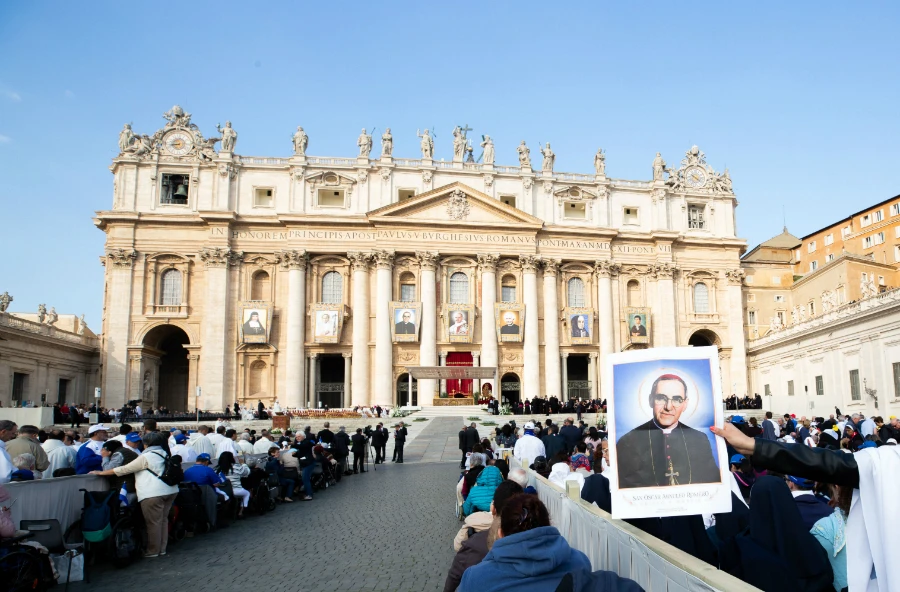
Vatican City, Oct 14, 2018 / 05:19 am (CNA/EWTN News).- “Jesus is radical,” Pope Francis said in his homily at the canonization of Pope Paul VI, Oscar Romero, and five other new saints.
“He gives all and he asks all: he gives a love that is total and asks for an undivided heart,” the pope told the pilgrims gathered in St. Peter’s Square Oct. 14.
Christ “gives himself to us as the living bread; can we give him crumbs in exchange?” the pope asked.
Francis officially recognized Pope Paul VI, Oscar Romero, Vincent Romano, Francesco Spinelli, Nunzio Sulprizio, Nazaria Ignacia March Mesa, and Maria Katharina Kasper as saints at the Mass.
“All these saints, in different contexts, put today’s word into practice in their lives, without lukewarmness, without calculation, with the passion to risk everything and to leave it all behind. May the Lord help us to imitate their example,” Pope Francis said at their canonization.
Oscar Romero, who was beatified by Pope Francis in El Salvador in 2015, was the archbishop of the nation’s capital city of San Salvador. He was shot while celebrating Mass March 24, 1980, during the birth of a civil war between leftist guerrilla forces and the dictatorial government of the right.
An outspoken critic of the violence and injustices being committed at the time, Romero was declared a martyr who was killed in hatred of the faith for his vocal defense of human rights.
Saint Oscar Romero “left the security of the world, even his own safety, in order to give his life according to the Gospel, close to the poor and to his people, with a heart drawn to Jesus and his brothers and sisters,” Pope Francis said in his homily Sunday.
“Let us ask ourselves where we are in our story of love with God. Do we content ourselves with a few commandments or do we follow Jesus as lovers, really prepared to leave behind something for him?” the pope asked.
Pope Saint Paul VI, like St. Paul, his namesake, “spent his life for Christ’s Gospel, crossing new boundaries and becoming its witness in proclamation and in dialogue, a prophet of a Church turned outwards, looking to those far away and taking care of the poor,” Francis said.
As pope, Paul VI oversaw much of the Second Vatican Council, which had been opened by Pope St. John XXIII, and in 1969 promulgated a new Roman Missal. He died in 1978, and was beatified by Pope Francis Oct. 19, 2014.
Apart from his role in the council, Paul VI is most widely known for his landmark encyclical Humanae Vitae, which was published in 1968 and reaffirmed the Church’s teaching against contraception in wake of the sexual revolution. This year marks the 50th anniversary the encyclical.
“Pope Saint Paul VI wrote: ‘It is indeed in the midst of their distress that our fellow men need to know joy, to hear its song,’” Pope Francis said.
“Today Jesus invites us to return to the source of joy, which is the encounter with him, the courageous choice to risk everything to follow him, the satisfaction of leaving something behind in order to embrace his way. The saints have travelled this path,” he continued.
The pope encouraged Catholics to imitate the saints’ detachment, “Is Jesus enough for us or do we look for many worldly securities?”
“Let us ask for the grace always to leave things behind for love of the Lord: to leave behind wealth, the yearning for status and power, structures that are no longer adequate for proclaiming the Gospel, those weights that slow down our mission, the strings that tie us to the world,” he said.
“Without a leap forward in love, our life and our Church become sick from ‘complacency and self-indulgence,’” he continued.
“The problem is on our part: our having too much, our wanting too much suffocates our hearts and makes us incapable of loving,” the pope said.
At the Sunday Angelus following the Mass, Pope Francis greeted Queen Sofia of Spain and the presidents of Chile, El Salvador, Panama, and Italy, who attended the canonization Mass.
The canonizations took place midway through the 2018 Synod of Bishops on the topic of young people, the faith and vocational discernment from Oct. 3-28.
 […]
[…]






A welcome report. Next is the mascot.
Time for a clean sweep. Get the jackhammer. Pedestrian derivitive imagery without the genesis of authentic faith need be wiped from our shrines and churches.
Then, consequences for the perpetrator.
Can a child conceived in sin become a saint?
Br. Jacques,
The question of scandal is one additional to the quality of the art. I don’t believe in censoring art or music solely because of the sins of the artist/composer, but certainly when the alleged abuse is this disturbing & recent & when the art is so poor & cartoonish, I believe there’s good enough reason to.
I’m not so certain that censoring art for any reason is a good idea. That said, if I were the owner of any of Rupnick’s art (which the Church in various locales is), then it is fully within my purview to do with it whatever I please – including destroy it – for any reason of my choosing.
I’ve concluded that Rupnick is incapable of feeling shame.
Then is he not human? No possibly of repentance?
Shame and repentance are different phenomena. Shame can lead to repentance but it need not. He has brought dire consequences to his victims and scandal upon the Church of Christ. Given his public persona a public acknowledgement of his guilt by him is required.
Br. Jaques, you have an erroneous notion about the nature of shame. I am not talking about guilt for sin. You should read up on the psychological meaning of shame. You seem very quick to pounce.
Diogenes: my apologies, I was wrong I, lacked knowledge of the clinical meaning of shame. I did not mean to “pounce” , however just the opposite. I meant that we should withhold judgment of the man assuming that we don’t really know his inner makeup. We do know that he has caused much pain and it seems that public acknowledgement of this is certainly in order; but we don’t know why he did what he did. We can’t really walk in another man’s shoes.
I hear you, Br. Jaques. But as members of a Christian community we are expected to take note of a brother or sister’s observable behavior and when we feel it is warranted to provide counsel. How can we ever correct a brother if we don’t take notice of what they’re doing? That is not to say that we can ever judge the state of another’s soul. That alone belongs to God. In the case of Rupnick, his acts have caused a rupture in the Christian community and the rupture in most people is cause for their feeling (a)shamed. There have been no reports to my knowledge that he acknowledged publicly what he’s done. He seems to just move along as if nothing has happened.
Has he repented recently? Has he demonstrated any sense of guilt or shame to date? Has he offered to make restitution to those he harmed? If not, why not?
Welcome news that the artwork was removed but the question is now “removed to where” and for “for what purpose?”
But what is the relationship between art and the one who created it? Is artwork good (intrinsically beautiful, inspiring etc.) as long as the creator is in good standing in society? Most people
agree that Michelangelo‘s Sistine chapel is beautiful and inspiring But what would happen if art historians suddenly found that he was the most reprobate character in history? Would we then paint them over and smash up all of his beautiful sculptures? Or would we refrain from doing so because those harmed were long gone and forgotten? I’m not saying that Rupnik’s art was either beautiful or inspiring ( quite the contrary : the little that I saw of it looked ugly to me). But prior to the public knowledge of his behavior, many Catholics liked and valued his work and placed them in Churches etc. What if Rupnik were the equivalent of a modern Michelangelo? Would we still be calling for the destruction of his work? But you may counter that his work was not as good as Michelangelo‘s, but that’s a matter of opinion and not easily proved. Now we get down to the character of the artist and the question is – can a bad man create good art? Can a non Christian create good Christian art? If Hitler, for instance, really was talented (he painted post cards) would we put his work in our Churches? If he did paint a beautiful painting and it was in a Church for years, much loved and valued and reproduced and insured for millions and we suddenly discovered that he was the artist what would we do?
I do not mean to make judgments here I just asking some questions. Why do we want to destroy the art simply because it was created by a sinful person? Would this art become more acceptable over time? If so why? Can evil create good ?
James, some good points and I partially agree with you, however I don’t think there are answers to your questions.
James Connor, my position is that whoever is the owner of the art has the right to do with it whatever he or she pleases. If I own the Mona Lisa and decide to set it afire, that is my prerogative. To do so would be stupid and an offense against cultural sensibilities but it’s still my prerogative.
Here’s the solution for Rupnik art:
Bury some samples of it inside the tomb of his papal benefactor the Pontiff Francis.
Then jackhammer the rest, and distribute the rubble to the Jesuits.
Now THAT’S a plan!
Thank you.😉