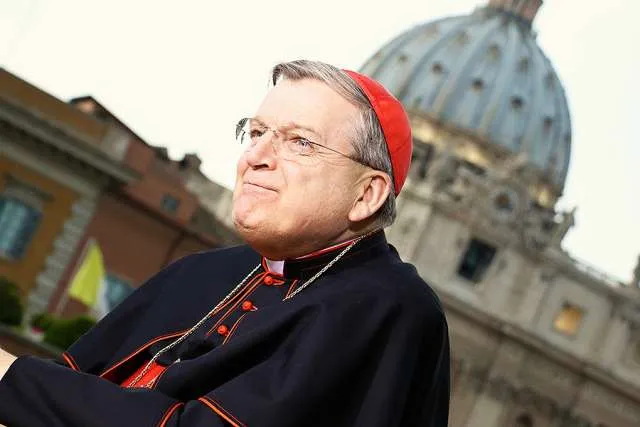
Sydney, Australia, Sep 24, 2017 / 12:38 pm (CNA).- Amid the ongoing debate surrounding “Amoris Laetitia,” dubia author Cardinal Raymond Burke said in a new interview that he’s wrongly depicted as the “enemy” of Pope Francis, but he stressed that current division in the Church demands an answer to requests for clarity.
“The urgency of a response to the dubia derives from the harm done to souls by the confusion and error, which result, as long as the fundamental questions raised are not answered in accord with the constant teaching and practice of the Church,” Cardinal Burke said.
“The urgency weighs very heavily on my heart,” he said. In his experience, the cardinal said he’s seen “a great deal of confusion, also people feeling that the Church is not a secure point of reference.”
“Some are feeling even a certain bewilderment…they are looking for a much stronger presentation of the Church’s doctrine.”
Cardinal Burke was one of four signatories of a letter submitted to Pope Francis last September outlining five dubia, or doubts, about the interpretation of his 2016 post-synodal apostolic exhortation “Amoris Laetitia.”
That letter had been submitted to the Pope privately, but released to the public two months later, prompting a firestorm of media commentary and debate.
However, the cardinal also addressed the purported “conflict” between him and Pope Francis, stressing that the media portrayal of he and the Pope is inaccurate, and frequently “overdone.”
“It’s all a caricature. They depict Pope Francis as a wonderful, open person and there’s nothing wrong with that, but they depict me as just the opposite,” he said, explaining that this is done “to advance their own agenda.”
However, Pope Francis “is actually not in favor of their agenda. They use this kind of technique to make it seem like he is and that’s fundamentally dishonest,” Cardinal Burke said.
Neither is there an intention to build up resistance against the Pope, he continued, explaining that the image of him being the “enemy” who is trying to undermine the Pope “isn’t the case at all.”
Cardinal Burke made his comments in a recent interview with Australian journalist Jordan Grantham, published Sept. 21 in Diocese of Parramatta’s online publicaton, “Catholic Outlook.”
The cardinal noted that as faithful Catholics, those who have expressed doubt or concern over the confusion surrounding “Amoris Laetitia” love the Pope “with complete obedience to the office of Peter.”
Yet at the same time, he said, “they don’t accept these questionable interpretations…of ‘Amoris Laetitia,’ interpretations, which in fact contradict what the Church has always taught and practiced.”
Without clarity on these issues, “people are in a very difficult state,” he said, explaining that this is demonstrated by the fact that bishops conferences have issued conflicting guidelines on how to interpret “Amoris Laetitia.”
In addition to Cardinal Burke, other signatories to the dubia letter were Cardinals Walter Brandmüller, president emeritus of the Pontifical Committee for Historical Sciences; Carlo Caffarra, Archbishop Emeritus of Bologna; and Joachim Meisner, Archbishop Emeritus of Cologne.
Cardinals Meisner and Caffarra passed away within two months of each other over the summer, leaving Cardinals Burke and Brandmüller to carry forward the ongoing debate over the dubia.
Cardinal Burke’s latest interview was not related to the release of a letter signed by 62 Catholic clergy and scholars, the most notable being superior general Bishop Bernard Fellay of the breakaway Society of St. Pius X. That letter presented itself as a “filial correction” to Pope Francis for reputed errors and heresies.
Among other things, the letter argues that the Pope has either directly or indirectly perpetrated seven heresies, most of which surround comments he has made about Martin Luther and ambiguities in “Amoris Laetitia,” specifically related to the question of the reception of Holy Communnion by divorced-and-remarried Catholics who cannot get an annulment.
The letter also objects to the Pope’s silence in the face of the “dubia” submitted to the Pope by the four cardinals.
Like the four cardinals’ original dubia letter, the 25-page letter of “filial correction” was also sent to the Pope privately, but the signatories decided to publish it after having received no response from the Pope.
Neither Cardinal Burke nor Cardinal Brandmüller signed the document. According to a Tweet sent out by the traditionalist blog “Rorate Caeli,” which has provided favorable coverage of the document’s release, cardinals were not asked to sign. The letter was “step one only.”
In his interview, Cardinal Burke said that many lay people argue over “Amoris Laetita,” and “many priests are suffering in particular because the faithful come to them, expecting certain things that are not possible because they’ve received one of the these erroneous interpretations of ‘Amoris Laetitia’.”
As a result, these people no longer understand Church teaching, the cardinal said. And in the Church, “we have only one guide, the Magisterium, the teaching of the Church, but we now seem to be divided into so-called political camps.”
The at times volatile “attacks” from parties who disagree is “a very mundane way of approaching things, it has no place in the Church,” Cardinal Burke continued. “But that’s where we’re at right now.”
The only way for the conversation to move forward on these matters, he said, “is to make the point of reference the doctrine of the Church. That’s what unifies us.”
Cardinal Burke also cleared up what he said are several misconceptions about him that are often promoted by the media, namely that he is “only interested in doctrine and law,” and that he is “out of touch with the times and living in the Middle Ages.”
“I am very pastoral and in fact, I don’t see any contradiction between being pastoral and being faithful in announcing the Church’s teaching and following the Church’s law,” he said.
The cardinal insisted that he is also “very conscious of the everyday culture in which we live, and I try to address it, but in a way that is full of compassion in the sense of addressing the Church’s teaching to the cultural situation and trying to lead the culture to a certain transformation.”
Referring to those who at times paint a picture of the Pope as a great revolutionary changing the tide of the Church in modern times, the cardinal said being the Successor of Peter “has nothing to do with revolutions.” Rather, it involves “maintaining the Church in unity with her long and constant tradition.”
Many people also claim the Pope is somehow going against the Church’s centuries-long tradition, he said. “And that isn’t possible either, because the Roman Pontiff is that principle of unity, unity which is not only present now, but unity with those who have gone before over the centuries.
“In fact, the two are one. When we are unified with the saints and especially with the great teachers of the faith along the centuries, then we also find unity with one another.”
Offering a word to all those currently worried about the state of the Church, Cardinal Burke stressed the need to remain confident in the fact that it is Jesus Christ whom they encounter in the Church, and who comes to meet us.
“Therefore, no matter what confusion or even divisions enter into the Church, we should never give up hope,” he said.
“We should cling all the more faithfully to what the Church has always taught and practiced. And that way we will really save our own souls, with the help of God’s grace, which, of course, we must always be about.”
 […]
[…]






A welcome report. Next is the mascot.
Time for a clean sweep. Get the jackhammer. Pedestrian derivitive imagery without the genesis of authentic faith need be wiped from our shrines and churches.
Then, consequences for the perpetrator.
Can a child conceived in sin become a saint?
Br. Jacques,
The question of scandal is one additional to the quality of the art. I don’t believe in censoring art or music solely because of the sins of the artist/composer, but certainly when the alleged abuse is this disturbing & recent & when the art is so poor & cartoonish, I believe there’s good enough reason to.
I’m not so certain that censoring art for any reason is a good idea. That said, if I were the owner of any of Rupnick’s art (which the Church in various locales is), then it is fully within my purview to do with it whatever I please – including destroy it – for any reason of my choosing.
I’ve concluded that Rupnick is incapable of feeling shame.
Then is he not human? No possibly of repentance?
Shame and repentance are different phenomena. Shame can lead to repentance but it need not. He has brought dire consequences to his victims and scandal upon the Church of Christ. Given his public persona a public acknowledgement of his guilt by him is required.
Br. Jaques, you have an erroneous notion about the nature of shame. I am not talking about guilt for sin. You should read up on the psychological meaning of shame. You seem very quick to pounce.
Diogenes: my apologies, I was wrong I, lacked knowledge of the clinical meaning of shame. I did not mean to “pounce” , however just the opposite. I meant that we should withhold judgment of the man assuming that we don’t really know his inner makeup. We do know that he has caused much pain and it seems that public acknowledgement of this is certainly in order; but we don’t know why he did what he did. We can’t really walk in another man’s shoes.
I hear you, Br. Jaques. But as members of a Christian community we are expected to take note of a brother or sister’s observable behavior and when we feel it is warranted to provide counsel. How can we ever correct a brother if we don’t take notice of what they’re doing? That is not to say that we can ever judge the state of another’s soul. That alone belongs to God. In the case of Rupnick, his acts have caused a rupture in the Christian community and the rupture in most people is cause for their feeling (a)shamed. There have been no reports to my knowledge that he acknowledged publicly what he’s done. He seems to just move along as if nothing has happened.
Has he repented recently? Has he demonstrated any sense of guilt or shame to date? Has he offered to make restitution to those he harmed? If not, why not?
Welcome news that the artwork was removed but the question is now “removed to where” and for “for what purpose?”
But what is the relationship between art and the one who created it? Is artwork good (intrinsically beautiful, inspiring etc.) as long as the creator is in good standing in society? Most people
agree that Michelangelo‘s Sistine chapel is beautiful and inspiring But what would happen if art historians suddenly found that he was the most reprobate character in history? Would we then paint them over and smash up all of his beautiful sculptures? Or would we refrain from doing so because those harmed were long gone and forgotten? I’m not saying that Rupnik’s art was either beautiful or inspiring ( quite the contrary : the little that I saw of it looked ugly to me). But prior to the public knowledge of his behavior, many Catholics liked and valued his work and placed them in Churches etc. What if Rupnik were the equivalent of a modern Michelangelo? Would we still be calling for the destruction of his work? But you may counter that his work was not as good as Michelangelo‘s, but that’s a matter of opinion and not easily proved. Now we get down to the character of the artist and the question is – can a bad man create good art? Can a non Christian create good Christian art? If Hitler, for instance, really was talented (he painted post cards) would we put his work in our Churches? If he did paint a beautiful painting and it was in a Church for years, much loved and valued and reproduced and insured for millions and we suddenly discovered that he was the artist what would we do?
I do not mean to make judgments here I just asking some questions. Why do we want to destroy the art simply because it was created by a sinful person? Would this art become more acceptable over time? If so why? Can evil create good ?
James, some good points and I partially agree with you, however I don’t think there are answers to your questions.
James Connor, my position is that whoever is the owner of the art has the right to do with it whatever he or she pleases. If I own the Mona Lisa and decide to set it afire, that is my prerogative. To do so would be stupid and an offense against cultural sensibilities but it’s still my prerogative.
Here’s the solution for Rupnik art:
Bury some samples of it inside the tomb of his papal benefactor the Pontiff Francis.
Then jackhammer the rest, and distribute the rubble to the Jesuits.
Now THAT’S a plan!
Thank you.😉