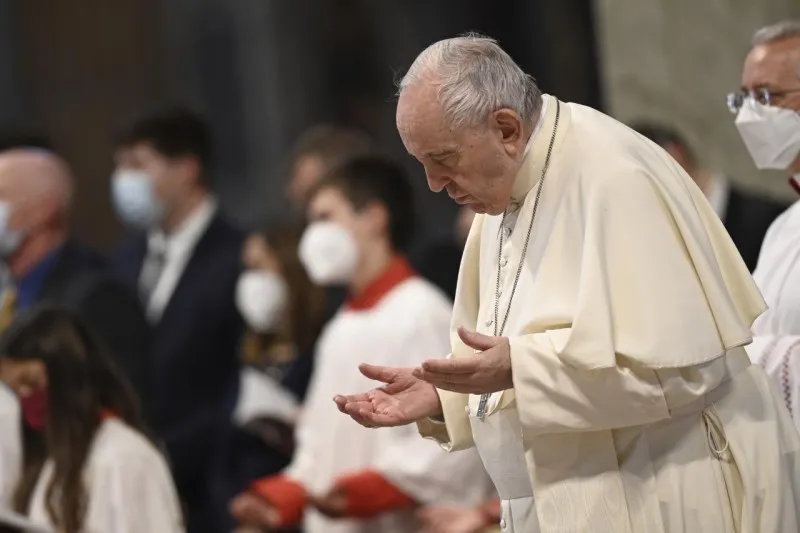
 Pope Francis at the Divine Mercy Sunday Mass at St. Peter’s Basilica on April 24, 2022. / Vatican Media
Denver Newsroom, Apr 24, 2022 / 06:14 am (CNA).
Pope Francis in his homily for Divine Mercy Sunday encouraged everyone, especially priests, to remember the moments in their lives when they have experienced God’s forgiveness, and the joy and peace that God’s forgiveness brings.
“The joy God gives is indeed born of forgiveness. It bestows peace. It is a joy that raises us up without humiliating us,” Pope Francis said during his homily at the Mass celebrated in St. Peter’s Basilica.
“Brothers and sisters, let us think of all those times when we received the pardon and peace of Jesus. Each one of us has received them; each one of us has had that experience. It is good for us to remember those moments. Let us put the memory of God’s warm embrace before the memory of our own mistakes and failings. In this way, we will grow in joy.”
The pope urged meditation on the three times in the Gospels when Jesus uses the greeting: “Peace be with you,” the first of which being Jesus’ first encounter with his disciples following his resurrection.
When Jesus’ disciples first encounter the risen Jesus, they react joyfully, despite having abandoned their master during his Passion and death. Despite courageously following Jesus in the past, “They had good reason to feel not only afraid, but useless; they had failed,” the pope said.
“In this climate, they hear for the first time, ‘Peace be with you!’ The disciples ought to have felt shame, yet they rejoice. Why? Because seeing his face and hearing his greeting turned their attention away from themselves and towards Jesus,” Pope Francis said.
“They were distracted from themselves and their failures and attracted by his gaze, that brimmed not with severity but with mercy. Christ did not reproach them for what they had done, but showed them his usual kindness. And this revives them, fills their hearts with the peace they had lost and makes them new persons, purified by a forgiveness that is utterly unmerited.”
The forgiveness that Jesus shows to his disciples in the Gospels is the same forgiveness He extends through the sacrament of Confession, the pope said.
The second time Jesus says “Peace be with you” is when he gives his disciples the Holy Spirit, giving them the ability to forgive sins and thus making them “dispensers of the mercy that they themselves received.”
Speaking to priests, the pope told them to they must first accept God’s forgiveness if they are to extend that forgiveness to others.
“I am now speaking to you, missionaries of mercy: if you do not feel forgiven, do not carry out your service as a missionary of mercy until you feel that forgiveness,” the pope said.
“The mercy that we have received enables us to dispense a great deal of mercy and forgiveness. Today and every day, in the Church forgiveness must be received in this same way, through the humble goodness of a merciful confessor who sees himself not as the holder of some power but as a channel of mercy, who pours out upon others the forgiveness that he himself first received. From this arises the ability to forgive everything because God always forgives everything.”
There is no need to “torment” the faithful when they come to Confession, the pope said.
“It is necessary to understand their situation, to listen, to forgive and to offer good counsel so that they can move forward. God forgives everything and we must not close that door to people,” he said.
Finally, the pope noted, Jesus says “Peace be with you” to the Apostle Thomas, who doubted the Lord’s resurrection until he was able to put his hand in Jesus’ wounds.
“There are times of difficulty when life seems to belie faith, moments of crisis when we need to touch and see. Like Thomas, it is precisely in those moments that we rediscover the heart of Christ, the Lord’s mercy,” Pope Francis said.
“In those situations, Jesus does not approach us in triumph and with overwhelming proofs. He does not perform earth-shattering miracles, but instead offers us heartwarming signs of his mercy. He comforts us in the same way he did in today’s Gospel: he offers us his wounds. We must not forget this fact. In response to our sin, the Lord is always present offering us his wounds.”
God’s mercy often makes us more aware of our neighbors’ wounds, the pope said, encouraging everyone to seek to help those suffering in mind or body, to bring peace to those suffering spiritually or physically, and to listen and bring comfort to another person. For in doing such things we “encounter Jesus,” the pope said.
“We think that we are experiencing unbearable pain and situations of suffering, and we suddenly discover that others around us are silently enduring even worse things. If we care for the wounds of our neighbour and pour upon them the balm of mercy, we find being reborn within us a hope that comforts us in our weariness,” the pope said.
Divine Mercy Sunday, celebrated the Sunday after Easter each year, was instituted by Pope St. John Paul II in 2000.
St. Maria Faustina Kowalska, a 20th-century Polish nun who received prophetic messages from Christ, received revelations about the infinite mercy of God – coined the “Divine Mercy” – and her obligation to spread the message to the world, as recorded in her diary, “Divine Mercy in my soul.”
[…]







A welcome report. Next is the mascot.
Time for a clean sweep. Get the jackhammer. Pedestrian derivitive imagery without the genesis of authentic faith need be wiped from our shrines and churches.
Then, consequences for the perpetrator.
Can a child conceived in sin become a saint?
Br. Jacques,
The question of scandal is one additional to the quality of the art. I don’t believe in censoring art or music solely because of the sins of the artist/composer, but certainly when the alleged abuse is this disturbing & recent & when the art is so poor & cartoonish, I believe there’s good enough reason to.
I’m not so certain that censoring art for any reason is a good idea. That said, if I were the owner of any of Rupnick’s art (which the Church in various locales is), then it is fully within my purview to do with it whatever I please – including destroy it – for any reason of my choosing.
I’ve concluded that Rupnick is incapable of feeling shame.
Then is he not human? No possibly of repentance?
Shame and repentance are different phenomena. Shame can lead to repentance but it need not. He has brought dire consequences to his victims and scandal upon the Church of Christ. Given his public persona a public acknowledgement of his guilt by him is required.
Br. Jaques, you have an erroneous notion about the nature of shame. I am not talking about guilt for sin. You should read up on the psychological meaning of shame. You seem very quick to pounce.
Diogenes: my apologies, I was wrong I, lacked knowledge of the clinical meaning of shame. I did not mean to “pounce” , however just the opposite. I meant that we should withhold judgment of the man assuming that we don’t really know his inner makeup. We do know that he has caused much pain and it seems that public acknowledgement of this is certainly in order; but we don’t know why he did what he did. We can’t really walk in another man’s shoes.
I hear you, Br. Jaques. But as members of a Christian community we are expected to take note of a brother or sister’s observable behavior and when we feel it is warranted to provide counsel. How can we ever correct a brother if we don’t take notice of what they’re doing? That is not to say that we can ever judge the state of another’s soul. That alone belongs to God. In the case of Rupnick, his acts have caused a rupture in the Christian community and the rupture in most people is cause for their feeling (a)shamed. There have been no reports to my knowledge that he acknowledged publicly what he’s done. He seems to just move along as if nothing has happened.
Has he repented recently? Has he demonstrated any sense of guilt or shame to date? Has he offered to make restitution to those he harmed? If not, why not?
Welcome news that the artwork was removed but the question is now “removed to where” and for “for what purpose?”
But what is the relationship between art and the one who created it? Is artwork good (intrinsically beautiful, inspiring etc.) as long as the creator is in good standing in society? Most people
agree that Michelangelo‘s Sistine chapel is beautiful and inspiring But what would happen if art historians suddenly found that he was the most reprobate character in history? Would we then paint them over and smash up all of his beautiful sculptures? Or would we refrain from doing so because those harmed were long gone and forgotten? I’m not saying that Rupnik’s art was either beautiful or inspiring ( quite the contrary : the little that I saw of it looked ugly to me). But prior to the public knowledge of his behavior, many Catholics liked and valued his work and placed them in Churches etc. What if Rupnik were the equivalent of a modern Michelangelo? Would we still be calling for the destruction of his work? But you may counter that his work was not as good as Michelangelo‘s, but that’s a matter of opinion and not easily proved. Now we get down to the character of the artist and the question is – can a bad man create good art? Can a non Christian create good Christian art? If Hitler, for instance, really was talented (he painted post cards) would we put his work in our Churches? If he did paint a beautiful painting and it was in a Church for years, much loved and valued and reproduced and insured for millions and we suddenly discovered that he was the artist what would we do?
I do not mean to make judgments here I just asking some questions. Why do we want to destroy the art simply because it was created by a sinful person? Would this art become more acceptable over time? If so why? Can evil create good ?
James, some good points and I partially agree with you, however I don’t think there are answers to your questions.
James Connor, my position is that whoever is the owner of the art has the right to do with it whatever he or she pleases. If I own the Mona Lisa and decide to set it afire, that is my prerogative. To do so would be stupid and an offense against cultural sensibilities but it’s still my prerogative.
Here’s the solution for Rupnik art:
Bury some samples of it inside the tomb of his papal benefactor the Pontiff Francis.
Then jackhammer the rest, and distribute the rubble to the Jesuits.
Now THAT’S a plan!
Thank you.😉