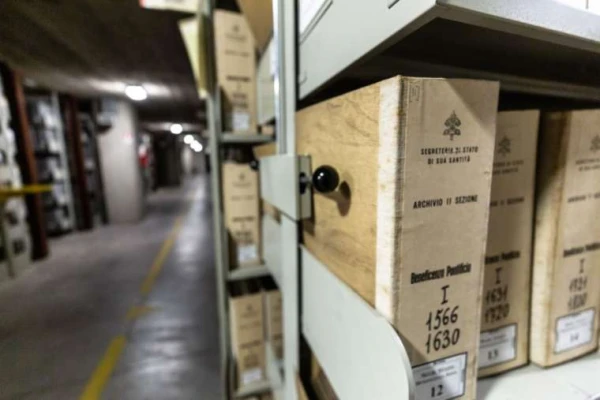
Washington D.C., Mar 15, 2020 / 12:00 pm (CNA).- A researcher from the United States Holocaust Memorial Museum told CNA that she hopes the recent opening of the Pius XII archives in the Vatican will give historians a fuller, more transparent image of the wartime pope.
Dr. Suzanne Brown-Fleming, the museum’s director of international academic programs, has been unable to travel to Rome to view the archives due to the COVID-19 outbreak, but told CNA that she hopes to make the trip in April.
Brown-Fleming spoke to CNA Thursday about what she expects to find in the archives.
The Vatican officially opened the archives, which cover Venerable Pius XII’s entire pontificate — March 1939 through October 1958 — on March 2. It is the first time scholars have been granted access to the approximately 16 million documents they contain.
Pius XII remains a disputed figure, with some historians criticising him for not making a more explicit denunciation of Hitler and the Nazis, and others pointing to Mit brennender Sorge, his 1937 encyclical to the Church in Germany, and the limits imposed on him by the Lateran Treaty.
After examining the documents in the archives, Brown-Fleming said that historians will “definitely have a more fair reading of [Pius XII].”
“I think that on both sides of the argument there has been picking and choosing as to ‘let’s show this document and interpret it this way and ignore these five documents,’ and his critics have done the same,” she said. “So I’m not sure either side has been completely fair, because there’s been no access to the full documentation.”
Brown-Fleming thinks that the public opinion will likely end up “somewhere between the two polar opposites that we’re seeing now,” but that this will not happen until the archives have been fully studied.
“But it will be a fair and transparent reading,” she said.
Pius XII died in 1958, his cause for canonization was opened in November 1965, by Pope (now Saint) Paul VI during the final session of the Second Vatican Council. On December 19, 2009, Pope Benedict XVI declared him “Venerable,” meaning the Church has determined that he led a life of heroic virtue.
A practicing Catholic, Brown-Fleming told CNA that she hopes she is able to find documentary proof that the Church and individual Catholics in Europe invoked the tenets of their faith and tried to save their Jewish neighbors.
“Did they respond in a uniform ‘love thy neighbor’ way, or did they parse in their minds? I think it’s going to be very interesting to know,” she said.
A big question, and one that Brown-Fleming hopes will be answered by the archives, concerns Pius XII’s actions in September 1943, when Rome’s Jewish population was rounded up and deported.
“There’s a big question around whether Pius XII gave orders to have Roman Jews hidden. Many Jews were hidden including on Vatican grounds,” she said. “Did he order that? Did he know about it and say, okay, ‘this is not a good idea because it puts Vatican property in danger’? Did he say, ‘yes, please do this and save who you can’?”
“We know that Jews were rescued by Catholic families in Italy and in France,” said Brown-Fleming. She told CNA that she was hopeful her time in the archives will reveal the motivations behind why these families chose to risk their lives to save people: “Was it because of messaging from the pope or was it spontaneous?”
Another question Brown-Fleming wants the archives to answer is what Pius XII knew in the post-war era, when a Vatican “ratline” enabled many former Nazis to escape to South America.
“In the Cold War period, many Nazis escaped to South America with the help of the Vatican–lower level officials,” she said. “But how much did the Pope know about this? That’s a very big question.” She is also hoping to find information about Pius XII’s personal attitude towards the Jewish people, which is “something that’s very hard to discern in public messaging.”
Once she is granted permission to travel to Italy and examine the archives, Brown-Fleming intends on starting her research in the Vatican Apostolic Archive. She explained that there are four reading rooms in the archive, and that the first room is dedicated to indices. She says the plan is to look for certain keywords in the indices.
Once those keywords are found, Brown-Fleming will request the entire folder. She hopes that, similar to the 2003 opening of Pius XI’s archives, the United States Holocaust Museum would be given permission to reproduce the some of the contents of the archives and keep them in Washington.
Regardless of what is found, Brown-Fleming said she is glad that there will finally be answers about the legacy of Pius XII, and she is confident that whatever is uncovered will be a positive move for the Church.
The archives will “kind of settle those questions” regarding Pius XII and the actions of the Church during World War II, “even if the answers aren’t always good. And I don’t think they always will be, because we’re talking about human beings and even a pope makes mistakes.”
“We’re going to find a mixed record, but at least we know what it is,” she said. “And then once we know what it is, we can really wrestle with that.”
 […]
[…]






A welcome report. Next is the mascot.
Time for a clean sweep. Get the jackhammer. Pedestrian derivitive imagery without the genesis of authentic faith need be wiped from our shrines and churches.
Then, consequences for the perpetrator.
Can a child conceived in sin become a saint?
Br. Jacques,
The question of scandal is one additional to the quality of the art. I don’t believe in censoring art or music solely because of the sins of the artist/composer, but certainly when the alleged abuse is this disturbing & recent & when the art is so poor & cartoonish, I believe there’s good enough reason to.
I’m not so certain that censoring art for any reason is a good idea. That said, if I were the owner of any of Rupnick’s art (which the Church in various locales is), then it is fully within my purview to do with it whatever I please – including destroy it – for any reason of my choosing.
I’ve concluded that Rupnick is incapable of feeling shame.
Then is he not human? No possibly of repentance?
Shame and repentance are different phenomena. Shame can lead to repentance but it need not. He has brought dire consequences to his victims and scandal upon the Church of Christ. Given his public persona a public acknowledgement of his guilt by him is required.
Br. Jaques, you have an erroneous notion about the nature of shame. I am not talking about guilt for sin. You should read up on the psychological meaning of shame. You seem very quick to pounce.
Diogenes: my apologies, I was wrong I, lacked knowledge of the clinical meaning of shame. I did not mean to “pounce” , however just the opposite. I meant that we should withhold judgment of the man assuming that we don’t really know his inner makeup. We do know that he has caused much pain and it seems that public acknowledgement of this is certainly in order; but we don’t know why he did what he did. We can’t really walk in another man’s shoes.
I hear you, Br. Jaques. But as members of a Christian community we are expected to take note of a brother or sister’s observable behavior and when we feel it is warranted to provide counsel. How can we ever correct a brother if we don’t take notice of what they’re doing? That is not to say that we can ever judge the state of another’s soul. That alone belongs to God. In the case of Rupnick, his acts have caused a rupture in the Christian community and the rupture in most people is cause for their feeling (a)shamed. There have been no reports to my knowledge that he acknowledged publicly what he’s done. He seems to just move along as if nothing has happened.
Has he repented recently? Has he demonstrated any sense of guilt or shame to date? Has he offered to make restitution to those he harmed? If not, why not?
Welcome news that the artwork was removed but the question is now “removed to where” and for “for what purpose?”
But what is the relationship between art and the one who created it? Is artwork good (intrinsically beautiful, inspiring etc.) as long as the creator is in good standing in society? Most people
agree that Michelangelo‘s Sistine chapel is beautiful and inspiring But what would happen if art historians suddenly found that he was the most reprobate character in history? Would we then paint them over and smash up all of his beautiful sculptures? Or would we refrain from doing so because those harmed were long gone and forgotten? I’m not saying that Rupnik’s art was either beautiful or inspiring ( quite the contrary : the little that I saw of it looked ugly to me). But prior to the public knowledge of his behavior, many Catholics liked and valued his work and placed them in Churches etc. What if Rupnik were the equivalent of a modern Michelangelo? Would we still be calling for the destruction of his work? But you may counter that his work was not as good as Michelangelo‘s, but that’s a matter of opinion and not easily proved. Now we get down to the character of the artist and the question is – can a bad man create good art? Can a non Christian create good Christian art? If Hitler, for instance, really was talented (he painted post cards) would we put his work in our Churches? If he did paint a beautiful painting and it was in a Church for years, much loved and valued and reproduced and insured for millions and we suddenly discovered that he was the artist what would we do?
I do not mean to make judgments here I just asking some questions. Why do we want to destroy the art simply because it was created by a sinful person? Would this art become more acceptable over time? If so why? Can evil create good ?
James, some good points and I partially agree with you, however I don’t think there are answers to your questions.
James Connor, my position is that whoever is the owner of the art has the right to do with it whatever he or she pleases. If I own the Mona Lisa and decide to set it afire, that is my prerogative. To do so would be stupid and an offense against cultural sensibilities but it’s still my prerogative.
Here’s the solution for Rupnik art:
Bury some samples of it inside the tomb of his papal benefactor the Pontiff Francis.
Then jackhammer the rest, and distribute the rubble to the Jesuits.
Now THAT’S a plan!
Thank you.😉