


In an ancient Greek legend, Alexander the Great famously solved the challenge of untying the Gordian knot by bypassing that seemingly impossible task entirely and instead chose, simply and directly, to slice through it with his sword. The moral of that legend seems to be that sometimes the best solution to a problem resistant to resolution is to reject its defining premises as false. After all, the goal in the example of the Gordian knot was not the undoing of the knot as such, but the unmooring of the rope from an oxcart.
In other words, Alexander saw that the “challenge” of the knot was an illusion grounded in a confusion about ends and was thereby able to solve the problem quite easily.
Communio theology and Thomism
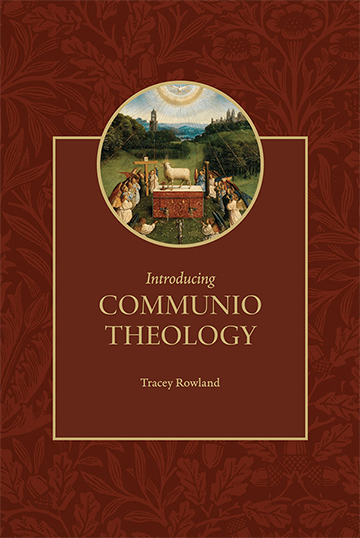
I thought of this legend as I read the new book published by Word on Fire, written by the Australian theologian and Ratzinger Prize winner, Dr. Tracey Rowland. Introducing Communio Theology is a very readable, insightful, and timely exposition of Communio theology. What follows is not a review of the book; rather, I want to focus on those aspects of the text that help us to untie the Gordian knot of these contemporary and seemingly intractable ecclesial conflicts.
I say that the book is “timely” because what Rowland does so well is to demonstrate how Communio theologians have, more than any other modern Catholic school of thought, made the defining characteristic of their movement a robust embracing of the uniquely Catholic principle of the “both-and”. This allows it to be the preeminent theological approach for untying the many Gordian knots of modern Catholicism. This requires an ancillary commitment to the critically important Thomistic principle of analogy.
This point about Thomistic principles is important because, as Rowland shows, the common mistake of pitting Communio theology against Thomists is something that needs to be refuted. As she showed in her previous book Catholic Theology (Bloomsbury, 2017), there have been no fewer than 17 different versions of Thomism in the 20th century, and ressourcement/Communio is one of them. The reality is that Communio theology is in many key ways a version of Thomistic thought.
The book is essential reading for anyone interested in the various heated debates in the Church today and who believes, as I do, that the debates will be intractable so long as the many false binaries that undergird them remain unchallenged. I will examine one example of these apparently unresolvable debates in order to highlight the approach of the Communio theologians Rowland mentions. An example most pertinent today, because of the challenge posed by the SSPX to the Church, is the impasse between “progressive” Catholics and the so-called “traditionalist” Catholics on the topic of the development of doctrine.
Divine Revelation and disputed teachings
On the one hand, the traditionalist claim is that the major doctrines of the Church, even if non-infallible, are in fact infallible. Such traditionalists engage in what Msgr. Thomas Guarino, in The Disputed Teachings of Vatican II, has called “infallibility bloat,” wherein doctrines that do not meet the strict criteria for being considered infallible are still treated as such because to admit that they might contain errors calls into question the indefectibility of the Church. There is also a not-so-subtle conflating of the related but distinct issues of infallibility and indefectibility.
As a result, the epistemic focus now shifts from Revelation as an unveiling of a deep and dramatic covenantal encounter with Christ–an encounter of which she is the sacrament for the world—to a set of epistemically “certain” propositions deduced from Scripture and Tradition as so many little truth nuggets and “God factoids” that must now be defended at all costs. Furthermore, Scripture and Tradition are treated as two independent streams of truth about God and Christ.
In theory, it is still affirmed that the Church can sometimes err, but in practice, this is effectively denied. Revelation thus comes to be identified, not with Christ as such, but instead with the detached “truth content” of a set of propositions that state things “about Christ” and “about the Trinity”.
This is, of course, a bit simplistic for the sake of brevity. But the full expression of this exaggerated reduction of Revelation to a set of propositions can be seen in the theology of the scholastic epigones of Francisco Suárez. This had an outsized influence on the theology of Revelation that we find in the Baroque era.
But the upshot of all of this is that for the staunch traditionalists of our time, the doctrines of the Church cannot change in any way. And since Vatican II and the post-conciliar popes did develop doctrines in ways that seem, on the surface, to contradict previous doctrines, then they must be in error. And many insist they must be rejected. From there, it is now a simple matter of gauging where traditionalists fall in their reaction to such alleged errors, ranging from “recognize and resist” types such as the SSPX to the full-blown sedevacantists who splintered off them.
By contrast, progressive Catholics, like their antecedents in the modernist movement of the early 20th century, reject the notion that Revelation is to be viewed in these largely propositional categories. Propositions are, say progressives, second and third-level reflections on Revelation and are in fact little more than the culturally conditioned mythopoetic projections of the subjective religious consciousness of the human mind. God might ultimately be behind our “God consciousness”, but only as an ineffable mystery that must be approached apophatically.
What this approach leads to, with a brutal internal logic (brutal because it cannot be softened in any way), is the spectacle of the anthropological tail wagging the Christological dog. We see this constantly among progressive Catholics. In their view, the primary Revelation from God takes place most primordially in the subjectivity of all human beings everywhere and in an inchoate and “unthematized” way. But they assert that God’s Revelation in Christ must now be read through the lens of this more primordial revelation, effectively relativizing Christ as merely one “exemplar” of the primordial and inchoate Revelation. Christ is thus reduced to “an exemplar of an en-graced and elevated human being” who certainly did not found a Church, was mistaken about the imminent end of the world, and did not “die for our sins”. He was an exemplar of moral and spiritual living and nothing more.
Obviously, for Catholics who think like this, doctrines not only can “develop” but even morph into their opposite. Doctrines can change and even flatly contradict previous doctrines on the same topic. And this would also include dogmas, since nothing propositional is off limits. In their view, all doctrines and dogmas are culturally conditioned and are to be situated in their historical context. Therefore, as that context and those cultural conditions change, so too can the doctrines.
False premises about Divine Revelation
So where does this leave us? The debate between traditionalists and progressives is caused at its root because they both share false premises about the nature of Revelation and the relationship of Revelation to the doctrines and dogmas of the Church, which express its central truths in propositional form. And that false premise was the detaching of the “content” of Revelation from Jesus Christ.
The traditionalists identify, in a way, Revelation with Christ—but then exaggerate its propositional nature to such an extent that the doctrines of the Church become the central focus of the theology of Revelation. Theology shifts to focus on tradition itself as the primary object of theological reflection on the nature of Revelation because it is viewed as the epistemically certain exposition of Revelation. And then Revelation recedes into the background as the originating event, which must now be interpreted through the lens of later doctrines.
Progressives, insofar as they affirm that a normative Revelation from God has in some way been given through Christ, nevertheless divorce Christ from the later doctrinal tradition. He then fades into the mist of time as a relic of first-century Jewish apocalypticism. They then move to reconstruct, anachronistically, the historical Jesus as the supporter of modern, leftist political causes. Christ as the unique bearer of Revelation is therefore so covered over with modern political ideology and Marxist deconstruction of all forms of hierarchy, as to become virtually invisible as anything truly meaningful in a religious sense.
The retired theologian Fr. Robert Imbelli has written extensively on what he has called the “decapitation” of the Church, which has resulted from this separation of Christ from the content of Revelation. A ressourcement/Communio theologian himself, Fr. Imbelli, who was in seminary in Rome during the Council, identifies the dogmatic constitution Dei Verbum as the most important conciliar text. The great breakthrough of Dei Verbum is its assertion, in line with the Church Fathers, that Divine Revelation is to be identified first with Christ himself and then secondarily with the scriptural witness and the doctrinal tradition.
Scripture and tradition are not two separate and independent “streams of information about Revelation” but are intertwined participations in Revelation, which is nothing more than Christ himself. Christ is Revelation. Period. Full stop. Thus, all later doctrines within the Church represent a normative ecclesial meditation upon that Revelation. Dei Verbum must be read as affirming both the identification of Christ himself without qualification as Revelation, and the ongoing development of doctrine in the Church as a normative participation in that primordial Revelation.
The way forward
This both-and approach of Dei Verbum cuts off at its legs the theology of the traditionalists and the progressives. It affirms, contra the progressives, that the Revelation of God in Christ is the most primordial and therefore constitutive anthropological truth about humanity, and not some putative “universal revelation” of God in every soul. And note well, it is not the universal presence of grace that Dei Verbum is rejecting, but its alleged prioritization as the more primary Revelation of God due to it being (again, allegedly) the more “universal” revelation. The view of the universal among progressive Catholics is thus exposed as simply the Enlightenment’s pursuit of religion within the boundaries of secular reason. It is Locke and Kant in religious drag.
But Dei Verbum also undercuts the hyper-propositionalism of the traditionalists and, by extension, their penchant for infallibility bloat. There are different types of traditionalists and of course all Catholics must be in some sense traditionalists. But here I am referring to those modern “Trads” who, in my view, have become an ideological movement within the Church more than a truly theological one. Wedded to an overly propositional view of Revelation and a concomitant embracing of an infallibility bloat for the entirety of the ordinary magisterium pre-1962, they have been unable to grasp the fact that Vatican II did in fact change some doctrines in the form of a development of the tradition to be more in line with the truths of Revelation as they are grounded in Christ. They cannot embrace the notion that the magisterium can, and in fact has, corrected itself on numerous occasions, and long before Vatican II.
Theirs is, therefore, more of an either-or epistemological ideology of an elusive certainty, rather than a truly Catholic both-and which embraces both the conceptual content of doctrines as true and the fact that their truth is relative to the primordial truth of Christ the Lord and can be adjusted by the magisterium accordingly.
Returning then to Rowland, one sees in the entirety of her new book a serious attempt to situate the Communio theologians as the best hope for reconciling false ecclesial binaries, and for giving us the best hermeneutic for retrieving Vatican II and for understanding what is involved with the contentious issue of the development of doctrine.
Here, I will refer directly to her extremely important chapter on Communio theology and Vatican II. Space precludes a full analysis of her text on this point, but suffice it to say that she both affirms the profound importance of the Council and our ongoing need to correctly interpret it, and the need to look honestly at the conciliar flaws. Once again, we see that Communio theologians such as Ratzinger, Balthasar, and de Lubac were profound critics of the post-conciliar developments.
In particular, what Rowland notes is that many Communio theologians have been willing to criticize the Council itself for at least catalyzing the later mayhem by not providing the Church with an explicit hermeneutic for its interpretation. They note that while it is true that like all councils Vatican II must be read in the light of the entire tradition, and while it is also true that the Council is clearly favoring a deep Christocentrism as its key theological fulcrum (e.g. Gaudium et Spes 22), and while it is true that much of the post-conciliar mischief is just a vulgar and stupid display of cultural accommodation gone mad, nevertheless the Council left enough theological hanging chads that required a more explicit exposition of a conciliar hermeneutic that it was inevitable that misuse would happen. Especially because such misuses were intentional.
Finally, and this is key, Rowland, leaning on the analysis of Guarino, points out that the Council decided to pursue a more irenic approach to modernity and eschewed the dialectics of rejection and condemnation in favor of looking for analogical points of contact and agreement. This analogical rather than dialectical approach had its strengths, but once again, absent an explicit hermeneutic, it also had inevitable flaws, as the analogical approach could be abused to baptize modernity as a kind of closeted Christianity.
Finally, on the twin issues of Revelation and Vatican II’s interpretation, the way forward cannot be a rejection of the Council and a return to a restorationism of Baroque era thinking, nor can it be the progressive reduction of the Church to a bureaucratized NGO. Revelation is both relational and conceptual, and the doctrinal concepts it spawns are both epistemically stable and capable of development, but only in a Christological way that is grounded in the originating event. Vatican II is a profound council that has ongoing significance, but only insofar as it overcomes its own deficit of hermeneutical clarity.
Therein lies the deep significance of Communio theology as an ongoing project in conjunction (though more generally) with the revival in Thomistic theology. And nobody has made this more evident and with more careful clarity than Rowland.
If you value the news and views Catholic World Report provides, please consider donating to support our efforts. Your contribution will help us continue to make CWR available to all readers worldwide for free, without a subscription. Thank you for your generosity!
Click here for more information on donating to CWR. Click here to sign up for our newsletter.

We read: “Dei Verbum must be read as affirming both the identification of Christ himself without qualification as Revelation, and the ongoing development of doctrine in the Church as a normative participation in that primordial Revelation.”
In humble support of the above, and addressing the problem of a false binary, here are three relevant quotes which already at least begin to address the “deficit of hermeneutical clarity” posed by the Council:
POPE PAUL VI following the Council, in 1973:
“As for the meaning of dogmatic formulas, this remains ever true and constant in the Church, even when it is expressed with greater clarity of more developed. The faithful therefore must shun the opinion, first, that dogmatic formulas (or some category of them) cannot signify truth in a determinate way, but can only offer changeable approximations to it, which to a certain extent distort or alter it; secondly, that these formulas signify the truth only in an indeterminate way, this truth being like a goal that is constantly being sought by means of such approximations [….]
‘…certain and unchangeable doctrine, to which faithful obedience is due, has to be explored and presented in a way that is demanded by our times. One thing is the deposit of faith, which consists of the truths contained in sacred doctrine, another thing is the manner of presentation, always however with the same meaning and signification [quoting POPE JOHN XXIII]'” (Pope Paul VI, “Mysterium Ecclesiae,” May 11, 1973).
And the 19th-century CARDINAL JOHN HENRY NEWMAN (expanding upon the 5th-cerntury Vincent of Lerins):
“I venture to set down seven notes of varying cogency, independence, and applicability to discriminate healthy developments of an idea from its state of corruption and decay, as follows: There is no corruption if it retains: (1) One and the same TYPE, (2) The same PRINCIPLES, (3) The same ORGANIZATION, (4) If its beginnings ANTICIPATE its subsequent phases, (5) Its later phenomena PROTECT and subserve its earlier, (6) If it has a power of assimilation and REVIVAL, (7) A vigorous ACTION from first to last….” (John Henry Newman, “The Development of Christian Doctrine,” 1885).
SUMMARY: already three nuggets of clarity (!) from Newman as “the Father of Vatican II”; from the cited John XXIII as the initiator and framer of Vatican II; and from Paul VI as the pope during— and in the later turmoil attached to— Vatican II.
Truth, revealed by Christ if it is to confer meaning consistent with its revelation, must be propositional. That is, how we are indebted to respond in our actions. And response is always contextual in accord with conditions.
The reconciliation of progressive and traditional is not achievable by mitigating the requirement of commandment. Although commands are themselves always subject to context. There are mitigating conditions and there are not. Communio understood as a consensual bond of faith, finds its cohesion in one faith.
Not sure how any Catholic could be criticised for being “Wedded to an overly propositional view of Revelation”. Do we dump the Apostles’ and Nicene Creeds now?
To identify the truthfulness of any utterance of the Church – in its documents or pronouncements by hierarchical persons – one has only to count the number of references to Jesus Christ who is the Revelation of the Father. As I recall, much of what came out of the failed Bergoglian Papacy gave scant reference to Jesus Christ.
Dr. Chapp writes: “…it is true that much of the post-conciliar mischief is just a vulgar and stupid display of cultural accommodation gone mad…”
Vatican II closed around 1965 or so. Five years later, in 1970, I graduated from a Catholic men’s college in NYC which was rapidly shedding its Catholic identity. Six of us Catholic school-raised roommates decided to thank our parents for the sacrifices they made on our behalf by hosting a breakfast and Mass in our dormitory apartment. For the accoutrements of the Mass, we used a beer glass to hold the wine and Wonderbread for the hosts. Our priest-chaplain instructed us to choose the readings for the Mass. The first reading was from Eric Fromm’s “The Art of Loving.” The second reading was from Khalil Gibran’s “The Prophet.” We somehow managed to choose a Gospel reading from the New Testament.
This is how Progressivism – like a rapidly metasticizing cancer – grows in the Church. And it all went downhill from there. Now try, like Sisyphus, to get that huge boulder from the bottom of the mountain back up that lofty incline from which it has fallen. In no way do I consider myself a Trafitionalist in the manner by which they are currently maligned but I do empathize with their deepest sense of what has been tossed aside.
The priest is supposed to consecrate both the hosts and the wine, using the current approved translation and valid matter for each of the two Eucharistic species. Wonder Bread is not valid matter for the Eucharist, making that consecration invalid.
Google search terms: Can a priest validly consecrate only wine?
No, a priest cannot validly consecrate only wine at Mass.
According to Canon 927 of the Code of Canon Law:
“It is absolutely forbidden, even in urgent and extreme necessity, to consecrate one element without the other.”
This means that both bread and wine must be consecrated together during the Mass. The double consecration is essential to the integrity of the Eucharistic sacrifice, symbolizing the separation of Christ’s Body and Blood on the Cross. While the consecration of each species is a distinct act, neither may be done without the other in the context of the Mass.
If only wine were consecrated (and not the bread), the Mass would be invalid, as the full sacrificial action requires both elements. The Church teaches that the sacrifice of the Mass is completed through the consecration of both species, even though Communion under one kind (bread or wine) is sufficient for the faithful to receive the whole Christ.
“The traditionalists identify, in a way, Revelation with Christ—but then exaggerate its propositional nature to such an extent that the doctrines of the Church become the central focus of the theology of Revelation.”
This statement is false as Traditionists recognize the trinitarian relationship of Sacred Tradition, Sacred Scripture, And The Teaching Of The Magisterium Grounded In Sacred Tradition And Sacred Scripture, The Deposit Of Faith , Christ Has Entrusted to His One, Holy, Catholic, And Apostolic Church, In The Unity Of The Holy Ghost, for The Salvation Of Souls, while those who are Baptized Catholic, but deny the Sanctity and Dignity of the marital act within The Sacrament of Holy Matrimony, which affirms God’s Desire that we respect The Sanctity and Dignity of the Life of every beloved son or daughter, from the moment of conception, and thus identify as being “progressive”, in essence, reject Sacred Tradition, Sacred Scripture, And The Teaching Of Christ’s Magisterium, The Office Of The Munus, ipso facto, separating themselves from communion with Christ and His Church.
“Only those are to be included as members of the Church who have been baptized and profess the true faith, and who have not been so unfortunate as to separate themselves from the unity of the Body, or been excluded by legitimate authority for grave faults committed. (Mystici Coporis 22)”
As a recent returnee to the “Conciliar Church” from the SSPX, I realize a failure in some of my arguments for how one should view Vatican II when it appears to oppose previous teaching. I need admit to friends and family that the document on religious liberty is a reversal of immediate previous teaching. At the same time I need to appeal to previous teaching which affirms that religious truth cannot be dictated from above, by the state. I read the book referenced by Dr. Chapp by Guarino once, and was disappointed with his final conclusion that Dignitatis Humanae was indeed a reversal. The second time I realized that to defend the document as being compatible with 19th Century papal theory on the duty of the state, wasn’t possible.
After reading Chapp’s Schtick this morning, I see another admission that I must concede to SSPX adherents. It is that the Council failed woefully in explaining right from the beginning what they were doing with the Syllabus of Errors. But it appears that fifty years after the post-Conciliar chaos, theologians may finally have a better formulated hermeneutic as to how faithful Catholics can candidly admit shortcomings in the Council, while having genuine sympathy for good, devout Traditionalists. Any Catholic should be at least uncomfortable with simple contradiction of previous and voluminous papal teaching. That is the predictable way it has been seen by many good souls, including Abp. Marcel LeFebvre. Thankfully, Traditionalists of good will may now more easily learn how they can embrace the Council without renouncing their Catholic heritage. Sts. Pius X and John XXIII pray for us.
We read of Guarino, that you are disappointed “with his final conclusion that Dignitatis Humanae was indeed a reversal.” But, by presenting a “reversal”, Guarino simply (or rather, not so simply) articulates a refocusing of emphasis— rather than a contradiction.
Guarino writes: “The entire history of the church witnesses to such growth. But the majority (and Paul VI) were willing, on occasion, to reverse [!] antecedent magisterial teaching—especially if this allowed the church to recover an earlier tradition that had become obscured over time [….]
“ ‘De libertate’ would have risen to the level of a Vincentian ‘permutatio fidei’— a distortive corruption of the faith [contradiction]— IF the council had taught that its affirmation of religious freedom entailed the notion that the ‘true religion’ was unknowable (this would have been Lessing’s ‘Ring Parable’ updated for the twentieth century), or IF Vatican II had taught that Christianity was simply one among many equally valid religions, a position the council never remotely approached. Indeed ‘De libertate’ (with the entire council) strongly defends the unique truth of the Catholic, Christian faith while simultaneously insisting [!] that all men and women have a right in conscience to worship God other than in the way God himself had revealed— in the history of Israel and in Jesus Christ. Men and women must be free to follow ‘the judgments of conscience,’ even if such judgments should prove erroneous” (“The Disputed Teachings of Vatican II: Continuity and Reversal in Catholic Doctrine, Eerdmans, 2018, pp. 193, 195).
Peter D. Hi.
I happily agree with most of what you wrote in reply to my comment above. But you wrote of me: “You are disappointed” with Guarino’s conclusions about Dignatis Humanae.
Trying to be brief in a combox one can be unclear. I tried to explain that I was disappointed with Guarino’s conclusion upon my first reading. (I still carried some baggage from SSPX days).
On my second reading I saw more difficulty in trying to reconcile DH with the Syllabus of Errors. This does not mean to me that DH was wrong, but that I have to reevaluate the magisterial status of the Syllabus. I was thinking Guarino was pointing out the “infallibility bloat” as correcting those who seem to believe the Syllabus is infallible teaching. I fully support Guarino’s position of “reversal” now.
I also appreciate the nuance you suggested whereby there is no contradiction, but a change of focus. I will need to think that one over. I see them more in opposition at this time. I am open to correction. But I am thinking of…was it Fr. Ratzinger, who used the expression “anti-Syllabus” in describing DH? Thanks for your reply and please follow up if my failure to accept “change in focus” at this time seems important.
Regards…
Apparently, Ratzinger made the claim in Principles of Catholic Theology. Raymond B. Marcin analyzed and quoted Ratzinger in Catholic Family News:
“If it is desirable to offer a diagnosis of the text [of Gaudium et Spes] as a whole, we might say that (in conjunction with the texts on religious liberty and world religions) it is a revision of the Syllabus of Pius IX, a kind of counter syllabus.”
“all Catholics must be in some sense traditionalists.” What sense?
Sacred Tradition IS indefectable. So that which contradicts it IS NO LONGER Sacred Tradition.
A child can see through the Modernist Trojan Horse: which is the beauty of Real Deal Catholicism.
The Abdu Dhabi declaration is an example of Modernist Apostasy. No amount of both/and liberal fudge can change the truth of the matter.
Catholic Truth is black and white.
50 shades of Grey liberal fudge is Masonic.
“infallibility bloat” is not the issue. The issue is whether freemasonic anti-Catholic ideology – euphemism “the modern world” – can be fudged with Catholic Truth to create a new religion capable of Abdu Dhabi declarations which contradict infallible Catholic Truth; a both/and with Freemasonic Ideology is anti-Catholic.
As a response to the discussion between Peter Beaulieu and Rory McKenzie centered on Guarino’s proposition “that all men and women have a right in conscience to worship God other than in the way God himself had revealed— in the history of Israel and in Jesus Christ. Men and women must be free to follow ‘the judgments of conscience,’ even if such judgments should prove erroneous” – the deficiency inherent in DH is rather in reference to Catholics, and their obligation to believe the revelation of faith known as the Deposit of the Faith.
Guarino’s excellent response to error in DH doesn’t address this prominent matter of obligation, such as when we voice the Nicaean Creed on Sunday morning, as well as the doctrines contained in the deposit of faith. Dignitatis Humanae failed to clarify that essential matter, which is why we may attribute this to the widespread failure of Catholics to practice what the Church commands.
Furthermore, the issue isn’t resolved by ‘change of focus’, that all men have a right to their personal conscience as the arbiter of right and wrong, of intrinsic good and intrinsic evil. This proposition steals what belongs to God, and assumes it to oneself as both judge and jury.
It defies the efficacy of natural law as well as revelation. Such a ‘change of focus’ would nullify Christ’s missionary commandment to preach to the nations all that I have taught you. We are not saved because we follow our conscience. We are saved because we believe in Christ and what he commanded.
This book sounded amazing and I ordered and read it. It was incredibly disappointing. Badly written, often superficial; much of it just literally recites various academics’ publication lists and employment history in a breathless attempt to impress the reader. The fall from the original European Communio theologians to their current Anglophone epigones is stark. I am not sure I can take the Word on Fire Academic project seriously anymore.
“the debates will be intractable so long as the many false binaries that undergird them remain unchallenged”
Could you please define “false binary” and provide a list?
Methinks some people will lie in an attempt to deceive. That is one example of proposing a false binary.
“Infallibility bloat.” I wonder what Pius XII would make of that concept? Or JPII, weighing in on ,ale-only priestly orders. Certainly there can be overreach, but it’s not “staunch” conservatism that reasons new pronouncements should not seem to contradict earlier teaching. OR are we embracing the theology of a “Church that can and does change”? “Revelation is both relational and conceptual” AND proportional — if we are talking Scripture. Unless we are ready to reject the straightforward teaching of the preconciliar papacies. I completely understand discomfort with fundamentalism. I also understand traditionalist discomfort with conversations about revelation that reject propositionalism. And so the tension remains.
Mea culpa for typos. Let’s try again…
“Infallibility bloat.” One wonders what Pius XII would make of that phrase—or John Paul II, for that matter, when addressing the question of an all-male priesthood. Of course, there can be overreach in any age. But it is not “staunch conservatism” to insist that newer pronouncements should not appear to contradict what has been previously taught.
Or are we now operating with an implicit theology of a Church that can and does change in substance?
I have no issue with the claim that revelation is “more than propositional.” Properly understood, it is relational, historical, and embodied. But it is also conceptual—and, in the case of Scripture, meaningfully propositional. If those elements are downplayed or relativized, then we are no longer clarifying revelation but loosening its content.
That is precisely where the tension lies. Many rightly resist a reductive fundamentalism that treats revelation as nothing but bare propositions. But it is equally understandable that traditionalists resist accounts of revelation that seem to dissolve propositional clarity altogether.
If revelation is both relational and conceptual, then the task is not to pit those against each other, but to hold them together without allowing one to hollow out the other. Otherwise, we risk drifting—quietly but significantly—away from the straightforward teaching of the preconciliar papacies, and from the very doctrinal coherence that has long defined the Church’s witness.
Yes, Joe M. I couldn’t agree more.
“Or are we now operating with an implicit theology of a Church that can and does change in substance?” and “I have no issue with the claim that revelation is ‘more than propositional.'”
His words are perfect. He IS the proposition we accept or reject. He IS the concept we accept or reject.
YES. The Word spoke, revealing Himself to us in and through His Word, His concept, His relating to us through embodied propositions. Made in His image and likeness, we are yet Not HIM. We are His creatures, given the ability to FREELY WILL and to FREELY CHOOSE. We understand His propositional Truth only because he revealed Himself to us through those means.
Of course HE is more than a proposition, but we need our measly words to propose, reveal and conceptually explain Him to others.
“Properly understood, it [Revelation] is relational, historical, and embodied.”
YES, of course. Without man’s ability to relate, to comprehend passage of time and event as history, without human nature’s power to reason, could man know Revelation? Can any human person understand or form a concept of God without His having proposed Himself through (relational, historical, propositionally embodied) His words?
“But it is also conceptual—and, in the case of Scripture, meaningfully propositional. If those elements are downplayed or relativized, then we are no longer clarifying revelation but loosening its content.”
AMEN. You’ve pinpointed the CRUX of the matter.
There seems to be an improper understanding of the papacy, doctrine, and infallibility. Vatican I and the theologians who wrote commentaries on it, unanimously state that when the pope speaks from his office (chair) as pope in matters of faith and morals and clearly intends to teach the Church in some binding fashion, it is infallible, period. It does not matter in what form he does this.
The pope could speak infallibly from a public audience, an encyclical, a public letter, etc. The idea that the popes have only spoken infallibly a few times in history is erroneous. Popes have spoken infallibly hundreds of times throughout Church history in various forms. We do not have a case of “infallibility bloat” since everyone now thinks the popes speak only in matters of opinion. The problem we now have is that we have popes speaking error from the chair of Peter intending to bind Catholics to heresy. Indeed, a problem that no one wants to deal with so they explain it all away as “infallibility bloat.” Its the old, “Nothing to see here folks, move along… that encyclical, the CDF document backing the encyclical and that catechism change means nothing. He is not intending to bind the Church to that teaching. Just ignore it or interpret it any way you like.” Meanwhile, those who have studied Vatican I and the theologians who defined its teachings realize we have a problem here. We need to recognize the problem exists in order to deal with it properly.
First and very important observation on the essay:
It is a categorical error to say that Jesus is “primordial.” Jesus is the ultimate authority because as God he TRANSCENDS time, not because he is prior to others.