



My father was a physical therapist. His funeral was well attended, with several hundred people, including a significant percentage of whom I had never met, his patients over thirty-five years practicing in our native northern Virginia. So many, at the church that day, from all walks of life, approached me to communicate how grateful they were for my dad’s medical care, which so often had alleviated their pain, restored them to health, and helped them get back to doing the things they loved.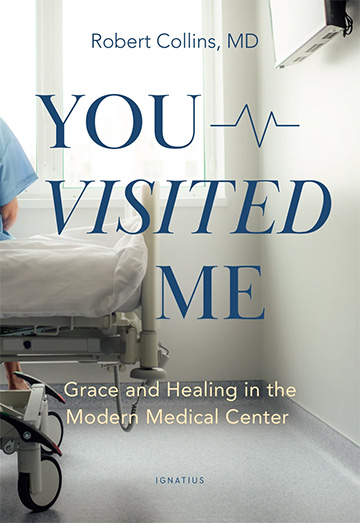
But it wasn’t just that he was good at his job, though he was that. It was that he so obviously cared about his patients. He not only wanted them to get better; he wanted them to be happy. And that included their spiritual welfare, too (he was an outspoken evangelical Christian).
I was reminded of that funeral when reading the new book You Visited Me: Grace and Healing in the Modern Medical Center, by Robert Collins, MD, a professor of internal medicine specializing in blood cancers at the University of Texas Southwestern Medical Center. Collins has discovered that to be in his line of work requires what one might call a ministerial touch and capacity.
It’s not just about doing good medicine. It’s about developing rapport and trust with patients.
“To become and to continue to be this kind of physician involves a life of sacrifice — deep devotion to one’s patients,” Collins writes. “It involves not only the time and effort it takes to master an area of expertise in the left-brained sense but also the time and humble effort to listen and understand.”
Not that Collins began that way. In his telling, he was a “young, agnostic physician, happily rolling along, full of myself, finished with residency, doing a clinical and research fellowship at a leading medical center.” He relates one embarrassing story, when, as a resident, he once described as a “cool case” a middle-aged wife and mother with a particularly unusual form of cancer that would soon kill her. Separated from an authentic good bedside manner, the kind of medical care Collins offers is little more than a journey through what he labels “modern barbaric oncology.”
Over the years, the skeptic Collins kept having religious patients who exhorted him to consider God. One day, he was struck by what he describes as a “quiet little quasi-mystical experience,” that awoke him from his slumber to “something truer, deeper, crucial.”
Thus proceeds a series of fascinating short chapters offering a panoply of anecdotes regarding his many patients.
The stories in the first half of the book make for tough reading, with one patient after another having slim chances of recovery. “It’s not a pretty way to go: the almost inevitable bad death, with the medical staff going through the motions, supplying false hope all along the way,” explains Collins.
One patient suffered a debilitating type of leukemia that, only a few years later, was able to be treated with a daily pill that enables patients to live out a comparatively normal lifespan… but it came too late for her.
Yet despite the odds, some of his more pious patients left a deep impression. “There were so many patients like Debra—patients who befriended me, patients I was taking care of but who were, in a kind, quiet way, taking care of me as well.” He relates an amusing story about one evangelical patient who felt like God was telling him to stop a certain treatment, a request that provoked ridicule among hospital staff. Yet, ironically enough, despite Dr. Collins’ initial incredulity, this ended up being the right call for the best treatment program.
The evangelical’s childlike faith would play a significant role in the author’s conversion.
Probably the most memorable patient in You Visited Me is Marie, who “might have been the most unpleasant patient I have ever known.” A twenty-something working in finance for an investment bank, she was mean and cruel to her care providers. “To say we didn’t like her is putting it mildly.” Collins admits the quality of her care was increasingly compromised, “because nobody wanted to take care of her.”
Yet despite their frustrations, he and the other medical providers made a conscientious decision to treat Marie with kindness and respect. In time, her anger and bitterness dissipated, and she was spiritually transformed, even returning to the Catholic faith of her youth. She died soon thereafter. Collins recalls: “I remembered her in the last, shining weeks of her life, after her miracle: beautiful, love-filled.”
Marie’s story points to perhaps the most salient lesson from Collins’ experiences in modern medicine. He observes: “I’ve heard the same thing over the years from many, many patients”—namely, that cancer was the best thing that ever happened to them, enabling them to deepen their relationship with God, reordering their lives.
For example, he witnesses a dying patient’s faith bring one of that patient’s wayward children back to the Church.
Through his profession, Collins perceived what makes Catholic thinking different: that our suffering can be united to the sufferings of Christ. Moreover, as St. Paul teaches in Colossians 1:24, we can “complete what is lacking in Christ’s afflictions for the sake of his body, that is, the Church.” Just as Christ redeems humanity through his salvific suffering on the Cross, Collins discovers, “we, in union with him as members of his Body, are perhaps playing a role in bringing his redemption to the part of the world that we touch.”
Suffering is terrible, but if we interpret its meaning within the salvific economy of Christ and the cross, we can make sense of it and actually perceive its potential power for good. As Joseph tells his brothers, “You meant evil against me; but God meant it for good…” (Gen 50:20).
That said, the further I read, the more I wondered whether Collins had ever seen anyone get better and recover.
Thankfully, yes. One patient, whose lymphoma has never returned in more than ten years, declared that despite thinking himself a devoted Christian, he was “trusting in anything but God.” The brokenness of his experience with lymphoma enabled him to truly place his trust in God. Incredibly, this patient even acknowledges the cancer’s role in triggering that opportunity to trust: “But it’s been the greatest season of my life…. I would do it again for the blessings and intimacy I gained.” Even Collins admits it’s unlikely the man’s conversion would have happened without the suffering.
Undoubtedly, prayer plays a central part for those whose condition improves. In one case, incredibly intense prayer seemed to heal a patient, almost instantaneously. “Now, from a purely medical and scientific perspective, there is no way that an improvement would occur that rapidly,” writes Collins.
On another occasion, he found that a patient who had dozens of lymph nodes that could be palpated suddenly had none. Though it’s not uncommon for nodes in such a disease to wane, for them to entirely disappear is incredibly rare. For the doctor, the scientific and medical work in tandem with “a different mode of healing,” that is, spiritual in nature.
Yet, as most of us know with friends or family who have experienced terminal illness, sometimes it doesn’t matter how hard you pray or how profound the conversion experience of the patient. Sometimes it is simply God’s time. That may not feel like our time, which is very much how I felt when my father was diagnosed with stage four cancer shortly after my wedding, when he was only sixty-two years old. People prayed. I really believed God was going to perform a miracle. But he didn’t, and my father died about six months after the initial diagnosis.
I know that experience taught my father a lot. It also taught me, my newlywed wife, and my mother a lot as well. That doesn’t necessarily make the grief process any easier, but as the years go by, I at least appreciate that God was doing good, accomplishing purpose, amid what for us can only be described as a catastrophe.
As Dr. Collins has come to realize, that precisely is the power of the Cross.
• Related at CWR: “God is alive and well in the modern medical center” (April 22, 2026): An interview with Robert Collins, M.D., by Paul Senz
You Visited Me: Grace and Healing in the Modern Medical Center
By Robert Collins, M.D.
Ignatius Press, 2026
Paperback, 201 pages
If you value the news and views Catholic World Report provides, please consider donating to support our efforts. Your contribution will help us continue to make CWR available to all readers worldwide for free, without a subscription. Thank you for your generosity!
Click here for more information on donating to CWR. Click here to sign up for our newsletter.

Thank you for this moving and uplifting message. It’s truly a blessing for a doctor to have a spiritual presence.
Death and dying, well addressed by Casey Chalk. A journey most make except for sudden unexpected death. As Christ warns we never know when it will occur. Religious transformations as described don’t always happen.
What’s important then is to allow the dying to express their grief, fear, anger freely and listen. Accompaniment to steal a word from Pope Francis. In time the assurance that you are not alone. In time we form a bond of love.
A caring care giver is free to speak of the One who is always present. Someone said nursing homes are God’s waiting room. Which is why priests urging parishioners to visit patient-residents at nursing homes is a vital charism for our own salvation.
My primary care physician retired recently at 86 years of age. Wonderful, wonderful, giving Catholic man. Every time that I visited his office I left feeling like I had been on a 3 day guided retreat.
Thank you so much for sharing this Mr Chalk.
When my husband was diagnosed with terminal illness the differences in his doctors’ attitudes and level of compassion were stark.
He had one ice cold oncologist he referred to as” Dr Death”. Two other doctors were enormously caring and helpful. They went the extra mile. I think healthcare providers can get burned out by repeatedly having to deliver patients death sentences. They can build up a defensive hard shell to be able to function daily.
Doctors with faith have inner, renewable resources of strength and that makes a difference.