


 By
By 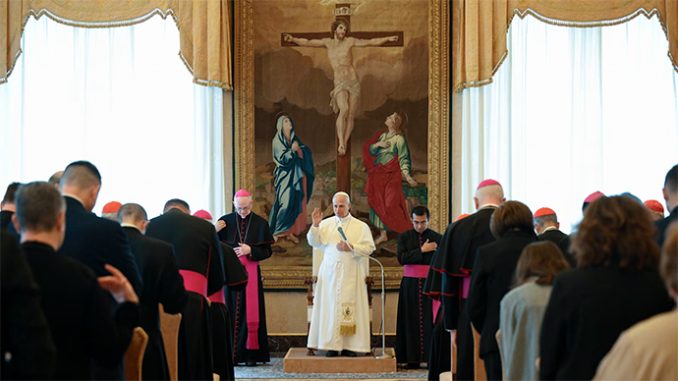
Pope Leo XIV warned Thursday against the temptation to make Christianity more attractive by diluting its content or softening its demands, telling Vatican evangelization officials that the faith is transmitted above all through credible Christian witness.
“It is certainly not by watering down the content or softening the demands that Christianity can be made attractive but by bearing witness with humility and courage to ‘the way, the truth, and the life’ that has converted and sanctified so many people,” the pope said May 28.
The pope made the remarks during a meeting in the Consistory Hall with members of the Dicastery for Evangelization’s Section for Fundamental Questions Regarding Evangelization in the World at the conclusion of its plenary assembly.
According to the apostolic constitution Praedicate Evangelium, the section is responsible for studying fundamental questions of evangelization and promoting an effective proclamation of the Gospel, identifying appropriate forms, tools, and language.
Leo said the crisis of faith, especially in the West, has contributed to “widespread religious indifference.”
“To many, faith no longer appears relevant to their lives,” he said. “The underlying danger, the gravity of which is not always perceived, is that the very essence of what is most human — namely, the search for meaning — may be lost. The great existential questions remain unanswered, whilst a technological culture that is supposed to meet every need is spreading.”
The pope said that even in such a context, “the encounter with Christ is able to restore full meaning and value to people’s lives,” adding that the Church’s missionary mandate remains urgent.
“No one can take her place in this mission, which is as urgent as it is necessary to ensure a reliable foundation for the future of humanity, so that it may be a future of peace, justice, freedom, and fraternity,” he said.
Leo also pointed to the continuing relevance of Pope Francis’ apostolic exhortation Evangelii Gaudium, which he said “continues to be a significant point of reference.”
He invited the dicastery to revisit the document in its work “to promote a mission that is ‘Christ-centered and kerygmatic … born of an encounter with Christ that is capable of transforming lives.’”
The pope said the Church should pay close attention to a growing demand for spirituality, especially among young people, something he said was “clearly evident during the Youth Jubilee.”
“The new generation is not closed to the Gospel; on the contrary, many, when they rediscover it, wish to know it better, because they sense that within it lies the secret to being truly happy,” he said.
At the same time, Leo said evangelization must confront changed conditions in the transmission of the faith from one generation to the next.
“In some parts of the world, this transmission has all but ceased, and this requires the ability to take on new challenges,” he said.
The result, he continued, is “a spiritual ‘poverty’ among the younger generations, a lack of motivation and of the means to develop, in full freedom, that commitment to the faith which gives meaning to life.”
The pope said the cultural climate of “media-saturated and consumerist societies” weakens the ability to pursue truth with patience, perseverance, and critical judgment.
“Every message risks being perceived as just one opinion among many,” he said.
In response, he stressed that transmitting the faith “necessarily involves encountering people and communities who express the joy of the Christian faith and the coherence of a Gospel-inspired way of life.”
Quoting Benedict XVI, Leo said: “What we need at this moment in history are men who, through an enlightened and lived faith, make God credible in this world.”
“We need people who keep their gaze fixed on God, learning true humanity from him,” the pope continued, quoting Benedict. “We need people whose intellect is enlightened by the light of God and whose hearts God opens, so that their intellect may speak to the intellect of others and their hearts may open the hearts of others. Only through men who are touched by God can God return to men.”
Leo also thanked the dicastery for its work during last year’s jubilee, which he said brought more than 33 million pilgrims to Rome.
“The world thirsts for hope more than ever,” he said. “It longs to live in peace and in the certainty that the commitment to building a city worthy of God’s children is not only possible but real, because it is imbued with a hope that offers true, not illusory, objectives.”
The pope said evangelization must remain “the fundamental motivation behind every action of the universal Church and of local communities.”
“The proclamation of the Gospel, which instils hope, is not a utopian proposal: It is a witness that draws people in because it reveals the call to love and truth,” he said.
Leo concluded by emphasizing the importance of catechesis, which he said “plays a decisive role in the life of the Church through its commitment to formation and the transmission of the faith.”
He called for special attention to catechumens, “who are requesting baptism in ever-increasing numbers,” and said Christian communities must accompany them beyond the celebration of the sacrament.
“Similar care must be accorded to the boys and girls who receive the sacrament of confirmation,” he said. “I encourage the many initiatives that accompany them as they continue on their journey of faith for their human and Christian growth.”
This story was first published by ACI Prensa, the Spanish-language sister service of EWTN News. It has been translated and adapted by EWTN News English.
If you value the news and views Catholic World Report provides, please consider donating to support our efforts. Your contribution will help us continue to make CWR available to all readers worldwide for free, without a subscription. Thank you for your generosity!
Click here for more information on donating to CWR. Click here to sign up for our newsletter.



Pope Leo is right on the joy of Christianity, and on intellects faithful to Christ communicating that faith to others intellect. There’s another dimension of faith that’s essential, which is the heroic life or death contest at the core of Christ’s revelation.
Faith requires that fire, the rising flames of which Christ wished to witness.
If the faithful or those seeking know what’s at stake as did the early Fathers we’d have more vocations and practicing Catholics.
We read: “Every message risks being perceived as just one opinion among many.”
A good summary of synodal roundtables…where diversity of opinion within one worldview was mistaken as engaging different worldviews…yes to Jimmy Martin tribalists but no to Courage International.
The Vademecum worldview cast diocesan bishops “primarily as facilitators” rather than primarily as, say, accountable successors of the Apostles (who secondarily might convene fraternal town-hall meetings).
In his Address to the Dicastery on Evangelization, Pope Leo XIV also remarks:
“The underlying danger, the gravity of which is not always perceived, is that the very essence of what is most human – namely, the search for meaning – may be lost. The great existential questions remain unanswered, whilst a technological culture [!] that is supposed to meet every need is spreading.”
We might be reminded of a similar and ignored remark by Solzhenitsyn already half century ago:
“The fight for our planet, physical and spiritual, a fight of cosmic proportions, is not a vague matter of the future; it has already started. The forces of Evil have begun their decisive offensive. You can feel the pressure, yet your screens and publications are full of prescribed smiles and raised glasses. What is the joy about?. . . All the celebrated technological achievements [!] of progress, including the conquest of space, do not redeem the twentieth century’s moral poverty, which no one could have imagined even as late as the nineteenth century” (Aleksandr Solzhenitsyn, “Commencement Address delivered at Harvard University,” June 8, 1978).
Young people are thirsting for direction towards truth. They would like to do justice to the gift of life in them. Church leaders need to support the restless seekers with appropriate doses of the Good News.
Fundamentally, the gospel of Jesus Christ is encapsulated in a dual imperative: “Come, follow me.” Pope Francis and Pope Leo XIII both masterfully articulate the first movement of this call — the kerygmatic invitation of “come,” as Francis famously emphasized to “todos, todos, todos.” This underscores the Church’s universal salvific mission to welcome all of humanity.
However, the theological tension arises when this welcoming posture is divorced from its necessary sequel. An invitation to come unto Christ is inherently an invitation to conversion. By appearing reticent to fully emphasize the second imperative — to follow— their approach risks truncating the gospel message, which is watering down the Gospel. The Church cannot truly invite the world to the Savior without simultaneously informing and demanding the lifelong discipleship, repentance, and obedience to the commandments that following Him requires. The invitation must be kept whole: universal access paired with transformative discipleship.
Exactly.
You are so right Michael B: “Do not cast your pearls before swine” Mat. 7:6 where Jesus warns against sharing sacred truths with those who are hostile or unappreciative. The likes of Francis and Leo have no clue–or perhaps do, but have a different purpose…See how ecumenical they are, todos, todos, and attending services at mosques in Turkey, Africa, everywhere, bringing a Pachamama to the Vatican, and, in the case of Leo, attending a Pachamama ceremoney in Brazil when he was a young priest.
Don’t water down Christianity, except when we’re talking about sexuality and same sex relationships, right Leo? You can’t make this stuff up.
I’d add contraception, fornication and divorce/remarriage to that.
I agree,Pope Leo is 60 years too late.
Don’t water down Christianity, except when we’re talking about sexuality and same sex relationships, right Leo?
That is not watered down Christianity, it is a denial and a betrayal of The Word Of God and thus Divine Law.
https://bigmodernism.substack.com/p/who-should-be-excommunicated-the
Yes, I think Pope Leo should apply the comments to himself and not try to water down Christianity.
Perhaps we should bring back the Baltimore Catechism. That would be a good starting point to answer the existential question regarding the search for meaning. As far as watering down our faith you can thank Vatican II for that.