

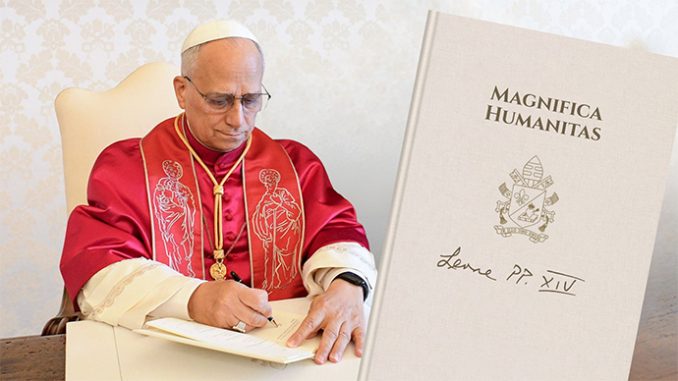
At least for me, Pope Leo XIV’s recent encyclical does little to resolve doubts about how Catholic social teaching should be interpreted and understood.
But I should explain my doubts.
In its modern form, social teaching started with concerns about workers’ problems in industrial society. Since then, its concerns have broadened enormously, and they now include the integral human development of everyone in the world, together with respect and protection for the natural setting on which human life depends.
The basis for doing so seems incontestable: man is a social being, and the point of social life is facilitating human goods. It follows that institutions that affect everyone should advance the common good, emphatically including the good of people who are in a weak position to advance their own interests.
But its extraordinarily broad scope means that it cannot tell us much that’s definite. Goods conflict, and our understanding of how to achieve and balance them is weak. So determining and advancing the common good involves a great many considerations that are ambiguous or point in different directions. Each of us has his own opinion, some better founded than others, but each is subject to legitimate objections.
Human ignorance and the uncertainties of life are not, of course, the only problems. People are often stupid, willful, perverse, or downright evil. And even if they are generally well-intentioned, their dealings with each other are often short-sighted and self-centered.
People usually view public authority as the remedy for these problems. What else can they look to? But government officials are unlikely to be much wiser and better than ordinary citizens. To make matters worse, those who maneuver themselves into positions of power are often much less so.
Even if officials are well-informed and well-intentioned, policies often defeat their purposes through mistakes in implementation or the assumptions—usually implicit—on which they are based. The art of politics is no more advanced today than medicine was in 1300. As such, it is no doubt better than nothing—a system of medicine based on Galen and Hippocrates is still widely practiced in India, and there must be some reason people still accept it. But caution seems called for.
These difficulties are intrinsic to human life. They advise us that while government is necessary and important, we shouldn’t expect too much of it, and should remember that political attempts to build utopia have repeatedly ended horrifically.
Under such circumstances, what can the Church teach people about politics and secular social life?
Actually, quite a lot. She can put them into perspective by reminding us of higher concerns, so that politics does not become our religion. She can promote caution by reminding us of human limitations and sinfulness. And she can remind us of the goals and principles that should order political discussion among people of goodwill and varying perspectives. To the extent she is courageous and maintains her independence of mind, she can also highlight gross errors and breaches of the common good like those that defined the great twentieth-century tyrannies.
These are big contributions, and political life needs all the help it can get. But social teaching cannot resolve many everyday political disputes, and it cannot attempt to do so without the Church being seen—often justifiably—as a partisan political player.
Even so, the Church makes strong claims for its social teaching: she has, we are told, the “right and duty to examine social realities, make pronouncements about them and indicate paths for finding just solutions.” There are a variety of reasons for that. One is the recollection of her political influence during the Middle Ages. The logic of that influence—the Church must somehow be politically supreme because she is the authority on ultimate goals and standards—maintains its hold even though its practical basis in an explicitly Catholic social order has vanished.
Another consideration is that a pope is also a man of his time. Like other people today, modern popes are often tempted to overestimate the ability of government policy—that is, action by political authority backed by organized force—to transform social life for the better. And like all of us, they have political opinions that to them seem unquestionable requirements of the public interest, but to other well-informed and well-intentioned people seem otherwise.
But if all that is so, it is natural for them to view their own strongly held political views as requirements of Catholic social teaching. Such views, therefore, tend to influence teaching documents. These can include dubious ones, like the view that the way to eradicate poverty is for state authority to mandate the sharing of wealth, and that wars are always at bottom about profit-seeking by business, notably the armaments industry.
The recent encyclical begins with a resume of Catholic social teaching as it has developed over the years. Since the topics dealt with are so comprehensive and complex, even a resume soon becomes a maze of distinctions and qualifications. And since the topics are so important, they prompt calls for decisive action that take them into account.
Indeed, so important are the topics that the current pope tends to put social teaching at the heart of the Faith. I commented recently on one comment that points that way, regarding the comparative importance of sexual morality and concerns like equality. The recent encyclical presents other examples, such as his statement that “the spirituality I wish to commend [which is apparently the same as his “Eucharistic spirituality”] is that of the ‘wise architect’ who, driven by hope for the Kingdom of God, is committed to building the world for the common good.”
The result of the complexity of the considerations and the urgency of what they demand is a discussion that emphatically asserts a variety of things that don’t sit easily together. He says, for example, that “building a city founded on the common good implies, first and foremost, building on a firm relationship with God.” But he also emphasizes “the autonomy of earthly realities,” dialogue with “all men and women of goodwill,” and contributing “to every initiative that builds a more just world”—which evidently includes the United Nations and comprehensive systems of regulation imposed by the governments that actually exist, none of which care much about God or even natural law.
All in all, he seems to call for a comprehensive regulatory order that brings the whole world in line with social teaching. That order will apparently be designed and run with the active participation of experts, who evidently know better than others what the situation demands. But it will also be designed and run with the full participation of people (the “excluded” and “marginalized”) who have no experience running anything on a large scale. And it will not inhibit anyone’s freedom and initiative.
The opening section adds to the puzzlement by contrasting the efforts the Pope approves with Babel, and identifying them with its opposite, the comparatively very limited attempt of Nehemiah to get the Jews returning to the Holy Land to rebuild the walls of Jerusalem so they can live securely in accordance with the national traditions they believe embody God’s special will for them. But what he approves seems to be, as a practical matter, an attempt to construct a secular utopia through collective effort led by secular institutions and their ideals, which sounds to some of us very Babel-like.
Nor is he tolerant of claims that social teaching is concerned with ultimate goals, and the realities of human life mean that what can reasonably be attempted will necessarily be much more limited, partial, and ambiguous. Although he insists on acceptance of human weakness, he also insists that “the civilization of love is no naïve utopia, but a demanding project.”
Magnifica Humanitas has eloquent passages, and many people have found it the font of wisdom it claims to be. Many of them no doubt see deeper than I do. With some, though, it may be that they let their own interpretive approaches do a lot of heavy lifting. That is not all bad: the encyclical raises issues that are important and rarely put so much in the spotlight, so we shouldn’t complain when people discuss them from their own point of view.
But much of it seems to me mechanical, contrived, and unpersuasive, so much so that apparently competent people have argued that some of it was almost surely AI-generated. However that may be, I cannot help but hope as a layman that our pastors reconsider at least their presentation of social teaching so that it becomes more comprehensible, both in itself and in relation to its proper function in social life and the total tradition of the Church.
If you value the news and views Catholic World Report provides, please consider donating to support our efforts. Your contribution will help us continue to make CWR available to all readers worldwide for free, without a subscription. Thank you for your generosity!
Click here for more information on donating to CWR. Click here to sign up for our newsletter.

Kalb asks: “…what can the Church teach people about politics and secular social life?”
Answer: That moral principles are integral to both politics and secular social life. The Church must, however, stay in its own lane – the teaching of Judeo-Christian morality. This means the decalogue of the Old Testament and the kerygma of the New. What has happened to the Church over recent decades is that it has abandoned Catholic morality altogether and exchanged it for a spot in the political landscape as just yet another player in the political arena. Let me give but one example.
Across the globe, hands down the greatest destoyer of human life has been abortion. It has taken the lives of HUNDREDS OF MILLIONS of human persons – more than all the wars, the famines and pestilences of the past. More recently, the governor of the State of Massachusetts signed a bill making it lawful to murder babies in their mothers’ wombs FOR THE FULL NINE MONTHS OF GESTATION. And, the reaction of our Pope, our bishops, our clergy and our Catholic leaders among the laity has been to remain silent. The governor’s action was a political one and yet the Catholic Church had nothing to say about its immorality.
If you want a reason why the Church is faltering it is because it plays a lousy hand politically and people know it. And, at the same time, it stands for nothing when it comes to enunciating Judeo-Christian values in the moral domain. It is risable that the Pope thinks he’s a leader on the world stage. He can’t even seem to deal with the immorality that he confronts everyday at the Vatican: Rupnick the Rapist, Homosexual Clergy who staff the various Vatican offices, and the thievery of Church financial resources.
Thank you, Deacon, well stated. The Church has deliberately chosen not to place an emphasis on abortion, sexual immorality, and the prevalent sins of our time. I recall Pope Francis advising that such issues should not be the primary focus, specifically that the Church should not be obsessed by moral issues. Meanwhile, as the world descended into a moral quagmire, Rome remained dormant and has yet to rouse itself.
Excellent analysis, Deacon!
The Church hierarchy seems indeed to have abandoned a strong defense of Judeo-Christian morality—-and minimized abortion the greatest holocaust of our era–in favor of virtue signaling on nebulous social justice issues and crushing the Latin Mass.
And some of the hierarchy’s ardent synod members seem hell bent to completely overturn sexual morality as evidenced by its most egregious effort yet—-the heterodox Synod Report #9 seeking to normalize homosexuality.
The job of the church is to make saints. The job of the state is to govern sinners. When the state attempts to make saints, it becomes a tyranny, and fails to govern sinners. When the church attempts to govern sinners, it becomes a tyranny, and fails to make saints. The genius of the West has been to keep them separate and in their own lanes. Both church and state in our age seem to have forgotten this.
Well said, however, government has never been separate from religion/faith and faith, if it is faith, is made present by the faithful in every and all aspects of human endeavor.
If one can separate any aspect of his / her life from his or her faith, they are not living their faith and their professed faith is a sham.
It would be interesting to know if there is any correlation between voter turnout and moral governance.
Historically, voter turnout is apathetic.
Ah if we could just get the participation the Soviets “achieved”…
About the primitive and absolute(!) notion of the two separate “lanes”, back in 1942 Jacques Maritain already proposed some elementary(!) and prudential “coloring outside the lines”:
“After the great disillusionment of ‘anthropocentric humanism’ and the atrocious experience of the antihumanism of our day, what the world needs is a new humanism, a ‘theocentric’ or integral humanism, which would consider man in all his natural grandeur [some say ‘magnificence’!] and weakness, in the entirety of his wounded being inhabited by God, in the full reality of nature, sine, and sanctity. Such a humanism would recognize all that is irrational in man, in order to tame it to reason, and all that is suprarational, in order to have reason vivified by it and to open man to the descent of the divine into him. Its main work would be to cause the Gospel leaven and inspiration to penetrate the secular structures of life—a work of sanctification of the profane and temporal” (“Christian Humanism” in “The Range of Reason”, 1942; reprinted in Donald and Idella Gallagher, editors, “A Maritain Reader,” Image, 1966).
SUMMARY: an early 135-word summary of Pope Leo’s “Magnifica Humanitas” of 42,604 words (dipping into the richness of the now assembled Catholic Social Teaching).
Yes, it’s a grand idea, but you would think that after the 20th century, we would have grown wary of government based on grand ideas. The defect is, has been, and always will be that such ideas are conceived by sinners, implemented by sinners, and imposed on sinners, and that the outcome is always measured in blood. The notion that we are just one noble ideal away from utopia ought to be something that any Christian who has read Genesis would dismiss with laughter.
Catholic Social Teaching’s (CST) principles and exercise have been in the Corner for too long.
In my view there is too much “soul saving” with focus on and in Church grounds.
CST Principles promote Christian Humanism and provide the tools for its development and exercise, while at all times being informed and immersed in the richness of the Scriptures and our communal Catholic Worship.
CST offers a new path for newly inspired people “alive and active” (Hebrews 4-12) to engage in the secular world armed with the knowing of God’s Love and all that it inspires each individual to do. With the image of the empty Cross always present.
Our era sees the need for more local neighbourhood engagement by men and women of faith to see the application of Subsidiarity and Solidarity at the Local level in the Civil sphere.
There’s too much emphasis on soul saving? Pardon me, but what church are you looking at? Ninety percent of what comes from the mouths and pens of our bishops and popes consists of “social teaching” — generally on subjects that our church men know little about and have no commission to address. Let’s face it : Catholic Social Teaching has been a complete failure, and deservedly so. I keep hoping that our leaders will find some time in their busy schedules to preach the actual gospel, and I keep being disappointed. They think their job is to make the world a better place, and they think that they know how to do it. Wrong on both counts.
Do Note that Reply above was aligned to that of Peter D. Beaulieu
August 13, 2026 at 9:32 am
The sad laughter is that some readers think that “secular, profane and temporal” are equivalent to “government” and “grand ideas.” Meanwhile, and not to be found in Genesis, are such principles (not “ideas”) as Subsidiarity which involves institutions outside of government altogether, like churches and families or even websites. I concur with your concern, but respectfully decline to be confined by predispositions.
“They advise us that while government is necessary and important, we shouldn’t expect too much of it and should remember that political attempts to build utopia have repeatedly ended horrifically.”
I think about government programs that have transformed U.S. society out of poverty for some segments of our population: notably the GI Bill and Social Security. Government priorities and policies determine how much the common good is respected. Look at the huge difference between Northern and Southern Korea, East Germany and West Germany. I agree that Catholic Social Teaching should inform government policies and priorities but let’s not undermine young peoples’ minds that it doesn’t matter if you vote or not, all of politics and government is corrupt. This solipsism creates a 40% turnout at the polls. At our recent primary elections our turn out was below 15%
“notably the GI Bill and Social Security.”
The GI Bill was a form of scrip compensation that, since it could only be spent in a certain way, was in large part a huge give away to colleges and universities.
Social Security was sold with lies “insurance bought and paid for” and operated with lies. One of the objectives of the very early designers of Social Security was population control, with the idea that one’s old age prosperity/security would be disengaged from issue. In that regard, it has been remarkably successful. However, since it is a Ponzi scheme, not a legal reserve system, the “security” isn’t nearly what one might think and we are coming to a point where its “funding” (which doesn’t mean what people think it means) is about to go negative-that will demand increased taxes, decreased benefits or floating more debt.
” all of politics and government is corrupt.”
Not all, just most. Why should we allow people to believe pollyannish fantasies rather than the reality. H.L. Mencken’s observation that every election is an auction in advance of stolen goods is accurate.
One of the most central one-liners in the Documents of Vatican II is this: “Christ the Lord…by the revelation of the mystery of the Father and His love, fully reveals man to himself and makes his supreme calling clear” ( n. 22).
“Reveals man to himself…?”
Three points:
FIRST, so, who is this man? “Magnifica Humanitas” is grounded in the thinking in Church’s social encyclicals and conciliar documents—Benedict’s “real” Council vs the “virtual” Council of Hans Kung and is current-day spawn—and rather than in the occasionally gratuitous flatulence literally under some of the more recent (and substitute?) synodality.
“Magnifica Humanitas” is addressed not to insider-baseball theologians, but to all those of good will and even to the expanse of humanity who have no understanding at all of the Gospel. Just as was first done by Pope St. John XXIII and then by much of Council.
SECOND, just as “Rerum Novarum” lifted us above the universal solvent Industrial Revolution, so too “Magnifica Humanitas” lifts all above even worse and foreseen abuses under AI algorithms.
KEY POINT: About Kalb’s complaint regarding a rule of “experts,” this term (or expertise) appears only four times, and in the context of “the Gospel and human expertise” (e.g., nn. 24,27,36). The Gospel is at the table, rather than not. (“The Church guards the heritage of God’s Word and draws from it religious and moral principles, without always having at hand the solution to particular problems,” Gaudium et Spes, n. 33).
For a less doubting insight into the new encyclical, give a listen (two minutes): https://www.facebook.com/share/v/184J6pZoY4/
The video follows the route marked out by Paul VI in his address closing the Council, to bring man to God by open-ended sympathy with the world’s concerns and joining in its efforts. That doesn’t seem to have worked – rather than transforming the world the world has transformed the Church.
Also, the approach suggests a gradual process of leavening. His Holiness, in spite of talk of rejecting efficiency as a standard, speaks of leavening but seems to have something more definite and immediately practical in mind.
The pope’s encyclical stepped in (to the help the world) with the perspective of grace. By expressing what he did, the Pope could not fail to show how far ahead the Church of Christ has thought (because it has discernment, the ability to know truth, what comes from Heaven) about modern technology management. In effect, Magnifica Humanitas is evangelical before it is anything else. Anyone reading it can recognize how vast the Church’s perspective is on human civilization and society.
Only God can give the remedy for our problem child (AI). But to receive true reliable knowledge (from Heaven, from God) persons need to come into the Church to receive Him Who is the Truth.
Well put, jst
Many good thoughts,deacon, but a tad too judgmental and harsh. Yes the Church must stay in its lane and teach morality . While it has gone deep into politics, I don’t believe it has “abandoned Catholic morality “. It surely has not abandoned the pro-life movement. Just consider the countless hours given by concerned Catholics that have been invested in the movement. Sure, a lot more can be done; but let’s not neglect what has been done and what IS being done by Catholics. As Vatican II emphasized the hierarchy can’t do it alone and the lay must shoulder a lot of the weight. This is being done and credit must be given when due. As far as blaming the pope for not cleaning up the house yet, give him a bit of slack. Perhaps it is a much bigger job than we realize. We are not in his shoes and can’t possibly understand his problems, and I sincerely doubt that either one of us could do better if given the chance.
Also , are we to promote and impose a “Catholic morality “ on the secular society or a universal morally (which just happens to be congruent with our beliefs) applicable to all mortals which is necessary for the survival of mankind. Hopefully our morality is not just one of many moralities which can be adopted or abandoned at will. Much like saying the Catholic Church is on an equal footing with all other Christian denominations.
Please forgive me if I seem to be rambling on and a bit incoherent at times. I am 87 and am recovering from a stroke- not an excuse, but rather a reason. God bless!
I don’t believe it has “abandoned Catholic morality “.
>Reinhard Marx has entered the chat
>Walter Kasper has entered the chat
>Robert McElroy has entered the chat
>John Stowe has entered the chat
>Mark Seitz has entered the chat
>James Martin has entered the chat
>Bryan Massingale has entered the chat
Based on your comment, it might be helpful if strokes were contagious.
“right and duty to examine social realities, make pronouncements about them and indicate paths for finding just solutions.”
To an economically alert person that’s an error. There are rarely “solutions” to any problem, there are tradeoffs and by and large, the episcopacy, including Bishops of Rome prattle on about economic “social realities” without any aptitude, education or participation in the dismal science. People who participate in economic life understand that life is like a tube of toothpaste, push here-it pops up there. People who spend their whole life outside exchange cannot understand it. You can militate for an increased minimum wage for example, but you must understand you are pricing out the unskilled and inexperienced. The next time that obnoxious Toshiba scanner with the computer generated voice at the grocery store is scolding you like an irate school marm because you took one too many seconds to put the bananas in the right place, understand it exists to escape the minimum wage.
But Bishops who “have long supported increases in the federal minimum wage” don’t get it:, assuming they ever set foot in a grocery store. I note they don’t support minimum productivity, minimum attendance and timeliness, minimum tenure, nor do they sponsor classes on resume writing or job fairs. Instead, they engage in state idolatry.
Worse are the ones that were/are “out and out” frauds. We are coming up on the fortieth anniversary of “Economic Justice for All”, a document led by Rembert Weakland who opined “All people have a right to participate in the economic life of society,” (whatever that means).
Yet that miserable moral cretin embezzled the offerings of the people that participated in the economic life he presumed to dictate about in a futile attempt to cover up his sodomite life, and threatened others who sought to report other crimes with lawfare. (See The Many ‘Sins and Crimes’ of Archbishop Rembert Weakland by Fr. DeSouza Aug 2022.)
He should have been prosecuted, not supported until he finally gave up the ghost.
Many of the Bishops whose collective authority promulgated that document was issued-were the ones who were playing “musical parishes” and paying off victims under the coercive exchange of an NDA.
So much for “justice”.
https://open.substack.com/pub/joetevington/p/pope-leo-xivs-first-encyclical-magnifica?utm_source=share&utm_medium=android&r=en7zd
We should well realize that the hierarchy of the Church is controlled by academically and ecclesialasticly elevated men who are a bit removed from the common lay person(s) in the pews and on the street.
Encyclicals, even the best intentioned, are written for the “red hats”.
Only a few popes have well demonstrated the ability to relate and communicate with the laity.
This means that the encyclicals often fail to teach, speak to or move the mass.
If theology is truly a human discernment as to the nature of God within our lives, it must be lived rather than academically discussed…and it need to adhere to the simple reality of loving God and showing that love by our love of neighbor, by living peace even at the cost of martyrdom.
How many of us are truly ready and presently able to live in such a manner?
Yours in Christ
The poor , the uneducated, the simple hard-working Catholic does not have the time to read what are now 50-page encyclicals.
On the scale of powerful comprehensiblity that runs from the Sermon on the Mount to the IRS tax code, the encyclicals are not even within view of the former.
For me the great cloud of ignorance (and it might just be me) is what the hell is ‘common good’ but a nebulous almost at times demonic excuse for taking away real people’s real rights.
Pope John XXIII
60. It is generally accepted today that the common good is best safeguarded when personal rights and duties are guaranteed. The chief concern of civil authorities must therefore be to ensure that these rights are recognized, respected, co-ordinated, defended and promoted, and that each individual is enabled to perform his duties more easily. For “to safeguard the inviolable rights of the human person, and to facilitate the performance of his duties, is the principal duty of every public authority.”
Your quote of John XXIII resolves the issue of the tension between a Marxist interpretation of the common good that is absorbed by the state rendering the individual a statistic, and the God given, inviolable rights of the person.
That God given rights are inherent to our human nature, and are known as self evident truths belonging to what St Thomas Aquinas called the Natural Law Within.
Robert,
You ask “what the hell is ‘common good’ but a nebulous almost at times demonic excuse for taking away real people’s real rights.” A good question, but possibly backwards? Yes, legitimate human freedom is open to many possible futures, but the natural law (the common good) much of the time does not inform us exactly what to do. But, rather, constrains us from what NOT to do (point #3 below). This picture is not so “nebulous.”
A few points of elaboration:
FIRST, the common good “embraces the sum of those conditions of social life by which individuals, families, and groups can achieve their own fulfillment in a relatively thorough and ready way” (Gaudium et Spes, n. 73; echoing the early encyclical “Mater et Magistra,” John XXIII, 1961).
SECOND, the Second Vatican Council then identifies what NOT to do, by proposing as an explicit teaching what is also self-evident:
“(Furthermore), whatever is opposed to life itself, such as any type of murder, genocide, abortion, euthanasia, or willful self-destruction, whatever violates the integrity of the human person, such as mutilation, torments inflicted on body and mind, attempts to coerce the will itself; whatever insults human dignity, such as subhuman living conditions, arbitrary imprisonment, deportation, slavery, prostitution, the selling of women and children; as well as disgraceful working conditions, where men are treated as mere tools for profit, rather than as free and responsible persons; all these things and others of their like are infamies indeed. They poison human society, but they do more harm to those who practice them than those who suffer from the injury. Moreover, they are a supreme dishonor to the Creator” (Gaudium et Spes, n. 27).
Likewise, the magisterium and the Catechism of the Catholic Church (CCC, 1992) also identify intrinsically evil acts, including: intentional killing of the innocent (CCC n. 2273), infanticide (n. 2268), abortion (n. 2273), euthanasia (n. 2277); (and sexual immorality: nn. 2352, 2353, 2356, 2357, 2370, 2380, 2381).
The follow-up encyclical “Veritatis Splendor” (Pope St. John Paul II, 1993) clarifies further that while there is no upper limit to the life of freedom, virtue and charity, there is a lower limit below which the Commandments (i.e., the natural law) are broken. Affirmed are moral absolutes, while refuted are the nebulous (!) notions of the Fundamental Option, Proportionalism (bundling of good with some evil) and Consequentialism (the error that the end justifies the means).
THIRD, to repeat, the not-nebulous natural law usually tells us what NOT to do:
“…the idea of natural law remains as it were ‘latent’ [!]. But it makes itself felt whenever the positive law [legislation] in itself or in the eyes of a large number of people, appears to be in conflict with the natural law. Then the primordial rights of the person, the family, and the national group stand forth with elemental force against the power of the state, which develops into tyranny by denying the foundations of political community, its own moral root: the natural law” (Heinrich Rommen, “Natural Law,” Liberty Fund, 1998).
And your view explains why it took centuries to give us the Declaration of Independence !!! ALL POSITIVE
All men created equal
All created with unalienable rights
Government exists to protect these rights.
What would Jefferson say to you ? I’ll tell you
“This was the object of the Declaration of Independence. Not to find out new principles, or new arguments, never before thought of, not merely to say things which had never been said before; but to place before mankind the common sense of the subject, in terms so plain and firm as to command their assent, and to justify ourselves in the independent stand we are compelled to take. Neither aiming at originality of principle or sentiment, nor yet copied from any particular and previous writing, it was intended to be an expression of the American mind, and to give to that expression the proper tone and spirit called for by the occasion.
All its authority rests then on the harmonizing sentiments of the day, whether expressed in conversation, in letters, printed essays, or in the elementary books of public right, as Aristotle, Cicero, Locke, Sidney, &c. …”
One more thing. You don’t realize that you are defeating the very meaning of “SELF EVIDENT”
Calvin Coolidge on the 150th Anniversary of the Declaration of Independence
“. If all men are created equal, that is final. If they are endowed with inalienable rights, that is final. If governments derive their just powers from the consent of the governed, that is final. No advance, no progress can be made beyond these propositions. If anyone wishes to deny their truth or their soundness, the only direction in which he can proceed historically is not forward, but backward toward the time when there was no equality, no rights of the individual, no rule of the people. Those who wish to proceed in that direction can not lay claim to progress”
“One must discern which direction the Current Church desires to lead the laity….historically the Catholic Church has been in the business of conforming the world to God (however imperfectly at time) in stark contrast of the modern Church intent on conforming their god to their world. The increasing polarization between the RadTrads and Modernists has all but eliminated any, all common ground the result being in many cases that the confusion, the chaos and disorder results that apostates simply leave the Church to find seek the Truth elsewhere, insufficient traditional Churches and an overwhelming number of modernist churches.”
Clearly a modern church that claims that polarization exists in The Catholic Church because Virtue is a means between two extremes, insufficient traditional Churches and an overwhelming number of modernist churches, is one that has fallen to the heresy of modernism that is humanistic at its core. Only The Word Of God, Our Savior, Jesus The Christ, Is Perfect Divine Eternal Infinite Truth And Love, and thus Virtuous.
Perfect Divine Eternal Infinite Love Begins and Ends with Respect for The Sanctity and Dignity of Human Life from the moment of conception to natural death and thus we can recognize through our Catholic Faith and reason, grounded in Perfect Divine Eternal Infinite Love this statement, reflects the modernist heresy at its core:
“The unity or division of the Church should not revolve around sexual matters. We tend to think that when the Church is talking about morality, that the only issue of morality is sexual. And in reality, I believe there are much greater, more important issues, such as justice, equality, freedom of men and women, freedom of religion …”
This statement stands in direct conflict with Pope Pius XI, Quadragesimo Anno, and The Catholic Church’s Teaching on Marriage And The Family that the past two anti popes have ipso facto dismissed by their denial of The Spirit Of Perfect Divine Eternal Infinite Love Between The Father And His Only Begotten Son, Jesus The Christ, and their promotion of the modernist heresy.
You cannot change The Spirit Of Divine Law without ipso facto changing The Letter Of Divine Law, thus you cannot possibly be defending The Papacy if a modernist is occupying The Chair of Peter.
At the heart of Liberty Is Christ, “4For it is impossible for those who were once illuminated, have tasted also the heavenly gift and were made partakers of the Holy Ghost, 5Have moreover tasted the good word of God and the powers of the world to come…”, to not believe that Christ’s Sacrifice On The Cross will lead us to Salvation, but we must desire forgiveness for our sins, and accept Salvational Love, God’s Gift Of Grace And Mercy; believe in The Power And The Glory Of Salvation Love, and rejoice in the fact that No Greater Love Is There Than This, To Desire Salvation For One’s Beloved.
“Hail The Cross, Our Only Hope.”
“Blessed are they who are Called to The Marriage Supper Of The Lamb.”
“For where your treasure is there will your heart be also.”
And although it is True that we are free to accept or reject Jesus The Christ, and thus Divine Law, because Love Is A Gift Given Freely From The Heart. This does not change the fact that Justice, Equality, And Freedom For All Persons depends on following Divine Law which begins and ends with respect for The Sanctity and Dignity of Human Life, Created In The Imago Dei, The Communion Of Perfect Divine Eternal Infinite Complementary Love, The Most Holy Blessed Trinity.
“When the freedom to be creative becomes the freedom to create oneself, then necessarily the Maker Himself is denied and ultimately man too is stripped of his dignity as a creature of God, as the image of God at the core of his being. The defence of the family is about man himself. And it becomes clear that when God is denied, human dignity also disappears. Whoever defends God is defending man.” – Pope Benedict’s Christmas Address 2012
Christmas greetings to the members of the Roman Curia (21 December 2012) | BENEDICT XVI
Who can deny that by “resigning “ The Ministerial Office of The Papacy, while retaining The “forever” Office Of The MUNUS, Pope Benedict XVI exposed the fact that any pope to follow who claimed as both Jorge Bergoglio did and now Robert Prevost has, that it is not True that God’s Defense Of The Family reflects God’s Defense of The Sanctity and Dignity Of Human Life from the moment of conception to natural death, and thus it is True that “whoever defends God, is defending man”, would ipso facto reveal themselves, in denying The Unity Of The Holy Ghost, The Spirit Of Perfect Divine Eternal Infinite Love Between The Father And His Only Begotten Son, Jesus The Christ, Who Must Proceed From Both The Father And His Only Begotten Son, Jesus The Christ, to be both anti Filioque and anti Pope, and thus invalidly elected to The Papacy.
To like X is not of necessity to have any opinion of ‘not-X’ so let me say that Pope Benedict was so clear but Leo does not seem Augustinian not did Francis seem Jesuit. Anybody get that…now on to Catholic Social Thought. It has 3 problems
1) Nobody has any statement on ‘common good’ that Stalin or Mao couldn’t easily use to destroy people in its name.
2) Seminarians, priests , and [ fill in the blank ] seem to have no idea what existing political thought emobodies things they should be promoting , eg American Founding, UN Declaration on Human Rights, Nuremburg Trials on Natural Law [ Pope Benedict did ask Catholic schools to revive teaching on Natural Law ]
3) There is a moral duty for Catholics to exercise the vote and their citizenship duties. You are not more moral for being an ignorant lazy non-citizen.
The question becomes clearer when the document is read alongside the tradition it explicitly invokes. If an account of human dignity in relation to artificial intelligence is to guide social teaching, readers need to see which principles are continuous and which applications are genuinely new. The discussion would benefit from distinguishing criticism of style or argument structure from disagreement about the moral claims themselves, because those are different tests for an encyclical.