


Saint Anselm of Canterbury described theology as fides quaerens intellectum–faith seeking understanding. Father Robert Spitzer, SJ, and Carl E. Olson have written a worthy contribution to the understanding-seeking effort: The Most Asked Questions about Faith, Reason, Jesus, and the Bible (Ignatius Press, 2026). The goal of the book is to address essential points and details within the larger contexts of disagreements and debates that have been around for centuries.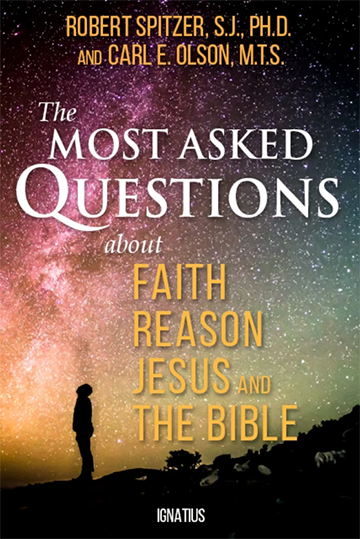
Fr. Spitzer is a prolific author, speaker, and more. His previous books include Christ, Science, and Reason: What We Can Know about Jesus, Mary, and Miracles; Science at the Doorstep to God: Science and Reason in Support of God, the Soul, and Life after Death; The Moral Wisdom of the Catholic Church: A Defense of Her Controversial Moral Teachings; Finding True Happiness: Satisfying Our Restless Hearts; Five Pillars of the Spiritual Life: A Practical Guide to Prayer for Active People; and many more. He is also President of the Magis Center of Reason and Faith, and was President of Gonzaga University from 1998 to 2009.
Carl E. Olson is editor of Catholic World Report. A convert from Evangelical Protestantism, he is the author of hundreds of articles on theology, Scripture, current events, and apologetics, as well as the books The Da Vinci Hoax; Will Catholics Be “Left Behind”? A Catholic Critique of the Rapture and Today’s Prophecy Preachers; Did Jesus Really Rise from the Dead? Questions and Answers about the Life, Death, and Resurrection of Jesus; and more. He also authored two Study Guides for Word on Fire and has contributed to other volumes.
Olson recently spoke with Catholic World Report about the new book and the importance of seeking answers to the most fundamental questions.
Catholic World Report: How did the book come about?
Carl Olson: Father Spitzer and Ignatius Press were interested in publishing a question-and-answer book of apologetics for a popular readership, based on several dozen short videos/talks given by Father Spitzer. They approached me and asked if I’d be interested in putting it together, using materials from Father Spitzer, as well as from my writing and experience.
We began with around one hundred questions and pared them down to around 75 or so. This book contains the first third of those questions and our responses, and it focuses—as the subtitle indicates—on faith, reason, Jesus, and the Bible.
CWR: There are many resources that seek to answer questions like those addressed in the book. Is there something unique in how you and Fr. Spitzer approach the questions, how you respond to them? What sets this book apart?
Olson: That’s a good question. On one hand, Fr. Spitzer and I are not trying to break new ground, as we think that timeless truths are what most people really long for today. We are addressing key questions—often old questions, but persistent in nature—while drawing upon our respective educations, backgrounds, knowledge, and experience.
On the other hand, I think that combination makes for an engaging conversation and interaction. Also, while both Fr. Spitzer and I have done much writing and speaking in the realm of apologetics, we bring our respective backgrounds as an educator and academic (Fr. Spitzer) and catechist and journalist (myself) to the table. And I believe that adds a unique quality to the book in terms of the tone, the anecdotes, and the way we write the book.
Also, we draw from a deep range of sources, but without, I hope, being needlessly difficult or academic for this sort of book. Those sources include Scripture, scientists, philosophers, Doctors of the Church, novelists and poets, theologians, popes, and more.
And we quote many atheists and skeptics—we have no interest in battling straw men!
CWR: The title of the book is The Most Asked Questions about Faith, Reason, Jesus, and the Bible–such foundational matters! Why did you choose to focus on those fundamental topics for this book? (And are there more books planned?)
Olson: Those were natural and logical starting points, as they are so essential and foundational. And they are also catechetical; we want readers to learn, to be challenged, and to ponder—not just hear assertions and arguments, as important as those can be.
The first question we address is: “Has Science Disproved God?” Because, of course, countless numbers of ordinary people think science has indeed disproved the existence of God. Other questions include “Is Faith Blind, Silly, and Childish?”, “How Do You Explain the Angry God of the Old Testament?”, and “What Is the Evidence for the Historical Reality of Jesus?”
We interact with the writings of atheists, including Richard Dawkins, Christopher Hitchens, and Sam Harris, as well as Nietzsche and Darwin, among others.
And, yes, we are working on the next two volumes. The second one focuses on faith, science, anthropology, and the Church. The third will hone in on the topics of suffering, spirituality, morality, and miracles.
CWR: Some of the fundamental topics under discussion here involve the very existence of God; do you think that non-Catholics, non-Christians, even atheists, are more open these days to the idea of the harmony of science and faith, and the possibility that science and rationality can even demonstrate the existence of God?
Olson: I think the simple answer is…it depends. It varies widely—even wildly!—and is difficult to analyze with precision because, first, beliefs can be complicated and many people do not express them clearly (or don’t want to express them publicly), and, secondly, it’s usually not a simple “Yes” or “No”.
For example, while some atheists are very antagonistic towards Christianity, there are also atheists who acknowledge that Christianity has done many good things—but it’s not for them. For example, in the book, I talk about an atheist, “Craig,” a teaching assistant at the University of Oregon. Craig and I had some fascinating conversations, and he was very candid in lamenting that he did not have faith; there was more of a sense of sorrow than anything else.
That said, I think there is a widespread and fairly lazy notion among run-of-the-mill skeptics (I see them on X often) that faith is anti-science, that Christianity is wildly irrational, and that “smart people” avoid the mumbo-jumbo of Christianity, especially Catholicism.
This is a form of secular fundamentalism, which relies on stereotypes, unquestioned prejudices, and sloppy thinking when it comes to the many claims and substantial arguments found in the Christian tradition at large. To quote former atheist Walker Percy, who converted to Catholicism at age 31, secular humanism “won’t do … It’s not good enough.”
Also, it’s important to point out (and it’s something we address more in the second volume) that scientists, overall, tend to be far more theistic and even Christian than is commonly recognized and admitted. There are many reasons for that, as people are complicated and faith is often mysterious. But one reason is that the order and design evident in the natural world—from the unseen realm of quantum physics to the overwhelming grandeur of the heavens—point to Someone or Something who created and upholds it all.
CWR: Do you think the heyday of the “New Atheists” (Dawkins, Hitchens, Harris, et al.) is over? And either way, did their influence on the conversation affect how you approached the questions of God’s existence in the book? In other words, do you think their writings/arguments have affected the way people think about these questions?
Olson: I think that their day in the media spotlight has mostly passed. And, of course, two of the most prominent of the New Atheists—Christopher Hitchens and Daniel Dennett—have died (Hitchens in 2011 and Dennett in 2024).
But the influence of their respective books and claims continues to be quite strong and pervasive, especially, it seems to me, among those who want simplistic and even crude rhetorical ammunition to use against theism in general and Christianity in particular. All four of them, in their respective ways, are adept polemicists and quite talented at pushing the buttons of popular audiences.
So, yes, we address many of the assertions made by Richard Dawkins in his best-selling book The God Delusion (2006), Hitchens in his best-selling book God Is Not Great (2007), as well as various works by Harris and Dennett. Just as many of the claims made by Dan Brown via his mega-selling novel The Da Vince Code (80 million copies sold!) have become part of the pop cultural landscape, so too the general dismissal of Christianity peddled by the “four horsemen” of the New Atheism.
In fact, Dawkins recently wrote a long essay for The Telegraph (“Twenty years since I wrote the book, the God Delusion won’t die”) to mark the 20th anniversary of The God Delusion, delivered with his characteristic mixture of flippancy and shallow misrepresentation. “The delusion of God will not lie down,” he wrote. “Partly because it serves as a comfort blanket for those whose idea of logic takes the form, ‘life would be intolerable without X, therefore X must exist.'”
In other words, he thinks theism is a form of adolescent emotionalism, an assertion that is both amusing and tiresome.
As Fr. Spitzer and I show in just a few pages, Dawkins—however smart he might be as a biologist—is a lousy philosopher. Actually, he’s not a philosopher at all, but is—in the accurate words of the Marxist author and critic Terry Eagleton—a promoter of “atheistic fundamentalism.” Dawkins, like his fellow horsemen, makes scientistic (not scientific) assumptions about, well, everything—and his attempts at arguments flail about for lack of any sort of metaphysical foundation.
And yet, as his recent essay in a major newspaper indicates, he’s still considered something of an expert on these topics. All the better, then, to show how often he gets important matters wrong—very wrong.
CWR: Is this book only for Catholics, or do you think it could do good for non-Catholics (non-Christians? Atheists?) as well?
Olson: All of the above! In some ways, this book is similar to my book Did Jesus Really Rise from the Dead?, because of the Q&A format and also because of how we write for a wide audience. We’re obviously Catholic and are convinced of the truth of the Catholic Faith, but we aren’t trying to simply preach to the choir.
We know there are good and important questions to be asked (even if they are sometimes asked in bad faith, as it were), and that good and meaningful answers should be given. In fact, I think a skeptic with sincere questions will find this book both readable and engaging.
CWR: What do you and Fr. Spitzer hope readers will take away from the book?
Olson: We want our book to help readers in several ways.
For those who are skeptical or doubtful, we hope it removes obstacles and clears up misunderstandings. We hope it deepens the belief of those Christians who might wonder if good arguments can be made for a robust, orthodox Christianity. And we hope it encourages Christians to engage in charitable apologetics and loving evangelization.
Overall, we hope the book will demonstrate that faith and reason are indeed “two wings,” as St. Pope John Paul II remarked in Fides et Ratio, his encyclical on faith and reason. We all should pursue truth in love because, in the end, God is Love and Jesus Christ is the way, the truth, and the life.
The claims made by the Catholic Church are rooted in history, philosophy, theology, and human experience; they are not simply dry or abstract talking points.
CWR: Is there anything else you would like to add?
Olson: One of the many enjoyable aspects of working on this book is how much I learned from Fr. Spitzer, whose breadth and scope of work are remarkable. And he was very gracious in allowing me to shape much of the book, even while I constantly drew upon his lectures and writings.
In the end, I think it resulted in a book that will help and encourage a wide range of readers!
If you value the news and views Catholic World Report provides, please consider donating to support our efforts. Your contribution will help us continue to make CWR available to all readers worldwide for free, without a subscription. Thank you for your generosity!
Click here for more information on donating to CWR. Click here to sign up for our newsletter.

I commend and thank CWR for awarding due recognition to Catholic Church teaching and the apologetical exposition of it – especially the encyclicals of John Paull II and Benedict XVI so often attacked or ignored by ‘synodal culture’ promoters who display little or no respect for the relationship between faith and reason in the intellectual and spiritual life of the Church, and whose focus is usually structural reform accompanied by emotivist ethical revision and pursuit of a “hermeneutic of discontinuity” in the interpretation and application of Vatican II.
Can’t wait to read!
I have no doubt that this one is going to be a powerhouse!
The psychologist Paul Vitz researches such nihilists or atheists as Friedrich Nietzsche and our modern evolutionary biologist and atheist Richard Dawkins. He finds that in neither case “do we find a strong, beloved father with a close relationship with his son or daughter.” Even the atheist Sigmund Freud said that psychoanalysis “daily demonstrates to us how youthful persons lose their religious belief as soon as the authority of the father breaks down” (Vitz, “Faith of our Fathers,” Ignatius, 1999).
About the absence of a father figure, as with Dawkins so also much of the LGBTQ phenomenon. The Dawkins universe has mutated.
Actual statistics from Pew research show a strong relationship with the father’s religious practice but not the one to one relationship you imagine. From Pew;
• When only the mother attends regularly but the father does not, roughly 39% of children attend regularly as adults.
• When only the father attends regularly (even if the mother does not), roughly 67% to 74% of children continue to attend church as adults.
• When both parents attend regularly, about 74% of children carry that practice into adulthood.
Learn to actrually read what others write…
The point is not the father’s religious practices, but the relationship (!) to the father if he even sticks around. Another example is Jean Jacques Rousseau who farmed out his five illegitimate children to orphanages because, he writes, he didn’t want them to experience what he experienced in youth.
Just wondering, here, what PEW research has to say about that sort of thing?
Dear Peter,
I generally am most comfortable with facts I can quantify. A person’s relationship with their father isn’t subject to such analysis and therefore isn’t a useful measure of almost anything really. I’m sorry you did not find the same value in the Pew findings as I did.
Admittedly, lower life forms have failed to narrow down into the exclusively quantitative universe. But, speaking that language, consider these “relationship” quantifications(!): About 23–24% of U.S. children live without a father in the household, which is roughly 1 in 4 children. The figure is 60% for “families” below the poverty line.
But, hey, higher life forms are surely correct to say that this factual and quantified relationship thingy “isn’t a useful measure of almost anything useful.”
I have for too long put off reading Fr. Spritzer’s books, while admiring his intelligent way of testifying about Christ, in video presentations.
That Carl Olson and Spitzer are now joined in this new effort is further compelling.
I thank God for their leadership and witness to the truth, and I will repay their work by getting and reading these books.
Spritzer and Olson. Reminded of Rumble and Carty during the good old 40s and 50s and thereabouts. Over the seas in Britain Sheed and Ward.
Time we had a new team to answer all the questions. Knowledgeable of Olson, they’ll do a sparkling job. Although then there are the mysteries. Some on board here have attempted to explain them. But then they wouldn’t be mysteries if they were successful.
Take the Trinity. Some will say three Persons who are Gods Although there’s absolutely one God not three. Correctly put, the three persons remain one unique God. I would ask Spitzer and Olson does that shatter the mystery.
And the Incarnation. Was Jesus of Nazareth in his human nature simply a subservient drone of sorts wired to do the Father’s will? Or was there a real independent human nature that was subject to real decision making and refusal?
Perhaps the new team has answers. Perhaps we’ll have an amazingly interesting, informative go at it.
With times of family gatherings around the corner, hope this book would help to serve as an intergenerational bonding agent for families , grandparents and grandchildren to read ,discuss and enjoy together ; if the current title is too academic , may be the future ones would . 🙂
Can even include couple of ‘Rounds ‘ in Divine Will songs –
https://www.youtube.com/watch?v=yNLS9tfJPIA&t=7s
‘With Your own Love, I come to love, honor, bless, praise and adore You in all Your Divine attributes ..’
Blessings !
‘With YOur own LOve, Icome to
Nov.13th – to rejoice in the many, varied lasting riches in The Church in Divine Will – such as in contemplating the seven joys of our Mother as the rosary of the Franciscan Crown & with St. Frances Cabrini.
More and more of us learning to relate to our Lord as His little children in Divine Will to return the glory owed The Fatherhood in the Most Holy Trinity – would it have been the mystery our Lord chose not to know in His Sacred Humanity to thus be merciful towards Apostles and all of us too , to be able to grasp such truths !
Thank God that our times gives us more glimpses of such glorious truths in the graces of the goodwill and efforts of many !
https://www.youtube.com/watch?v=yJi6z8pa75c
The treatment, if any, of Vatican II in volume 2 will be a real test of the overall value of the project. If Fr. Spitzer and Mr. Olson take the Larry Chapp approach that “all that is needed are better interpretations of a handful of problematic passages,” it will essentially promote some of the ongoing ambiguities and statements of Vatican II that simply do not line up with Sacred Tradition no matter how one tries to spin them. On the other hand, if it calls for a serious and sincere examination of the problematic passages followed by sound revisions to make them coincide with Sacred Tradition, then it will provide a valuable service to all faithful Catholics who accept the vast majority of Vatican II, but also recognize some problems in it that should be corrected; not just left as is and declared that all is fine and only needs better interpretation. The “better interpretation” approach simply keeps the door open to multiple interpretations and diversity of opinions, some of which are the kinds we see in some ridiculous and malevolent proposals arising out of recent synodal events that are falsely promoted as direct continuances of Vatican II.
We shall see.