


After watching “White Christmas” with the family for the umpteenth time last December, I was moved, perhaps by a demon, to scribble a spoof of the song, “Choreography.” There, Danny Kaye laments “the theater, the theater, what’s happened to the theater/especially where dancing is concerned”—dancing having been replaced by choreography.
With deepest apologies to Irving Berlin, I offer my little burlesque here before getting down to some serious business:
The doctrine, the doctrine, what’s happened to the doctrine?
Especially where “context” is concerned.
Profs who taught truths
Aren’t teachin’ truths no more, they do contextuality.
Censors who caught goofs
Aren’t catchin’ goofs no more, they love contextuality.
Prefects who were brilliant
Would stop the show in days that used to be.
But now the show is o’er, the old truths ain’t no more,
Instead of truth it’s all con-text-u-al-i-ty!y!
Enough.
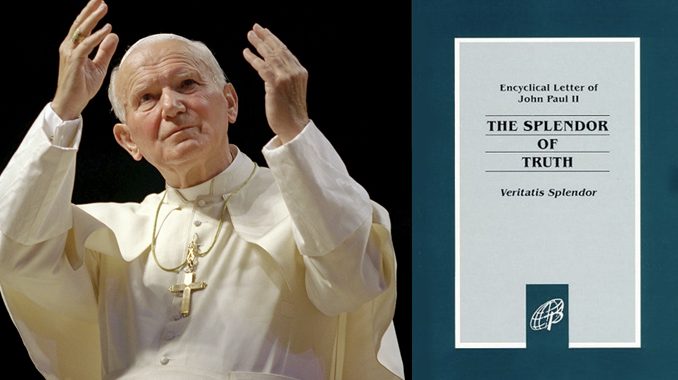
The moral theology method known as “proportionalism” holds that the morality of an act is determined by a sort of calculus involving the nature of the act, the intentions of the actor, and the consequences of the action. Moral judgment, in other words, is a matter of “context,” in which the subjective counts as much or more than the objective. Central to this theory is the notion that there are no “intrinsically evil” acts—things that are always and everywhere wrong, irrespective of the context (intentions and consequences). Rebutting that and reaffirming the settled view of the Catholic Church that some things are morally off the board, period, was one aim of Pope John Paul II’s 1993 encyclical, Veritatis Splendor.
John Paul’s teaching sent the establishment theologians’ guild into a tizzy. The full absurdity of their claim that there are no intrinsically evil acts (or, if there are, we really can’t know them to be such) was only brought home to me, however, during a National Public Radio discussion of the encyclical.
My fellow guest, a woman appalled by the encyclical, insisted—I am not making this up—that Einstein’s theory of relativity applied to morality, and then tried to slam dunk on me by challenging me to name one intrinsically evil act. To which I responded, quietly, “What combination of intentions and consequence would justify your being raped in the parking lot outside this building after our discussion?”
We moved on to other points.
While explaining the importance of understanding that some things are wrong, full stop, John Paul II made two interesting, subsidiary points in Veritatis Splendor.
First, it drains the moral life of its drama, and thereby diminishes our humanity, to deny that intrinsically evil acts, known to be such and willfully committed, are grave sins. Second, in a world where we’re surrounded by human inequality (of intelligence, beauty, ability to throw a 105-m.p.h. fastball, play Hummel’s Third Piano Concerto, or perform “Classical Gas”), the fact that everyone is obliged to avoid intrinsically evil acts is a sturdy foundation for defending the claim, basic to democracy, that we are all created equal. Someday, someone should write a book of democratic theory based on that insight.
For the moment, though, and I finally come to the main point, what will the proportionalist theological guild offer the Artificial Intelligence titans who candidly admit, “I don’t think there is anything objectively more or less ethical,” or who blithely allow that “I don’t believe morality is objective”? Anthropic’s large language model “Claude” now has a “constitution” stating that “our collective moral knowledge is still evolving,” a view that is seemingly compatible with an app built with “Claude” sending a 17-year-old to a “sex-positive clinic” that offers “queer, polyamory, and kink-informed therapy for teens.”
I very much doubt that the AI titans have ever heard of proportionalist moral theology. That’s the good news. The bad news is that these brilliant people live in a culture that, while perhaps grudgingly acknowledging “your truth” and “my truth,” cannot conceive of the reality of the truth: a culture in which proposing that some things are wrong, period, is “insensitive,” “intolerant,” “undemocratic,” “misogynistic,” “transphobic,” “homophobic,” or all of the above.
If religious ethicists and moral theologians, stuck in the quicksand of “contextuality,” cannot identify the moral boundaries that revelation, reason and 5,000 years of human experience have taught us are essential to personal happiness and social solidarity, they’re not going to help the masters of the AI universe develop this extraordinary technology in ways that do not further degrade our culture, society, and politics.
Only those with a firm grip on the reality of immutable moral truths will be able to shape an intelligent AI conversation and offer the needed ethical counsel — and perhaps even invite the techies to conversion.
If you value the news and views Catholic World Report provides, please consider donating to support our efforts. Your contribution will help us continue to make CWR available to all readers worldwide for free, without a subscription. Thank you for your generosity!
Click here for more information on donating to CWR. Click here to sign up for our newsletter.



Leave a Reply