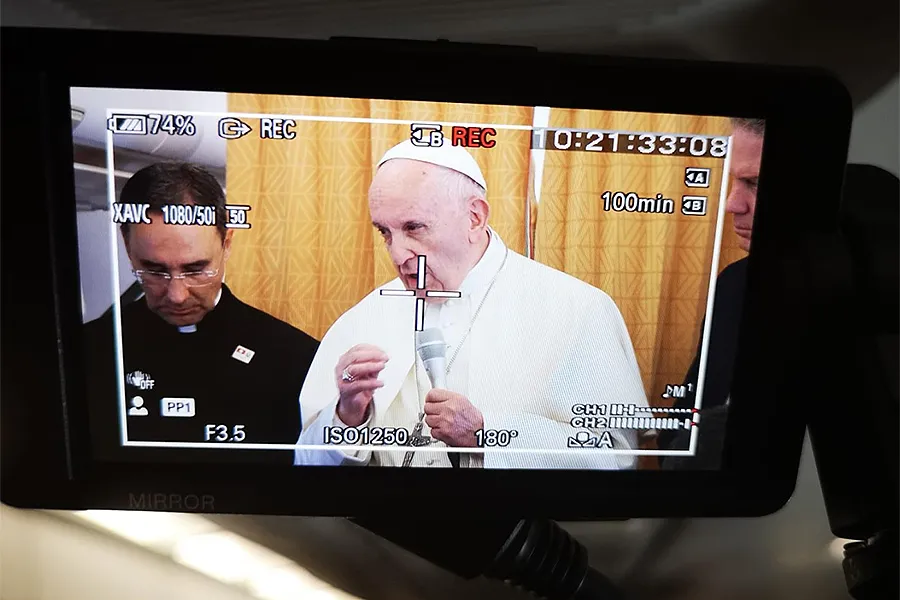
Vatican City, Jun 21, 2018 / 04:29 pm (CNA).- In a June 21 conversation with journalists on the way back from a trip to Geneva, Pope Francis touched on an array of topics, including ecumenism, intercommunion, peace and just war, and refugees.
Please read below for CNA’s full transcript of the Pope’s inflight press conference:
Greg Burke:
Thank you, Your Holiness… we wait a second, here we go… perfect! Thank you in the meantime. To journey, to pray, to work together… we have walked, we have prayed also, at various times, and now we touch on work a little, even to eat after, so that it is seen that to journey together brings fruit.
Today the welcoming- we have seen, after many speeches that it is the mutual respect and it is something more, it is also friendship. However, there is still so much work to do and so many challenges and this interests us normally, the challenges… so, to you journalists… but, if you want to say something first [Holy Father]?
Pope Francis:
Thank you for your work, the day was a little heavy, at least for me… but I am content, I am content [ed. note: or ‘happy’] because the various things that we have done — that is, the prayers to begin, then the speech during lunch it was the most beautiful, then the academic meeting, and then the Mass, they are things that have made me happy… The tiring but beautiful things! Thank you so much! Now I am available to you.
Greg Burke:
Good. We begin with the Swiss. (Arnaud Bedat of L’Illustre magazine)
Bedat:
Holy Father, you have been in Geneva, but also in Switzerland. What are the images and what are the strong, important moments that had an impact on you during this day?
Pope Francis:
Repeat for me.
Bedat:
(repeated)
Pope Francis:
I believe that it is a common word: encounter. It was a day of varied encounters. The right word of the day is ‘encounter,’ and when a person encounters another and feels appreciation for the meeting, this always touches the heart, no? They were positive meetings, good even, beginning with the dialogue with the president at the beginning; it was not a speech of courtesy, as usual… [it was] a deep speech on the profound world debates and [spoken by him] with an intelligence… that I remain astonished, beginning from that.
Then the meetings that you all saw, and that which you did not see is the meeting at lunch, that was very profound [or deep] in the way it touched on many debates, mabe the debate we spent the most time on is “the youth.” Because even all of the churches are concerned, in the good sense, for the youth and the pre-synod that occurred in Rome from March 19 and then attracted enough attention, because there were youth of all [different] beliefs, even agnostics and of all the countries. Think, 315 youth there and 15,000 connected [ed note: via Facebook] that they entered and exited and this perhaps awakened a special interest.
But the word that came to me maybe the whole trip is that it was a voyage of ‘encounter.’ Maybe… I don’t know… an experience of encounter… no rudeness, nothing entirely formal. A human encounter. And this… between Protestants, Catholics and all [people] it says a lot, eh!
Greg Burke:
Thanks, Holiness. Now the German group. Roland Juchem of the German Catholic CIC Agency is here.
Roland Juchem:
Thanks, Holy Father. You speak often of concrete steps toward ecumenism. Today, for example, you again referred to that, saying “Let’s see what is possible to do concretely rather than getting discouraged for what isn’t.”
The German bishops recently have decided to take a step and so we ask ourselves why Archbishop Ladaria wrote a letter that seems like an “emergency brake.” After the meeting May 3, it was affirmed that the German bishops would have had to find a possibly unanimous solution. What will be the next steps? Will an intervention from the Vatican be necessary to clarify or will the German bishops have to find an agreement?
Pope Francis:
Well. This is not a novelty because in the Code of Canon Law, what the German bishops were talking about is foreseen: communion in special cases. And, they were looking at the problem of mixed marriages, no? If it is possible or it isn’t possible. And the Code says that the bishop of the particular Church – this word is important, “particular,” if it is of a diocese – must read that. It’s in his hands. This is in the Code. The German bishops, because they had seen that it wasn’t clear… also some priests did things who weren’t in agreement with the bishop, have wished to study this theme and have made this study that I don’t want to exaggerate, but it was a study of more than a year, and more… it’s more than a year… well done… and the study was restrictive.
What the bishops wanted is to say clearly what is in the Code. And, I read it and said: this is a restrictive document, no? It wasn’t open to everyone. It’s a well thought-out thing, with ecclesial spirit. And they wished to do it for the local Church, not the particular. The thing slid along up until there for the German [bishops’] conference. And there, there is a problem, because the Code does not foresee that. It foresees the bishop of the diocese, but not the conference, because a thing approved by an episcopal conference immediately becomes universal.
And this was the difficulty of the discussion: not so much the content, but this. And they sent the document. Then, there were two or three meetings of dialogue or of clarification and Archbishop Ladaria sent that letter, but with my permission. He didn’t do it alone! I told him: ‘Yes, it’s better to make a step ahead and say that the document isn’t yet mature and that the thing needed to be studied more.’ Then, there was another meeting and at the end they will study the thing.
I think that this will be an orientative document so that each of the diocesan bishops can manage what canon law already permits.
It wasn’t a brake … it is reading the thing so that it goes along the right path. When I made a visit to the Lutheran Church of Rome, a question of the kind was posed, and I replied according to the spirit of the Code of Canon Law. It is the spirit that they are seeking now. Maybe it wasn’t the right information in the right moment, a little bit of confusion, but this is the thing: the particular Church, the Code permits it, the local Church [episcopal conference] cannot because it would be universal.
(journalist inaudible)
But the conference can study and give orientative opinions to help the bishops to manage the particular cases. Thanks.
Greg Burke:
Now from the Spanish group there is Eva Fernandez of COPE agency and Spanish radio
Pope Francis:
They are good, these [journalists] of COPE
Eva Fernandez:
Thank you, Holy Father! We have seen that even the secretary general of the Ecumenical Council of Churches spoke of help to refugees. Just recently we have seen the incident of the Aquarius ship, also the separation of families in the United States. Do you think that some leaders instrumentalize/use the tragedy of refugees. Do they use them…?
Pope Francis:
I have spoken a lot on refugees, the criteria are those that I have said: to welcome, to accompany, to place, to integrate. This is the criteria for all refugees. Then I have said that every country should do this with the virtue of the rule of prudence, because a country should welcome as many refugees as it can and as many as it can integrate, educate, assimilate, give work to. This I would say is the straightforward/easy, serene plan for refugees. Here we are living [with] a wave of refugees that flee from wars and from hunger. The war and hunger of many countries in Africa, wars and persecution in the Middle East. Italy and Greece were very generous in welcoming [refugees], and for the Middle East, Turkey [was also], in respect to Syria, it has received many… Lebanon many… Lebanon has as many Syrians as Lebanese… and then Jordan… other countries, also Spain has received [them? some?].
There is a problem of trafficking migrants, and also there is the problem when in some cases they return, because they should return if this — I do not know/understand well the terms in agreement — if they are in the Libyan water, they should return… and there, I have seen the photographs of the detention centers controlled by the traffickers. Traffickers immediately separate the women from the men… women and babies go… God knows where! This is what the traffickers do! There is even a case that I know of where the traffickers were close to a ship that had accepted barges and… [they were saying] “give us the women and the babies and take the males.”
These traffickers and the detention centers of the traffickers eh, that have returned, they are terrible… terrible! In the detention camps of the Second World War they saw these things! And also the mutilizations in the torture of [forced?] labor and then they threw them to be in the comunes of the men. For this the leaders are concerned that they [the people] do not return and fall into the hands of these people [the traffickers]. It is a world-wide concern! I know that the leaders speak on this and they want to find an agreement, even to modify the Dublin agreement and all of this.
In Spain you have had the case of this ship that is docked in Valencia, but all of this is a mess… the problem of the wars is difficult to resolve. The problem of the persecution also of Christians in the Middle East, also in Nigeria… but the problem of hunger they can resolve, and many European leaders are thinking of an emergency plan to invest in these countries, to invest intelligently, to give work and education in these two things in the countries from which those people come… because — [I’ll say] one thing, not to offend, but it is the truth — in the collective subconscious, is a bad motto: Africa is exploited. And Africa is to be preyed on… this is in the subconscious… ‘eh, they are Africans.’ Always ‘land of slaves.’
And this should change with this plan of investment, and to increase education, because the African people have many cultural riches, many, and they have a great intelligence. The children are very intelligent and they, with a good education, can go beyond… this will be the road halfway to the goal, but in the moment leaders should make an agreement between themselves to go forward with these emergency fixes… this here in Europe! We go in America: in America there is a great migration problem.
(journalist inaudible)
In Latin America too there is an internal migration problem… in my homeland there is a migration problem from North to South and even these people leave the countryside because there is no work and the go to the big cities and where there are these megacities [or huge cities], the slums and all these things, but it is also an external migration to other countries that have work… and speaking concretely of the United States, I back that which the bishops of the country say. I side with them. Thank you.
Greg Burke:
Thanks, Holiness. Now is the English group: Deborah Castellano Lubov of the Zenit Agency.
Deborah Castellano Lubov (Zenit):
Thanks, Holiness! Holiness, in your address today to the ecumenical encounter you made reference to the enormous strength of the Gospel. We know some of the Churches, now the World Council of Churches, the so-called “pacifist Churches” who believe that a Christian cannot use violence. We remember that two years ago in the Vatican there was as conference organized. Do you think that it would be the case for the Catholic Church to unite to these so-called “Churches of peace” and set aside the doctrine of just war? Thanks.
Pope Francis:
A clarification, why do you say that there are “pacifist Churches?”
Deborah Castellano Lubov:
They are considered as pacifist because they have this way of reasoning that if a person (intuits) a violence, at that point they can no longer be considered Christians.
Pope Francis:
Thanks. I understand. Because you put your finger right in the wound, eh? I think that… today at lunch a pastor said that maybe the first human right is the right to hope and I liked that. And this has to do a bit with this and we spoke about the crisis of human rights today. I think that I have to begin from this to arrive to your question. The crisis of human rights is clearly seen. They speak a bit about human rights but so many groups or some countries take a distance, and “yes, human rights,” but there isn’t the strength, the enthusiasm, the conviction. I don’t say 70 years ago but 20 years ago. And this is grave because we have to see the causes, but what are the causes for which we have arrived to this that today human rights are relative. Also the right to peace is relative. It is a crisis of human rights. This I think that we must think it through to the end, or with certainty.
Then, Churches of peace. I think that all the Churches that have this spirit of peace must reunite and work together as we said in the speeches today, myself and the other people that spoke. And at lunch, unity for peace was spoken of. Peace is an exigency because there is risk of a war that we … some have said this: this third world war, if it is done, we know with which arms it will be done… but if there were a fourth, it would be done with sticks because humanity will be destroyed. The commitment for peace is serious, but when you think of the money that is spent on weapons… for this, the religions of peace… is the mandate of God. Peace, fraternity, human unity. All of the conflicts, don’t resolve them like Cain, resolve them with negotiations, with dialogue, with mediations… for example, we’re in a crisis of mediations. The mediation as a juridical figure (very rich) today is in pure crisis. Hope is in crisis, crisis of human rights, crisis of mediations, crisis of peace.
But then if you say that there are religions of peace, I ask myself, where are the religions of war? It’s tough to understand this. It’s tough. But, some groups, I would say in almost all of the small religious groups, I will say a bit simply fundamentalists, seek wars… Also we Catholics have some. They always seek destruction, no? And this is very important to have our eyes on it. I don’t know if I replied. Thanks.
They say that the population is asking for lunch, eh, dinner, that there is just enough time to arrive with a full stomach. It’s just to tell you… a word that I want to say clearly that today was an ecumenical day, really ecumenical! And at lunch we said a beautiful word, a beautiful thing, that I leave with you so that you think on it and reflect, you make a nice consideration of this. In the ecumenical movement we have to take from the dictionary a word: “proselytism.” Clear? You cannot have ecumenism with proselytism. You have to choose. Either you have an ecumenical spirit or you are a proselytizer.
Thanks! I would continue speaking because I like it… but now let’s make the Substitute [of the Secretariat of State] come because it is the last trip he’ll make with us, because now he’s going to change color, but not for embarrassment! We want to say goodbye to him. It’s a Sardinian cake to celebrate!
Cardinal-elect Angelo Becciu (Sardinian-born Substitute of the Holy See Secretariat of State):
Thanks! It is a double surprise of calling me and thanking me in front of you! And then there’s a Sardinian cake. Well, then, we’ll try it with pleasure! I truly thank the Holy Father for this occasion, but for everything, because he has allowed me this magnificent experience of traveling so much with him. At the beginning, he scared me saying, ‘No, I’ve made few trips.’ Do you remember? And then after one, he added another and then another and we said to ourselves, ‘good thing he said there would be few and they’ve been many.’ A magnificent experience of seeing the Holy Father spread the Word of God courageously. My service has been only this: to help him in this. Alright? Thanks to all of you and to those who have helped us! Thanks.
Pope Francis:
Buon appetito, have a good dinner and thanks so much! And pray for me, please. Thanks.
 […]
[…]




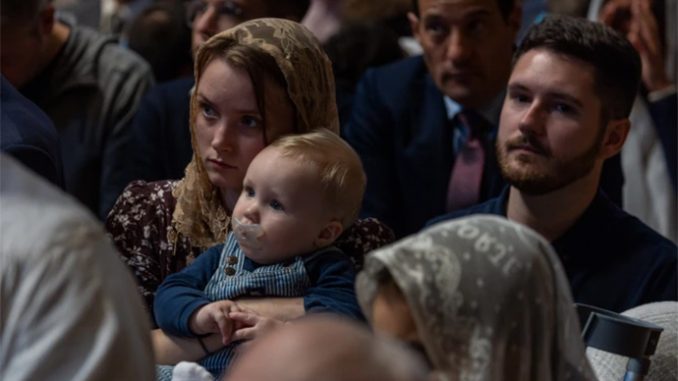



Summorum Pontificum was abrogated in 2021. This is just clinging to a past that is beyond its expiration date.
I see the Monopoly Man in the last picture took off his hat in church.
The TLM has lost. Trads just don’t realize it yet.
“Has lost”? I didn’t know it was a contest. Thanks a lot for letting me know that it is, from one perspective anyway.
It’s not a contest or competition. We’re a universal Church with room for many Rites and liturgies.
Unity, not uniformity.
Yeah but that was the Rupnik-Pontificate, so it’s to be ignored.
Scott Walker: you come across as an angry & bitter man. Try Christ.
Classic. Argumentum ad hominem followed with the obligatory ipse dixit.
Scott Walker. You have the perspicacity to have spotted the Monopoly Man in this very rare photo. Perhaps a premonition that the gods of good fortune are betting on the restoration of the TLM [why else would the Monopoly Man, an obvious traditionalist, have attended this Mass?].
Yours exhibits perfectly the problem at hand.
Scott;
Re: your 10/25 @9:51 p.m. – Do yourself a favor and go to a TLM. Get there about 30-45 minutes early, sit quietly (notice that the others are doing so) perhaps say a Rosary. Read from your Missal or just sit there and enjoy the silence until the Mass begins.
If you have to get up before dawn and then drive 50 or more miles to get there – tant mieux.
When in God’s universe and God’s eternity and human worship of God and His revelations of immutability has truth ever changed or been timebound?
Agree 100%! Cardinal Burke’s grand Vetus Ordo Mass at St. Peter’s, the usual parade of lace, Latin, and liturgical nostalgia, polished up as if it’s some kind of triumph. You’d think the 1962 Missal had just staged a stunning comeback on the Vatican charts. In reality? It’s more like an old vinyl spinning for a very small crowd who still swear it sounds better than Spotify.
Once again, the Tridentine enthusiasts are treating this as proof that “tradition lives on,” when in fact, it’s mostly wheezing on life support. Even before Traditionis Custodes turned down the volume, there were barely 1,700 parishes worldwide offering the old Mass out of roughly 225,000. That’s not a “movement”; that’s a niche hobby. In the U.S., it was about 700 out of 18,000 — a sliver that wouldn’t fill a pew in St. Peter’s.
Meanwhile, the rest of the Church, the overwhelming majority, has moved on, celebrating Vatican II’s liturgical reforms with the Novus Ordo in living, breathing communities. But sure, let’s pretend this tiny, dwindling enclave of dissenters represents the future. Nothing says “vibrant renewal” quite like shrinking attendance and defiant muttering about 1962.
“the usual parade of lace, Latin, and liturgical nostalgia, polished up as if it’s some kind of triumph.” Oh, the horror! Latin!?
Do the Divine Liturgy of Saint John Chrysostom next. Don’t hold back. Your charity and insight is sooooo needed.
“It’s more like an old vinyl spinning for a very small crowd who still swear it sounds better than Spotify.”
I’ve used Spotify for years and own 4,000 LPs. Both have advantages and drawbacks. But, in your world, we just toss out the vinyl and mock it.’
I have a hard time believing you are an actual deacon.
Carl, I doubt that he is a deacon. He uses the title to give credibility to what he writes without which there is none. If he were a deacon in actuality, he wouldn’t hesitate to use his full (and actual) name. He’s best ignored.
Deacon Dom, why such uncharity?
Why is liturgical diversity celebrated only selectively?
Catholics worshipping together at a licit Mass is a good thing whether it’s the TLM in the photos or a mariachi Mass in honor of Our Lady of Guadalupe.
For goodness sakes. Our Church is catholic and universal. There’s plenty of room for everyone.
I looked at all 2 minutes and 3 seconds of this video, and I found no dwindling:
March 1st 2023 – The Altar is Installed – Building The Immaculata
https://www.youtube.com/watch?v=oMYtADn_xh8
Death has, of course, “abrogated” the abrogator. But not the TLM. This from one who is not a particular advocate of it. I simply respect those who are.
Snarky attitudes, btw, are invariably more harmful to the articulators of them than they are to their targets. That they (the articulators) don’t know this is part of their problem.
Our patrimony.
Let the Extraordinary Form of the Mass BREATHE freely alongside so many other Rites in the Church each of which have their own form. Lets stop the warring among Catholics. If we don’t, we’re no better than Hamas v. Jews and Ukrainians v. Russians. But if we do, we’re more like Christ.
Right on, Deacon!
Deacon and Br Jaques: agreed. Liturgical peace is the only way forward. But who is making war? It’s been a one-sided liturgical-genocide since 16.07.2021.
“The pilgrimage began on the evening of Oct. 24 with vespers in Rome’s Basilica of San Lorenzo in Lucina, presided over by Cardinal Matteo Zuppi, archbishop of Bologna. A solemn closing Mass of Christ the King will be celebrated at the Church of Santissima Trinità dei Pellegrini on the final day of the pilgrimage, Oct. 26.”
Summorum Pontificum pilgrimage began with vespers in Rome’s Basilica of San Lorenzo in Lucina, presided over by Cardinal Matteo Zuppi, who has defected from The Catholic Faith through his public manifest heresy that denies Sacred Tradition, Sacred Scripture. And The Teaching Of The True Magisterium of The Catholic Church, Grounded In Sacred Tradition And Sacred Tradition, The Deposit Of Faith Christ Has Entrusted To His Church For The Salvation Of Souls, by his desire to Bless and have Christ’s One, Holy, Catholic, And Apostolic Church begin to Bless, disordered sexual relationships that deny Christ’s teaching regarding lust and the sin of adultery? Who would approve such a denial of The Deposit Of Faith , Christ Has Entrusted To His One, Holy, Catholic, And Apostolic Church, for The Salvation Of Souls and claim such an act is an act of compassion?
The question is, how can both Cardinal Zuppi and Cardinal Burke both be Baptized Catholics who desire to keep their Baptismal Promise to remain in communion with Christ and His One, Holy, Catholic, And Apostolic Church, and thus be United in Prayer With The One Word Of God, Jesus The Christ?
“They went out from us, but they were not of us. For if they had been of us, they would no doubt have remained with us; but that they may be manifest, that they are not all of us.”
https://www.ncregister.com/blog/cardinal-zuppi-same-sex-blessing
Grace a Dieu
Blessed are the Peacemakers.
Amen, Knowall.
And those who save souls.
Apparently the purpose of depriving Catholic faithful of the TLM is for the Church Establishment to show that they own and control everything in their “Bugnini-ized-NGO-of-the-decapitated-Body.”
As JP2 and B16 observed, they are incapable of “generosity.”
And Insane.
See, when you write things like that, it confirms that trads are recalcitrant and will never agree to be integrated into the post-Vatican II Church. Peter Kwasniewski published a screed on Friday saying that trads will never compromise nor assimilate nor yield. Pope Francis was correct that TLM adherents and communities inculcate insular separation from the rest of the Church.
Donald:
As I believe you are replying to me, I do not have the opportunity (any longer) to attend The Mass I served and sang at as a boy, so I am like millions more aptly labeled a “Bugnini-Mass-hostage.”
I simply observe that the Church Establishment is utterly incapable of being “generous” (as JP2/ B16 specifically directed) to faithful who desire the TLM, and as their just reward they deserve to wear the badge of their malice, as a sign of how miserly they are.
I suppose their miserliness flows from the apostasy that their “thought leaders” profess, and that do many of them silently assent to.
Poor darlings that they are..,
That’s just silly, Donald. I love the TLM but it’s not a deal breaker for me. I know many other Catholics who feel likewise.
Choices are good and so is diversity in a catholic and universal Church. It’s not all one or the other.
Donald: you sound angry. Why call fellow Catholics “trads”? It’s offensive. Does anyone have a gun pressed to your temple forcing you to attend Mass in the Extraordinary Form?
Why should Catholics be forced to make compromises with beliefs that are not catholic or damage the faith?
The church is dying because of all a the compromises that have been.
If the faith that is being taught and practiced today is the same as before the council, then why such hatred and anger towards the pre vatican II liturgy and practices?
The evidence is that there is a small cadre of prelates led by the late Pope for whom the suppression of this liturgy is an imperious exercise of ecclesial power. Now that we know the putative reasons for TC were contrived, it should be annulled.
Francis famous enjoined others to make a mess. Nobody can accuse him of not leading by example.
How many of vernaculars can the Mass be said? No restrictions that I am aware, but the Latin Mass is supposedly divisive. Nearly Verboten. It’s not about God or faith. It’s ungodly power politics baby.
I am not “a trad” but I would refuse to participate in that grand TLM in the Vatican because I do not wish to land myself to manipulation. It would be unthinkable for me to participate in such Mass while the same TLM is being suppressed/restricted to the point of suffocation elsewhere.
Most “trads” seem not to realize that they are being used by the Vatican as a tool for proving credibility to its current course. I have seen “trads” lashing those Catholics who criticize the Pope for his inconsistencies and watering down the faith or turning it into something else. Those “trads” appear not to realize that an occasional TLM given to them is only to buy their allegiance or at least to be quiet.
This is a brilliant technique, actually, “see, even the most traditional Catholics approve me so I am not deviating from the faith”.
However, there is an obvious flavour of insincerity and absurdity in a situation when TLM is pompously celebrated in the Vatican yet it is being suffocated elsewhere – in the common parishes, among common people who need it. If TLM is to be suppressed, it must be suppressed everywhere – but PL needs TLM, not as a people’s Mass but as a part of his entourage, as an artefact in a museum.
I don’t see any manipulation going on. I don’t know that we should even be looking for that. Why not be grateful for this opportunity & move forward?
Anna:
That is a very shrewd observation.
It’s all part of the cult and practice of deceitfulnees.
Anna, Is anyone threatening to put a gun to your head and march you from your home to a church where the Extraordinary Form of the Mass is going to be said? Do you ‘vent your spleen’ when someone mentions Mass in the Anglican Ordinariate Form? Or the Melikte? Or the Ruthenian? Or the Maronite? Etc, etc, etc, etc, etc…?
This Sunday November 2 will be the beginning of Eastern Daylight time, meaning that if I want to go to the Latin Mass in Lewiston, 55 miles away I can, since I won’t have to drive in the dark.
So I’ll be on my feet at 5:30 and around 6 Rachel and I will be on the road and we’ll proceed westerly to Lewiston to the magnificent Sts. Peter & Paul Basilica, built around 1900 or so by the Franco-American Catholics there (the Stations of the Cross are in French). Does all this make me a “trad”? I haven’t the slightest idea.
It’s been a long time since I’ve been there – I can’t wait!!
As a simple matter of ecclesiological liturgical coherence, the TLM should be completely eliminated. Yes, even the Ecclesia Dei religious communities should be told that they may no longer accept new candidates for ordination unless they agree to switch from celebrating the old Mass to the new Mass.
The TLM is no longer an adequate liturgical expression of Catholic faith after Vatican 2. That’s the crux of the matter. It would be liturgically incoherent to maintain both liturgical expressions simultaneously, and to continue with the unrevised Mass.
“The TLM is no longer an adequate liturgical expression of Catholic faith after Vatican 2.”
And The Divine Liturgy of Saint John Chrysostom? Should it go as well? After all, the priest has his back to the people much of the time, some parts aren’t in English, the icon screen keeps the people from seeing all that is happening up front, and the reverence is overwhelming. Surely that’s not adequate for 2025, right?
Carl, I have to think that most of these who rail against the EF are simply poorly catechized Catholics. I would also venture a guess that they are not well-travelled either. How could they possibly tolerate attending Mass in Germany, Sweden, Italy, Austria, Czech, France, Spain, Portugal, Russia, Ukraine, Poland, etc since none of them are likely to celebrate Mass in English and they “won’t understand a word of it?”