


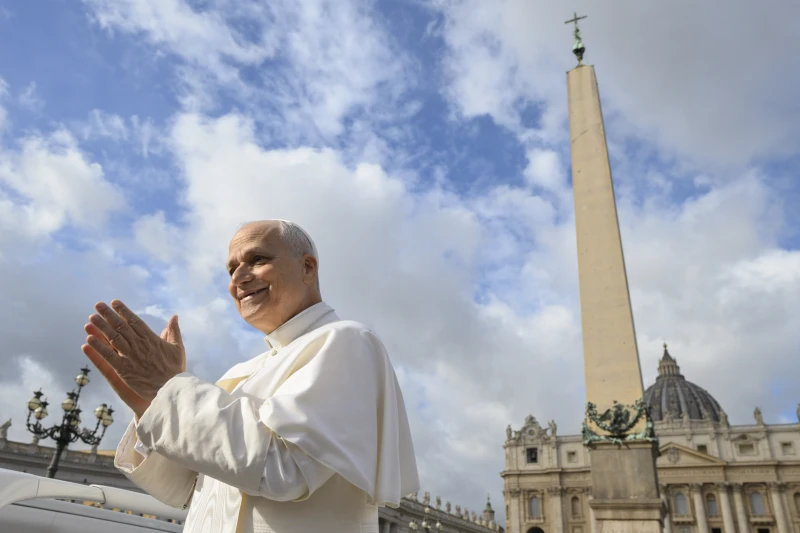
Vatican City, Oct 25, 2025 / 13:00 pm (CNA).
Pope Leo XIV on Saturday said the key to living in a difficult time, when the Church’s teachings are often challenged, is to embrace the hope that is “not knowing.”
“As pilgrims of hope, we must view our troubled times in the light of the resurrection,” the pope said in an audience with jubilee pilgrims in St. Peter’s Square Oct. 25.
Leo brought attention to Nicholas of Cusa — a Catholic cardinal and theologian from Germany, who lived in the 15th century — as a model for how to live one’s faith “during a turbulent era that involved serious spiritual divisions.”
The pope described Nicholas of Cusa as “a great thinker and servant of unity” who “can teach us that hoping is also ‘not knowing.’”
“As St. Paul writes, ‘How can one hope for what one already sees?’” Leo said. “Nicholas of Cusa could not see the unity of the Church, shaken by opposing currents and divided between East and West. He could not see peace in the world and among religions, at a time when Christianity felt threatened from outside.”
But instead of living in fear like many of his contemporaries, Nicholas chose to associate with those who had hope, the pontiff explained.
Nicholas, Leo said, “understood that there are opposites to be held together, that God is a mystery in which what is in tension finds unity. Nicholas knew that he did not know, and so he understood reality better and better. What a great gift for the Church! What a call to renewal of the heart! Here are his teachings: make space, hold opposites together, hope for what is not yet seen.”
Pope Leo said the Church is experiencing the same thing today: questions challenging the Church’s teaching, from young people, from the poor, from women, from those without a voice or who are different from the majority.
“We are in a blessed time: so many questions!” he said. “The Church becomes an expert in humanity if it walks with humanity and has the echo of its questions in its heart.”
“To hope is not to know,” Leo underlined. “We do not already have the answers to all the questions. But we have Jesus. We follow Jesus. And so we hope for what we do not yet see.”
If you value the news and views Catholic World Report provides, please consider donating to support our efforts. Your contribution will help us continue to make CWR available to all readers worldwide for free, without a subscription. Thank you for your generosity!
Click here for more information on donating to CWR. Click here to sign up for our newsletter.


“We are in a blessed time: so many questions! To hope is not to know…”
I think Pope Leo is explaining for us the papacy of his predecessor.
Bergoglio was all about making Catholics unsure about everything.
Hope opens innumerable paths for the faithful to move on. It prevents congestion on the oft-beaten path. Long live faith, hope, and love.
Hope is for an end to the Modernist Apostasy and a return to Catholicism.
I have to agree with Brineyman above (7:43 p.m.).
Is there an end-date on this Francis-talk?
To prepare us for this “troubled era,” St. John Paul II earlier gave us Centesimus Annus (1991). Yes, there is a point to be made about what appear to be opposites–“contradistinctions” rather than real “contradictions”–but as for the latter, the non-demonstrable first principle of non-contradiction applies precisely because of the LOGOS made flesh.
So, while the mission of the Church remains ever to proclaim Jesus Christ “in season and out if season,” it is not its mission to pronounce answers to every more worldly question imaginable.
GAUDIUM ET SPES says it this way:
“The Church guards the heritage of God’s Word and draws from it religious and moral principles, without always having at hand the solution to particular problems (n. 33). And, for example, “Contemplating this melancholy state of humanity, the Council wishes to recall first of all the permanent binding force of universal natural law and its all-embracing principles [….]” (n. 79).
ST. JOHN PAUL II adds:
“Nor does the Church close its eyes to the danger of fanaticism or fundamentalism among those who, in the name of an ideology which purports to be scientific or religious, claim the right to impose on others their own concept of what is true and good. Christian truth is not of this kind. Since it is not an ideology, the Christian faith does not presume to imprison changing socio-political realities in a rigid schema, and it recognizes that human life is realized in history in conditions that are diverse and imperfect. Furthermore, in constantly reaffirming the transcendent dignity of the person [!], the Church’s method is always that of respect for freedom.” [It is the Church’s duty to teach] “those principles of the moral order[!] which have their origin in human nature itself [!]” (Centesimus Annus, nn. 14, 46).
THEREFORE, I propose that in his breezy remarks, Pope Leo can still be interpreted in this way, rather than as a Francis II or, worse, a disciple of Cardinal Hollerich, and remain hopeful that as time goes on, my proposition will pan out.
As for the novelties of the synodal expert CARDINAL HOLLERICH, in addition to his signaling to mainstream the homosexual subculture, here, about real contradictions, we also have this…In an interview with The Pillar, Cardinal Hollerich remarks:
“In Japan, I got to know a different way of thinking. The Japanese don’t think in terms of the European logic of opposites. We say: It is black, therefore it is not white. The Japanese say: It is white, but maybe it is also black. You can combine opposites in Japan without changing your point of view.” https://www.pillarcatholic.com/p/who-is-cardinal-hollerich .