


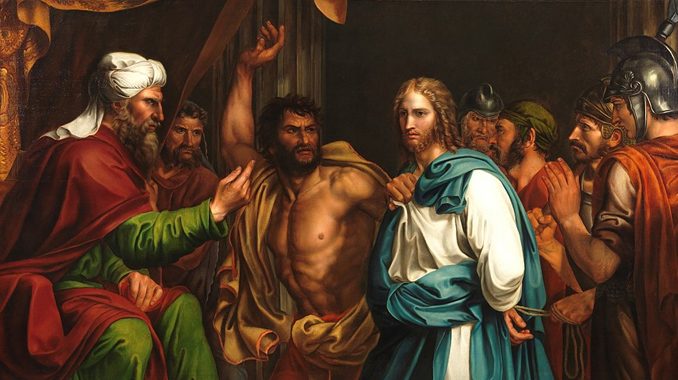
33 A.D.: Management Letter
From: The Offices of Solomon, Goliath and Cassius, LLC, International Management Consultants. We’re customer-focused, proactive, and results-oriented. Failure is not an option.
To: His Excellency and High Priest, Caiaphas, and the Distinguished Members of the Sanhedrin
Subject: Management Practices of the Teacher
Introduction
In accordance with the engagement letter with Caiaphas, high priest representing the Sanhedrin in Jerusalem, we have reviewed the management practices of the Christ, henceforth referred to as “the Teacher.” Several members of the Sanhedrin observed that the Teacher has attracted a significant following and suggested a review of his management practices. All observations and recommendations adhere to best practices.
Observation 1: Chief of Staff Selection
The Teacher recruited twelve followers, styled as “Apostles.” Chief among them is Simon Peter, a self-described “sinful man,” whom the Teacher nevertheless appointed as chief of staff. What he lacks in discipline and consistency, he makes up for with bravado. He is the Teacher’s weakest link. Our Risk Management team expresses deep concern. Let’s address the elephant in the room.
Recommendation:
We recommend that the Sanhedrin instruct the Teacher to replace Simon with a more educated and disciplined disciple as chief of staff. Candidates should be responsive to Sanhedrin oversight. Another rough and ill-educated Galilean is out of the question. Consider a sophisticated Judean, the only Judean on his staff: Judas. Judas enforces best practices. When a woman recklessly anointed the feet of the Teacher with costly nard, Judas made his objections known. It’s basic blocking and tackling.
Observation 2: Healing on the Sabbath
We noted that on several occasions, the Teacher healed those with infirmities on the Sabbath in violation of the clear regulations of the Sanhedrin. We need to manage the optics of this.
Recommendation:
Best practices require compliance reports and miracle permits for all healings. No miracles should be performed on the Sabbath without prior authorization. Identify a competent business manager to oversee compliance.
Observation 3: Temple Reconstruction Plan
The Teacher publicly declared, “Destroy this temple, and in three days I will raise it up.” Let’s peel back the onion on this. Our consultants interpret this as a capital construction commitment.
Recommendation:
The Sanhedrin, in cooperation with the Romans, should require the Teacher to submit architectural drawings, construction schedules, and a capital expenditure budget. The proposed three-day completion schedule raises serious questions about feasibility. Consultation with Judas, the Teacher’s treasurer, is essential.
Observation 4: Diversity and Organizational Composition
The Twelve are all men, and women are not represented among the Apostles. Inclusion is foundational to diversity and equity. Hope is not a strategy. So, let’s put lipstick on this pig.
Recommendation:
The Sanhedrin should encourage the Teacher to expand the Apostles’ membership to include qualified members of the Sanhedrin and their spouses. This would promote diversity of thought while ensuring appropriate institutional oversight.
Observation 5: Titles and Claims
The Teacher has claimed titles that call into question his mental state. Reports indicate he told a Samaritan woman he is the Messiah and has been overheard claiming to be “the Son of Man.” Our sources report he said that he is “the way, the truth, and the life.” Nobody has a monopoly on truth. Even some family members have suggested, “He is out of his mind.”
Recommendation:
In coordination with the Roman authorities, the Sanhedrin should carefully question the Teacher, demand clear answers, and require a complete psychological evaluation. Ask him, “What is truth?”
Observation 6: The Caiaphas Principle
High Priest Caiaphas has demonstrated political acumen beyond the requirements of his clerical office. His remark that one man should die rather than the entire nation shows exceptional intellectual insight and practicality. Caiaphas has enunciated a universal principle for dealing with family disputes, social unrest, and international conflicts. The Caiaphas Principle promises to be an indispensable tool for rooting out resistance when an enemy is embedded within a larger population. The Teacher is dangerously naïve. He maintains, “Love your enemies and pray for those who persecute you.” Such sentiments are incompatible with our performance indicators.
Recommendation:
The Sanhedrin should direct the Teacher to integrate the brilliant Caiaphas Principle—good ends justify every available means—in conflict management. Be careful when invoking “an eye for an eye, and a tooth for a tooth.” Sometimes a tooth is worth a thousand teeth. Winning isn’t everything. It’s the only thing.
Observation 7: Succession Planning
The Teacher currently has no viable succession plan. No individual—even a miracle worker—can sustain an organizational vision indefinitely. This is a clear violation of organizational fiduciary responsibility. We cannot expect the Teacher to live forever. We don’t have enough boots on the ground. But Judas demonstrates singular competence and sophistication as an accomplished financial manager.
Recommendation:
The Sanhedrin should encourage the Teacher to appoint Judas as chief executive officer and business manager. This would enhance the continuity and sustainability of the organization. We need to monetize/strategize/analyze/incentivize.
Caveat
Fundraising is essential to any organizational endeavor. Reports indicate that the Teacher admires poor widows who contribute their last coins to the treasury. The consultants question this allocation of management attention to low-value donors. Don’t leave money on the table.
Observation 8: Final Risk Mitigation
We have observed the Roman practice of crucifying those who threaten their occupation. The prescient Caiaphas Principle may eliminate the threat to Roman rule while simultaneously resolving the Teacher’s unacceptable violations of Sanhedrin policies, procedures, and protocols. We need creative destruction.
Recommendation:
The Sanhedrin should not rule out crucifixion for risk mitigation purposes.
Humbly Submitted for Your Consideration:
We of the Offices of Solomon, Goliath, and Cassius submit these observations and recommendations for management consideration. Best practices and eternal vigilance are the price of compliance. Past experience is no guarantee of future success.
Buy low, sell high.
“Failure is not an option.”
If you value the news and views Catholic World Report provides, please consider donating to support our efforts. Your contribution will help us continue to make CWR available to all readers worldwide for free, without a subscription. Thank you for your generosity!
Click here for more information on donating to CWR. Click here to sign up for our newsletter.

Leave a Reply