


CNA Staff, Oct 21, 2025 / 15:56 pm (CNA).
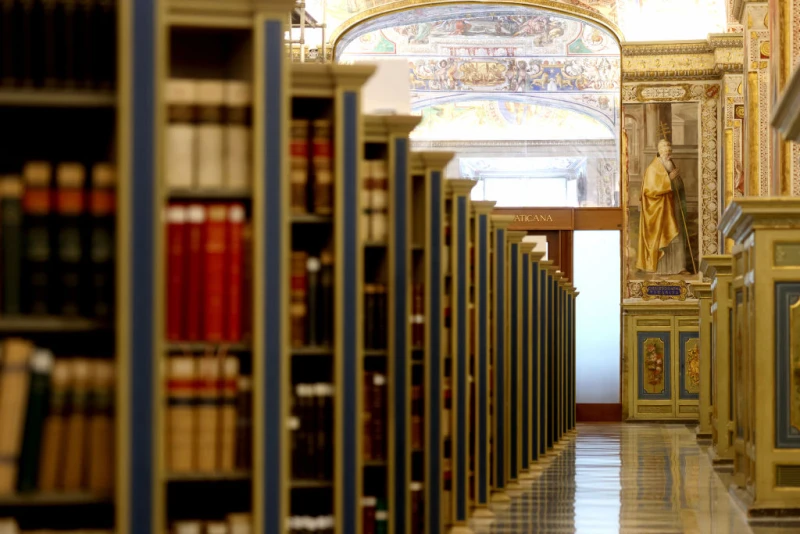
Reports circulating in media outlets and on social media in October 2025 allege that the Vatican has opened a prayer room for Muslims in the Apostolic Library.
Claim: The Vatican Library has opened a prayer room for Muslims.
CNA finds: The library does allow Muslim scholars a room in which to pray while they are on site doing research in the Vatican’s extensive archives.
Breakdown: In mid-October 2025, sensational news coverage rocketed around internet media outlets and social media feeds: The Vatican is “allow[ing]” a “designated Muslim prayer room” in its Apostolic Library (National Review); the library has “add[ed] a Muslim prayer room” (The Dallas Express); the Vatican has “[set] up [a] dedicated Muslim prayer room at [the] heart of [the] pope’s 500-year-old library” (GB News); the Holy See has “open[ed]” a “Muslim prayer room in [the] Apostolic Library” (EuroWeekly News).
The headlines are not technically inaccurate. But they appear to suggest a sort of proactivity on the Vatican’s part, as if the Holy See opened up a Muslim prayer room in order to cater to Rome’s Islamic population. And readers could be forgiven for thinking the endeavor is more significant than it appears to be.
Indeed, the reports generated passionate criticism online; one deacon, for instance, claimed the prayer room constitutes “a total betrayal of Our Lord Jesus Christ,” while the news outlet Zenit noted the policy had sparked a “quiet storm” in response.
The truth appears to be somewhat more mundane. The prayer room’s existence became widely known after the Oct. 8 publication of an interview between the Italian newspaper La Repubblica and the priest Father Don Giacomo Cardinali, the vice prefect of the Vatican Apostolic Library.
In the wide-ranging interview, Cardinali described the library as a “universal institution” and “the most secular of the entire Holy See.”
“Our interlocutors are research centers, public universities, the Louvre, the Metropolitan, NASA,” the priest told the newspaper. “They don’t really know what a priest is, much less how to distinguish him from a bishop or a cardinal.”
Asked if “scholars of other religions” ever come to the library, the priest responded: “Of course.”
“Some Muslim scholars asked us for a room with a carpet to pray, [so] we gave it to them: We have incredible ancient Korans,” the priest said.
“We are a universal library,” he added. “There are Arabic, Jewish, Ethiopian collections, unique Chinese pieces. Years ago we discovered that we have the oldest medieval Japanese archive that exists outside the Rising Sun.”
The verdict: The Vatican Apostolic Library does indeed allow Muslims a room for prayer. But, importantly, it does not appear to be a generally accessible Islamic prayer space but rather one designated for the “Muslim scholars” that may be on site at the time. Further, it was only opened at the request of scholars themselves.
And though it is understandable that a Muslim prayer room in the Holy See may inspire a bit of cognitive dissonance, the vice prefect of the Vatican Apostolic Library describes the space as nothing more than “a room with a carpet.”
Amid the sensational news coverage, Britain’s Daily Mail may have said it best when it reported, simply: “The Vatican has granted Muslim scholars’ request for a prayer room.”
We rate this claim true, with important context.
If you value the news and views Catholic World Report provides, please consider donating to support our efforts. Your contribution will help us continue to make CWR available to all readers worldwide for free, without a subscription. Thank you for your generosity!
Click here for more information on donating to CWR. Click here to sign up for our newsletter.


When it come to fasting and prayer, Muslims are second to none. They pray for themselves and pray for those of us in need of prayers. Long live their love for prayer.
Oh good for you. How do you know what they pray for, or to who?
Well they pray to the God of Abraham & they’ve prayed for my grandchild who was ill. His mother & I appreciated that very much.
Apart from the God of Abraham, we may part ways on a number of issues but that much we hold in common as children of Abraham
This is sugar coating something that never should have been allowed to happen. What next? A room for Satanists to pray? No. Just no. Ford doesn’t open a room at their headquarters library for GM to gather.
What about thou shall not have false God’s before me?
Would they allow a Christian prayer room at Masjid al-Haram or Al Aqsa?
Possibly yes…in the sense that in both cases—the Vatican Library (and the entire Vatican?) and the Christian prayer room—Christianity is subordinated and annexed to the central Islamic worldview… the madrassa! Jihad by another name…
Huh?
They “ rate this claim true, with important context”?
What context?
That the Muslim prayer room is actually a room where Muslims pray?
That the Muslim prayer room in the Vatican is actually in the Vatican Library?
I don’t see how the “important context” matters much.
The Vatican established a prayer room for Muslims. Period.
Now, I think a meaningful bit of context might be that Muslim fundamentalists are martyring Christians all around the world, including some ten thousand in this year alone in Nigeria.
The prayer room war. Will the Vatican pose no objection to a mosque and minaret calling Muslims to prayer day and night adjacent to Vatican City?
Cardinal Gerhard Muller alleged that the prayer room request was an encroachment, a statement that infers Islam is the superior faith. As a matter of arguable evidence we increasingly find mosques and minarets all over Europe, whereas we don’t find Muslim nations grading Christians ‘prayer spaces’ like churches. And if they do they’re subject to atrocities.
As an opinion it seems CNA’s Daniel Payne’s view is acceptable, that the request was made by Muslim scholars studying at the Apostolic library, and it should be reserved solely for them. A refusal aside from the politics would seem petty. It can also be viewed as an indication of Catholic magnanimity.
Islam has a 13 plus century history from which we can make a reasonably accurate assessment of its intent and nature.
It has always been imperial, martial and supercedent.
Muslims have already taken over parts of Michigan. About three months ago, Dearborn Mayor Abdullah H. Hammoud told local resident Edward “Ted” Barham, a Christian, that he was “not welcome” in the city after Barham raised concerns about new street signs honoring Arab American News publisher Osama Siblani.
Per Fox news: Christian minister Edward “Ted” Barham says he will not respond with hate after Dearborn Mayor Abdullah Hammoud told him he was “not welcome” during a heated city council exchange over a controversial honorary street sign naming that went viral.
In a new interview with Fox News Digital, Barham said the moment has only strengthened his resolve to speak out about freedom of speech and freedom of faith.
“I did not respond to the mayor with hate. I said, God bless you,” Barham said, adding that he takes seriously Jesus’ command to “love your enemies, bless those who curse you.” He said the incident was not isolated, pointing to earlier clashes with city officials over his public ministry.
Barham objected at the Sept. 9 council meeting to street signs honoring controversial Arab American News publisher Osama Siblani.
DEARBORN’S MUSLIM MAYOR TELLS CHRISTIAN HE’S ‘NOT WELCOME’…….
..the attack on free speech is very troubling but representative of the left’s attitude.
it seems the attitude here is that “hit the road Jack, and don’t come back”
The US, as well as European nations, require a cultural assimilation mandate for immigrants. Creating virtual alien nations within a host nation is antithetical to social integration and justice. Our Church, and the European Union have encouraged this indiscriminate open border policy.
Early in Francis’ Papacy, there was a PEP (Papal Excuse Patrol) ready to qualify the Pope’s innumerable and intemperate gaffes. Looks like a new squad is forming.
This situation reflects two very different impulses: on one hand, a kind of tribal reflex that Christians should avoid, and on the other, a legitimate concern rooted in history, prudence, and discernment — virtues the Christian tradition actually demands.
A sober reading of Islamic history makes one thing clear: for many of its political and religious movements, expansion has not been incidental but central. Across centuries, Islamic empires advanced not through dialogue but through territorial acquisition, often justified as a religious duty. That historical pattern isn’t speculation; it’s documented reality.
This is why the Vatican’s decision matters. Symbolically and strategically, granting even a small foothold in Rome carries weight far beyond the physical space involved. For over a millennium, Rome has been viewed by various Islamic powers as a coveted prize — not for coexistence, but for eventual dominance. In many interpretations of Islamic jurisprudence, once land is claimed for Islam, it is considered permanently Islamic territory, and there is a religious obligation to defend and expand it.
Christians view the world through the lens of Christ — a framework shaped by grace, reason, and moral restraint. But it is a mistake to assume that all others operate from the same moral or theological foundation. Prudence requires acknowledging that not every worldview reciprocates goodwill or interprets gestures of openness as invitations to peaceful coexistence.
Kindness is a Christian duty, but so is discernment. Extending goodwill does not obligate us to ignore historical patterns or the stated aims of ideological movements. Wisdom means recognizing that not every gesture of hospitality will be met with the same intentions.
Five times per day, special timing methods, call to prayer from a mosque somewhere, necessity of wudu, prayed aloud, facing Kasba/Mecca, Friday prayer “day of meeting” more elaborate including discussions “holiest/happiest day of the week”, sunni and shia pray differently/separate rooms, etc.
‘ The daily prayers are considered obligatory (fard) by many and they are performed at times determined essentially by the position of the Sun in the sky. Hence, salat times vary at different locations on the Earth. Wudu is needed for all of the prayers.
Some Muslims pray three times a day. ‘
https://en.wikipedia.org/wiki/Salah_times
In the Koran, Jesus is described as a prophet. Muslims also deny the resurrection and believe Jesus never died. They believe Christians are infidels who must be converted. They do not believe in the same God who sent his son to be crucified to save us. To put a Muslim prayer room in the Vatican was wrong whether they asked or not. I say this not in hate but in respect of for our lord.