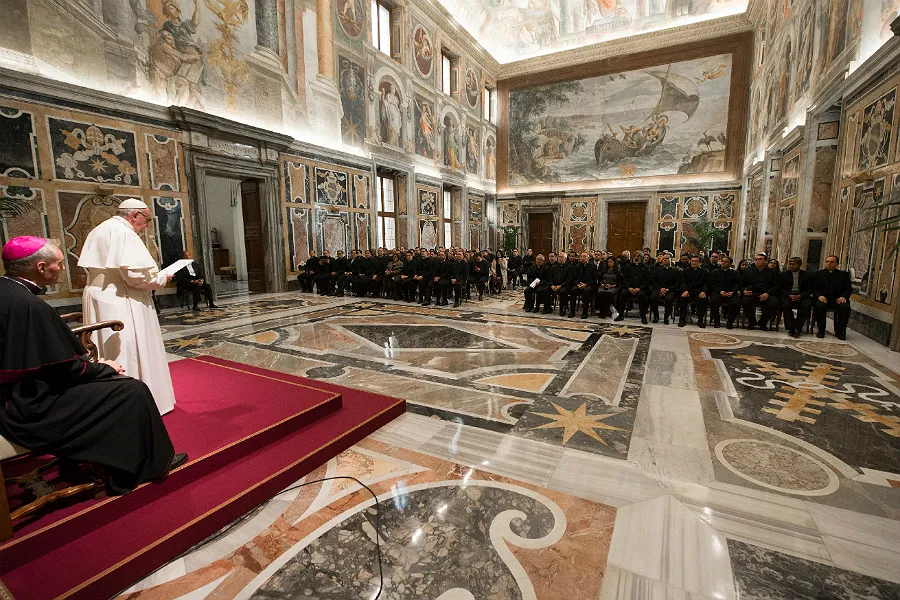
Vatican City, Nov 15, 2018 / 04:13 pm (CNA/EWTN News).- Pope Francis encouraged the community of the Pontifical Latin American College Thursday to avoid cultural fragmentation and to be close to their people.
“One of the phenomena currently afflicting the continent is cultural fragmentation, the polarization of the social fabric and the loss of roots,” the pope said Nov. 15 in the Clementine Hall of the Vatican’s Apostolic Palace.
“This is exacerbated when arguments are fomented that divide and propagate different types of confrontations and hatred towards those who ‘are not one of us’, even importing cultural models that have little or nothing to do with our history and identity and that, far from combining in new syntheses as in the past, end up uprooting our cultures from their richest autochthonous traditions.
He spoke to the community to mark the 160th anniversary of the college’s founding. He noted that it “is one of the few Roman Colleges whose identity does not refer to a nation or a charism, but which seeks rather to be the meeting place, in Rome, of our Latin American land … offering you, young priests, the opportunity to create a vision, a reflection and an experience of communion that is expressly ‘Latin Americanized’.”
Francis lamented that new generations are “uprooted and fragmented”, and said that “the Church is not external to this situation and is exposed to this temptation; since she is subject to the same environment, she runs the risk of becoming disoriented by falling prey to one form of polarization or another, or becoming uprooted if one forgets that the vocation is a meeting ground.”
He added that “the invasion of ideological colonization is also suffered in the Church.”
Because of this, he said it is important at the college “to create bonds and alliances of friendship and fraternity. And not because of a declaration of principles or gestures of goodwill, but because during these years you can learn to know better and make your own the joys and hopes, sorrows and anguish of your brothers; you can name and face specific situations that our people live, and face and feel your neighbour’s problems as if they were your own.”
The Pontifical Latin American College should help create a good priestly community “if one knows how to help oneself, if one is able to lay down roots in the lives of others, brothers and sons with a common history and heritage, part of a same presbytery and the same Latin American people. A priestly community that discovers that the greatest strength it has to build history is born of the concrete solidarity among you today, and will continue tomorrow between your churches and peoples to be able to transcend the merely ‘parochial’ and to lead communities that know how to open up to others to interact and to promote hope.”
Latin America needs, he said, “artisans of relationship and communion, open and trusting in the novelty that the Kingdom of God can inspire today … A priest in his parish, in his diocese, can do a lot – and this is fine – but he also runs the risk of burning himself out, of isolating himself or harvesting for himself. Feeling part of a priestly community, in which everyone is important – not because it is the sum of people living together, but because of the relationships they create, this feeling part of the community – can awaken and encourage processes and dynamics capable of transcending time.”
“This sense of belonging and recognition will help to creatively unleash and stimulate renewed missionary energies that promote an evangelical humanism capable of becoming intelligence and a driving force in our continent,” Pope Francis said.
“Without this sense of belonging and work hand in hand, on the contrary, we will disperse, we will weaken and, worse still, we will deprive so many of our brothers of the strength, the light and the consolation of friendship with Jesus Christ and of a community of faith that gives a horizon of meaning and life. And so, little by little, and almost without realizing it, we will end up offering Latin America … a God without Christ, a Christ without a Church, a Church without a people … pure re-elaborated Gnosticism.”
He said Latin America knows that “the love for Christ and of Christ can not manifest itself except in passion for life and for the destiny of our peoples, and especially solidarity with the poorest, the suffering and those in need.”
The pope said this “reminds us of the importance … of developing the pleasure of always being close to the life of our people; never isolating ourselves from them. The life of the diocesan presbyter is lived – the repetition is valid – in this identification and belonging. The mission is passion for Jesus, but at the same time, it is passion for His people. It is learning to look where He looks and to let ourselves be moved by the same things He is moved by: feelings for the life of His brothers, especially sinners and of all those who are despondent and fatigued, like sheep without a shepherd. Please, do not huddle in personal or community enclosures that keep us away from the hubs where history is written. Captivated by Jesus and members of His Body, we integrate fully into society, share life with everyone, listen to their concerns … rejoice with those who are happy, mourn with those who mourn and offer every Eucharist for all those faces that were entrusted to us.”
Francis said the linking of the college’s anniversary with the canonization of St. Oscar Romero, a sometime student, is providential, calling him a “living sign of the fruitfulness and sanctity of the Latin American Church. A man rooted in the Word of God and in the hearts of his people.”
“This reality allows us to make contact with that long chain of witnesses in which we are invited to place our roots and take inspiration from every day … Do not fear holiness, and do not fear spending your life for your people.”
“On the path of cultural and pastoral miscegenation we are not orphans; Our Mother accompanies us,” Pope Francis stated. “She wanted to be like that, mestizo and fertile, and that is how she is with us, our Mother of tenderness and strength who rescues us from the paralysis or confusion of fear, just because she is simply there, as our Mother.”
“Brother priests, let us not forget, and confidently ask her to show us the way, to free us from the perversion of clericalism, increasingly to make us ‘village pastors’ and not to let us become ‘clerics of the state’.”
He concluded with a message for his brother Jesuits who help run the college, saying that “one of the distinctive notes of the Society’s charism is seeking to harmonize contradictions without falling prey to reductionism. This is why Saint Ignatius wanted to think of the Jesuits as men of contemplation and action, men of discernment and obedience, committed to daily life and free to leave.”
The Jesuits at the college should help the young priests “to harmonize the contradictions that life presents to them and present them without falling into reductionism, gaining in the spirit of discernment and freedom,” he said.
“Teach how to embrace problems and conflicts without fear; to handle dissent and confrontation. Teach how to reveal all kinds of ‘correct’ but reductionist discourse is a crucial task for those who accompany their brothers in formation. Help them to discover the art and taste of discernment as a way of proceeding to find, in the midst of difficulties, the ways of the Spirit by tasting and feeling the Deus semper maior within. Be teachers of broad horizons and, at the same time, teach how to take charge of the small, to embrace the poor and the sick, and to take on the reality of everyday life. Non coereceri a maximo, contineri tamen a minimo divinum est.”
 […]
[…]




When it come to fasting and prayer, Muslims are second to none. They pray for themselves and pray for those of us in need of prayers. Long live their love for prayer.
Oh good for you. How do you know what they pray for, or to who?
Well they pray to the God of Abraham & they’ve prayed for my grandchild who was ill. His mother & I appreciated that very much.
Apart from the God of Abraham, we may part ways on a number of issues but that much we hold in common as children of Abraham
This is sugar coating something that never should have been allowed to happen. What next? A room for Satanists to pray? No. Just no. Ford doesn’t open a room at their headquarters library for GM to gather.
What about thou shall not have false God’s before me?
Would they allow a Christian prayer room at Masjid al-Haram or Al Aqsa?
Possibly yes…in the sense that in both cases—the Vatican Library (and the entire Vatican?) and the Christian prayer room—Christianity is subordinated and annexed to the central Islamic worldview… the madrassa! Jihad by another name…
Huh?
They “ rate this claim true, with important context”?
What context?
That the Muslim prayer room is actually a room where Muslims pray?
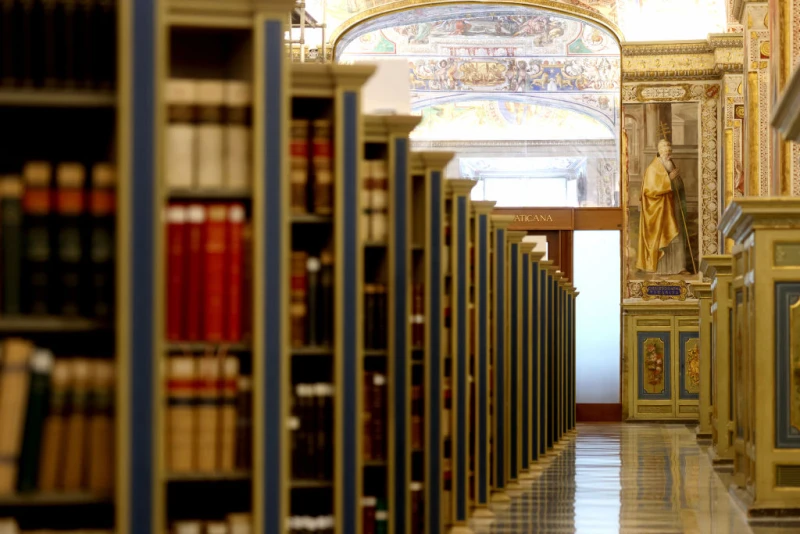
That the Muslim prayer room in the Vatican is actually in the Vatican Library?
I don’t see how the “important context” matters much.
The Vatican established a prayer room for Muslims. Period.
Now, I think a meaningful bit of context might be that Muslim fundamentalists are martyring Christians all around the world, including some ten thousand in this year alone in Nigeria.
The prayer room war. Will the Vatican pose no objection to a mosque and minaret calling Muslims to prayer day and night adjacent to Vatican City?
Cardinal Gerhard Muller alleged that the prayer room request was an encroachment, a statement that infers Islam is the superior faith. As a matter of arguable evidence we increasingly find mosques and minarets all over Europe, whereas we don’t find Muslim nations grading Christians ‘prayer spaces’ like churches. And if they do they’re subject to atrocities.
As an opinion it seems CNA’s Daniel Payne’s view is acceptable, that the request was made by Muslim scholars studying at the Apostolic library, and it should be reserved solely for them. A refusal aside from the politics would seem petty. It can also be viewed as an indication of Catholic magnanimity.
Islam has a 13 plus century history from which we can make a reasonably accurate assessment of its intent and nature.
It has always been imperial, martial and supercedent.
Muslims have already taken over parts of Michigan. About three months ago, Dearborn Mayor Abdullah H. Hammoud told local resident Edward “Ted” Barham, a Christian, that he was “not welcome” in the city after Barham raised concerns about new street signs honoring Arab American News publisher Osama Siblani.
Per Fox news: Christian minister Edward “Ted” Barham says he will not respond with hate after Dearborn Mayor Abdullah Hammoud told him he was “not welcome” during a heated city council exchange over a controversial honorary street sign naming that went viral.
In a new interview with Fox News Digital, Barham said the moment has only strengthened his resolve to speak out about freedom of speech and freedom of faith.
“I did not respond to the mayor with hate. I said, God bless you,” Barham said, adding that he takes seriously Jesus’ command to “love your enemies, bless those who curse you.” He said the incident was not isolated, pointing to earlier clashes with city officials over his public ministry.
Barham objected at the Sept. 9 council meeting to street signs honoring controversial Arab American News publisher Osama Siblani.
DEARBORN’S MUSLIM MAYOR TELLS CHRISTIAN HE’S ‘NOT WELCOME’…….
..the attack on free speech is very troubling but representative of the left’s attitude.
it seems the attitude here is that “hit the road Jack, and don’t come back”
The US, as well as European nations, require a cultural assimilation mandate for immigrants. Creating virtual alien nations within a host nation is antithetical to social integration and justice. Our Church, and the European Union have encouraged this indiscriminate open border policy.
Early in Francis’ Papacy, there was a PEP (Papal Excuse Patrol) ready to qualify the Pope’s innumerable and intemperate gaffes. Looks like a new squad is forming.
This situation reflects two very different impulses: on one hand, a kind of tribal reflex that Christians should avoid, and on the other, a legitimate concern rooted in history, prudence, and discernment — virtues the Christian tradition actually demands.
A sober reading of Islamic history makes one thing clear: for many of its political and religious movements, expansion has not been incidental but central. Across centuries, Islamic empires advanced not through dialogue but through territorial acquisition, often justified as a religious duty. That historical pattern isn’t speculation; it’s documented reality.
This is why the Vatican’s decision matters. Symbolically and strategically, granting even a small foothold in Rome carries weight far beyond the physical space involved. For over a millennium, Rome has been viewed by various Islamic powers as a coveted prize — not for coexistence, but for eventual dominance. In many interpretations of Islamic jurisprudence, once land is claimed for Islam, it is considered permanently Islamic territory, and there is a religious obligation to defend and expand it.
Christians view the world through the lens of Christ — a framework shaped by grace, reason, and moral restraint. But it is a mistake to assume that all others operate from the same moral or theological foundation. Prudence requires acknowledging that not every worldview reciprocates goodwill or interprets gestures of openness as invitations to peaceful coexistence.
Kindness is a Christian duty, but so is discernment. Extending goodwill does not obligate us to ignore historical patterns or the stated aims of ideological movements. Wisdom means recognizing that not every gesture of hospitality will be met with the same intentions.
Five times per day, special timing methods, call to prayer from a mosque somewhere, necessity of wudu, prayed aloud, facing Kasba/Mecca, Friday prayer “day of meeting” more elaborate including discussions “holiest/happiest day of the week”, sunni and shia pray differently/separate rooms, etc.
‘ The daily prayers are considered obligatory (fard) by many and they are performed at times determined essentially by the position of the Sun in the sky. Hence, salat times vary at different locations on the Earth. Wudu is needed for all of the prayers.
Some Muslims pray three times a day. ‘
https://en.wikipedia.org/wiki/Salah_times