
Vatican City, May 6, 2017 / 10:46 am (CNA/EWTN News).- As 40 new Swiss Guards take an oath to defend and protect Pope Francis, their commander has emphasized that their role is not only to be a security force, but has a spiritual aspect as well.
“If someone in the (job) interview only talks about security and doesn’t know who they are giving security for…for me he is not a candidate,” Christoph Graf, Commander of the Swiss Guard, told journalists May 5.
“For me a candidate must have a foundation in the faith, to be a practicing Catholic” who goes to Mass and prays, he said, adding that if a young man knows nothing of the faith, “I don’t know what he’s looking for (in the Swiss Guard).”
Because of the army’s ties to the Pope and to the Church, he said having a solid faith life is “fundamental,” and explained that it’s even possible “to help some on the path of faith” if they have only a minimal knowledge.
In addition to being a line of defense for the Bishop of Rome, the Guard must also be “missionary,” he said, saying they must protect the Pope “with weapons, but also the faith. With prayer.”
Graf, who has served as the 35th Commander of the Pontifical Swiss Guard since 2015, spoke at a press conference a day ahead of the official swearing-in of 40 new Swiss Guards, who take a special oath to defend and protect the Pope.
With roughly 100 applicants for 30-35 spots each year, competition to be a Swiss Guard is tough, Graf said – there is a process of filtering the candidates in order to ween the list down to 40 or 50 people, who come to him for a final interview.
After speaking with each of them for 15-20 minutes, “you know” who the real candidates are, he said.
Those who are accepted serve for a minimum of two years, but can also stay in service for an additional year or two, which was the case for many guards during last year’s Jubilee of Mercy.
With a motto of “Courage and Loyalty,” the Pontifical Swiss Guard currently has just over 110 members, making it the smallest, though oldest army in the world.
<blockquote class=”twitter-tweet” data-lang=”en”><p lang=”es” dir=”ltr”><a href=”https://twitter.com/hashtag/Vaticano?src=hash”>#Vaticano</a>. <a href=”https://twitter.com/hashtag/GuardiasSuizos?src=hash”>#GuardiasSuizos</a> preparándose para su ceremonia dónde jurarán fidelidad al Papa. Fotos: <a href=”https://twitter.com/aciprensa”>@aciprensa</a> <a href=”https://t.co/Cx3bO3wMjZ”>pic.twitter.com/Cx3bO3wMjZ</a></p>— Daniel Ibáñez (@dibanezgut) <a href=”https://twitter.com/dibanezgut/status/860865593112711168″>May 6, 2017</a></blockquote>
<script async src=”//platform.twitter.com/widgets.js” charset=”utf-8″></script>
The official swearing-in ceremony takes place each year on the anniversary of the May 6, 1527 battle that has come to be known as the Sack of Rome, and which was the most significant and deadly event in the history of the Swiss Guard.
In the course of the battle, 147 guards lost their lives while fighting the army of the mutinous Holy Roman Empire in defense of Clement VII, who was able to escape through a secret passageway leading from the Vatican to Castel Sant’Angelo, which sits next to the Tiber River.
As part of the schedule this year, the family members of the new guards prayed Vespers the evening of May 5 in the church of Santa Maria della Pieta in the Vatican’s Teutonic College. Later, the “deposition of the crown” ceremony took place in commemoration of the guards who died during the Sack of Rome.
Before taking their official oath in the afternoon, the guards had 7:30 a.m. Mass with Cardinal Gerhard Muller, Prefect of the Congregation for the Doctrine of the Faith, at the Altar of the Chair in St. Peter’s Basilica.
They then met with Pope Francis before getting ready for the swearing-in ceremony, which took place in the San Damasco courtyard of the apostolic palace and was attended by Graf and representatives of the Swiss Army and the Swiss government, as well as the Bishops Conference of Switzerland.
During the event, each new recruit approaches the flag of the Swiss Guard when his name is called out. Firmly grasping the banner with his left hand, the new guard raises his right hand and opens three fingers as a sign of his faith in the Holy Trinity.
As he holds up his fingers, the guard proclaims this oath: “I, (name), swear diligently and faithfully to abide by all that has just been read out to me, so grant me God and so help me his saints.”
In English, the full oath reads: “I swear I will faithfully, loyally and honorably serve the Supreme Pontiff Francis and his legitimate successors, and also dedicate myself to them with all my strength, sacrificing if necessary also my life to defend them. I assume this same commitment with regard to the Sacred College of Cardinals whenever the see is vacant. Furthermore, I promise to the Commanding Captain and my other superiors respect, fidelity and obedience. This I swear! May God and our Holy Patrons assist me!”
In comments to CNA, one of the new guards, Filippo Inches, spoke of the connection between his service and the faith, saying that “without doubt my faith has increased and has been fortified.”
“Because living 24/7 in this environment, in the context of the Vatican, surrounded by all these monsignors, archbishops and the Pope himself; participating at least one or twice a week in one of his events, listening to his preaching – inevitably and involuntarily something sticks,” he said.
Inches, who has served as a Swiss Guard for the past 11 months, is from the small Swiss town of Vacallo, which sits on the border with Italy, just 37 miles north of Milan. He took his official oath to protect and defend Pope Francis alongside 39 other guards this year.
By serving in the small army, “you also realize increasingly how important the role of the Church is as an institution,” he said, suggesting that while the Church is often criticized from the outside, being on the inside shows a different story.
“On the inside, you are aware of how many efforts are made to seek for dialogue, and peaceful solution to the various controversies and conflicts, whether on a political level, an economic level, cultural with different forums and also at the scientific level,” Inches said.
The guard explained that he had wanted to join ever since he was young. He traveled to Rome often as a child, where he always noticed the Swiss Guard, but it wasn’t until he was studying humanities in university that he decided to jump into the “adventure” of becoming one.
He said that for him, defending the Pope means “being a part of history” given the army’s ancient roots.
“So belonging to this corps I am very proud,” he said, “you see the universality, both of the Church and of history.”
Inches said he has had the opportunity to see the Pope and speak with him on several occasions during events or while standing guard outside his room.
“It can happen that he greets you, extending his hand and exchanging some joke,” he said, adding that what moves him most is when he sees the Pope coming in and out of his room, because “he gives this look like there is always a certain familiarity between him and the guards.”
In his speech to the guards and their families before the official swearing-in ceremony, Pope Francis told the guards that while they might not be called to give their lives like the 127 who died during the Sack of Rome, they are called “to another sacrifice no less arduous: to serve the power of faith.”
“This is a true barrier to resist the various strengths and powers of this world and above all he who is the ‘prince of this world’,” the Pope said, telling the guards they are called to be “strong and valorous, sustained by faith in Christ and by his Word of salvation.”
He invited them to live their time in Rome with “sincere brotherhood,” supporting each other in an exemplary Christian life that is “motivated and supported by your faith.”
“I’m sure that the strongest push to come to Rome to fulfill this service was given to you precisely by your faith,” he said, explaining that their mission comes primarily from their baptism, which allows them to bear witness to their faith in Christ.
He urged them to practice charitable service toward one another, being “missionary disciples” in the daily tasks which might seem repetitive, but to which “it is important to always give new meaning.”
During his speech at the swearing-in, Graf noted that this year marks the 600th anniversary of the birth of one of the patron saints of the Swiss Guard, St. Nicholas of Flue, known as the “defensor Pacis et pater patriate,” or, “the defender of peace and the father of our country.” Other patron saints are St. Martin and St. Sebastian.
Graf encouraged the guards to look to Scripture and the lives of the saints for examples of how to give their lives generously and with humility, saying “whoever wants to successfully guide must first learn how to love people.”
He pointed to various economic and political crises taking place throughout Europe, including those of poverty, unemployment, terrorism, migration and “a growing Islamophobia,” which are causing “a certain sense of impotence and disorientation.”
“Must not a cause for this crisis also be sought in the growing disappearance of faith, in the growing lack of God?” he asked.
“Wake up, dear Christians!” he said. “The present world has a new need for examples, especially in our Europe.”
“The present world needs simple and humble people who live and bear witness to the faith. People who carry out their daily duties with love, who pray and do penance,” he said, asking for both prayer and fasting, saying “you will be surprised at what you can do with that.”
 […]
[…]


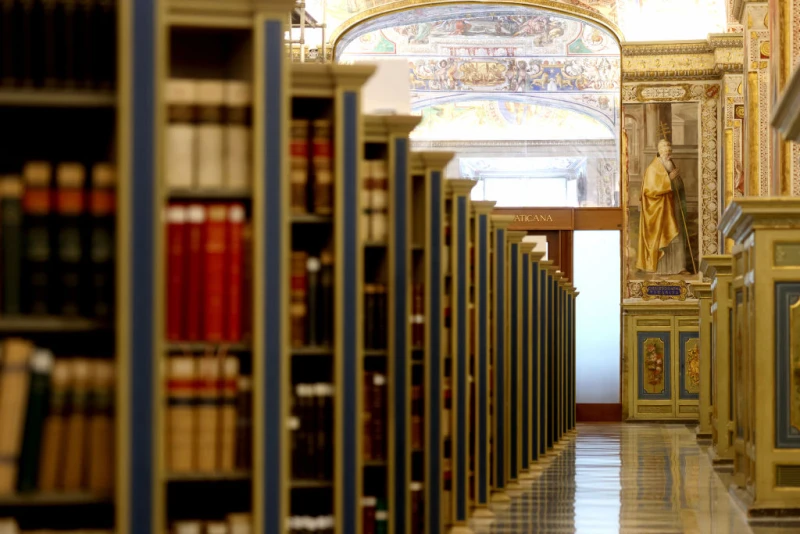


When it come to fasting and prayer, Muslims are second to none. They pray for themselves and pray for those of us in need of prayers. Long live their love for prayer.
Oh good for you. How do you know what they pray for, or to who?
Well they pray to the God of Abraham & they’ve prayed for my grandchild who was ill. His mother & I appreciated that very much.
Apart from the God of Abraham, we may part ways on a number of issues but that much we hold in common as children of Abraham
This is sugar coating something that never should have been allowed to happen. What next? A room for Satanists to pray? No. Just no. Ford doesn’t open a room at their headquarters library for GM to gather.
What about thou shall not have false God’s before me?
Would they allow a Christian prayer room at Masjid al-Haram or Al Aqsa?
Possibly yes…in the sense that in both cases—the Vatican Library (and the entire Vatican?) and the Christian prayer room—Christianity is subordinated and annexed to the central Islamic worldview… the madrassa! Jihad by another name…
Huh?
They “ rate this claim true, with important context”?
What context?
That the Muslim prayer room is actually a room where Muslims pray?
That the Muslim prayer room in the Vatican is actually in the Vatican Library?
I don’t see how the “important context” matters much.
The Vatican established a prayer room for Muslims. Period.
Now, I think a meaningful bit of context might be that Muslim fundamentalists are martyring Christians all around the world, including some ten thousand in this year alone in Nigeria.
The prayer room war. Will the Vatican pose no objection to a mosque and minaret calling Muslims to prayer day and night adjacent to Vatican City?
Cardinal Gerhard Muller alleged that the prayer room request was an encroachment, a statement that infers Islam is the superior faith. As a matter of arguable evidence we increasingly find mosques and minarets all over Europe, whereas we don’t find Muslim nations grading Christians ‘prayer spaces’ like churches. And if they do they’re subject to atrocities.
As an opinion it seems CNA’s Daniel Payne’s view is acceptable, that the request was made by Muslim scholars studying at the Apostolic library, and it should be reserved solely for them. A refusal aside from the politics would seem petty. It can also be viewed as an indication of Catholic magnanimity.
Islam has a 13 plus century history from which we can make a reasonably accurate assessment of its intent and nature.
It has always been imperial, martial and supercedent.
Muslims have already taken over parts of Michigan. About three months ago, Dearborn Mayor Abdullah H. Hammoud told local resident Edward “Ted” Barham, a Christian, that he was “not welcome” in the city after Barham raised concerns about new street signs honoring Arab American News publisher Osama Siblani.
Per Fox news: Christian minister Edward “Ted” Barham says he will not respond with hate after Dearborn Mayor Abdullah Hammoud told him he was “not welcome” during a heated city council exchange over a controversial honorary street sign naming that went viral.
In a new interview with Fox News Digital, Barham said the moment has only strengthened his resolve to speak out about freedom of speech and freedom of faith.
“I did not respond to the mayor with hate. I said, God bless you,” Barham said, adding that he takes seriously Jesus’ command to “love your enemies, bless those who curse you.” He said the incident was not isolated, pointing to earlier clashes with city officials over his public ministry.
Barham objected at the Sept. 9 council meeting to street signs honoring controversial Arab American News publisher Osama Siblani.
DEARBORN’S MUSLIM MAYOR TELLS CHRISTIAN HE’S ‘NOT WELCOME’…….
..the attack on free speech is very troubling but representative of the left’s attitude.
it seems the attitude here is that “hit the road Jack, and don’t come back”
The US, as well as European nations, require a cultural assimilation mandate for immigrants. Creating virtual alien nations within a host nation is antithetical to social integration and justice. Our Church, and the European Union have encouraged this indiscriminate open border policy.
Early in Francis’ Papacy, there was a PEP (Papal Excuse Patrol) ready to qualify the Pope’s innumerable and intemperate gaffes. Looks like a new squad is forming.
This situation reflects two very different impulses: on one hand, a kind of tribal reflex that Christians should avoid, and on the other, a legitimate concern rooted in history, prudence, and discernment — virtues the Christian tradition actually demands.
A sober reading of Islamic history makes one thing clear: for many of its political and religious movements, expansion has not been incidental but central. Across centuries, Islamic empires advanced not through dialogue but through territorial acquisition, often justified as a religious duty. That historical pattern isn’t speculation; it’s documented reality.
This is why the Vatican’s decision matters. Symbolically and strategically, granting even a small foothold in Rome carries weight far beyond the physical space involved. For over a millennium, Rome has been viewed by various Islamic powers as a coveted prize — not for coexistence, but for eventual dominance. In many interpretations of Islamic jurisprudence, once land is claimed for Islam, it is considered permanently Islamic territory, and there is a religious obligation to defend and expand it.
Christians view the world through the lens of Christ — a framework shaped by grace, reason, and moral restraint. But it is a mistake to assume that all others operate from the same moral or theological foundation. Prudence requires acknowledging that not every worldview reciprocates goodwill or interprets gestures of openness as invitations to peaceful coexistence.
Kindness is a Christian duty, but so is discernment. Extending goodwill does not obligate us to ignore historical patterns or the stated aims of ideological movements. Wisdom means recognizing that not every gesture of hospitality will be met with the same intentions.
Five times per day, special timing methods, call to prayer from a mosque somewhere, necessity of wudu, prayed aloud, facing Kasba/Mecca, Friday prayer “day of meeting” more elaborate including discussions “holiest/happiest day of the week”, sunni and shia pray differently/separate rooms, etc.
‘ The daily prayers are considered obligatory (fard) by many and they are performed at times determined essentially by the position of the Sun in the sky. Hence, salat times vary at different locations on the Earth. Wudu is needed for all of the prayers.
Some Muslims pray three times a day. ‘
https://en.wikipedia.org/wiki/Salah_times