

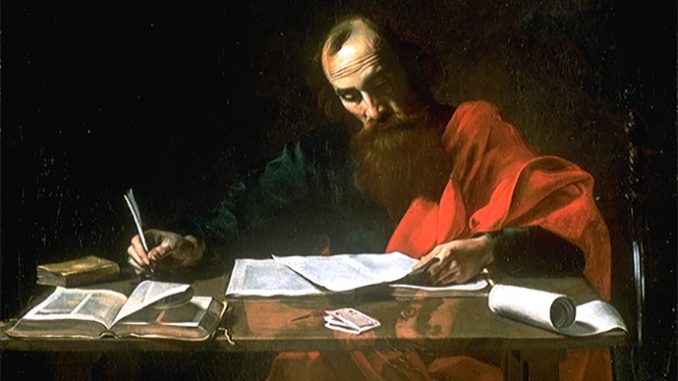
“The Apostle Paul, an outstanding and almost inimitable yet stimulating figure, stands before us as an example of total dedication to the Lord and to his Church, as well as of great openness to humanity and its cultures. It is right, therefore, that we reserve a special place for him in not only our veneration but also in our effort to understand what he has to say to us as well, Christians of today.” — Pope Benedict XVI, General Audience, July 2, 2008.
If you do not follow closely all things synodal, you likely missed the latest synodal document, released on July 27th, titled “Recollecting: Accompanying the preparation of the local Church’s evaluation Assembly: Notes for Bishops and synodal teams”.
While mercifully short by synodal standards—just 19 pages—it contains all of the features we’ve come to expect from synodal texts: much bureaucratic jargon, endless references to “process/es” (59x) and “experience” (44x) and “journey” (60x), detailed explanation of when people will gather and what they will discuss, and so forth.
As I noted less than a year ago, the basic message is: “synodality is here to stay and you will synodalize.” However, rather than write yet another piece pointing out the now familiar characteristics of such documents, I want to dialogue a bit with Saint Paul, with two contemporary observations in mind.
First, from the new synodal document itself: “As the Holy Father Pope Leo XIV recalled, ‘Synodality is not a series of meetings, nor is it a working method. It is a spiritual style.'” While it is not yet evident how Pope Leo understands this “spiritual style,” it is ironic that the document itself is largely focused on outlining and describing meetings and methods. While my sense is that Pope Leo is slowly and quietly moving away from the more troubling excesses of the synodal project, that is a subject for another essay.
Secondly, from Marc Cardinal Ouellet’s excellent book, Word, Sacrament, Charism: The Risks and Opportunities of a Synodal Church (Ignatius Press, 2025)1, which (the publisher explains) “states that the main weakness in the synodal process has been the lack of theological reflection, which risks leaving the Church at the level of charitable NGOs.”
It is this paucity of theological framing and focus that has most bothered me, in part because of the vacuum it creates but also because it strongly suggests a flawed view of theology and doctrine, which are often treated as afterthoughts.
As it happens, this new document was released just as I had finished leading a several-month-long Bible study at our parish of St. Paul’s epistles to the Ephesians, the Philippians , and the Colossians.2
Those, along with his letter to the Galatians, were most likely written in AD 60-62 while Paul was under home arrest awaiting trial in Rome. Paul would be martyred just a few years later (c. 64-67), and his prison epistles reflect his clear-eyed understanding that the end of his earthly life was quickly approaching.
It is understandable to see first-century Rome as a time and world so far removed from us that comparisons are difficult or even pointless. But, as Benedict XVI noted, “we can see that various aspects of today’s social and cultural context are not very different from what they were then.”
A few that come to mind include the (apparent) stability of an empire marked by numerous political tensions and cultural conflicts, a Church filled with divisions and tensions, confusion about various theological and moral questions, a dominant paganism that was rotting from the inside, and a mixture of hope and trepidation among Christians. And, most enduringly, there is the human condition, with sin, redemption, suffering, and holiness all essential to Paul’s experiences and his letters.
As we read and discussed these three letters (which I’ve studied many times since I was a young boy), a number of points were impressed on me, often in ways I’d not appreciated deeply enough before. Here are just a few—all of them, I think, are truths that we need now more than ever, as they are not time-bound or historically limited but divinely inspired and as challenging today as in the first century.
(1) We were dead in sin; we are made alive in Christ (cf. Eph. 2:1-10; Col 2:11-15). There are many themes that are central in Paul’s thought, but all of them are somehow connected to his soteriology. And Paul’s language is strong, even dramatic, precisely because the truth about our past state is indeed dark—”we were by nature children of wrath, like the rest of mankind”—just as the glorious truth about our redemption in Christ is bursting with eternal light: “But God, who is rich in mercy, out of the great love with which he loved us, even when we were dead through our trespasses, made us alive together with Christ…”
Like a great painter, Paul renders a depiction of salvation that is a chiaroscuro of grace, with an understanding of man’s desperate state that is unsparing, contrasted with a call to holiness and perfection that is stunning, even daunting. Perhaps that is too much for many people today, who seem to prefer what Tracey Rowland calls “bourgeois Christianity”, which “is the attitude of people who identify themselves as Christians but define Christianity by a series of markers that are in no way different from the prevailing social fashions.” But, of course, it is precisely the startling reality of the Gospel that we need so desperately, and need to share so eagerly.
It’s quite revealing that the flood of synodal documents over the past decade or so has rarely mentioned sin, redemption, the Cross, salvation, and personal conversion.3 There is, in fact, hardly any theological substance at all, as if theology is—as far too many apparently assume—is boring or “academic” or “not practical”. But, for Paul, theology—contemplating the things of God—was as natural as breathing. He would, I think, agree completely with Dorothy Sayers (1893-1957), who lambasted the anti-theological (and thus anti-soteriological) assumptions of so many Christians in the mid-20th century:
It is the dogma that is the drama — not beautiful phrases, nor comforting sentiments, nor vague aspirations to lovingkindness and uplift, nor the promise of something nice after death — but the terrifying assertion that the same God who made the world, lived in the world and passed through the grave and gate of death. Show that to the heathen, and they may not believe it; but at least they may realize that here is something that a man might be glad to believe.
Alas, dogma—perhaps especially dogma about the uniqueness of Christ and his salvific suffering and death—is too often viewed with suspicion, even disdain, by many who claim to be Christian. But the dogma, ultimately, is not triumphalist teaching but the triumphant King himself. To reject his teaching is to reject him.
(2) Our true identity is heavenly, which shapes who were are in this world (cf. Eph 1:3, 19-20; 2:4-6; Phil 3:20-21; Col 1:3-5). One of the most remarkable characteristics of Paul is how he thinks, lives, and prays in the constant light of heavenly glory. Eschatology, for Paul, is not academic or abstract; he is as convinced of eternal communion with the Triune God as he is of anything on earth.
I could, of course, point to numerous passages in other letters—to the Corinthians or I Thessalonians—but it is captured well in his direct remark: “For to me to live is Christ, and to die is gain” (Phil 1:21). As Benedict XVI observed:
Paul has no fear of death; indeed, on the contrary, death indicates being totally with Christ. Yet Paul also shares in the sentiments of Christ who did not live for himself but for us. Living for others becomes his life and plan thus demonstrates his perfect readiness to do God’s will, to do whatever God decides. Above all he is prepared, in the future as well, to live on this earth for others, to live for Christ, to live for his living presence and thus for the renewal of the world.
Paul, later in his letter to the Christians in Philippi, states: “But our commonwealth is in heaven, and from it we await a Savior, the Lord Jesus Christ, who will change our lowly body to be like his glorious body, by the power which enables him even to subject all things to himself” (Phil 3:20-21)
Put another way—as 1 Corinthians 15 shows in abundance—Paul, having seen Christ resurrected (Acts 9:1-9), was animated in every possible way by the reality of the Resurrection. Without that “big bang” event within history, the Christian Faith is an empty sham. Why, then, so little mention of the Resurrection in the reams of synodal documents? Why such reluctance to root the Church’s identity in the very event that brought her into being?
(3) The pastoral never conflicts with the theological. Or, put another way, the notion of “lived experienced” trumping doctrine is a sham. Rather than being an appeal to natural law, which is objective to nature and ordered to the divine law, it is an appeal to sentiment and subjectivity. Paul recognized that such appeals are rooted in passions, and he warned against them in the strongest of terms:
Put to death therefore what is earthly in you: immorality, impurity, passion, evil desire, and covetousness, which is idolatry. On account of these the wrath of God is coming. In these you once walked, when you lived in them. But now put them all away: anger, wrath, malice, slander, and foul talk from your mouth. Do not lie to one another, seeing that you have put off the old nature with its practices and have put on the new nature, which is being renewed in knowledge after the image of its creator. Here there cannot be Greek and Jew, circumcised and uncircumcised, barbarian, Scyth′ian, slave, free man, but Christ is all, and in all. (Col 3:5-11)
This and other passages demonstrate how Paul never injects a false partition between theological truth and pastoral exhortation; the two not only go hand-in-hand, they must be so. Paul moves from grand descriptions of living in Christ to moral exhortations as easily and logically as a great pianist moves from dense chordal changes to serene adagios; there is no conflict between the two, as they are both ordered to the whole. This is described well by the French biblical scholar Fr. Lucien Cerfaux (1883-1968) in The Spiritual Journey of Saint Paul4:
The Christian life is therefore no longer limited, as it might have seemed to be, to the contemplation of the mystery, nor to the heroism of suffering, nor to a mystical deepening of the presence of God in us. It is a life of everyday things, lived in intellectual and moral health.
A wonderful example of this is found in the famous fifth chapter of Ephesians, where, prior to reflecting on the nuptial mystery of Christ and the Church, Paul again draws upon the contrast between darkness and light:
Let no one deceive you with empty words, for it is because of these things that the wrath of God comes upon the sons of disobedience. Therefore do not associate with them, for once you were darkness, but now you are light in the Lord; walk as children of light (for the fruit of light is found in all that is good and right and true), and try to learn what is pleasing to the Lord. Take no part in the unfruitful works of darkness, but instead expose them. For it is a shame even to speak of the things that they do in secret; but when anything is exposed by the light it becomes visible, for anything that becomes visible is light. (Eph 5:6-13)
One can, I think, easily surmise what Paul (see Romans 1 for further details) would think about the egregious Final Report of Synodal Group 9, which contained testimonies from openly homosexual couples. The commandments of Christ—whether about money, power, marriage, or sexuality—are not limitations on our freedom, but are the very means to authentic freedom.5 Christ, as Benedict XVI asserted, “is not only the one who commands but also one who is organically connected with us, from whom comes the power to act in an upright way. … His commandments are not only words or orders but a vital energy that comes from him and helps us.”
So, do we truly identify ourselves, first and foremost—above all else—as disciples of Christ? Or do we add adjectives and disclaimers to who and what we think we are? Christ, as Paul explains in the famous kenosis passage, “emptied himself” (Phil 2:7), sacrificed himself, and gave himself to us. Are we willing to do the same to our passions, desires, dreams, fears, and hopes? Can real unity be realized if we are not truthful about who we are and what we are called to be? Can authentic dialogue take place when our preferred earthly identities take precedence over our heavenly calling to live in Christ, the Crucified One?
Finally: Rejoicing is essential, in good times and bad times. Paul’s letter to the Philippians is filled with many exclamations of joy and rejoicing. This is, of course, remarkable because of Paul’s increasingly dire situation. Yet, again, his perspective is both rooted in earthly reality and heavenly promises:
Rejoice in the Lord always; again I will say, Rejoice. Let all men know your forbearance. The Lord is at hand. (Phil 4:4-5)
The Lord is at hand. That is, the Lord is not only coming again in glory, but is already with us in hidden glory—in his Mystical Body, the Church, and in the sacraments. Processes and documents, however important for a time or place, cannot deliver the hope we should share in this hidden glory, no matter how popular or relevant they may seem to be. What we need now is to share in the same hope that Paul shared in—walking on the road to eternal life in authentic faith, in doctrinal clarity, and in self-giving charity.
(Author’s note: This essay was first published on the “What We Need Now” site and is reposted here with kind permission.)
Endnotes:
1Full disclosure: I work for Ignatius Press, the publisher of Cardinal Ouellet’s book.
2Since the summer of 2000, I’ve taught a weekly Bible study at Nativity of the Mother of God Ukrainian Catholic Church in Springfield, Oregon. During that time, we’ve studied all the New Testament books at least once, and the vast majority of the Old Testament books.
3There are, however, references to “communitarian conversion,” “the conversion of ecclesial processes,” and “ecclesial conversion”.
4Sheed and Ward, 1968.
5This, of course, was a key point of St. Pope John Paul II’s “Veritatis Splendor” (1993), which remains as divisive and contested in more progressive Catholic circles as it did when promulgated over 30 years ago.
If you value the news and views Catholic World Report provides, please consider donating to support our efforts. Your contribution will help us continue to make CWR available to all readers worldwide for free, without a subscription. Thank you for your generosity!
Click here for more information on donating to CWR. Click here to sign up for our newsletter.



Leave a Reply