



John Henry Cardinal Newman is the most recent Saint to be declared a Doctor of the Church. In his honor, Hermann Geissler authored a book entitled St. John Newman: A New Doctor of the Church.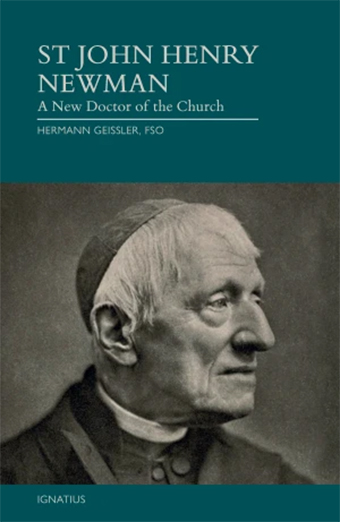
Father Geissler was born in Austria. He studied at the Benedict XVI Philosophical-Theological University in Vienna and earned a doctorate in theology at the Pontifical Lateran University in Rome on “Conscience and Truth in the Writing of Cardinal John Henry Newman.”
Geissler, who is a member of the Spiritual Family “The Work” (Familia Spiritualis Opus), was ordained a priest in 1991. From 1993 to 2019, he worked at the Doctrine of the Faith, and in 2009, Pope Benedict appointed him head of the doctrinal section. He has published numerous articles on the life, spirituality, and theology of Newman. He is the director of the International Center of Newman Friends in Rome. He is a professor of theology at various theological institutions in Italy and Austria.
In short, Geissler is well-equipped to write a book on the life and works of Cardinal Newman.
Over the years, a succession of Pontiffs expressed their profound admiration for Newman. Pope Pius XII foretold that Newman “will one day be a Doctor of the Church.” John XXIII cited him in his very first encyclical (Ad Petri Cathedram), highlighting his search for Christian unity. In 1975, Paul VI declared that Newman “today becomes ever a brighter beacon for all who are seeking an informed orientation and sure guidance amid the uncertainties of the modern world.” He continued by stating that the Second Vatican Council “can be considered in a special way as Newman’s hour.”
John Paul II spoke of Newman on numerous occasions. In 1990, he stated: “The mystery of the Church always remained the great love of John Henry Newman’s life.” In 2010, Pope Benedict XVI, during his apostolic visit to England, beatified him. He emphasized:
In our day, when an intellectual and moral relativism threatens to sap the very foundations of our society, Newman reminds us, as men and women made in the image and likeness of God, we were created to know the truth.
Pope Francis canonized him in 2019, and Pope Leo, in 2025, numbered St. John Henry Newman among the Doctors of the Church and made him, along with St. Thomas Aquinas, co-patron Saint of Education. Cardinal Marc Quellet, of Canada, asserted that Newman was truly a Doctor Ecclesiae.
Following the Introduction, Geissler has six chapters, each of which pertains to one of Cardinal Newman’s works. I will briefly comment on the first two chapters.
The first is titled “A Witness of Faith: Newman’s Life and Thought.” In 1870, Newman had published the Essay in Aid of a Grammar of Assent. This was the fruit of his lengthy concern about the relationship between faith and reason. He championed the right to certainty about matters of faith, even if it is not possible to demonstrate them scientifically. Contrary to what many argued, science is not the only means for obtaining reliable truth.
The second chapter, “A Living Truth: The Development of Christian Doctrine,” examines Newman’s book An Essay on the Development of Christian Doctrine. Newman was pondering how to evaluate Catholic innovations. For example, what is one to make of Marian devotion, the veneration of angels and saints, prayers for the deceased, and the doctrine of papal primacy? Were these symptoms of infidelity? Or were they an organic development of the faith entrusted to the Church by Jesus Christ and his apostles?
Geissler rightly notes that Newman saw Christian doctrine as a living reality, and since it is living, it must grow as time moves on. Doctrines do not change, but over the course of the centuries, the Church obtains a fuller understanding of them. Newman speaks of the various early Church Councils and creeds, specifically the Nicene Creed (AD 325), which affirmed, by employing the non-biblical word homoousion (consubstantial) with the Father. Thus, in a doctrinal manner, the divinity of Jesus was confirmed in the light of the Arian heresy.
But what counts as valid criteria for an authentic development of doctrine? Geissler provides an excellent and insightful explanation of Newman’s seven criteria. While it’s not possible to treat all of them here, I’ll remark briefly on the seventh and final criterion. Newman holds that true doctrinal development manifests a “chronic vigor.” Faithful development has an enduring, vital force. While heresies die over the centuries, genuine doctrines continue to thrive.
Newman recognized that there needed to be an authoritative power to judge the validity of doctrinal development. Here, Geissler states that Newman recognized that only the Catholic Church possesses such authority. And it was this realization that finally propelled him to become a Catholic. In the face of heresies and theological controversies, Newman saw Rome as the stalwart of truth.
As Newman famously declared, “the side was right because Rome was on it.” Peter was the arbiter as to what was authentic development. The Catholic Church, within its magisterial tradition, embraces the fullness of doctrine, for they are synonymous. They are one and the same.
Two final points need to be made about Geissler’s book in relation to Cardinal Newman being named a new Doctor of the Church.
The first is that Geissler adeptly demonstrates the contemporary relevance of Newman’s thought. This applicability is helpful to the reader, for it testifies that Newman’s thought was not only important for his age but for every age.
Second, the overarching theme of the entire book is the importance of conscience. Throughout the whole of Newman’s life, he was led by his conscience—a conscience that, over many years, sought the truth wherever it was found. Ultimately, his conscience led him to the Catholic Church. And it is there that he found his home, for it was there that the truth that would save him lay. The same is true for the whole of humankind until the end of time.
Those interested in John Henry Cardinal Newman would find no better place to start than to read Geissler’s book, which is an accessible and informative introduction to the newest Doctor of the Church.
St. John Henry Newman: A New Doctor of the Church
By Hermann Geissler, FSO
Ignatius Press, 2026
Paperback, 128 pages.
If you value the news and views Catholic World Report provides, please consider donating to support our efforts. Your contribution will help us continue to make CWR available to all readers worldwide for free, without a subscription. Thank you for your generosity!
Click here for more information on donating to CWR. Click here to sign up for our newsletter.

Leave a Reply