


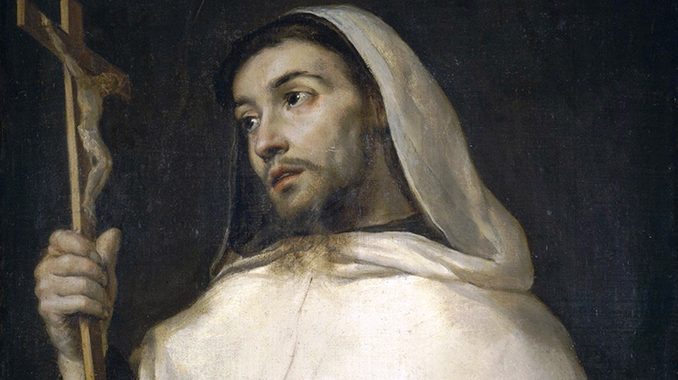
Although he is not on the general Roman calendar, both branches of the Carmelite families observe August 7th as the feast of St. Albert of Trapani. To understand the importance of this St Albert for the Carmelites and for the Church, one first needs to understand something about the history of the Carmelites.
The Carmelites draw their spiritual inspiration from the Old Testament prophet Elijah and the community that grew up around him (the so-called “sons of the prophets”; see 2 Kings 2:3), as well as figures including St John the Baptist and the Desert Fathers. The example of such figures inspired a group of men in the twelfth century in the Kingdom of Jerusalem (Western European-controlled Holy Land) to form a community of hermits on Mount Carmel near the capital of Acre.
Many of those men likely were former Crusaders who swore their allegiance to Christ and lived together a life of prayer and penance. Around the year 1207, the Latin bishop of Jerusalem codified the practices of the hermits “living near the spring on Mount Carmel” into a rule of life. Though the men lived in individual huts, they gathered together in worship in a church dedicated to the Virgin Mary. Thus, the group became known as the Brothers of Our Lady of Mount Carmel.
As the Muslim armies began their long counteroffensive against the Kingdom of Jerusalem throughout the thirteenth century, some of this band of hermits returned to Europe, taking their way of life with them. Various groups of Carmelites settled in what had perhaps been their countries of origin: England, France, Sicily. They carried on their way of life, though Pope Innocent IV in 1247 recognized certain changes and additions to their rule of life warranted by the change in circumstances. The move to Europe and the need for preachers and confessors led the nascent Carmelite order to move from a more strictly eremetic way of life and to adopt the model of the new mendicant orders. This mendicant synthesis of contemplation and action began attracting new vocations in Europe.
St Albert of Trapani belongs to this transitional phase of Carmelite history. He was born in the town of Trapani on the western tip of Sicily in the middle of the thirteenth century (c 1240). Late accounts of his life say that he was born to elderly parents unable to have children until they prayed to Our Lady and promised to dedicate to God any child given to them. He joined the Carmelite order, newly established in Sicily, and became known throughout the island nation for his preaching, his purity of life, and his charity.
In many ways, his life reads like an exemplary Carmelite. He was said to have prayed the entire Psalter every day, like many of the desert fathers, rooting his being in meditating on the Word of God day and night. He brought this encounter with Christ in the Scriptures into his preaching, his chastity and poverty giving the power of evangelical witness to his words. It is said that he carried a flask of ground wormwood with him and seasoned anything he ate or drank with the bitter powder, so that even his food and drink were marked by an attitude of penance. He did what he could to aid those in need, sometimes in miraculous ways: curing the sick, exorcising demons, and in one instance purifying the water of a well that had turned foul. Several stories recount him helping Jews as well as Christians, regardless of the religious differences between the groups. Jews converted to Christianity, inspired by his preaching and example.
Perhaps his most famous miracle is dated to 1301, during a period when several powers in continental Europe were trying to take control of Sicily. The navy of the Kingdom of Naples had established a blockade around the important eastern Sicilian port of Messina, as well as landing troops to surround and besiege the city. As the siege wore on for several months, people began to starve. Albert did what he could to relieve the suffering of the poor and offered Masses for the intention of relief from starvation. At last, several ships carrying food and humanitarian supplies were allowed through the blockade, and soon after, the siege was lifted. The people of Messina attributed all this to Albert’s intercession.
Albert would die at the Carmelite friary in Messina on August 7, 1307. Popular devotion began to him almost at once among the Sicilian people, and alongside figures like St Simon Stock and St Angelus of Jerusalem, he became an exemplar of Carmelite life in this period. He was canonized by Pope Sixtus IV (the same pope who commissioned the Sistine Chapel) in 1476. Saints Mary Magdalene de’ Pazzi and Teresa of Avila both had strong devotion to him, with the latter holding him up as a model for her efforts to bring Carmelite life more in line with its traditional roots.
Yet St Albert of Trapani is a model not only for Carmelites. His life is a call for all of us to deepen our commitment to live Gospel-based virtue, to let our prayer and penance overflow in charity. This is the prayer the Carmelites pray on his feast day:
Lord God,
you made Saint Albert of Trapani
a model of purity and prayer,
and a devoted servant of Our Lady.
May we practice these same virtues
and so be worthy always
to share the banquet of your grace.
Prayer. Penance. Love of Our Lady. To give of ourselves eucharistically, because God has first given himself to us.
These are basic virtues of Christianity that we all need to be reminded of. Through the prayers of St Albert of Trapani, may we all deepen our allegiance to Jesus Christ.
If you value the news and views Catholic World Report provides, please consider donating to support our efforts. Your contribution will help us continue to make CWR available to all readers worldwide for free, without a subscription. Thank you for your generosity!
Click here for more information on donating to CWR. Click here to sign up for our newsletter.

Leave a Reply