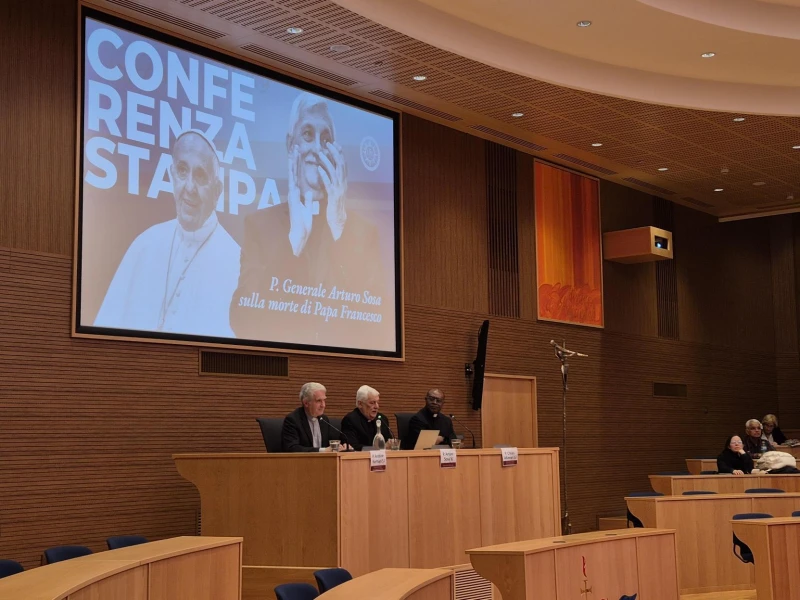
Jesuit Superior General Father Arturo Sosa, SJ, center, speaks about Pope Francis at a press conference at the Jesuit general curia in Rome on April 24, 2025. / Credit: Hannah Brockhaus/CNA
Vatican City, Apr 24, 2025 / 17:28 pm (CNA).
Father Arturo Sosa, SJ, superior general of the Society of Jesus, reflected on the first Jesuit pope in a press conference on Thursday, saying Francis “did not seek to please everyone” or to measure himself by a popularity index.
“Once he chose to be a disciple of Jesus, his deep motivation in life was to put God’s will into practice,” Sosa said, calling the late pontiff “a man of prayer, who asked for prayers to make decisions according to the will of God.”
During the press conference, held in the Jesuit general curia in Rome, Sosa also answered a question about what qualities are needed in the next pope. “Undoubtedly, we are looking for another man of God,” he said.
“And after that, for me, it is important to have a pope with a universal outlook,” he added, drawing a distinction with what he called an “international outlook.”
The Jesuit superior defended Francis against accusations he caused controversy — like with Fiducia Supplicans, the Vatican’s declaration on same-sex blessings — or fell short in some areas by saying he was not the source of problems in the Church but inherited problems that were already there.
“Pope Francis helped put the difference of positions on the table” and provoked dialogue, Sosa said, stressing that the late pope wanted to listen to everyone.
“I don’t think of Pope Francis as a reformer,” Sosa also said. “I think of him as someone who continued the reform that the Church has always carried out.”
About Francis’ record on abuse, Sosa said the pope “always acknowledged his limitations, his mistakes, and his slowness” to respond to cases. “This is not about giving Pope Francis a medal or giving him a grade but about learning about potential criticism and mistakes.”
“With regard to abuse cases, I think the Church is not in the same place when Pope Francis was elected. That’s without a doubt. It hasn’t been a straight line… but the Church has advanced in that direction,” he added.
According to the superior general, Pope Francis’ most urgent legacy for today will be his calls for peace: “I think Pope Francis has shouted in every moment, on every occasion, about peace.”
“The world needs peace and peace is built by us,” Sosa added. “Peace means to put aside any other priority than people and the dignity of people. And peace means justice with the poor. I think the constant prayer and the constant argument about peace by Pope Francis is a very important message for today.”
Pope Francis, who joined the Society of Jesus in 1958, was the first-ever Jesuit to be pope. During his international trips, he would always spend time with local Jesuits in the countries he visited. He also met with Jesuits in Rome during their 36th general congregation on Oct. 24, 2016.
“He established a very fraternal relationship with the Jesuits,” Sosa said on April 24. “We will end this period of Pope Francis thanking the Lord.”
If you value the news and views Catholic World Report provides, please consider donating to support our efforts. Your contribution will help us continue to make CWR available to all readers worldwide for free, without a subscription. Thank you for your generosity!
Click here for more information on donating to CWR. Click here to sign up for our newsletter.
Vatican City, Feb 2, 2019 / 06:01 am (CNA).- Pope Francis is set to celebrate the first papal Mass on the Arabian peninsula next week during his Feb. 3-5 visit to Abu Dhabi, capital of the United Arab Emirates.
The pope’s Mass at the Zayed sports stadium on Feb. 5 is expected to draw at least 135,000 people. Many in attendance will be migrant workers from Asia residing in the UAE, a country in which 89 percent of the population are not citizens. It will not only be the first papal Mass on the peninsula, but the first public Mass in the country.
Since the Second Vatican Council there have been significant milestones in Muslim-Catholic relations in the region. Here is a look at some of the highlights:
First pope on a plane
The first time a pope ever traveled on a plane was on a trip to the Middle East. Saint Paul VI flew from Italy to Jordan in January 1964, making history as the first pope to leave Europe. Paul VI met with King Hussein in Amman before continuing his journey to Jerusalem.
The following year, Paul VI issued Nostra aetate, the Second Vatican Council’s declaration on the relation of the Church to non-Christian religions, which stated that “the Church looks upon Muslims with respect” as worshipers of the one God.
First pope in a mosque
Saint John Paul II made history as the first pope to enter a mosque during his visit to Syria in May 2001. John Paul II went to Damascus’ Umayyad Mosque, which had been built in 715 on top of a fourth-century Christian cathedral said to contain the head of John the Baptist.
In March 2003, days before US President George W. Bush announced the official start of the Iraq war, St. John Paul II called for a worldwide fast for peace in the Middle East.
The Polish pontiff, known for his extensive papal travels during his 27-year pontificate, was also the first pope to visit several Middle Eastern nations, including Egypt, Lebanon, Syria, and Turkey.
First synod for the Middle East
Benedict XVI called for the first special Synod of Bishops focused on the Middle East over two weeks in October 2010. His post-synodal apostolic exhortation, Ecclesia in Medio Oriente, focused on the role of Christians living in the Middle East, predicting before the Arab Spring that many Christians would face a decision to emigrate due to the changing political situation in their countries or to remain as a witness to the faith.
Benedict XVI also added Arabic as one of the official languages in his weekly General Audience addresses in St. Peter’s Square. His final papal trip was to Lebanon in 2012, the first papal trip to the region following the outbreak of the Arab Spring.
First papal Mass in Arabia
Pope Francis’ trip to the United Arab Emirates Feb. 3-5 will be the first papal trip to the Arabian peninsula. The focus of the pope’s two-day visit will be interreligious dialogue, particularly with Islam. However, the papal Mass will also make history as the first public outdoor Mass on the peninsula, where each country has restrictions on the freedom of worship.
Pope Francis said that he hopes his trip to Abu Dhabi will be “a new page in the history of the relations between the religions” in the region. During the journey Francis will meet the Great Imam of al-Azhar for the fifth time and will also visit the great mosque of Abu Dhabi.
The UAE trip continues Pope Francis’ emphasis on a culture of encounter and interreligious dialogue. Pope Francis previously visited Egypt in 2017 and plans also to visit Morocco March 30-31.
History still to be made
The Middle Eastern countries of Iraq, Saudi Arabia, Yemen, Oman, Kuwait, Qatar, and Bahrain have yet to receive a papal visit.
On the way to World Youth Day in January, Pope Francis expressed his desire to visit Iraq, but noted that the local bishops have made it clear the country is not yet secure enough for a papal visit.
In Bahrain, construction is underway for the biggest Catholic cathedral in the region, due to be completed in January 2021. The mother church of the Vicariate Apostolic of Northern Arabia will be the first consecrated under the title Our Lady of Arabia.
Swiss Guard cadets prepare their armor in the guards’ barracks at the Vatican on April 30, 2024. / Credit: Matthew Santucci/CNA
Vatican City, May 5, 2024 / 17:00 pm (CNA).
For the newest class of 34 Swiss Guards who will be sworn in on Monday, their service is based on faith and a love for the Church and the pope, as storied as the uniform itself.
“For me it was something, first and foremost, to give something to the Church, because the Catholic Church gave us a lot when I was a child and with this service, I can give something back,” explained Nicolas Hirt, one of the new guards who hails from the Swiss canton of Fribourg.
The cadets, joined by their instructors, gathered for a media event on April 30 in the courtyard behind the barracks adjacent to the Sant’Anna entrance, which was adorned with the flags from each of the Swiss cantons.
The Swiss Guard’s annual swearing-in ceremony will take place on Monday, May 6, in the San Damaso courtyard of the Apostolic Palace. There, the new guards will solemnly raise their right hands, with three fingers extended, representing the Holy Trinity, and proclaim their oath: “I swear I will faithfully, loyally, and honorably serve the Supreme Pontiff and his legitimate successors and I dedicate myself to them with all my strength. I assume this same commitment with regard to the Sacred College of Cardinals whenever the Apostolic See is vacant.”
Swiss Guard cadets drill at the Vatican on April 30, 2024. Credit: Matthew Santucci/CNA
There was a palpable sense of pride, perhaps even a hint of nervousness, as the young men marched last week in the storied corridors, perfecting the ancient rites ahead of a day that will mark a milestone in their lives.
Renato Peter, who comes from a small village near St. Gallen (the first from his village to enter the guards), said he first developed a desire to enter into the service of the papal guards after a trip to Rome in 2012 with his diocese.
“When you work in the Vatican, you have to feel like you go back in history because a lot of European history has been made here,” said Peter, who is mindful that those who wear the iconic tricolor uniform bear a great responsibility and represent a connection to the history of the Church.
“We are the smallest military in the world,” Peter continued, emphasizing that service in the Swiss Guards is like no other. “But, we are not training to make war. We are like the military, yes, but we’re for the security of the Pope.”
The Swiss Guard is indeed the smallest standing army in the world, numbering only 135 members (Pope Francis increased its ranks from 110 in 2018), protecting not only the smallest sovereign territory in the world, Vatican City State, but also acting as the personal security force of the Holy Father.
This year the Swiss Guard celebrated 518 years of service to the Apostolic See. Its history dates back to Jan. 22, 1506, when 150 Swiss mercenaries, led by Captain Kasper von Silenen from the central Swiss canton of Uri, arrived in Rome at the request of Pope Julius II.
But the swearing-in ceremony takes place on May 6, marking the anniversary of the Sack of Rome in 1527 by the Holy Roman Emperor Charles V when 147 guards died protecting Pope Clement VII.
The Swiss Guards form an integral part of the history of the papacy, and a core component of the security apparatus of the Vatican, but they also occupy a special palace in the popular imagination, one underscored by a profound spirituality.
“It’s another world, another culture, and above all doing a fairly unique job, that is to say, there is the protection of the Holy Father,” said Vice-Corporal Eliah Cinotti, spokesman for the guards.
“I don’t think there are many of us who are lucky enough to have the opportunity to serve the Holy Father in that way, therefore the Swiss Guard is a quite unique institution.”
Cinotti observed that for many of the pilgrims coming to Rome, which is often a once-in-a-lifetime experience, the guards act as a point of encounter between the people and the Church, shedding light on an evangelical dimension of their mission.
“Since we are Swiss Guards and represent the pope, we are also there to be Christians, to listen to these people. There is no specific training for this because it already comes from our Christian character to help others.”
Service in the Swiss Guards is both physically and psychologically demanding, and the entry requirements are strict, even though the guards do not face deployment to active war zones, like conventional soldiers.
A prospective guard must hold Swiss citizenship, be Catholic, single, and male (after five years in service the guards are allowed to marry), and be at least 1.74 meters tall (approximately 5’8”). They are required to have completed secondary school (or the equivalent) and have completed mandatory military service.
Despite what some may consider prohibitive entry restrictions, Cinotti noted, during the annual call for applications there are anywhere from 45-50 applicants, and there has not been a problem with recruitment.
During the first round, prospective candidates go through a preliminary screening and, if selected, they will sit with a recruitment officer in Switzerland for an initial interview, which generally lasts anywhere from 30 minutes to one hour. Candidates also have to undergo an intensive psychological test, to assess whether they can withstand the demands of the job.
Should their candidacy proceed, they are then sent to Rome where, for the first two months, they are exposed to the working environment of the Vatican, and around 56 hours of intensive instruction in Italian. Their instruction also includes an emphasis on their cultural and spiritual formation.
Swiss Guard cadets inspect their armor in their barracks at the Vatican on April 30, 2024. Credit: Matthew Santucci/CNA
The cadets are then sent to the Italian-speaking canton of Ticino in Switzerland, where they are instructed in self-defense and the use of firearms by local police. While the guards carry medieval halberds — an ax blade topped with a spike mounted on a long shaft — during official papal events, each is equipped with a 9mm GLOCK 19 Gen4 pistol, taser, and pepper spray.
There is also a two-year minimum service requirement after which they can decide to remain, or return to Switzerland.
“About 80% return to Switzerland and 20% stay,” Cinotti said. “And the 80% who return to Switzerland go to the police or the army or return to their basic profession or go to study at university.”
He also noted there have been some years where a guard will discern a vocation to the priesthood. “And we also had a certain point, people who entered the seminary at the time, one per year more or less.”
He added: “We haven’t had anyone for two years, but I think they will arrive, or rather it’s a question of vocations.”
Swiss Guards stand in the middle of Paul VI Hall during Pope Francis’ general audience on Jan. 10, 2024. Credit: Vatican Media
Cinotti spoke on the myriad security challenges that a guard will have to face in his day-to-day work, which can last anywhere from six to 12 hours of continuous duty, noting that there has been an uptick in the number of people coming to the Vatican for help.
Cinotti also noted that for all of the guards, there has been the additional learning curve of adapting to Pope Francis’ pastoral style, which has brought him in close proximity to the faithful during his audiences in Rome and his travels abroad.
“Pope Francis is like every pope,” Cinotti remarked. “He has his own style, and we must adapt to the pope.”
“If he wants to go to contact the people of God, we must guarantee that, of course, everything is fine, but we cannot prevent it. He does what he wants, he is the pope,” he added.
While this can raise some logistical problems, Cinotti reassured that the guards have been trained to respond to possible threats. He said they have developed a symbiotic, and always professional, relationship with Francis.
“He transmits a certain serenity and a certain awareness that we are there next to him, we are there, like the gendarmerie, which allows us to operate in complete tranquility on the ground without being disturbed,” he said.
“He likes to change plans and will change plans throughout the day,” Cinotti added, “but it suits us very well because we adapt to him and we do this service and for us, it is still important to guarantee his safety.”
My personal tendency is to think like Sosa, as to this I remarked several times regarding the purpose of Francis’ duality. Was it duplicity, or genuine reevaluation intended by loosening the hawsers? Though not entirely.
It’s the last that superior general fr Sosa infers. If that is the case we certainly appear rudderless and drifting at random. In that I find it inconsistent with Christ, the savior who reached out his hand to steady Christ’s faith in turbulent waters. We must have something irrepressibly strong to hold on to.
We read: “Pope Francis helped put the difference of positions on the table” and provoked dialogue, Sosa said, stressing that the late pope wanted to listen to everyone.”
Over fifty years ago, this naive (?) technique was pioneered in the Archdiocese of Seattle–the posturing of listening and responding to others rather than initiating or imposing anything.
For his style and its outcomes, the diocesan archbishop was tagged not for what he did directly but, more charitably, for what less directly still happened on his watch. After the Visitation (and much else), the public letter of correction read partly as follows, and remarkably is still timely, yes (?), for today now on the worldwide stage:
“(a) The need to bring into clear focus–working together with priests, religious and theologians–certain teachings of the Church and their implications for the pastoral practice of the Archdiocese. These include the role of conscience in making moral decisions; the role of the Magisterium in giving definitive guidance in matters of faith and morals; the nature and mission of the Church, together with its sacramental and hierarchical structure; an anthropology which provides an authentic understanding of the dignity of the human person; and a Christology which correctly reflects our Catholic faith concerning Christ’s divinity, His humanity, His salvific mission, and His inseparable union with the Church.
“(b) In particular, the need to present more clearly the Church’s teaching concerning the permanence and indissolubility of marriage [….]
“(c) Greater vigilance in upholding the Church’s teaching, especially with regard to contraception and homosexuality.”
(d and e) Etc.
The upcoming conclave now has to deal broadly with governance, and particularly with Vatican bankruptcy and the metastasized imposition of der Synodal Weg.
It’s always better when Jesuits maintain silence. The election of any Jesuit to the See of Peter is always a mistake.
My personal tendency is to think like Sosa, as to this I remarked several times regarding the purpose of Francis’ duality. Was it duplicity, or genuine reevaluation intended by loosening the hawsers? Though not entirely.
It’s the last that superior general fr Sosa infers. If that is the case we certainly appear rudderless and drifting at random. In that I find it inconsistent with Christ, the savior who reached out his hand to steady Christ’s faith in turbulent waters. We must have something irrepressibly strong to hold on to.
We read: “Pope Francis helped put the difference of positions on the table” and provoked dialogue, Sosa said, stressing that the late pope wanted to listen to everyone.”
Over fifty years ago, this naive (?) technique was pioneered in the Archdiocese of Seattle–the posturing of listening and responding to others rather than initiating or imposing anything.
For his style and its outcomes, the diocesan archbishop was tagged not for what he did directly but, more charitably, for what less directly still happened on his watch. After the Visitation (and much else), the public letter of correction read partly as follows, and remarkably is still timely, yes (?), for today now on the worldwide stage:
“(a) The need to bring into clear focus–working together with priests, religious and theologians–certain teachings of the Church and their implications for the pastoral practice of the Archdiocese. These include the role of conscience in making moral decisions; the role of the Magisterium in giving definitive guidance in matters of faith and morals; the nature and mission of the Church, together with its sacramental and hierarchical structure; an anthropology which provides an authentic understanding of the dignity of the human person; and a Christology which correctly reflects our Catholic faith concerning Christ’s divinity, His humanity, His salvific mission, and His inseparable union with the Church.
“(b) In particular, the need to present more clearly the Church’s teaching concerning the permanence and indissolubility of marriage [….]
“(c) Greater vigilance in upholding the Church’s teaching, especially with regard to contraception and homosexuality.”
(d and e) Etc.
The upcoming conclave now has to deal broadly with governance, and particularly with Vatican bankruptcy and the metastasized imposition of der Synodal Weg.
O Give thanks to the Lord for He is good.