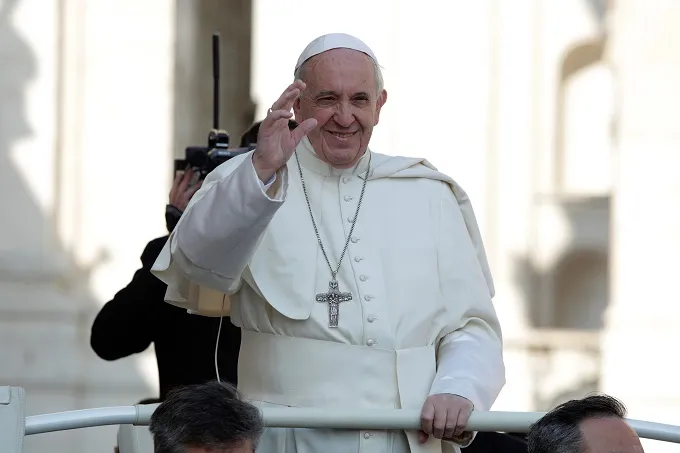
Vatican City, Apr 12, 2017 / 07:21 am (CNA/EWTN News).- As the Church this week reflects on Jesus’ crucifixion and death, Pope Francis said that it is the cross that gives us hope, and urged faithful to enter into the mystery of Christ’s death by contemplating the joy that comes from sacrifice.
“During these days, days of love, let us be enveloped by the mystery of Jesus who, like a grain of wheat, in dying gives us life. He is the seed of our hope,” the Pope said April 12.
“Let us contemplate the Crucified Christ, the source of hope. Little by little we realize that hope with Jesus is learning to see, indeed right now, the plant in the seed, Easter in the cross, life in death.”
Speaking during his weekly general audience in St. Peter’s Square, Francis told pilgrims he was giving them some homework. He instructed them when they get home to stop in front the crucifix, look at Jesus and tell him: “With you, I can always hope. You are my hope.”
“Now imagine the crucifix,” he told the crowd, “and all together say to Jesus Crucified, three times: ‘You are my hope.’” When the crowd said, Francis wasn’t convinced, and had them repeat it again even louder.
“We we really believe that in the Crucified Christ our hope is reborn,” he said, but cautioned that “it is a different hope from that of the world. What hope is this? The hope that is born of the cross.”
Love and hope come together on the cross of Christ, he said, explaining that this is a cross everyone must carry at different points in their lives.
“But it’s beautiful to help others, to serve others,” he said, noting that this can get tiring at times, “but life is like that…This is love and hope together: to serve and give.”
“Of course, this love comes from the cross, from sacrifice, as it did for Jesus,” he said, stressing that the cross in itself is not the goal, but rather “a necessary step” to the ultimate goal, which is “glory, as Easter shows us,” he said.
It is in laying down one’s life, not holding onto it, that we find true joy, the Pope said, and pointed to the sacrifice of a mother, which he said is “another beautiful image that Jesus left to his disciples during the Last Supper.”
Jesus says in John 16:21 that “the woman, when giving birth, is in pain, because her hour has come; but, when she has given birth to the child, she no longer remembers the suffering, because of the joy that a child has come into the world.”
This is what mothers do, Francis said, noting that they give life to another through suffering, but then they are “joyful and happy (because) love gives birth to life and even gives meaning to pain.”
Love is the “engine” that fuels our hope, he said, and encouraged pilgrims to ask themselves: “Do I love? Have I learned to love? Am I learning every day to love more?”
“There is no other way to overcome evil and to give hope to the world,” he said, except by serving with humility and love.
“Have you thought about this?” he asked. No one likes to lose power and the logic of the seed that must die before bearing fruit is difficult to understand, he said, but stressed that this is the way of God.
He pointed to how many times in life we move forward with the mentality that the more we have the more we want. However, Jesus clearly says the opposite: “He who loves his life will lose it.”
This is why our hope is born from Christ’s transformation of death into life, he said, explaining that in the same way Jesus transforms our own sin into forgiveness, “our death into the resurrection, our fear into confidence.”
“That’s why there on the Cross, our hope is born and is always born again; that’s why with Jesus all our darkness can be transformed into light, every defeat into victory, every disappointment into hope. Every? Yes, every.”
 […]
[…]


 By
By 


A comprehensive attempt at reconciling Humanity with technological advancement. Leo XIV to his credit integrates John Paul II with Pope Francis. He does so with focus on the common good and the preservation if not restoration of our humanness in an already digitalized culture.
“In this same vein, I too have reaffirmed that the Church does not claim to possess a monopoly on truth, because truth is not a territory to be defended, but a good to be shared. For his part, Pope Francis expressed this same perspective in his striking phrase, time is greater than space”.
This is a provocative comment that can be understood from a progressive or more conservative perspective. At this interval Pope Leo deserves a positive interpretation of his effort at reconciliation of the Francis break with his predecessors.
Should read: [for] his effort at reconciliation of the Francis break with his predecessors.
Interesting read.
One example where “time is greater than space” breaks down, would be Zionism. Zionism is not limited by either space or time, where both are subordinated and dominated; and it stakes its claims on them equally, only limited by momentary exigencies.
‘ We must speak frankly: there are some people who are committed to conquering their perceived enemies and their chosen method—their only method—is lethal violence. I am nearly finished writing my next book right now, titled Eastern Christian Encounters with Islam, and anyone with even a passing knowledge of the history of Syria, Egypt, Armenia, or many other countries knows how many millions of Christians, ancient and modern, from the seventh century to the twenty-first, have perished or been persecuted because certain Muslims were more interested in jihad than in jaw-jaw, more ruthless in pursuit of conquest than conversation. (At the same time, however, as the book will show, there have been periods and places where Muslim-Christian relations were rather amicable if often one-sided.)
Constant exhortations to Christians, then, to continue to dialogue with other religions must be met by even more constant and even more vigorous demands, by, from, and for Muslims themselves, that they now and forever forswear any and all uses of violence against all people over cartoons or other equally absurdly trivial and non-life-threatening things. ‘
https://www.catholicworldreport.com/2015/02/10/the-dangers-of-abstraction-and-the-limits-of-dialogue/
My Comment Joseph M. Sammut
Magnifica Humanitas
We are living a moment where artificial intelligence is rapidly shaping how we work, decide, and relate to one another. It is often presented as progress, yet it quietly raises deeper questions about human dignity, truth, and responsibility.
Magnifica Humanitas helps us recognise that the real issue is not only the technology itself, but the values being built into it. Technology is never neutral; it carries the vision of those who design and use it.
This creates a tension: will these systems serve the human person, or will they begin to reshape what it means to be human in narrower, controlled ways?
The Letter invites us to move beyond passive acceptance. It calls us to take responsibility—to question, to discern, and to ensure that the development of artificial intelligence reflects our shared dignity and interdependence.
The challenge before us is clear: not simply to manage technology, but to shape it with conscience, so that it truly serves life.