
The Dispatch: More from CWR...

The Mathematics of Morality

No calculation of consequences can render an intrinsically evil act morally acceptable.

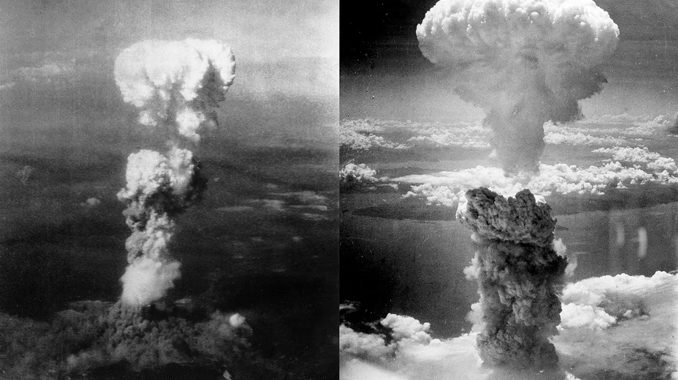
Aerial photos of atomic bomb mushroom clouds, over the two Japanese cities of Hiroshima (left) and Nagasaki (right) in August 1945. (Wikipedia)

Pope John Paul II reaffirmed traditional Catholic moral teaching in his 1993 encyclical Veritatis Splendor. In particular, he rejected consequentialism and its close cousin, proportionalism, as incompatible with orthodox Catholic morality. It is worthwhile to consider the consequences of sin, but circumstances and intention can never justify an intrinsically evil act.

In one of the most intellectually seductive comments in the Bible, the High Priest Caiaphas famously said, “Better that one man should die than a whole Jewish nation.” The Roman occupiers were brutal enough. Caiaphas knew the Romans viewed the Judeans as a powder keg. Do the math. Why not eliminate one man for the sake of the entire nation? Caiaphas’s argument exemplifies the consequentialist temptation: sacrificing an innocent person for an anticipated greater good.

Many defenses of the large-scale bombing of population centers during World War II appeal to consequentialist reasoning: the destruction of civilians, it is often argued, was justified by the greater good of ending the war. Japan announced its surrender on August 15, 1945, the feast of the Assumption. Yet the bombings also produced devastating immediate and long-term human consequences.

Osama bin Laden explicitly invoked Hiroshima and Nagasaki to justify his retaliatory terrorist violence. The late Senator Lindsey Graham appealed to the same history in defending Israel’s conduct in Gaza. In a February 2026 interview with Sky News Arabia’s Hadley Gamble, Graham said, “Just flatten it. We flattened Berlin. We flattened Tokyo,” and defended the atomic bombing of Japan by asking, “Were we wrong to drop an atomic bomb to end the Japanese reign of terror?” He added that, if he were Israel, he “would have probably done it the same way.”

Some Catholics make the same consequentialist argument. Here is a comment from a Catholic website in response to an article that opined that the atomic bombings were intrinsically evil violations of Catholic just war teaching:

You seem to be unaware of the very extensive recent scholarship that has established beyond a reasonable doubt that the Japanese government was NOT ready to surrender before the second bomb was dropped on Nagasaki. The bombs were decisive, not superfluous. And in Japanese-held areas, half a million people, mostly non-white Asians, were dying every month the war went on, from starvation, disease, and brutality. Your moral arithmetic must account for those numbers.

“Moral arithmetic” becomes consequentialist when the calculation of consequences is used to justify an intrinsically evil act. Catholic teaching unequivocally condemns any act of war aimed indiscriminately at the destruction of entire cities or extensive areas together with their populations (cf. Vatican II, Gaudium et Spes, n. 80). The moral question concerning Hiroshima and Nagasaki is whether those attacks should be understood as falling under that prohibition.

No calculation of consequences can render an intrinsically evil act morally acceptable. We may disagree about historical facts or their application, but we should at least be honest about the moral framework we are using. Understanding the principles that guide our judgments is necessary for genuine moral dialogue. A defender of the bombings might object that this is not consequentialism at all.

The question then becomes whether the attacks were directed at legitimate military objectives, whether civilian deaths were proportionate and unintended, and whether the attacks fell within the Church’s condemnation of indiscriminate destruction. If an act is intrinsically evil by reason of its object, however, anticipated favorable consequences cannot make it permissible.

In May 1945, President Truman formed an Interim Committee to advise on the use of nuclear energy and weapons. The Committee’s conclusion: “We can propose no technical demonstration likely to bring an end to the war. We can see no acceptable alternative to direct military use.”

The day after Hiroshima, Senator Richard B. Russell urged Truman to use as many atomic bombs as possible, saying Americans believed Japan should be struck until brought “groveling to their knees.” Truman responded:

I know that Japan is a terribly cruel and uncivilized nation in warfare, but I can’t bring myself to believe that because they are beasts, we should ourselves act in that same manner. For myself, I certainly regret the necessity of wiping out whole populations because of the ‘pigheadedness’ of the leaders of a nation, and, for your information, I am not going to do it unless absolutely necessary.

On August 9, the day Nagasaki was bombed, Truman received a telegram from Samuel McCrea Cavert, a Protestant [not Catholic!] clergyman, pleading that he stop further atomic devastation. Two days later, Truman replied, “When you have to deal with a beast, you have to treat him as a beast.” The two bombs took the lives of more than 200,000 people by the end of 1945, many of them civilians, including women and children.

Beasts?

We cannot settle questions of war and peace merely by adding up the lives saved and the lives lost. Catholic moral reasoning begins with a simple principle: do good and avoid evil. Consequences matter, but they cannot make an intrinsically evil act good. Catholic martyrs are saints because they refused to commit evil even when circumstances and consequences seemed to demand it.

John Henry Newman, in Apologia Pro Vita Sua, defended the Catholic Church’s teaching about sin:

The Catholic Church holds it better for the sun and moon to drop from heaven, for the earth to fail, and for all the many millions on it to die of starvation in extremest agony, as far as temporal affliction goes, than that one soul, I will not say, should be lost, but should commit one single venial sin, should tell one wilful untruth, or should steal one poor farthing without excuse.

Sin—including Original Sin—is ultimately the source of human suffering.

We cannot expect those committed to consequentialist reasoning to abandon the mathematics of their morality. But we should expect honesty as we identify our guiding moral systems.

“For what shall it profit a man, if he gain the whole world, and suffer the loss of his soul?” (Mk 8:36)


If you value the news and views Catholic World Report provides, please consider donating to support our efforts. Your contribution will help us continue to make CWR available to all readers worldwide for free, without a subscription. Thank you for your generosity!

Click here for more information on donating to CWR. Click here to sign up for our newsletter.


About Father Jerry J. Pokorsky 56 Articles
Father Jerry J. Pokorsky is a priest of the Diocese of Arlington. He is pastor of St. Catherine of Siena parish in Great Falls, Virginia.. He holds a Master of Divinity degree as well as a master’s degree in moral theology.

75 Comments

  1. Violence and the consequences of violence, which is the creation and perpetuation of ever escalating violence, can never be justified within objective morality and subjective morality is always a lie used to make one believe that a wolf is a sheep.

    After having been betrayed in the garden, condemned to death, scourged, crowned with thorns and made to carry the cross to Golgotha, Jesus did not ask his heavenly Father for a violent rescue…and neither should we.

    Peace is never accomplished by the violence of war. War only leads to a momentary cessation of immediate conflict, a conflict that then morphs into other forms so as to continue the violence and perpetuate the injustice.

    The faith and the Church rose out of the blood of the martyrs, “warriors” willing to die for peace and who resisted violence with love.

    Hate is a form of violence and is never justified.

    We are our brothers keeper who should keep in mind the consequences Cain received for his violent, hate filled action.

    We each have a choice of whether to follow Cain or Christ…to create our own condemnation or to accept the offer of salvation.

    Yours in Christ.

    • What about the failed attempts to take out the drug induced Hitler? Was those attempts wrong to save their country? Will a man die to save his own family? I think most would.

    • Everyone that says a particular evil act is justified because in the end it killed fewer people than pursuing the alternative. It is very easy to find people that make that argument. It’s widespread and the author is not compelled to offer specific examples.

      • “It’s widespread and the author is not compelled to offer specific examples.”

        The best arguments provide examples. Otherwise an abstract idea becomes nebulous and instruments against a phantom menaces.

  2. To Mr. Harrell: The Catechism actually mentions that those who have responsibility for others have a Duty to defend them.
    That would be even if violence would be required. The church is not pacifist.

    Good article Father Pokorsky, although I do not think that the late Lindsey Graham is a good example to use when discussing the merits or lack of merits in war.

  3. About the match line between mathematics and moral theology, three points and a takeaway:

    FIRST, some 75 million people died in World War II, two-thirds of them civilians. The novelty of bombing civilians began not in 1937 at Guernica in Spain but earlier with both Britain and Germany in World War I. The numbers killed later at Hiroshima and Nagasaki pale in comparison with all of those killed by conventional saturation bombing, including the 100,000 in one night of conventional fire-bombing at Tokyo.

    All of this is not to justify the atomic bombings, but to underline how totally disjointed is our world today under routinized Technocracy in all of its forms.

    SECOND, All of World War I and World War II and the Cold War are simply phases in the same war. So, the question imposes itself: In 1945, DID actual photographs of flattened Hiroshima/ Nagasaki unwittingly transplant ‘theoretica’l nuclear physics into the ‘non-theoretical’ and bi-polar world of global politics? The evolving Cold War “phase” mutated onto steroids? A bizarre half-century nuclear arms race—toying daily with Mutual Assured Destruction (MAD)? Late wartime correspondence (the Szilard/Compton Letter, July 24, 1945)—intended for TRUMAN but never delivered—warned of this mutation under the Law of Unintended Consequences…. Today, nine nuclear powers–and from out of the 7th-century a rogue/jihadist tenth member cutting its own key to the executive washroom.

    THIRD, for those who might be so bored as to be interested in my personal memories and reflections on atom-splitting and on the entirety of our 20th-century convulsion: https://theimaginativeconservative.org/2021/08/meditations-bomb-small-town-cul-de-sac-peter-beaulieu.html

    TAKEAWAY: The whole thing is surreal, incomprehensible, and cruel beyond any imagining. Therapeutic history books fail us. And now, with whatever is left of human grandeur and responsibility, we have a new and substitute toy—AI algorithms.

    About which, “Magnifica Humanitas” is NOT just another waste of 40,000 words on Vatican letterhead….AI = domination by benefit/cost ratios on steroids?

      • The South or South America?
        🙂
        Years ago the local doctor in our rural Southern community wasn’t a Nazi leader as far as I know but he had flown in the Luftwaffe during the war. His wife was German, also & a practicing Catholic. I wasn’t aware of him ever attending Mass.

        I’m guessing they received some kind of refugee status through the Church to come here. He didn’t profess loyalty to the Third Reich but he never completely left all the eugenics aside. His estimation of rural people was pretty low.

        It’s hard to know how he ended up in a little country practice but we were grateful for the extremely reasonable fees he charged. If you didn’t have anything seriously wrong it was a great deal.

        • “His estimation of rural people was pretty low.”

          Was it as low as Obama’s?

          “They get bitter, they cling to guns or religion or antipathy to people who aren’t like them or anti-immigrant sentiment or anti-trade sentiment as a way to explain their frustrations.”

          April, 2008.

          • Our doctor gave the impression he thought the local country people were backwards and inferior in some way. When he died I learned through his obituary he’d been a Planned Parenthood supporter. Which makes sense.

            He may very well have agreed with Pres. Obama about those other things.

    • Thanks, Dr. Beaulieu for the link to your profound 2001 essay! I had not encountered it before. More worthwhile and deeper than 99% of what I read even in most “Christian conservative” websites.

  4. What’s not reported is that Hiroshima was the military headquarters for the defense of Japanese home islands. Additionally, soldiers viewing the destroyed landscape in Hiroshima saw the remains of much industrial machinery installed in residential areas. Given the military importance of Hiroshima, and that the civilians were actively participating in the war effort, made Hiroshima a legitimate military target.

    • Civilians can always be considered to be actively participating in the war effort.

      They are not soldiers, by definition, but they contribute economically. It is always civilians who supply the military with guns, bombs, ships, tanks, armor, cars, clothes, food, buildings, medecine, cleaning supplies, tax dollars… by that logic, as the article mentioned, most terrorist attacks are directed at legitimate civilian targets. Any business that contracts with the federal government, and any employee of those businesses, is rendered a legitimate target. That includes Dell, Microsoft, Boeing, Sysco, and enough others to render the deaths of the few civilians utterly unconnected with companies somehow contributing to the war effort into “unintended collateral damage”.

      This is clearly a perverse definition.

      One could justify unintended deaths of many civilians, based on the innacuracy of the bombs available, and in most cases I expect that was the reason. But not all. If I recall correctly, the stated reason behind firebombing Dresden was specifically to demolish the morale of the German civilians. Mainly by killing them and destroying their homes, businesses, and churches.

      When the atomic bomb was dropped on Nagasaki, the bomber used the steeple of Immaculate Conception Cathedral to find his target. Presumably, since Japan was still fighting, there were actual military targets to be found.

      • Factcheck: The destruction of Dresden was allowed by Churchill to proceed in order to impress Stalin, even the day after the Yalta agreement had been signed: “So the ghastly mass murder was completed in vain […] all non-combatants, mostly women, children, and old men, but including foreign slave laborers [….] at least two-thirds of the victims were burned alive,” (Von Kuehnlet-Leddihn, “Leftism: from de Sade and Marx to Hitler and Marcuse,” Arlington House, 1974, p. 310). Possibly 500,000 were killed in Japan by General LeMays incendiary saturation bombings (100,000 in Tokyo alone), twice that killed at Hiroshima and Nagasaki combined.

        Conventional WW II bombing was only accurate within half a mile, but with the top-secret new bombsites (correcting for wind, air speed, and even airplane turbulence) the later bombing was within 100 yards of the target. So, about Nagasaki, why did the bomb detonate two miles from the intended target?

        …”In general the Nagasaki attack did not go smoothly. Luis Alvarez (a scientist who had flown on the Hiroshima raid) later stated his belief that Nagasaki was bombed by radar—not visually, as orders specified and as the officers on the Nagasaki mission claimed. The aiming point designated in the Mission Planning Summary was missed by almost two miles” (sources from the Groves Papers are detailed in Gar Alperovitz, “The Decision to Use the Bomb”: HarperCollins, 1995, p. 534)

        About Immaculate Conception cathedral, on July 17, 2025 the donation-funded second bell was finally installed in the restored church building and was rung on August 9—eighty years after the 1945 detonation. https://stkateriinstitute.org/nagasaki-bell-project-2/

        • It has been my understanding that, for the most part, precision bombing in WWII was more of a myth than a reality in real world combat conditions. The conventional explosive bombs dropped during WWII were dumb bombs with no guidance system. After the drop they were governed by Newton’s laws. The Norden bombsight worked great on test runs, but the realities of air combat degraded its performance. The Navy was an early backer of the Norden bombsight. The Navy had to abandon the use of high altitude bombing and the Norden bombsight and go with dive bombing and skip bombing. According to the Wikipedia article on the Norden bombsight:
          *
          https://en.wikipedia.org/wiki/Norden_bombsight
          *
          the circular error probable in 1945 was 900 feet. The article said that a 500 pound bomb had a lethal radius of 60 to 90 feet. The first early versions of Allied smart bombs were in their infancy during WWII, and were not a factor in the war.
          *
          According to an Air & Space Forces magazine article titled “Daylight Precision Bombing”
          *
          https://www.airandspaceforces.com/article/1008daylight/
          *
          The Hiroshima a-bomb fell 800 feet from the aiming point, and the Nagasaki a-bomb fell 1,500 feet from the aiming point. The article stated that the jet stream over Japan was a problem for high altitude bombing missions. The article further stated that “Japanese industry, including cottage industries making military parts and equipment, was so integrated with populated areas that it was difficult to draw the line between them”. The article also stated that it wasn’t until the Gulf War that bombing truly attained pickle barrel levels of accuracy.
          *
          There is a video on YouTube about the bomb damage to both Hiroshima and Nagasaki, “The Effects of the Bomb: Hiroshima Nagasaki”:
          *
          https://www.youtube.com/watch?v=eFalyguyRAU
          *
          It has an interview with a priest where he talked about the explosion and the aftermath. He discussed a debate as to the use of the bombs. Video of the Jesuit novitiate starts at the 15:50 minute mark and is followed by the interview.
          *
          At the 27:30 minute mark it was stated that homes were scattered in factory areas where machinery was used to do piecework to support the war effort.
          *
          This agrees with the “Daylight Precision Bombing” article in the Air and Space Forces Magazine.

          • Thank you for the references. I was only casually informed on the bomb site.
            Still, at Nagasaki the intended target and the actual “aiming point” (fog, radar vs visual) are very likely not the same thing. As for the jet stream effect, the usual deflection would not apply to a bomb weighing 10,000 pounds rather than only 500. The real miss was 1.9 miles, not 1/3 rd mile (1,500 yards).

          • The first post war bomb tests were done during Operation Crossroads. Its purpose was to test the effects of the a-bomb on naval ships. The first test Able was an air drop of a Nagasaki type plutonium bomb. The press was invited. The drop fell wide of the aiming point blunting the effectiveness of the weapon. The press had mixed reviews. You could consider this to be a demonstration use of the bomb.
            *
            The second test Baker was an underwater explosion. This resulted in a lot of radioactive contamination. Plutonium is toxic, there was plutonium contamination of the test ships. A person working on the tests placed a fish on film and the radiation from the fish produced an image. When this was known it resulted in the halting of decontamination efforts. Most of the test ships had to be sunk.

          • A total of 23 atomic bomb tests were conducted at Bikini atoll between 1946 and 1958. The report is that cockroaches survived the whole thing.

    • Great comment, I could make more. Will point out that more than 80 yrs since end of WW2, no one around today have a clue about the fact that the allies wanted the War ended. The horrendous loose of life had to end. It is easy now to sit back and criticize the decision to drop the bomb.
      Talk about the math. Now today the Church in effect hardly bats an eye regarding the millions upon millions of babies aborted each year. Few sermons, bishops are silent as can be on the subject. Only a few brave Catholics pray in front of abortion mills, it would be astounding if for just once a bishop would pray with his fellow Catholics in front of an abortion mills. That kind of math is unlikely.

    • Vatican II GS #80:

      Any act of war aimed indiscriminately at the destruction of entire cities of extensive areas along with their population is a crime against God and man himself. It merits unequivocal and unhesitating condemnation.

    • I hope you’re not serious. The immense evil that would have resulted made involvement a moral necessity. Imagine Nazism in power over all Europe, the middle east, North Africa, etc. Imagine the many many more million innocents that would have been killed because they were Jews, Roma, disabled, gay, Slavs….

  5. I’m on page 15 of Magnifica Humanitas, and already the “common good” is mentioned many, many times. What’s that about?

    • In answer, here’s my comment to “Robert” under a different article:

      Robert,
      You ask “what the hell is ‘common good’ but a nebulous almost at times demonic excuse for taking away real people’s real rights.” A good question, but possibly backwards? Yes, legitimate human freedom is open to many possible futures, but the natural law (the common good) much of the time does not inform us exactly what to do. But, rather, constrains us from what NOT to do (point #3 below). This picture is not so “nebulous.”

      A few points of elaboration:

      FIRST, the common good “embraces the sum of those conditions of social life by which individuals, families, and groups can achieve their own fulfillment in a relatively thorough and ready way” (Gaudium et Spes, n. 73; echoing the early encyclical “Mater et Magistra,” John XXIII, 1961).

      SECOND, the Second Vatican Council then identifies what NOT to do, by proposing as an explicit teaching what is also self-evident:

      “(Furthermore), whatever is opposed to life itself, such as any type of murder, genocide, abortion, euthanasia, or willful self-destruction, whatever violates the integrity of the human person, such as mutilation, torments inflicted on body and mind, attempts to coerce the will itself; whatever insults human dignity, such as subhuman living conditions, arbitrary imprisonment, deportation, slavery, prostitution, the selling of women and children; as well as disgraceful working conditions, where men are treated as mere tools for profit, rather than as free and responsible persons; all these things and others of their like are infamies indeed. They poison human society, but they do more harm to those who practice them than those who suffer from the injury. Moreover, they are a supreme dishonor to the Creator” (Gaudium et Spes, n. 27).

      Likewise, the magisterium and the Catechism of the Catholic Church (CCC, 1992) also identify intrinsically evil acts, including: intentional killing of the innocent (CCC n. 2273), infanticide (n. 2268), abortion (n. 2273), euthanasia (n. 2277); (and sexual immorality: nn. 2352, 2353, 2356, 2357, 2370, 2380, 2381).

      The follow-up encyclical “Veritatis Splendor” (Pope St. John Paul II, 1993) clarifies further that while there is no upper limit to the life of freedom, virtue and charity, there is a lower limit below which the Commandments (i.e., the natural law) are broken. Affirmed are moral absolutes, while refuted are the nebulous (!) notions of the Fundamental Option, Proportionalism (bundling of good with some evil) and Consequentialism (the error that the end justifies the means).

      THIRD, to repeat, the not-nebulous natural law usually tells us what NOT to do:

      “…the idea of natural law remains as it were ‘latent’ [!]. But it makes itself felt whenever the positive law [legislation] in itself or in the eyes of a large number of people, appears to be in conflict with the natural law. Then the primordial rights of the person, the family, and the national group stand forth with elemental force against the power of the state, which develops into tyranny by denying the foundations of political community, its own moral root: the natural law” (Heinrich Rommen, “Natural Law,” Liberty Fund, 1998).

  6. One may reasonably consider the idea that modern Catholicism would rather appease objective evils rather than mitigate those evils as effectively as humanly possible.

  7. Pokorsky’s “argument” is a biased and unsupported straw man. He operates under the false a priori argument that dropping the bombs was intrinsically evil. Allied bombing pales in comparison to the Japanese army’s mass murder of 15 million people in Southeast Asia.

      • Well Boomer, who exactly determined that is was a war crime? That was my point. What do you actually know about World War II that you haven’t read about in the New York Times or your DNC talking points? What scholarly books have you read about the bombing campaigns?

        • War crime has been defined;
          A war crime is a serious violation of international humanitarian law committed during an armed conflict. It involves breaking the accepted rules and customs of war designed to protect non-combatants, wounded soldiers, and prisoners.Key Legal FrameworksThe Geneva Conventions: Treaties that set the baseline standards for humane treatment during wartime, particularly for civilians and prisoners of war.The Hague Conventions: International agreements focusing on the methods and means of acceptable combat behavior.The Rome Statute: The founding document of the International Criminal Court (ICC), which formally defines specific acts as war crimes.Common ExamplesIntentionally killing, torturing, or mistreating civilians or prisoners of war.Directing attacks against protected infrastructure, such as hospitals, schools, or historical monuments.Using prohibited or indiscriminate weapons, like chemical or biological agents. Forcing children into military service or using civilians as human shields. Plundering or wantonly destroying property not justified by military necessity. (targeting civilian infrastructure as with the hospital as point zero in Hiroshima is a war crime, kid. No book can replace being there at the memorial site for a life lesson.)

        • No. War crimes are commonly defined see my reply to Athanasius. Legit self defense still requires avoiding crimes. It does not give one license to do anything at all or take revenge. It must be proportional and only as needed to protect one’s life or the life of others.

  8. Al-Jazeera, a Qatari owned and operated public news outlet, operates AJ News. Graham’s interview comments were given to AJ News to air. Most likely the senator hoped Iran would hear the talk.

    Talk differs from action. Both are given for many different reasons. A question for consideration: Has Iran been flattened?

  9. Somewhere in the decades that have followed that unique fusion of human blood lust and a leaping capacity to inflict death on a scope or scale previously unseen that was World War II, the A Bomb has somehow become the “designated deviant”, as if the firestorms of Dresden or Tokyo were the precision guided bombs we’re used to seeing go down an exhaust stack.

    I am not a particular fan of Truman, but I have sympathy for a folksy haberdasher who became Roosevelt’s latest “bucket of warm spit” (a quote attributed to his first second on the value of the “veep” office) suddenly thrust into this decision, without so much as having been informed about existence of the damn thing by FDR.

    As to the use of the term “beast”, it clearly didn’t apply to ordinary Japanese, but the Imperial high command, with the Kamikazes, the Rape of Nanking, The Bataan Death March and Unit 731 arguably did everything in their power to dehumanize themselves.

    So here you are three months into a Presidency forced upon you. Contra William, FDR was President most treated with unquestioned fealty. You are told “Trinity” (was that name insidious mockery?) was a success. You have war weary nation and you are told the price of completion was conventional bombing was a land invasion which is estimated to kill millions, including the women and children who would be used as terrestrial kamikazes.

    You imagine a scenario where you don’t use this weapon, and the public, after enduring 407K deaths, finds out that in say, 1947 Operation Downfall has claimed another 300,000 GI lives and you chose a land invasion relying on swarms of B-29’s to use chemical bombs. GI’s come home and it leaks out how awful house by house operations are. Two million civilians are dead. Letters fill Congressional offices and you are Impeached and remain a pariah for the rest of your days.

    I’m just glad I wasn’t presented with this decision, and I think the Japanese were responsible for Nagasaki.

  10. Some amateur ruminations about the “decision” to actually use the bomb in August 1945 on Japan (rather than as a deterrent to the German nuclear program (surrendered in May)—what if instead it was more about “momentum” as an accumulation of half-decisions? Truman edited every line of his later biography to ensure that the buck stopped with him alone. But might he have been taking credit to protect a nation from a possible crisis of conscience?

    Four points and a takeaway:

    FIRST, consider that the estimate of a million military casualties doesn’t show up until 1947 (article signed by Stimson, Sec. of War), the year after John Hersey’s on-the-ground report in his “Hiroshima” (full edition of Harper’s Magazine in March 1946)….Wartime estimates for a staged invasion are a small fraction of this figure (e.g, Stoff et al, “The Manhattan Project” documents, 1991; and Alperovitz citing Rufus Miles, Jr., “International Security,” Fall 1985, and Barton Bernstein, the “Bulletin of the Atomic Scientists,” June 1986).

    SECOND, for sake of argument: (a) WHAT if Truman had decided (!) to clarify to a post-Samurai culture what our cultural expression “unconditional surrender” (the Civil War ultimatum at Fort Donelson) meant and what it did NOT mean—as was urged by members of his staff and by the public press? (The emperor was eventually retained, and American soldiers were not the portrayed cannibals in search of Japanese children.). (b) WHAT if the ambiguous Japanese comment “Mokusatsu” had been interpreted as “no comment” rather than early “rejection” of the Potsdam Declaration? (c) WHAT if the urgency of the “decision” was not even about two Japanese cities (!) but was to restrain Russia from invading Manchuria on August 15 and then imposing an Iron Curtain across Japan? (A strategic concession unnecessarily [?] conceded to Stalin at the Yalta Conference, to help ensure that Germany was trapped in a two-front war.)

    THIRD, and (d) WHAT does Brigadier General Leslie M. Groves (manager of the entire Manhattan Project) actually mean by these CONTRADICTORY assessments: “In my opinion, [Truman’s] resolve to continue with the original plan will always stand as an act of unsurpassed courage and wisdom [….] (p. 266).

    But ALSO this: “As far as I was concerned, [Truman’s] decision was one of noninterference [momentum!]—basically not to upset the existing plans (p. 265) (“Now it can be Told: The Story of the Manhattan Project,” De Capo Press, 1962).

    FOURTH, about a “decision” versus “momentum,” also this likely controversial conclusion from the “Strategic Bombing Survey” (1946): “…certainly prior to 31 December 1945, and in all probability prior to 1 November 1945, Japan would have surrendered even if the atomic bombs had not been dropped, even if Russia had not entered the war, and even if no invasion had been planned or contemplated.” BUT, possibly influenced by overall air boss Major General Curtis E. LeMay: “The atomic bomb had nothing to do with the end of the war at all” (e.g., Sept. 12, 1945 press conference).

    TAKEAWAY: How much do we claim to be making decisions while we’re really just ratifying the flow of events? Example: Obergefell v. Hodges, 2015.

    • You keep making the same points about this topic every year. The Japanese would not have surrendered. Surrender was not an option in the Japanese hierarchy, and the current historical evidence makes that clear. The estimate of one million potential American casualties was also not made after the war in 1947. It was made after Iwo Jima and Okinawa, two battles that cost the lives of most of the Japanese soldiers who fought there. I’m not sure where you are getting your information, but it might be time for an update. Victor David Hansen’s book, The Second World Wars, is a good place to start for detailed and current scholarship.

    • Japan was not going to surrender! They had been preparing their populace for “the honorable death of the 100 million,” even teaching children to attack soldiers with bamboo sticks. The people standing outside to hear a government loudspeaker message fully expected it was going to order that resistance. Instead it was the Emperor’s surrender speech, delivered in archaic courtly language the common people couldn’t understand. Remember the films of Japanese civilians holding babies jumping off cliffs rather than surrender during the island campaigns? Remember the ghastly Okinawa campaign with combined death tolls–principally civilians– greater than Hiroshima and Nagasaki combined? Besides the casualties of a Home Islands invasion, there was also a standing order to kill all prisoners in Japanese hands–many more thousands of people. (see Tennozan by George Feifer on the relationship between Okinawa and the decision to drop the atomic bomb or Downfall by Richard B. Funk on the end of war.)

      There had been an attended coup by rabid young officers to prevent the surrender speech from being broadcast by attacking the radio station. A plan to attack the palace and kidnap the Emperor was thwarted by the chance sighting of American bombers overhead.

      I cannot imagine how anyone would have expected low casualties and quick surrender from a Home Islands invasion. And if we had simply blockaded Japan, there would have been millions of civilian deaths from starvation and disease–but no surrender. Or had we declared victory and sailed sailed away, there were still all those Japanese soldiers occupying swathes of Asia. What to do about them? Oh, I know. We should have adopted a policy of absolute pacificism and not waged WWII in the first place.

    • Responding to Athanasius and Meisel,

      The points you raise are familiar. My proposition, above, is that the “decision” was more a result of “momentum” than full deliberation, because of many complicated layers of fast-moving events. As for my sources (Athanasius), I have already identified them and my proposition actual differs from Alperovitz, based on how I read his massive documentation.

      Four points:

      FIRST, the prominent WW II historian, Samuel Eliot Morrison (now on the list of Retired List as Rear Admiral USNR) strongly supports both of your positions, but also writes “If the Suzuki government could have made up its mind promptly to accept the Potsdam Declaration as a basis for peace, there would have been no explosion of an atomic bomb over Japan. Suzuki’s bumbling statement to the press triggered it off” (“Victory in the Pacific 1945,” Vol. XIV of “History of the U.S. Naval Operations in World War II,” 1960, p. 343). The tip of the iceberg?

      SECOND, …which, for some, raises the question whether it would have helped to make a difference if Truman and clarified what the Civil War slogan “unconditional surrender” meant AND what it did NOT mean to an Asian culture (as he was urged to do by both the press and his own advisors). Afterword, the sticking point of the emperor was in fact allowed, and Japanese citizens could have been assured that American soldiers were not cannibals in search of Japanese children (a civilian fear at Okinawa, based on Japan’s wartime propaganda). Just one significant and interactive detail among many. (Underlining Sandra’s point about the attempted coup, foreseeing such a possibility the emperor actually made two recordings so that if one was filched the other could still be aired.)

      THIRD, about the estimated (?) one hundred million casualties, one relevant entry—in the source I already cite (Stoff, Fanton, Williams) is facsimile Documents #51/52: “Recommendation on the Immediate use of Nuclear Weapons” (Compton, Lawrence, Oppenheimer, Fermi, June 16, 1945 and “Minutes of President’s Meeting,” June 18. 1945). After documenting the casualties for Leyte, Luzon, Iwo Jima, Okinawa and Normandy. And lifting from context: “ADMIRAL KING called attention to what he considered an important difference between Okinawa and Kyushu. There had been only one way to go on Okinawa. This meant that straight frontal attack against a highly fortified position. On Kyushu, however, landings would be made on three fronts simultaneously and there would be much more room to maneuver. It was his opinion that a realistic casualty figure for Kyushu would lie somewhere between the number experienced by General MacArthur in the operation on Luzon [listed as 11,000] and the Okinawa casualties [listed as 34,000 Ground and 7,700 Navy].”

      FOURTH, an official position is that the Kyushu landing would have been the only necessary phase of a broader ground war on the Japanese islands. This conclusion (which can also be debated) from the “Strategic Bombing Survey” (1946): “certainly prior to 31 December 1945, and in all probability prior to 1 November 1945, Japan would have surrendered even if the atomic bombs had not been dropped, even if Russia had not entered the war, and even if no invasion had been planned or contemplated.”
      ____________________________________
      My amateur comments (like your own), here, are not to claim triumph in a complicated CWR debate, but simply to begin to respond to your known questions which I respect. And as for at least imagining such alternative views, readers curious about my further ruminations on what is truly unimaginable and what to think about it, feel invited to try this:
      https://theimaginativeconservative.org/2021/08/meditations-bomb-small-town-cul-de-sac-peter-beaulieu.html

  11. It was logistics that defeated Germany. Not the West, rather the enormous distances of Russia, and the overwhelming numbers of Russian manpower. Japan similarly lost due to logistics. Here, the enormous American industrial base. As predicted by Admiral Yamamoto, Japan would run roughshod in the Pacific for six months until our industrial output took effect.
    Today, we’re entering into the era of technical logistics driven by AI. The advent of the AI self managed drone, and other yet known technologies that will render all the war theory, ethical decision making, outcomes whether consequential driven, paradigmatically changed by new technologies that will make conventional weapons obsolete, all the rules for war defunct.
    Defunct because the object of winning a war will depend on split second decisions necessarily made absent of ethical context. War will literally be Hell.
    All the more reason why the Roman pontiff must declare war itself immoral. Complicating this is our obligation to defend the weak as in Nigeria.

      • My opinion regarding the immorality of war refers to what war has become since WWII, when there was room for just cause and at least the opportunity to make morally just decisions.
        Today, with advances in technology, AI guided attack drones, hypersonic missiles et Al there’s small opportunity for moral decision making, when war will likely be reduced to split second decisions and preemptive attack.

    • “All the more reason why the Roman pontiff must declare war itself immoral.”

      And while we’re at it, we can declare murder, rape, theft and many other things immoral. Surely a Papal pronouncement will be the word to end all wars.

      And there’s the little problem of doctrinal continuity. Oh never mind, he can just call it “inadmissible”.

      Are you generally in favor of the hermeneutics of rupture or just in this case?

      • If we have no alternative in order to defend ourselves or a weaker entity war today becomes immoral due to the current means of AI determinability of target. We’ve entered into the unknown divested of any real moral responsibility.
        You’ve unfortunately returned to your former tirade of derogatory presumptions. Keep well. Stay balanced.

        • Should read: If we have no alternative in order to defend ourselves or a weaker entity [war is acceptable]. Otherwise we’ve entered into the unknown divested of any real moral responsibility.

        • Thanks for not addressing my concerns, and becoming defensive and abrasive when questioned about the general effects of your proposal.

          I’m not sure however, that you are in any position to accuse anybody of presumption. You are making enormous presumptions about AI. As a preface to specific questions, I think you should explain how and where you’ve acquired your technical knowledge about this novelty, whose nature and consequences are unknown even to “experts”.

          Part of balance is focus. So let’s focus on your claim that there is a pressing mandate for the Pope to declare all war as immoral. Specific questions.

          1.) Where is the Pope’s specific authority to make such a binding pronouncement?

          2.) What is A Pope’s specific competence to speculate about an emergent technology and its effects? (Villanova math degree earned decades ago).

          3.) If the Pope declares all war immoral, what are the effects on nations or non-state actors (so most all that might be likely to initiate war).

          4.) Assuming he makes this pronouncement, how is it enforced?

          5.) Why, given the demands on the Pope, intensified by his need to meet with celebrities such as (Patty Smith, Cate Blanchett, Matthew McConaughey, etc.) should he should he make doctrinally disruptive statements, which would only intensify the unease of people who think that the prelature is now engaged in the manufacture of doctrine, not its preservation and transmission.

          I would accuse Francis of Jesuitical casuistry with his use of “inadmissible”, but that implies cleverness and he exhibited all of the nuance of a freight train.

          Let me rather blunt Father. The days of “pay and obey” are over, even as the Church is under the control of authoritarians who are arbitrary and capricious. They treat the SSPX with disdain and charges of ecclesial criminality, while ignoring (and promoting) blatant heretics just Jimmy Martin and Reinhard Marx.

          The soon to be Sainted Abp Sheen told us that the renewal of Church will only come from the pews, with pewsitters insisting that the hierarchy act uprightly. Christ himself said I know my sheep AND my sheep know me and a lot of us smell wolves among the Shepherds and have done so for almost all of our adult lives.

          • Rebel you’re misreading my words. The admonition No More War, Never Again was made by Paul VI. It’s not a binding mandate. Rather a moral proposal to the world. Popes have frequently made such public admonitions.
            Needless to say I don’t possess advanced technical knowledge, simply what is available by general reading. My views are reasonable opinions that I believe have value based on attainable knowledge.
            I hope I don’t come across as a clericalist. Rather I hope I’m perceived as someone who has personal views on world affairs. When I address specific moral issues it is then that I possess certitude. I know my faith. As well I’m well acquainted with Bishop Sheen, who is a favored author and communicator of our faith.

          • You’ve discovered something here that many of us have observed on the site. The person in question will often make different assertions, some of which are sound and others are deeply problematic. When you post a response evaluating that content, you will get a variety of responses. “You’re misunderstanding me” is one, even though that’s not actually the case. Prevarication – “that’s not what I really said or meant,” when the message is actually quite clear. Or simply, “I’m a priest and who are you to challenge or question me.”

          • AMEN AND THANK YOU. This is not said in reply to anything any priest may have said.

            Prayers for all engaged in moral battle.

          • I accept any criticisms of my responses. I regret being abrasive. Leo XIV and other pontiffs in refuting war are urging, not mandating that nations refrain from initiating war and instead negotiate.
            Although I’ve stated elsewhere on the Iran matter how do you negotiate with fanatics. Another option besides war [when we killed the Ayatollah, family, top commanders, politicians that was an act of war] was containment, as when we stealth bombed Fordow.

    • Logistics are not managed by terrain, but by people. An industrial base is not developed by random chance, but by people making good, honest decisions.

      You could also say that Germany defeated itself, as the assassination attempt on Hitler resulted in the purging of most of the most skilled Generals in Germany – resulting in them being rather worse at managing logistics.

      War is not rendered immoral by different weapons being available. Evil men will also have those weapons, and good men will still have to fight them, *effectively*, for there to be any hope of peace. It shouldn’t have to be explained, but oppression is not peace. Muslim sex slaves may not be able to fight back, but that does not make it a peaceful life.

      As far as AI goes, it’s a tool. Just as you can develop war doctrine that gives soldiers ethical OR unethical methods to make decisions, ethical OR unethical procedures to follow, so you can give a computer an unethical set of instructions. Bad ethics, or a mistake, in the code can lead to grave consequences. So can bad ethics, or a mistake, in firing nuclear weapons, or dropping conventional bombs.

      Split-second decisions made while missing ethical context is a common feature of war, and always has been. Is that flash from a sniper rifle or a journalist’s camera? Are those children running over because they want candy, or because they’ve had bombs strapped to them? Is that man surrendering or reaching for a detonator? Are those train tracks a civilian line, or are they carting Jews to a concentration camp? Is the call of “bear” over the radio signalling to launch nuclear weapons, or is it just a soldier encountering a polar bear?

      We’ve moved further along in the swords and shields game. If good men drop their swords and shields, bad men will destroy the world even faster – and then themselves with it.

      • Logistics are traditionally understood in military terms as geography as well as industrial capacity. Germany lost the war when their armored divisions froze to the ground within sight of Moscow, the arrival of Zhukov and his Siberian army. Russia’s enormous industrial base was out of reach of German aerial capacity.
        Although the point I wished to convey to Rebel is the incoherence of decision making and predictability in warfare with technologies that replace human responsibility with analogs. Nor do I dismiss the justification of defensive war and war in protection of the weak as in Nigeria.

        • To say that WWII was won by “manufacturing and logistics” is a true statement. But it is also not entirely true. Some reflections, here, on why we might propose that this is only the beginning of an urgent and more nuanced conversation on the nature and morality of war, rather than the end.

          Some talking points and a Question:

          FIRST, take WINSTON CHURCHILL for example, “War is a game with a good deal of chance in it, from the little I have seen of it, I should say that nothing in war ever goes right except occasionally by accident” (House of Commons, March 12, 1901)? It was only dumb luck that at Pearl Harbor our all of our aircraft carriers were at sea and could live to fight another day. The outcome of the Battle of Midway, too, was the result of a series of details that more likely should have gone the other way.

          SECOND, a thick conversation is provided by lessons learned in the Napoleonic Wars, as expanded by CARL VON CLAUSEWITZ in his colossal “On War,” still a textbook at the Westpoint Academy. About which, his seeming slogan (“[the point] that must be made absolutely clear, namely that war is simply the continuation of policy by other means”) is universally misconstrued. The word is “continuation,” not “replacement,” meaning that warfare is to be conducted within the multidimensional context of geography, history, language, culture, economy, etc.

          THIRD, the moral issues raised by AI are not so much at the tactical level (precision targeting no in place of indiscriminate saturation bombing), but rather at the higher level of STRATEGY. The difference between a pre-emptive strike and a first strike must not be decided by an AI data dump. Whether any kind of action might deteriorate into a total war, or not, is also a novel dilemma without much precedent and not to be ruled upon by AI algorithms.

          FOURTH, in 1982 Pope John Paul II, in his address to the Second Special Session of the United Nations dedicated to disarmament (“Negotiation: The Only Realistic Solution to the Continuing Threat of War” [Boston: St. Paul Editions, 1982]): “In current conditions ‘deterrence’ based on balance [e.g., the deployment of offensive/defensive Cruise Missiles to offset Soviet Union’s massive superiority in battlefield tanks], certainly not as an end in itself but AS A STEP on the way toward a progressive disarmament, may still be judged morally acceptable” (p. 10).

          FIFTH, Several national Episcopal conferences then produced equally non-doctrinal PASTORAL LETTERS on nuclear weapons. Major differences (!) were on the nature of the problem itself, the risk of collateral damage or the “slippery slope” (American), the strategic imbalance of armaments on the eastern front (German), or the intrinsic threat of Marxist ideology (French). See “The Challenge to Peace” (“Pastoral Letter” of the National Conference of Catholic Bishops, 1983), and James Schall, S.J. (San Francisco: Ignatius Press, 1984): “Out of Justice, Peace” (Joint Pastoral Letter of the West German Bishops); and “Winning the Peace” (Joint Pastoral Letter of the French Bishops).

          QUESTION: Yes, above and beyond any AI algorithm, how to decide some kind of multi-dimensional engagement—or war or not, when the adversary is of a pre-/anti-Western mindset(!) and threatens ownership of a nuclear weapon—and historically imposes JIHAD as the religious definition (!) of a “just war”?

  12. The YouTube channel “Unauthorized History of the Pacific War” has an episode “Downfall-Why Japan Surrendered with very special guest Richard Frank-Episode 225” that covers the end of the war in the Pacific. The video covers many topics about the situation with Japan. At 33:54 they show a graphic of two troop deployment maps of Operation Olympic. One “As Planned And Truman Briefed” and one titled “As Nightmare By Late July 1945.” The Nightmare one shows about 1 to 1 troop strength that was pretty much a bloodbath scenario. People were dying in the Pacific from the effects of the war. A post war UN report estimated that about 400,000 Asians were dying per month for every year that the war went on. The situation was grim. Even a blockade was expected to cause mass starvation and death. The bombs were viewed as the least awful option.
    *
    It was a good thing that the war ended when it did. In October of 1945 Typhoon Louise hit the island of Okinawa. Allied military installations were hit hard by the storm.

  13. Author D. M. Giangreco has a book “Truman and the Bomb: The Untold Story” published August 1, 2023. Amazon has a sample from the book. The Read Sample button is under the picture of the book cover. The sample has a lot of interesting information. It includes a letter written by James Michener to a friend of the atmosphere of dread that preceded the anticipated land invasion of Japan and the relief when it was no longer necessary. James Michener knew what the reactions would be in the circles that he traveled in and made his friend promise to not release the letter until after his death. The sample has a lot of material that deals with the revisionist histories that developed after the war, including the Enola Gay controversy. The book has an appendix that deals with the revisionist histories “The Historiography of Hiroshima: The Rise and Fall of Revisionism.”

  14. The Japanese used barbaric methods in executing their war. Americans and other Allied countries persecuted the war in ways intended to win the peace. Sometimes to stop an aggressor, you have to land a strong enough punch to convince them that it’s not in their interest to continue aggressing. Girlie soldiers are a liability in times of war..

  15. Many of the comments on this article can be classified under the categories of, “The end justifies the means” or, They started it so they got what they deserved.” And some of this from regular commenters who give excellent responses to Catholic moral issues. Unfortunate.

    • You are confused.

      The argument isn’t that “the end justifies the means”, it is that in the face of constrained options-all of which are morally problematic-and a fanatic enemy, one might choose to end the war as swiftly as possible, using a novel new weapon whose nature and consequences haven’t quite been subject to the deep thoughts of moral philosophers yet. There is a time when “any port in as storm”.

      It’s also not a case of “they got what they deserved”. If one is promiscuous and contracts a nasty venereal disease, do they “deserve it”? No, but contracting the disease is an anticipable consequence of sleeping around, just as a novel new weapon is a foreseeable consequence of awakening the “sleeping dragon”. Japan had its own program, so it knew it was possible.

      If one really wanted to inflict maximum carnage on Japan, regardless of cost-we could have had a land invasion (some estimates of the death toll were as high as 20 million), or with the B-29 having secured air dominance at altitude, high altitude conventional bombs (not terribly accurate) could have been used to “soften” the target. Of course, the B-29 was killing its crews thanks to a temperamental engine.

      The reality is, Japan initiated the war and even prior to Pearl Harbor, gave every indication of possessing uniquely vicious and merciless war ethic that valued dying before surrender-including surrender of civilians. Some of their victims had their scrotums sewed to their lips and hung out with a sign that said “they died a hard death”. Their moral corrosion bears some culpability.

      They failed to respond to Tokyo, they failed to respond to Hiroshima. They infused civilian workers into industrial areas, guaranteeing civilian causalities no matter what sort of warfare was employed.

      I knew one Pacific theater vet. My late great uncle survived Tarawa and the Hiroshima clean up (his daughter did not). He was a relatively quiet man, but retained a bearing that commanded respect until he died in 2001. Like most survivors of that war, he suffered quietly. As the sole survivor of his unit at Tarawa, I know he had survivors guilt, and also spoke little of the war, but one time expressed dismay at watching Japanese charge toward fire as if they were happy to make the Allied soldiers expend a bullet. He was convinced that the Japanese would not have surrendered and he and his men would have been forced to fire on children turned into terrestrial kamikazes. He wasn’t a moral theologian, but he was Catholic enough to become the Grand Knight of his Knights of Columbus Council. I will not condemn him for his judgment and wanting to come home to his new wife and old life-the latter he never got, and a part of him and his wife were taken away when their daughter was lost to congenital birth defects, because 81 years ago today, he was either on hot ground or preparing to go.

      People comfortably removed from the fog of war should show as much mercy to the victors as they exhibit to the vanquished and should have as much anger at the people that did everything in their power to invite dehumanizing caricatures and escalating severity.

      No amount of hand-wringing will change the past. Lachrymose preening might assure some of their moral superiority, I guess. Now lets talk about mustard gas and World War I, or the carnage festival that was miniballs cracking bone at Gettysburg.

      • Probably it should be pointed out that even if we were to prove today, beyond a shadow of any possible doubt, that dropping the atomic bombs was immoral, it would not show whether or not those involved were culpable, fully or partly. That sort of speculation should be withheld until after the Final Judgement.

        That does not make it unsuitable to question whether it was objectively moral or not, or to attempt to apply the principles of morality to it. We need to suss out what wartime decisions are moral, and which are not. Just war principles say that targeting civilians is immoral, de facto. I have never heard any wiggle room for targeting civilians now in order to theoretically avoid killing more later – that is classic doing evil that good may come of it. That is always immoral, no matter what the good you’re hoping for is. While there is still room for other arguments for dropping the bombs (e.g. at what point is a civilian so involved in supporting the war that he constitutes a military target? How proximate to fatal weapons must he be in the supply chain before you can shoot him?), that specific argument does not work, and cannot work in any future wars either. While the atrocities of the enemy can certainly serve to justify declaring war (Japan undoubtedly earned that), they cannot justify waging war unjustly, by the same principle. We cannot break Divine Law for any reason.

          • And, then there’s the way historians and bureaucrats, both, segment their stuff into silos standing apart from one another. Instead, the larger question: were WWI and WW II and the Cold War all simply phases in the SAME war? Yes?

            Seen this way, we might pause at the letter penned by the nuclear scientists (the Compton/Szilard Letter of July 17/24, 1945) and intended for Truman (but not successfully delivered)—warning that rather than possibly ending a war in the Pacific actual use of the bombs would certainly trigger a nuclear arms race. In August 1945, DID actual photographs of flattened Hiroshima/Nagasaki unwittingly transplant theoretical (!) nuclear physics into the non-theoretical (!) and bi-polar world of Iron Curtain politics?

            The fledgling Cold War “phase” now mutated on mushroom cloud steroids? A bizarre half-century nuclear arms race—toying daily with Mutual Assured Destruction (MAD)?

            And, today, a proliferation of nine nuclear powers with a tenth one—transplanted right out of the jihadist 7th century—grinding its own key to the executive lounge.

            Benedict warned about the replacement of moral theology by the “tyranny of relativism” and the indeterminant “calculus of consequences.”

      • To Pitchfork:
        I believe that your post just verifies what I wrote.
        I condemned no one, but pointed out what is objectively intrinsically immoral.
        “Lachrymose preening” Wow. I am going to have to remember that phrase.

        • You apparently didn’t read it. I clarified what you misapprehended and you are repeating yourself, with that same 20 20 hindsight.

  16. If people want to see how conventional land invasions go they should study the Soviet battle for Berlin. Hitler was just as fanatical as the Japanese leadership. He ordered a fight to the death. He wanted Gotterdammerung. He ordered the destruction of Germany’s productive infrastructure. Old men and Hitler Youth made up part of the Volkssturm, a militia. The Germans had a recoilless anti-tank weapon called the Panzerfaust. There are pictures of civilians being trained in its use. I’ve seen multiple sources where it was said that there were roving bands of extremists who could execute on the spot those Germans suspected of desertion. The siege was brutal and left the city a wreck. The casualty count was up there with Hiroshima and Nagasaki. Just about every horror story predicted for the Japanese land invasion took place in that siege.

    • German women paid a fearsome price for the the Nazi invasion of Russia. They may not have died from the gang rapes, but they may have wished for or sought death. It was a horrific atrocity, that some evidence indicates was initiated or at least tolerated by the Red Army.

      That’s a ground invasion, filled with the horrors of war.

2 Trackbacks / Pingbacks

  1. Against Consequentialism and Proportionalism – Palæo-American Perennialist
  2. The Mathematics of Morality – seamasodalaigh

Leave a Reply

Your email address will not be published.

All comments posted at Catholic World Report are moderated. While vigorous debate is welcome and encouraged, please note that in the interest of maintaining a civilized and helpful level of discussion, comments containing obscene language or personal attacks—or those that are deemed by the editors to be needlessly combative or inflammatory—will not be published. Thank you.


*