


 By
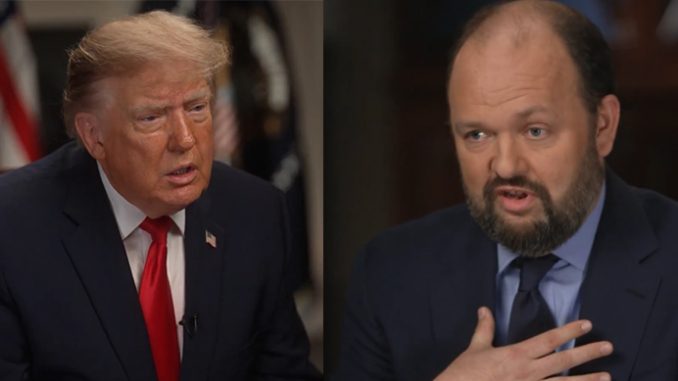
U.S. President Donald Trump’s refusal to say he would forgive his political enemies even when standing before the judgment throne of God has drawn attention to the state of the soul of America’s chief executive, including a warning from a New York priest about how refusing to forgive risks one’s eternal fate.
In a Nov. 8 interview with “60 Minutes” correspondent Ross Douthat, who is Catholic, Douthat steered the conversation from politics to mortality and the Gospel’s call to forgiveness.
Douthat pointedly asked Trump whether he could feel love and forgiveness for his nemeses, such as former FBI director James Comey and former House Speaker Nancy Pelosi, if doing so were required to enter paradise.
Trump said he still hates some of his enemies because of what he called their “weaponization” of the law against him.
Douthat pressed him on this point, asking again whether, before the judgment of God and after all that has been given to him, “you couldn’t find it in your heart to forgive some of your enemies?”
“Can I be honest?” Trump said. “I probably cannot do that now because I do hate some of my enemies and I always will.”
Father Gerald Murray, pastor of St. Joseph’s Church in New York, told EWTN News that he is praying the president will “come to understand that a man who dies hating his enemies risks losing Christ’s invitation to enter God’s presence in heaven.”
“The president of the United States is a believing Christian,” Murray said. “He knows that Jesus Christ commanded us to love our enemies and to forgive those who persecute us.”
“Hatred is not of God. Hatred harms the man who hates. Forgiveness draws that man closer to Christ who forgave all who hated him,” Murray underscored.
Catholic teaching holds that forgiveness is not optional for a Christian. Jesus commands: “Love your enemies and pray for those who persecute you” (Mt 5:44).
The Catechism of the Catholic Church teaches that mercy and forgiveness are essential to remaining in the state of grace and to final reconciliation with God. Persistent refusal to forgive, the Church holds, endangers the soul.
Father Gabriel Mosher, OP told EWTN News that it is possible that Trump’s “charmed life,” which Douthat in the interview suggested should enable him to forgive his enemies, might be the very reason Trump said he will not forgive.
In his experience, Mosher said that “those who have both suffered much and who lack the power to seek retribution develop a greater capacity to forgive than others.”
“This command of Christ is one of the most difficult things to live out,” Mosher emphasized. “It requires a vulnerability that, perhaps, President Trump’s lifestyle doesn’t afford him.”
“The more we are conformed to Christ in his suffering, the more we are conformed to the One who forgave his enemies while crucified upon his victorious Cross,” he observed.
Douthat asked what Trump believes will happen when he dies.
“You mean, where I go?” Trump replied. “I’m a religious person, so in theory, I go to heaven.”
When Douthat asked directly whether he thinks he is going to heaven, Trump answered: “I hope so. I don’t want to go to hell.”
In the aftermath of the interview, some Catholics expressed reservations about Douthat’s line of questioning.
Matt Mehan, a Catholic scholar at Hillsdale College, said that although he thought Douthat’s intent when asking Trump those questions was loving and honorable, “intention is not enough.”
Mehan contended that Douthat should not have asked the president such “deeply intimate questions” on national television and called putting Trump in such a position “inhumane.”
Luma Simms, a fellow at the Ethics and Public Policy Center, agreed with Mehan, saying that “toying or probing (or whatever name you want to give it) with someone’s soul on television is actually neither honorable, nor respectful of another human being.”
Meanwhile, Laura Stalberg Gigliotti, a cultural commentator who uses the pseudonym Peachy Keenan, noted that “Christʼs exhortation to love not just your neighbors but your enemies, those who have hurt you, killed you, maligned you, is the hardest teaching in all of Christianity.”
Surveying the situation, Pillar Catholic editor JD Flynn mused that Douthat may very well have “managed to plant a seed in Trump — perhaps to leave the president wondering, at least, whether holding on to bitterness won’t be his final undoing.”
“I hope Ross planted a seed in us, too,” Flynn added, referencing the common challenge of all of humanity to ultimately let go of grudges and forgive.
If you value the news and views Catholic World Report provides, please consider donating to support our efforts. Your contribution will help us continue to make CWR available to all readers worldwide for free, without a subscription. Thank you for your generosity!
Click here for more information on donating to CWR. Click here to sign up for our newsletter.

In a deference to Trump is it really necessary to love your enemy in order to be forgiven? Would not the willful act of forgiveness be sufficient when one is emotively overwhelmed with the offence?
If I recall correctly this was recommended by Our Lord to Catherine of Siena. Loving our enemies those responsible for egregious offenses can be cultivated beginning with a simple prayer of forgiveness.
“Douthat pointedly asked Trump whether he could FEEL love and forgiveness for his nemeses…”
Does the word “feel” affect the answer? Isn’t forgiving a decision?
Oh yes, Crusader, Trump was no doubt trying to make a nuanced theological point…
For another example of Trump’s deep grasp of Christianity, do check out:
https://www.youtube.com/watch?v=_Bv5z2M9M-4
And then there’s this about a vertebrate Christ versus only turning the other cheek…
…Any fully Christian reconciliation is a re-bonding of both hearts, not a one-sided and obsequious doormat. So, the lay theologian Josef Pieper and the cleric Thomas Aquinas (very synodal!) distinguish between, yes, an always heartfelt “readiness” (!) to forgive without bitterness—from still incomplete instances awaiting a full reconciliation in this fallen and weaponized world…has anyone apologized?
First PIEPER: “Christ drove the money-changers from the temple with a whip, and when the most patient of men stood before the high priest and was struck in the face by a servant, he did NOT turn the other cheek, but answered: ‘If there was harm in what I said, tell us what was harmful in it, but if not, why dost thou strike me?’” (Jn 18:23).
Then AQUINAS in his commentary on St. John’s Gospel:
“Holy Scripture must be understood in the light of what Christ and his saints have actually practiced. Christ did not offer his other cheek, nor Paul either. Thus to interpret the injunction of the Sermon on the Mount [turning the other cheek] LITERALLY [italics] is to misunderstand it. This injunction signifies rather the readiness of the soul to bear, IF IT BE NECESSARY [italics], such things and worse, without bitterness against the attacker. This readiness our Lord showed, when he gave up his body to be crucified. That response of the Lord was useful, therefore, for our instruction” (Pieper, “Fortitude and Temperance,” 1954; citing Aquinas John 18, lect. 4,2).
Did Ross interview Biden and ask if he was ready to repent of his many sins, sins of omission and commission? Just curious.
Fair question. But Douthat only recently joined CBS.
As if we needed more evidence that our President is an immoral man. Sad.
Forgiving and praying for your enemies is about the toughest requirement of Christianity.
But, if theyre not sorry do you have to forgive? and some sins are held bound in heaven.
Do they ask the women this as well?
The women, unlike Trump are private personages. No one really cares if they are moral people.
I really don’t care if Trump loves his enemies. I am more concerned with the war with Iran and the economy. I did not vote for Trump, but in his defense, he is President, not Pope.
November 1, Learjet 60 crashed in Palm Beach County, Fla., approx. 7 miles from Mar-a-Lago.
Is it that the plane’s elevator snapped when it attempted to climb, because of some ice? Or was there a sabotage that acted on the elevator, at an arranged moment?
Pilots never gave indication that de-icing was failing.