

 By
The government says there is “no indication of an immediate risk” to the Catholic community located in Niagara Falls.
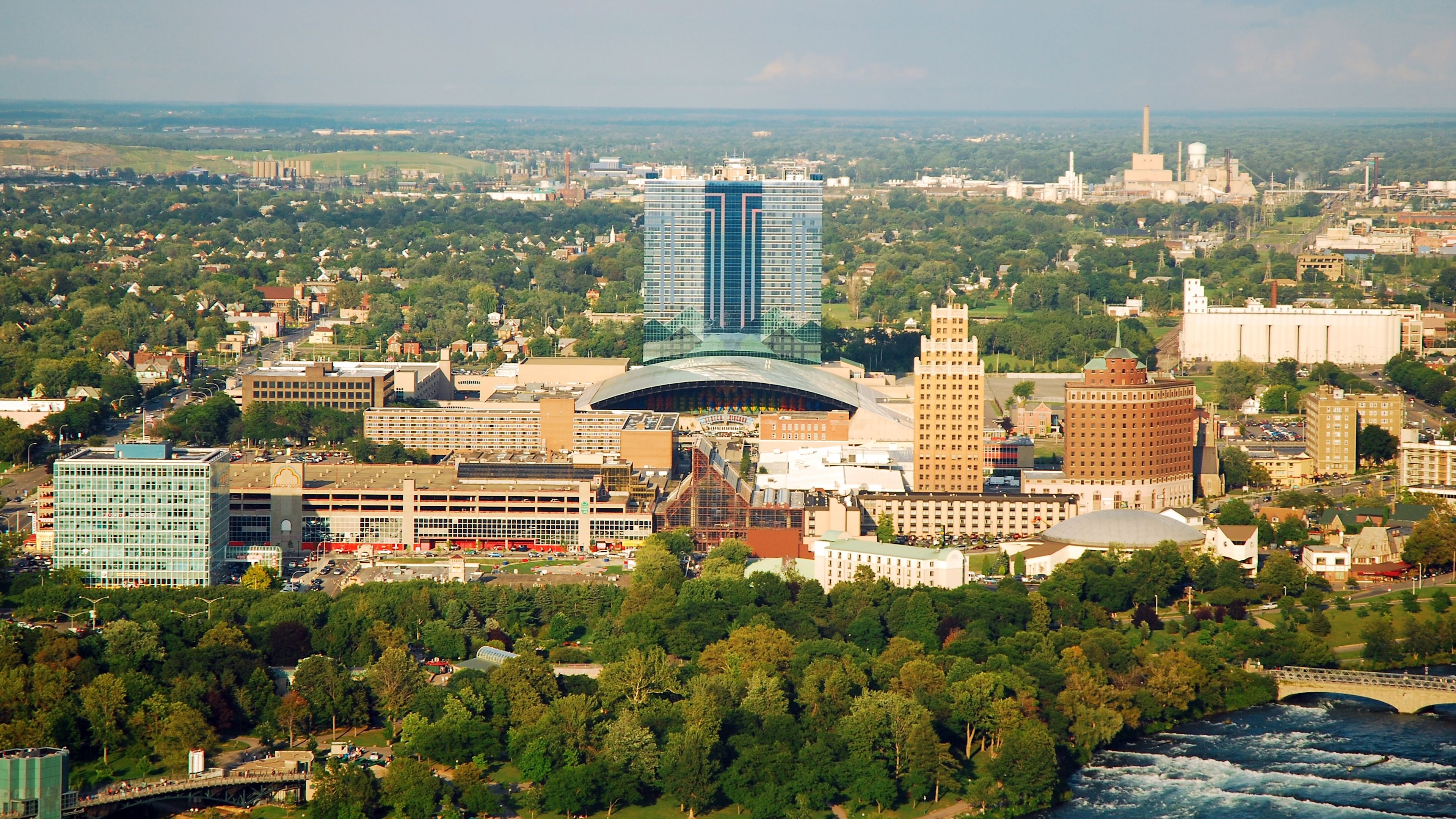
The U.S. Environmental Protection Agency (EPA) is investigating potentially elevated levels of radiation at a New York Catholic school that sits just a few miles from a World War II-era nuclear disposal site.
Data collected by the agency alongside state investigators in September from the property of the Catholic Academy of Niagara Falls showed some results that were “near background levels of radiation.”
An agency spokeswoman told EWTN News that the school property, which is also home to Prince of Peace Parish, sits on land with radiation levels “not clearly below our levels of concern and not clearly above them.”
The agency “[doesn’t] have any reason to believe there is significant radiological material based on screening to date,” the EPA said. But “some areas did have slightly elevated levels and were identified for further sampling.”
The school, located in Niagara Falls, New York, is about eight miles from the government-owned Niagara Falls Storage Site. Among the materials on that site is nuclear residue from the United States’ production of the first nuclear bombs during World War II.
The U.S. Army Corps of Engineers has recently undertaken remediation at the site. On its website the corps says it has removed more than 26,000 cubic yards of soil to be shipped to proper storage facilities.
The EPA said the evidence indicates the radiation levels at the school and church “are not cause for immediate concern.” The agency said it would be taking further sampling and was coordinating with the school in planning next steps.
“In response to concerns expressed by parents, agencies have coordinated with the school administration to do further radiological surveying … on the outside and the inside of the school using instrumentation specifically calibrated to assess any potential exposure to radiological contamination,” the agency said.
The school did not respond to a request for comment on the situation. But the radiation levels have aroused concerns in the school community, according to local media.
Jocelyn McKiernan, whose son attends the Catholic school, told local news station WIVB that her family was seeking “full transparency” from the school regarding the controversy.
“We deserve to know what’s there, how much radioactive waste has been discovered, and if it’s inside the building or not,” she told the network.
McKiernan was reportedly escorted from the school after showing up seeking to meet with the school’s principal. Meanwhile, McKiernan and her husband, Daniel, had reportedly discovered in July that their own property may have toxic contaminants from three decades ago.
The school said in a Nov. 4 newsletter to families that school leadership had met with officials from both the EPA and the state government to examine the government’s findings.
It said further testing would be done when school was not in session and that results were expected back within three months.
The Diocese of Buffalo, where the school is located, told EWTN News on Nov. 10 that the school’s principal Johanna Richards “informed parents and the entire school community as soon as the results of the initial screening was accomplished and results known.”
“Admittedly, she now feels that she could have informed parents that the testing was scheduled,” diocesan spokesman Gregory Tucker said, though he noted that “there is regular testing underway throughout the community as a result of this legacy environmental issue,” and as such Richards “did not think at the time that it was necessary” to announce the testing.
The school is “being as communicative as possible about this issue and with the aim of providing as much reassurance as they can at this stage,” he said.
“Everyone is in this together and understandably wants to get to a definitive determination that there is no threat to the school community.”
This story was updated on Nov. 10, 2026 at 1:50 p.m. EST with a statement from the Diocese of Buffalo.
If you value the news and views Catholic World Report provides, please consider donating to support our efforts. Your contribution will help us continue to make CWR available to all readers worldwide for free, without a subscription. Thank you for your generosity!
Click here for more information on donating to CWR. Click here to sign up for our newsletter.

From the national perspective the Niagara Falls site is one of 113 nuclear waste sites in the United States subject to a long-established and ongoing nuclear waste cleanup, wherever threshold radiation limits are exceeded. The largest of which is 3,000 miles west of New York: parts of the 540 square-mile wartime Hanford Nuclear Reservation. (Yours truly was born in 1944 on the Hanford Reservation.) Hanford accounts for two thirds of the total nuclear waste problem and surely most of the estimated and ongoing $300 to $600 million total cost (extending to 2076 at Hanford).
Impacted nationwide are 1.7 trillion gallons of contaminated groundwater; 40 million cubic meters of contaminate soil and debris; storing, treating, and disposing of radioactive and hazardous waste including 160,000 cubic meters currently in storage (2009) and over 100 million gallons of liquid, high level, radioactive waste (56 million gallon at Hanford); and long-term care and monitoring—or stewardship—for potentially hundreds of years of an estimated 109 sites following cleanup (Niagara Falls appears to be a borderline and possible site). The total cost of cleanup (above) is roughly 5% of the decades-long nuclear weapons program ($5.5 Trillion in 1996 dollars).
(Source: Max S. Power, “America’s Nuclear Wastelands: Politics, Accountability, and Cleanup,” Washington State University Press, 2008).
It’s intriguing and sobering to note that the Manhattan Project scientific community tried to alert President Truman that if nuclear bombs were dropped on Hiroshima and Nagasaki, this would trigger a decades-long nuclear arms race (ultimately the reciprocal threat of Mutual Assured Destruction). (Documents 58-62, July 2,3,24, 1945, in Stoff, Fanton, Williams, “The Manhattan Project: A Documentary Introduction to the Atomic Age,” Mc Graw -Hill, 1991).
About what could be framed as a 20th-century three-phase and single war, from World War I through World War II and the Cold War, we have this early insight from Winston Churchill: “War is a game with a good deal of chance in it, from the little I have seen of it, I should say that nothing in war ever goes right except occasionally by accident” (House of Commons, March 12, 1901).