

 By
By 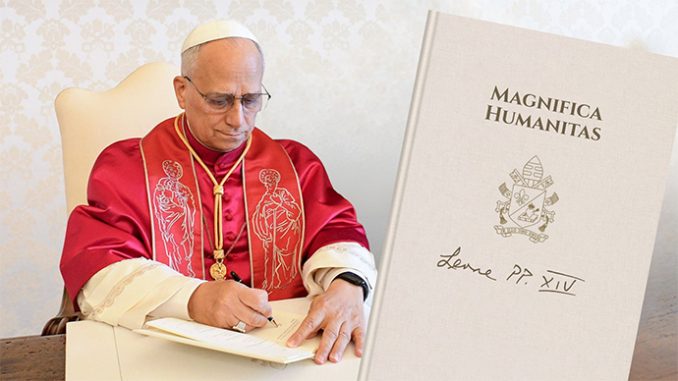
In his encyclical Magnifica Humanitas, published Monday, Pope Leo XIV calls on society and AI developers to implement “shared standards of social justice” in order for artificial intelligence to respect human dignity and serve the common good.
AI is not a morally neutral tool; It matters not only how it is used, but how it is designed, Leo writes in “Magnifica Humanitas: On Safeguarding the Human Person in the Time of Artificial Intelligence,” published May 25. Magnifica Humanitas means “Magnificent Humanity” in Latin. [Editor’s note: The hardcover English edition of the encyclical is published by Ignatius Press.]
He also warns that “a more moral AI is not enough if that morality is determined by a few … In fact, as with every major technological shift, AI tends to amplify the power of those who already possess economic resources, expertise and access to data.”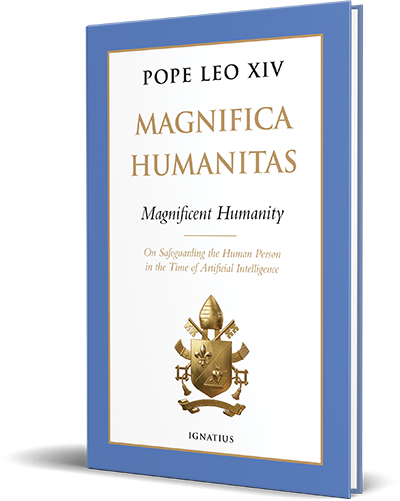
The first encyclical letter of Leo XIV covers a wide range of social issues, focusing heavily on the impacts of AI in the areas of education, the economy, unemployment, work, the development of young people, human trafficking and war.
He proposes the principles of Catholic Social Doctrine — the dignity of the person, the common good, the universal destination of goods, subsidiarity, solidarity and justice — as guidelines for decision-making and the “criteria for judging whether technologies truly serve humanity or are subjugating it.”
While rejecting dichotomous thinking that pits the opportunities of AI against its risks, or enthusiasm against fear, Leo offers a stark assessment of the technological paradigm the world finds itself in today and describes a path of progress that serves people “or a progress that subjects them to the mentality of power.”
“The risk extends beyond the misuse of certain technologies. More gravely, the pervasive technocratic paradigm in which we are immersed, and that is amplified by the digital revolution and AI, threatens to normalize an anti-human vision,” he writes.
Leo borrows the term, “technocratic paradigm,” from Pope Francis’ 2015 encyclical Laudato Si’, in which, Leo writes, Francis critiqued a paradigm “that seeks to reduce everything to an object to be dominated.”
In that anti-human vision, he continues, “the fullness of life is equated with having more, reducing weakness, eliminating uncertainty and exerting total control. When efficiency becomes the ultimate measure of value, human beings are tempted to see themselves as a project to be optimized rather than as persons called to relationship and communion.”
According to Pope Leo, the central question — safeguarding our humanity — is something everyone should have a role in answering.
He invokes one of his spiritual guides, St. Augustine of Hippo, quoting from “De Civitate Dei” (“The City of God”): “‘Two loves have built two cities: the earthly city, the love of self even to the contempt of God; the heavenly city, the love of God even to the contempt of self.’ As throughout history, these two loves continue to contend for dominance in our hearts today.”
From Catholic Social Doctrine to the fight for power
The encyclical’s 245 paragraphs are broken down into an introduction and five chapters, with the first two dedicated to an explanation of the development of the Church’s Social Doctrine from Pope Leo XIII to today, the main principles of that doctrine, and how they can be applied to the current technological age.
Chapter three introduces “the technocratic paradigm” of artificial intelligence and the imbalance of digital power.
Chapter four turns to the importance of safeguarding truth, democracy, work, education, and human freedom in the age of AI, while the fifth chapter is dedicated to an analysis of the normalization of war, the fight for power, and how everyone has a responsibility to help build a civilization of love through the cultivation of peace and justice.
Throughout the encyclical, Leo draws on the image of construction to ask how humanity will respond to the new technological age. Humanity, he says, must choose between building the Tower of Babel (Genesis 11:1-9) and building a city where God and humanity can dwell together, as Nehemiah gathered together people to rebuild the walls of Jerusalem after the Babylonian exile (Nehemiah 2-6).
“In light of these two images, the Holy Spirit challenges us today regarding our relationship with technology and the ongoing digital revolution,” he writes. “Technology has the power to heal, connect, educate and protect our common home; but it can also divide, exclude and generate new forms of injustice.”
Pope Leo XIV draws on quotations from prominent 19th and 20th-century thinkers, both Catholic and Jewish, including St. John Paul II, Victor Frankl, Hannah Arendt, J.R.R. Tolkien, Giorgio La Pira, and Fr. Romano Guardini, to argue that while technology is not a solution in itself to humanity’s problems, nor is it inherently evil.
“In practice, however, technology is never neutral, because it takes on the characteristics of those who devise it, finance it, regulate it and use it,” he writes.
The choice, he continues, is not between a “yes” or “no” to technology, but “between constructing Babel or rebuilding Jerusalem; between a power that claims to dominate the heavens and a people who work together in the presence of God to rebuild the walls of fraternal coexistence.”
Frequently cited sources for the encyclical letter include Pope Benedict XVI’s encyclical Caritas in Veritate and the Compendium of the Social Doctrine of the Church.
Writing that he does not wish to give a comprehensive overview of AI, the pope points readers to previous writings by the Church on AI, in particular, the 2025 note Antiqua et Nova by the Dicastery for the Doctrine of the Faith and the Dicastery for Culture and Education and Quo Vadis, Humanitas? published earlier this year by the International Theological Commission — both of which are cited often in the footnotes of Magnifica Humanitas.
Christian humanism and the technocratic paradigm
The pope writes about the mindsets of transhumanism and posthumanism and how they are the ideological vision underlying technology.
He proposes a Christian humanism, where human beings “are not confined by the boundaries of their own nature; rather, they are called to self-transcendence, not through an escape from reality or a contempt for their limitations, but through their fulfillment in love.”
In Magnifica Humanitas, the Holy Father also expresses concern about the “new monopolies of AI.”
“To speak of the common good means exposing this new form of epistemic, economic, and political asymmetry,” he writes.
The key question, he says, is that posed by Saint John Paul II: Does AI “make human life on earth ‘more human’ in every aspect of that life? Does it make it more worthy of man?’”
Leo writes that “a decisive test for the ethical discernment of AI and digital transformation” is in the fight against new forms of slavery, such as human trafficking. The pontiff goes on to “sincerely ask for pardon,” in the name of the Church, for the “immense suffering and humiliation endured by so many” before slavery was unequivocally condemned in the 19th century.
“This development offers a clear example of the Church’s growth in understanding the perennial truths of Revelation that she safeguards. Although there was not always consistency in practice,” he writes, “there has been a continuous affirmation throughout history of the dignity of every human being, created in the image of God, even if it took eighteen centuries for its full incompatibility with slavery to be explicitly recognized.”
The memory of past blindness and complicity regarding the injustice of slavery is “a call to vigilance,” the pope says. “What we have learned must be translated into discernment and responsibility in the present.”
‘A violent culture of power’
A large section of the pope’s letter is devoted to what he writes is, “a troubling revival of war as an instrument of international politics,” AI use in warfare, a crisis in multilateralism, and the erosion of ethical principles that used to limit war.
“Humanity is slipping into a violent culture of power,” he warns. “Today, more than ever, without prejudice to the right to self-defense in the strictest sense, it is important to reaffirm that the ‘just war’ theory which has all too often been used to justify any kind of war, is now outdated. Humanity possesses far more effective and capable tools for promoting human life and resolving conflicts, such as dialogue, diplomacy and forgiveness.”
“The modern Babel can be seen not only in the globalized technocratic paradigm, but also in the remote clash between opposing imperialisms, between powers that wish to preserve their supremacy, and those that aspire to seize that supremacy, resulting in a multiplicity of local conflicts. Moreover, there seems to be no limit to the race — driven by a dehumanizing ambition — to develop evermore powerful technologies or to secure control over them,” Pope Leo writes.
But the pontiff does not conclude on a negative note. He adds that, “despite this downward spiral, we can also glimpse a great part of humanity that is striving to remain human and working to build the holy city of coexistence and peace.”
Concluding the document, he expresses the hope that, “In the humble fidelity of daily life, even the era of AI can become a time in which the Holy Spirit brings about the civilization of love in our lives.”
“Indeed, the Lord continues to make all things new and offers every era the possibility of becoming part of salvation history in the light of the Incarnation.”
If you value the news and views Catholic World Report provides, please consider donating to support our efforts. Your contribution will help us continue to make CWR available to all readers worldwide for free, without a subscription. Thank you for your generosity!
Click here for more information on donating to CWR. Click here to sign up for our newsletter.

Pope Leo XIV’s Magnifica Humanitas offers a profound diagnosis of the contemporary technocratic paradigm, rightly identifying the reduction of the human person to a project of optimization rather than a subject called to communion. The crisis generated by artificial intelligence and digital culture is therefore not merely technological, but deeply anthropological and spiritual.
From a metaphysical and theological standpoint, this crisis may also be understood as a crisis of receptivity (receptio). The technocratic imagination tends increasingly to replace the logic of gift with the logic of production (productio), and participation with operational functionality. In such a horizon, the person risks no longer being formed by truth, but merely processing information and simulating interiority.
What is ultimately endangered is the human capacity for passio veri — the ability to receive reality as given, to be addressed by truth, and to be transformed by it. Without such receptivity, the human subject gradually risks reduction to mere technical function.
Christological and Marian horizon of the encyclical acquires here particular significance. The mystery of the Incarnation reveals that salvation is not self-production, but the reception of a gift descending from God. Within this order, the Fiat and Magnificat of the Virgin Mary manifest, in an eminent way, the creaturely form of receptive cooperation with grace (receptio actuosa). Mary does not produce salvation autonomously; rather, through free and obedient reception, she becomes the privileged locus in which the Gift enters history.
I think Marian theology may offer an important anthropological and metaphysical response to the contemporary technocratic temptation of self-salvation. The human person remains fully human not by rivaling the computational power of the machine, but by preserving the vulnerable and relational capacity to receive truth, communion, and grace as gift.
The first paragraph I “bumped into”, of the PL’s encyclical, with its oblique oddity:
“Whenever humanity is in danger of marring its true identity, we Christians lift our eyes to the Incarnate God, knowing that it is “only in the mystery of the Word made flesh that the mystery of humanity truly becomes clear.” [1] In Jesus Christ, this humanity in its grandeur becomes the Way, the Truth and the Life, opening the path for each of us to grow toward fullness.”
The first phrase:
“Whenever humanity is in danger of marring its true identity, we Christians lift our eyes to the Incarnate God, knowing that it is “only in the mystery of the Word made flesh that the mystery of humanity truly becomes clear.” [1],
is a true, sound Christian theology.
The second phrase:
“In Jesus Christ, this humanity in its grandeur becomes the Way, the Truth and the Life, opening the path for each of us to grow toward fullness.”
is very different. There is something there that catches a mind into a loop of mutually exclusive possibilities. In a context of the previous phrase, it can be read in two ways:
(“Only in the mystery of the Word (Christ) the mystery of humanity = humankind becomes clear.) In Jesus Christ, this humanity in its grandeur becomes the Way, the Truth and the Life”
Here we have a suggestion of a swap, HUMANITY of Christ with HUMANITY = humankind: no longet Jesus Christ is the Way, the Truth but the Life but HUMANITY = humankind becomes the Way, the Truth and the Life.
Which one is meant there then?
Words “Whenever humanity is in danger of marring its true identity” is definitely about humanity = humankind, not Christ’s humanity – and so as the whole document.
Most important argument against the meaning “HUMANITY of Christ is the Way, the Truth and the Life” here is that Christ cannot be divided into humanity and divinity (it is a heresy); He, the Person both human and divine, is the Way, the Truth and the Life. Humanity, either his or humanity = humankind cannot be the Way, the Truth and the Life because it is reserved to “I AM” = God = Christ.
Hence, we have here something mirky, with a double meaning created with a juxtaposition of “a proper theological idea” and another phrase that opens two contrary possibilities of interpretations, 1) in an accordance with true Christian theology and 2) in accordance with a horizontal humanism where humanity itself is a source of salvation.
The following text of the encyclical supports the 2) interpretation, of a horizontal humanism where the quotes from the Scriptures are being interpreted in a rather primitive way like:
“We must, then, avoid the “Babel syndrome,” namely the idolatry of profit that sacrifices the weak, a uniformity that neutralizes differences”.
But all is rather mild, inoffensive – it says all the “right” think various groups of people expect PL to say and thus it is quite disjoint. It is like a disco ball designed to reflect everyone in a favorable way so that everyone looked, became happy and went on his way to build the new earthly “city of love”, in accordance with that reflection. In essence, the PL’s encyclicals preserves only “magnificence” from Christ and handles it to “humanity” (that magnificence, being separated from Christ, is a mere mirror, not Christ, now). It is no longer a painful growing of humankind into Christ in a communion with Him.
Humanity has been a mystery from time immemorial for Man. Natural law gave some evidence of its inherent nature, although the great philosophers opined on the ultimate end of Man addressed by Aristotle.
Jews had the understanding that Man is created in God’s image although imperfectly. Leo XIV refers to the revelation of Christ as the answer. It is only in Christ that our true nature is revealed in his human nature.
There is no absolute division between the physical nature and divine nature even though they remain distinct from each other in the mystery of the incarnation. That is why we hold that Jesus is not two rather one unique person within the Trinity.
It’s the divinity shining through the human body of Christ that reveals our end and true nature in our unity within the mystical body.
An issue arises with Pope Leo’s affirming his predecessor’s notion of the human person’s infinite dignity. This issue was addressed some months past where I took the position that if Man is created in God’s image – a premise that establishes his eternal dignity – that premise is not dependent on the holiness of the person, rather on permanent features of human nature: memory, intellect, and free will. Both Augustine and Aquinas confirm this.
Whether one is in Heaven or in Hell Man does not lose these three faculties that liken him to God. That image of God remains and with that a specific, everlasting dignity.
Furthermore, Leo XIV does recognize Man’s limitations. “This transformation is a work of the Holy Spirit. As Saint Thomas Aquinas taught, this process of elevation and transformation “surpasses every capability of created nature,”134 for an infinite disparity separates our finite nature from the life of God.135”.
Thoroughly disappointed with this encyclical. It is convoluted, replete with unwarranted assumptions and unjustified assertions, superficial, secular globalist, and more humanist than Christian theological. Sure, you can find a sentence here or there that is true or inspiring, but overall the encyclical is a homage to secular liberal optimism and aspirations for global human unity rather than a theological or catechetical exploration of Christian anthropology that elaborates about human sin and salvation through Christ as hermeneutical keys to understanding present-day social problems.
Yeah, of course you are. The rest of us are fine with it.
Dorothy: I haven’t nor will I read this document. But given what your assessment of it is, I doubt if he has much to say about eschatology.
Pride in remaining willfully ignorant is definitely not something to boast about.
Suzanne, Speaking of the sin of pride, you seem to feel a need to make a critical comment about almost everyone. You come across as a snob.
Yes. I am a bit snobbish in that I think reading and learning are superior to remaining ignorant.
Then stop.
DiogenesRedux
Quote: “Dorothy: I haven’t nor will I read this document. But given what your assessment of it is, I doubt if he has much to say about eschatology.”
I believe it is important for everyone to read it, just as it is important to read recent synodal documents ‘Final report’ and ‘Path of Implementation’ because they are connected. They both lack a clear eternal point of view, of the Church.
What I mean is that the only value of the Church is her living relationship with Christ, of a Bride. A Bride sees everything with the eyes of her Beloved and measures every phenomenon in relation to Him. This point of measuring everything by His Person is entirely missing in all three documents. None of them ceaselessly refer to the Person of Christ when speaking about human needs, about what is good and what is evil. Instead, good and evil there are measured by mere humans. It can sound good and even inspiring at times but it is all fragmented, being not joined together by the Head, Christ.
I can recall much nobler and much more inspiring reflections on AI, human destiny etc., done by non-Christians and even by atheists. The only “thing” that makes Church supremely valuable, is her living communion with her Bridegroom. If she lives that communion, she cannot help it but to speak of Christ, no matter what she discusses. Interpreting everything (from drones to the AI) via the Person of Christ is the only unique “thing” she possesses and can give to the humanity. If she loses it, she is of no use whatsoever. There are plenty of more intelligent people who say intelligent things.
Anna, Dorothy and DiogenesRedux,
Sometimes when riding a bus to work I sat next to an articulate young man who also happened to be blind. Said he, “I’m glad I’m blind because people who can see are dealing with mirages.”
I’m not sure exactly why, but his comment comes to mind when I read that you don’t see the actual content of the encyclical “Magnifica Humanitas”. Thank you ever so much for sharing!
Dr.Beaulieu’s comment on the risk of ‘mirages’ provides a much-needed, salutary perspective. On one hand, DiogenesRedux is right to insist that the Church must never cease to measure everything through the Person of Christ. On the other hand, Peter reminds us that doing so requires us to avoid a self-imposed blindness toward the Magisterium’s efforts to dialogue with the postmodern and sometimes antichristian world.The challenge of AI in MH places us within this permanent historical Augustinian dialectic. AI risks becoming a new Babel if man uses it merely to glorify “his” own name. The Church’s pastoral mission must ignite a new Pentecost—speaking to the technological world without losing her Christocentric soul.
Has the Faustian pact that some in Silicon Valley and the AI world have made with Mephistopheles and the eternal consequences thereof been adequately addressed by this encyclical?
If not, an opportunity has been lost to invoke Christ the Alpha and Omega, the Infinite and sole guarantor of human dignity.
In the only true pact any human must make.
A big problem for AI is that its implementation is often being forced on users. In Windows 11 Microsoft has been force feeding AI on the users. First by mandatory high hardware requirements turning many existing PCs into e-waste. Their rollout of Copilot and Recall was not very user friendly. The behavior is like the Borg where resistance is futile and that the users will be assimilated into the AI Borg collective whether they like it or not.
*
There is a distinct anti-human strain of AI advocates. Pushing AI as a way to completely replace human workers. Using AI as an excuse to reduce headcount via mass layoffs. A cover story for non-innovative offshoring and outsourcing. Many people in management already treat their employees like sub-human expendable devices. AI fits right in with such a dehumanized managerial culture. A very morally impoverished environment in which to train general purpose AI. A real Oliver Twist world, with a ready supply of Fagins.