Vatican City, Mar 15, 2017 / 03:01 pm (CNA/EWTN News).- Pope Francis greeted and blessed a group of pilgrims from China who broke protocol and approached him during the Wednesday general audience.
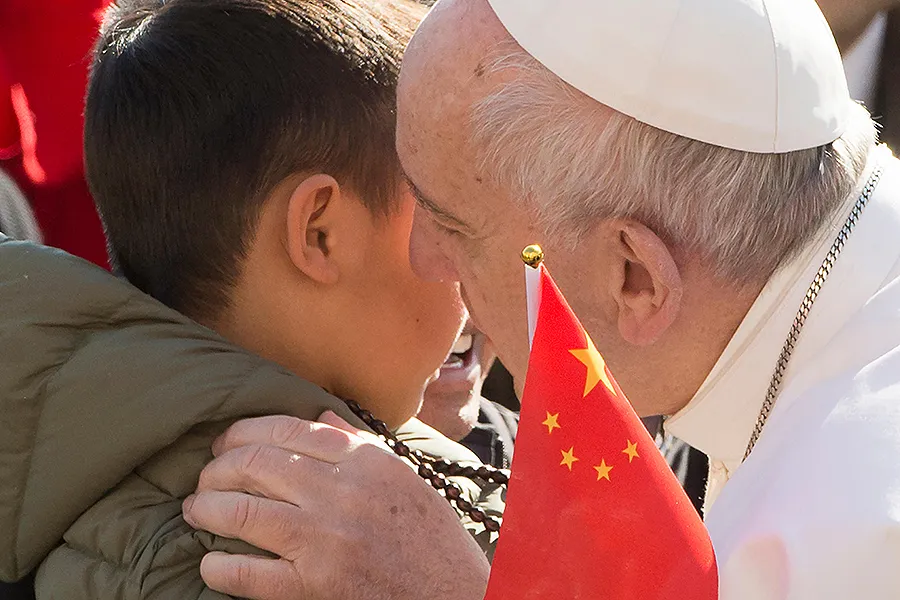
The group of faithful, some of whom approached the Holy Father on their knees, held Chinese flags and amid sobs, asked for him to bless a statue of Our Lady of Fatima they had carried into Saint Peter's Square.
At first, some Swiss Guards tried to prevent the pilgrims from approaching the pontiff, but Francis quickly stopped them and shared a few moments with the pilgrims.
Among the pilgrims there were some children whom the Pope spent a few minutes with.
China only allows Catholic worship services for the Chinese Patriotic Catholic Association, which is subordinate to the Chinese Communist Party, and rejects the authority of the Vatican to appoint bishops or to govern them.
The Catholic Church faithful to the Pope is not completely clandestine, although it faces constant opposition.
Diplomatic relations between China and the Vatican were broken in 1951, two years after the communists came to power and expelled foreign clerics.
For some years the Holy See has been working on an accord for the reestablishment of diplomatic relations with China, a rapprochement encouraged by Pope Francis.
In August 2014, while he was on his way to South Korea, the Holy Father sent a telegram to the President of China to express his best wishes when his plane was over Chinese airspace.
The fact that the Pope had received permission to fly over Chinese airspace was considered a small step forward. Pope John Paul II had to avoid the airspace of this country during his trips to Asia.
If you value the news and views Catholic World Report provides, please consider donating to support our efforts. Your contribution will help us continue to make CWR available to all readers worldwide for free, without a subscription. Thank you for your generosity!
Click here for more information on donating to CWR. Click here to sign up for our newsletter.
Thirty-four new Swiss Guards were sworn in Thursday in an elaborate ceremony in Vatican City in which the guards promised to protect the pope, even “sacrificing if necessary also my own life.”
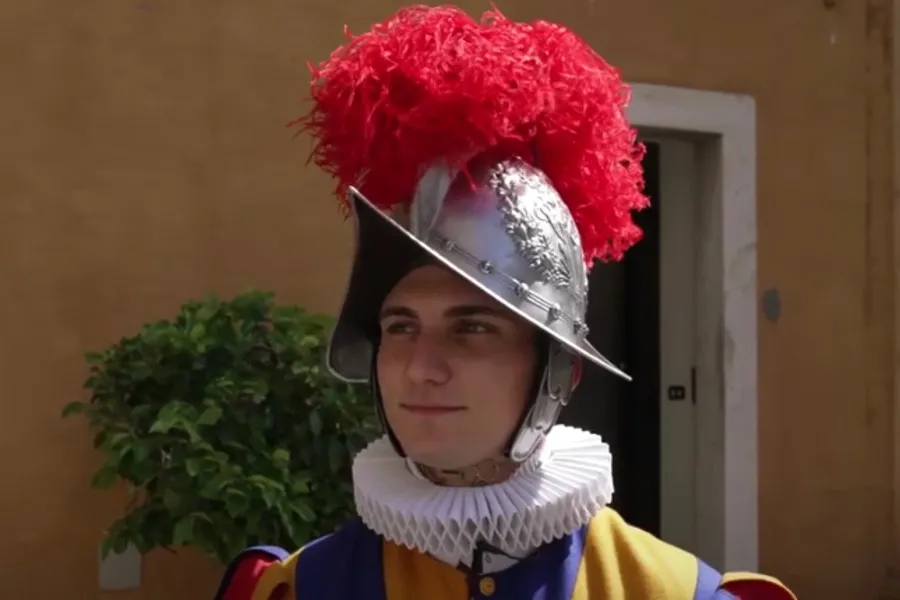
Gian Andrea Bossi, a 20-year-old from Davos, Switzerland, was among the new Swiss Guards to take the oath on May 6.
“It is a great honor for me, for all of us. … We’ve prepared for weeks, for months for this day,” Bossi told EWTN News.
“I’ve always wanted to serve God in a way, and I wanted to serve the Catholic Church,” he said.
Gian Andrea Bossi, a 20-year-old Swiss Guard who was sworn-in on May 6, 2021. / Colm Flynn/EWTN News.
The swearing-in ceremony for one of the world’s oldest standing armies took place on the 494th anniversary of the Sack of Rome, the battle on May 6, 1527, in which 147 Swiss Guards lost their lives defending Pope Clement VII from mutinous troops of the Holy Roman Empire.
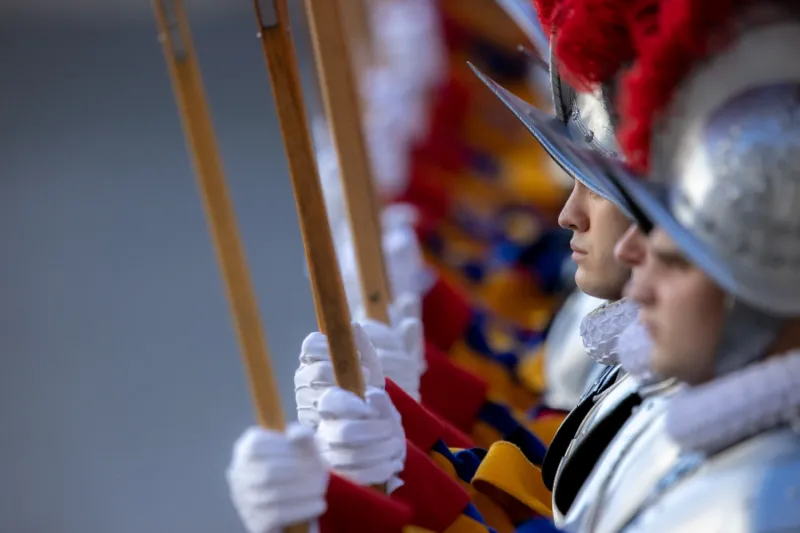
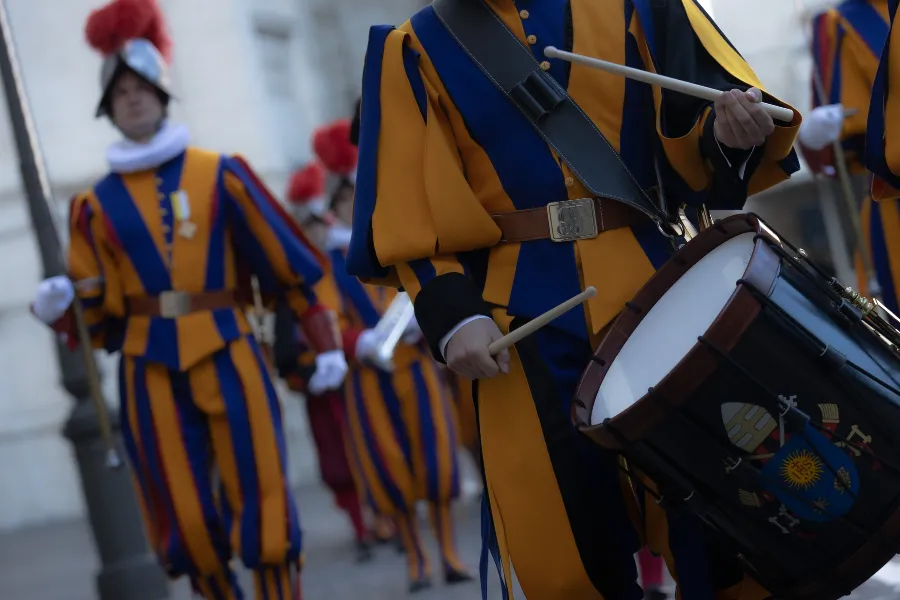
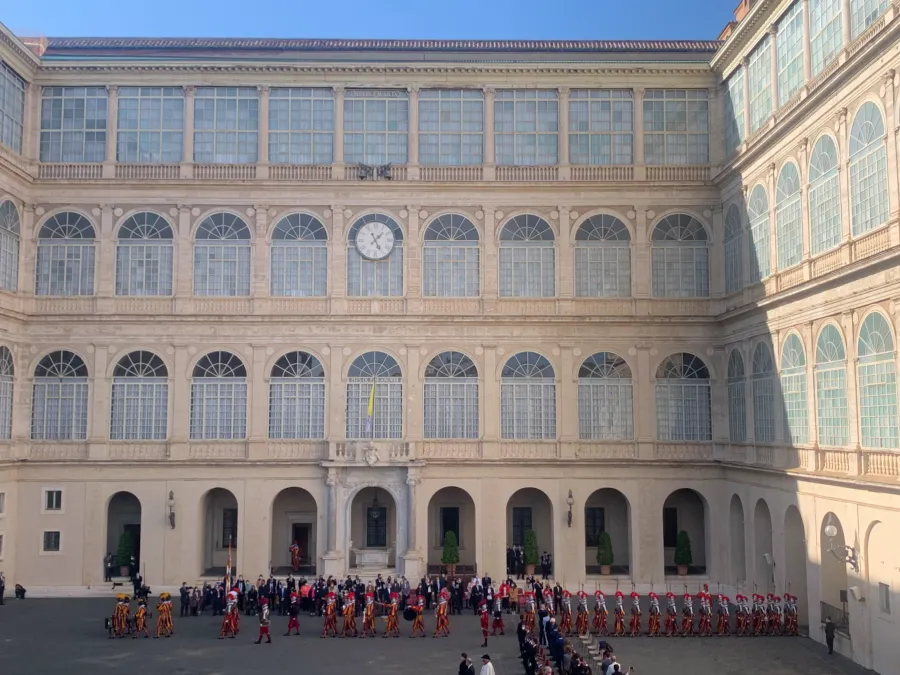
The ceremony began with three Swiss Guards blowing trumpets from the loggia, and then the guards marched to the sound of drums in a solemn procession.
Due to coronavirus restrictions, only the families of the guards and the press were allowed to attend the ceremony held in Vatican City’s San Damaso Courtyard. In 2020, at least 13 Swiss Guards tested positive for COVID-19.
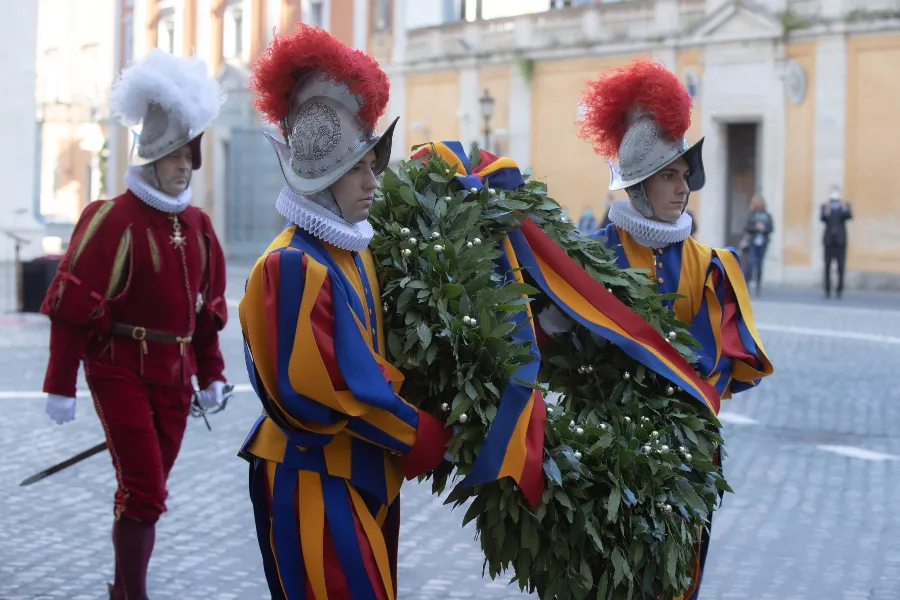
As part of the schedule this year, the family members of the new guards prayed Vespers on the evening of May 5 in the church of Santa Maria della Pieta in the Vatican’s Teutonic College. Later, the “deposition of the crown” ceremony took place in commemoration of the guards who died during the Sack of Rome.
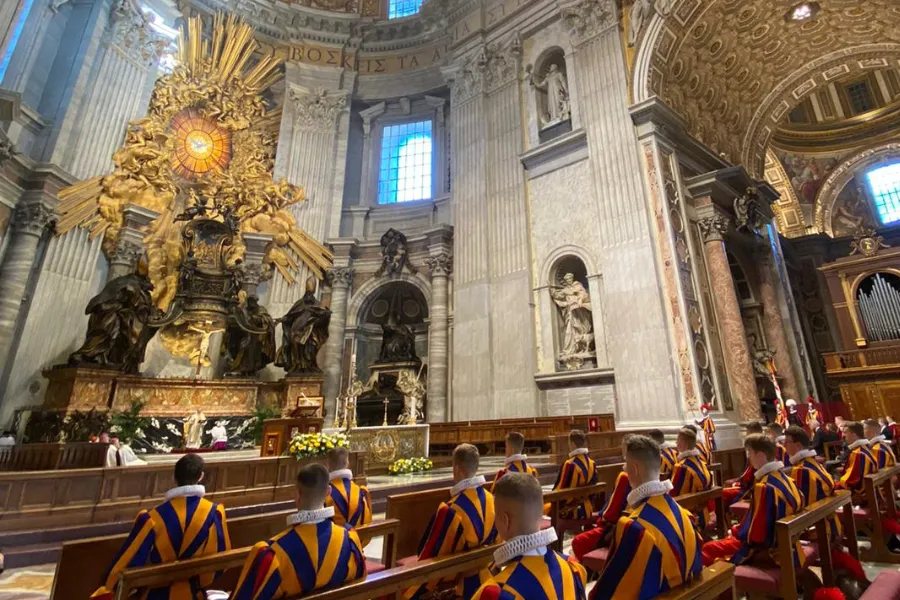
Vatican Secretary of State Cardinal Pietro Parolin also offered Mass with the Swiss Guards in St. Peter’s Basilica in the morning ahead of the swearing-in ceremony.
Swiss Guards attend Mass at St. Peter’s Basilica on May 6, 2021. / Colm Flynn/EWTN News
Gérald Crettaz, the father of one of the new Swiss Guards, 23-year-old Baptiste Crettaz, said that he was very proud of his son for taking the oath.
“In our current world, where everyone is quite selfish and self-centered, my son is committed to something bigger, something wider that doesn’t belong to him, but to everyone. I think it is fantastic and it is so generous,” Crettaz said.
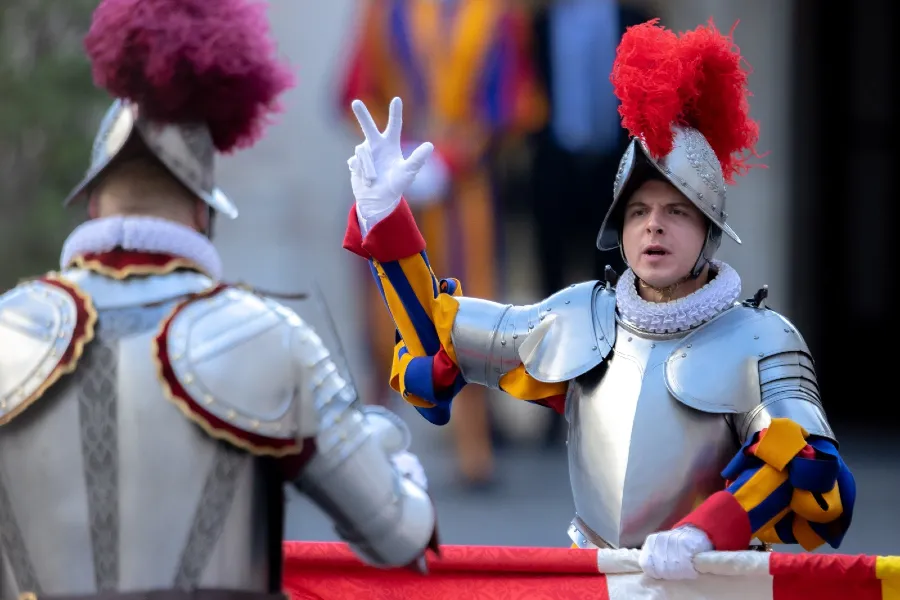
During the ceremony itself, each new recruit approached the flag of the Swiss Guard as his name was called out. Firmly grasping the banner with his left hand, the new guard raised his right hand and opened three fingers as a sign of his faith in the Holy Trinity.
While holding up his fingers, the guard said aloud: “I, (name), swear diligently and faithfully to abide by all that has just been read out to me, so grant me God and so help me his saints.”
In English, the full oath reads: “I swear I will faithfully, loyally and honorably serve the Supreme Pontiff Francis and his legitimate successors, and also dedicate myself to them with all my strength, sacrificing if necessary also my life to defend them. I assume this same commitment with regard to the Sacred College of Cardinals whenever the see is vacant. Furthermore, I promise to the Commanding Captain and my other superiors respect, fidelity, and obedience. This I swear! May God and our Holy Patrons assist me!”
Swiss Guards march into San Damaso Courtyard May 6, 2021. / Courtney Mares/CNA
Swiss Guards — known for their colorful striped Renaissance-era uniforms — are responsible for Vatican security together with the Vatican gendarmes. The Vatican military was established by Pope Julius II in 1506.
Candidates for the Pontifical Swiss Guard are required to meet strict requirements. Each recruit must be a Catholic unmarried male at least 5 feet, 8 inches tall and between the ages of 19 and 30. Swiss citizenship is required, as is a letter of good standing from the candidate’s parish priest.
“It is something that only we, Swiss people, can do, and it is important to show that there still are young people ready to be committed to promote some values,” Swiss Guard Baptiste Crettaz said.
“The fact that we are ready to give up our life for the Holy Father represents a strong meaning,” he said.
The Vatican approved an expansion of the size of the Pontifical Swiss Guards three years ago from 110 to 135 men. Despite the new recruits, it still remains the smallest army in the world.
“I am excited to see the Vatican, to get to know the pope … also to be closer to the Church, to the faith, to grow in the faith,” Bossi said.
“In the end it is to serve God, to serve the Church, to protect the faith and defend the pope,” he said.
Pope Francis received an audience with the new Swiss Guards in the Vatican Apostolic Palace ahead of the ceremony. The pope recalled that some former guards had discerned the priesthood after their service, while others went on to form their own family.
“I pray that those who begin their service now may also respond fully to Christ’s call, following him with faithful generosity,” he said.
“May these years that you will spend here be an occasion for a deepening of your faith and an even stronger love for the Church. I accompany you with my prayers and I thank you for choosing to make a few years of your life available to the Successor of Peter.”
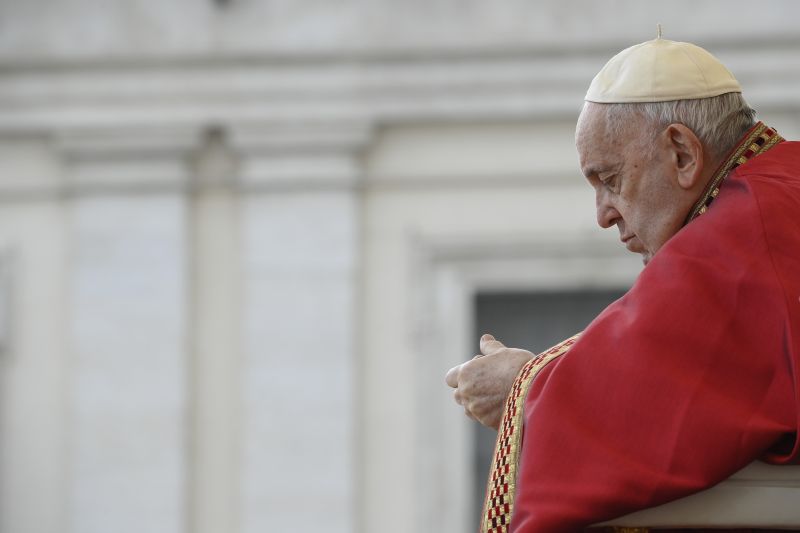
Pope Francis presides over the funeral Mass for Pope Emeritus Benedict XVI in St. Peter’s Square on Jan. 5, 2023. / Vatican Media
Rome Newsroom, Jan 15, 2023 / 11:00 am (CNA).
It was widely anticipated that a major reform of the Diocese of Rome was coming, as Pope Francis has been thinking about it for some time.
But no one expected it to come when it did: On Jan. 6, one day after the funeral of Francis’ predecessor as Bishop of Rome, Pope Emeritus Benedict XVI.
With the reform, Pope Francis firmly took over the reins of the vicariate, or hierarchy, of the diocese. Everything is centralized, and everything must pass, at least formally, under the control of the pontiff.
Cardinal Angelo de Donatis, the pope’s vicar for the diocese, sees his role deeply diminished. The diocese’s auxiliary bishops strengthen their direct link with the pope. In the end, the pope has made it clear that he is the one who also formally presides over the Episcopal Council, a new body established as an “expression of synodality.”
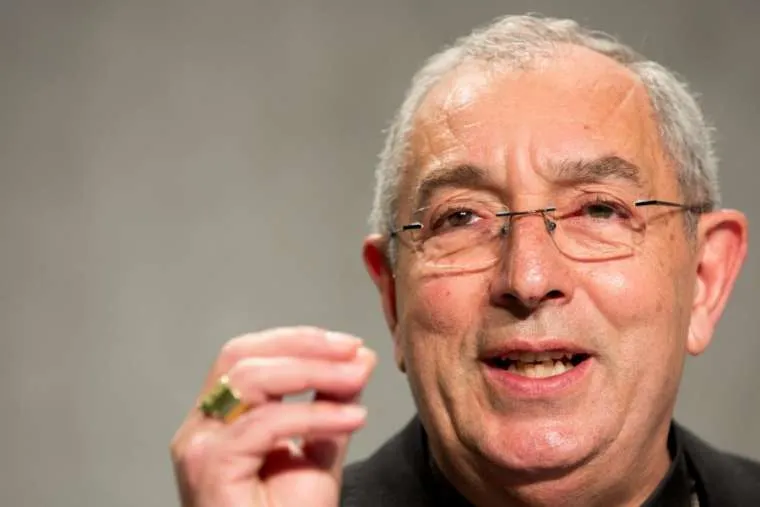
Cardinal Angelo De Donatis. . Daniel Ibanez/CNA
The backstory
Before going into some details of the new decree, however, some background is necessary.
The last reform of the structure of the Vicariate of Rome was outlined by John Paul II in 1908, with the apostolic constitution Ecclesia In Urbe. For the new reform, Pope Francis copied and pasted several passages from that document. In some cases, these have been minimally rewritten to emphasize some details instead of others. In other cases, greater changes were made but these do little to alter the basic substance of things.
The reform presents two general characteristics of Pope Francis’ way of legislating: using councils or commissions and requiring those bodies to report directly to him.
It is clear that the pope is the bishop of Rome and that the pope’s vicar for the diocese is his auxiliary. Pope Francis, however, in this case, goes further, including with the constitution a decree that directly defines the areas of competence of the auxiliary bishops.
Pope Francis shows, in this way, a willingness to exercise greater personal control over everything that happens in the vicariate. At the same time, this choice also testifies to a “break” in the relationship of trust with his vicar, Cardinal de Donatsi.
Although Francis called de Donatis to preach retreats to the Roman Curia in 2014, he was never the pope’s candidate to succeed Cardinal Vallini as vicar. That was Cardinal Paolo Lojudice.
Pope Francis, however, wanted to first consult the parish priests of Rome, 80% of whom preferred de Donatis. It was impossible, therefore, for the pope not to listen to them. He appointed De Donatis vicar (and cardinal) and made Lojudice archbishop of the prestigious Diocese of Siena, and a cardinal, as well.
Last May, at the general assembly of the Italian Episcopal Conference, it seemed clear that Pope Francis preferred the appointment of Cardinal Lojudice as the new president of the CEI.
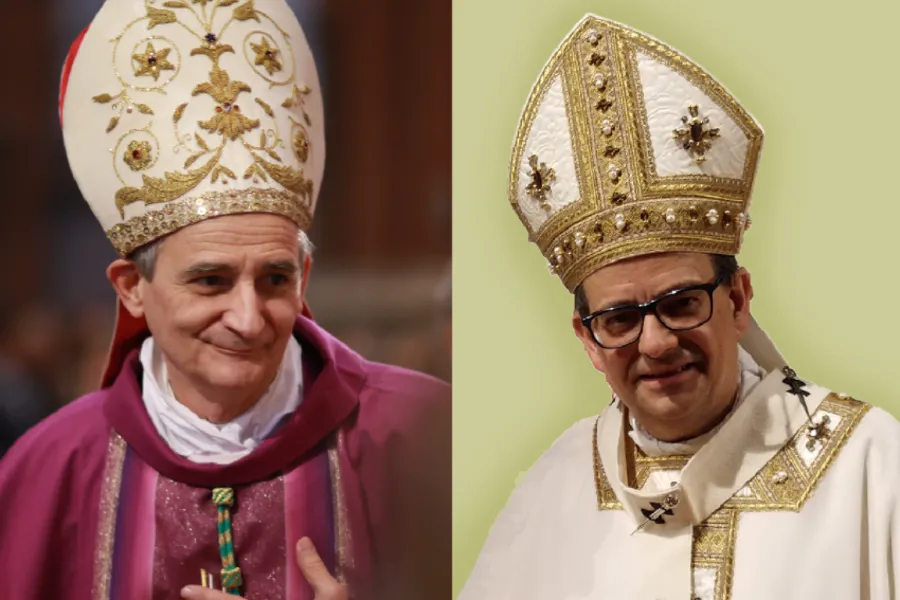
Cardinal Matteo Zuppi and Cardinal Augusto Paolo Lojudice. Francesco Pierantoni via Wikimedia (CC BY 2.0)/Pufui PcPifpef via Wikimedia (CC BY-SA 4.0).
The plan was to appoint Lojudice vicar of the Diocese of Rome to succeed Cardinal de Donatis, who had finished his five-year term, which would then have made Lojudice the primary contact person for the pope both in Rome and among the Italian bishops. De Donatis would have been appointed the new Penitentiary in place of Cardinal Mauro Piacenza, who has now turned 78.
The Italian bishops, however, preferred Cardinal Matteo Zuppi, archbishop of Bologna, who was not unwelcome to Pope Francis.
Lojudice didn’t become vicar for the Rome Diocese, either, as everyone assumed would happen. Meanwhile, the relationship of trust between de Donatis and the pope seemed to have been interrupted in 2020, when, at the beginning of the lockdown for COVID-19, de Donatis decided to close the churches of Rome. When Pope Francis later highlighted the inadvisability of closing churches, de Donatis withdrew the decree but announced that every decision had been made in agreement with the pope. There also have been other moments of friction in recent years.
The pope, however, now seems intent on changing the vicar this year when de Donatis’ mandate expires. An indication of this is the fact that in the decree in which the Pope defines the area and pastoral competencies of the auxiliary bishops, de Donatis is not mentioned as vicar. One might take his presence for granted, of course, but the general interpretation is that the change will be made.
What’s new
What are the novelties introduced by Pope Francis? First, the figure of the prelate general secretary disappears, while the vicegerente (or the deputy of the vicar) manages the offices of the General Secretariat. The prelate secretary also had the function of the moderator of the Curia. In this case, everything is entrusted to the vicegerente, who thus sees his functions and weight increase.
The pope chose the vicegerente from among the auxiliary bishops, and in this case, Baldassare Reina was selected. Bishop Reina does not come from the Diocese of Rome but was called from Agrigento. The pope’s logic is to break possible power chains by bringing in fresh and foreign forces.
The choice of a new parish priest is entrusted to a lengthy procedure which must then, in any case, be submitted to the pope, who acts as the true and proper bishop of Rome without relying on the vicar, who is left with the appointment of assistant parish priests.
Article 20 of the Constitution requests a report for each candidate for the priesthood or diaconate to be submitted before ordination. Also, in this case, the candidates must be presented by the cardinal vicar to the pope, and only after obtaining the Episcopal Council’s consent. Therefore, the vicar seems to be practically a commissariat: He does not choose the candidates but submits them to the pope and can submit them only after the Episcopal Council has endorsed the choice.
The council is defined as the “first organ of Synodality” and must meet “at least three times a month,” presided over by the pope. Only in the absence of the pope can the cardinal vicar preside over the council, which is made up of the vicegerent and the auxiliary bishops. However, the pope wants to receive “the agenda for each meeting as soon as possible.”
Finally, there is also the establishment of an Independent Supervisory Commission. This will have a regulation that must be “approved by the Pope” and six members appointed by the pope who can remain in office for a maximum of two five-year terms.
The service for the protection of minors and vulnerable people is also added, which “reports to the Episcopal Council, through the auxiliary bishop appointed by me,” the pope has decreed.
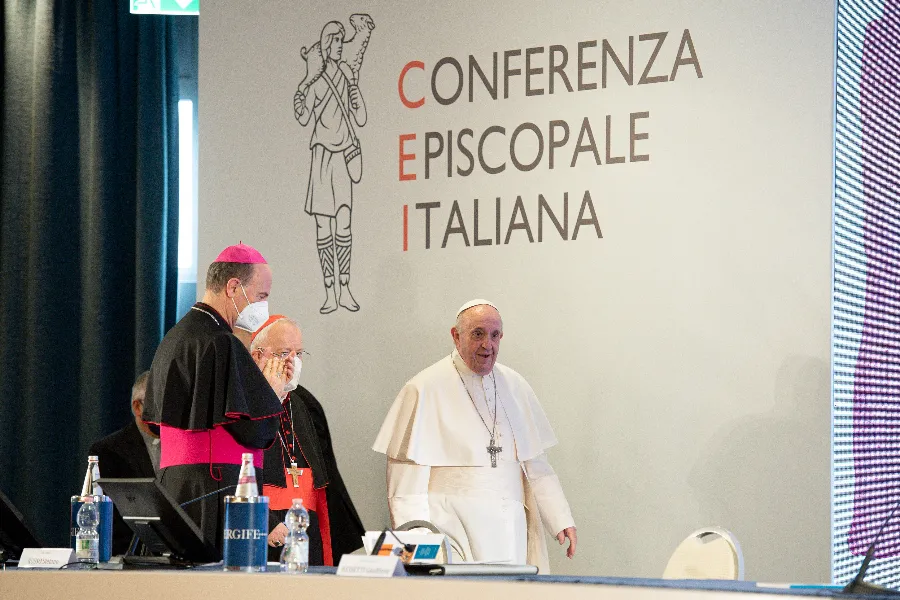
Pope Francis attends the Italian bishops’ plenary assembly in Rome on May 24, 2021. Vatican Media.
The effects of the reform
The constitution also redistributes the areas and offices of the Vicariate’s Curia, and the accompanying decree gives each auxiliary bishop a specific task.
Beyond the reorganization, it should be noted how the pope enters into action as the actual bishop of Rome. Everything must pass through the decisions of the pope, while before, the cardinal vicar enjoyed trust and discretion. For the first time, however, the pope’s vicar is defined as an “auxiliary.” He is, therefore, an auxiliary among the auxiliaries, with a considerable reduction in his weight.
With this centralization, Pope Francis probably wants to overcome the risk of having “abuses” within the Vicariate.
It is worth remembering that in June 2021, Pope Francis ordered an inspection of the Vicariate itself. It was an audit entrusted to the Auditor General of the Holy See, Alessandro Cassinis Righini. It was the first time the Vicariate sifted through the accounting books, registers, and cooperative societies.
However, the Pope, as a matter of practice, has sent an inspection to all the dicasteries of the Curia every time there is a reform or a new mandate. The review, therefore, already predicted the change of pace in the Vicariate, one that has led Pope Francis to be increasingly alone in command.




Leave a Reply