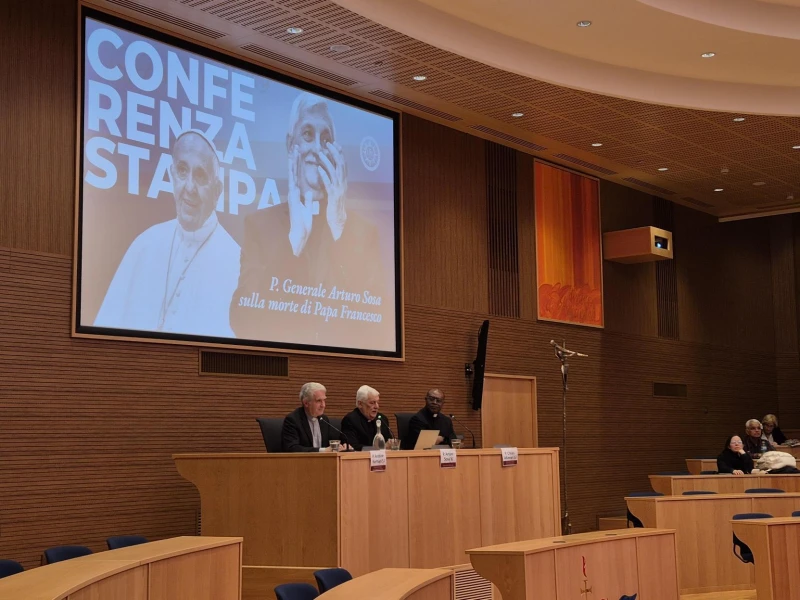
Jesuit Superior General Father Arturo Sosa, SJ, center, speaks about Pope Francis at a press conference at the Jesuit general curia in Rome on April 24, 2025. / Credit: Hannah Brockhaus/CNA
Vatican City, Apr 24, 2025 / 17:28 pm (CNA).
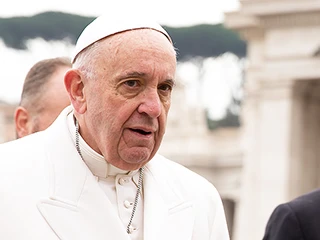
Father Arturo Sosa, SJ, superior general of the Society of Jesus, reflected on the first Jesuit pope in a press conference on Thursday, saying Francis “did not seek to please everyone” or to measure himself by a popularity index.
“Once he chose to be a disciple of Jesus, his deep motivation in life was to put God’s will into practice,” Sosa said, calling the late pontiff “a man of prayer, who asked for prayers to make decisions according to the will of God.”
During the press conference, held in the Jesuit general curia in Rome, Sosa also answered a question about what qualities are needed in the next pope. “Undoubtedly, we are looking for another man of God,” he said.
“And after that, for me, it is important to have a pope with a universal outlook,” he added, drawing a distinction with what he called an “international outlook.”
The Jesuit superior defended Francis against accusations he caused controversy — like with Fiducia Supplicans, the Vatican’s declaration on same-sex blessings — or fell short in some areas by saying he was not the source of problems in the Church but inherited problems that were already there.
“Pope Francis helped put the difference of positions on the table” and provoked dialogue, Sosa said, stressing that the late pope wanted to listen to everyone.
“I don’t think of Pope Francis as a reformer,” Sosa also said. “I think of him as someone who continued the reform that the Church has always carried out.”
About Francis’ record on abuse, Sosa said the pope “always acknowledged his limitations, his mistakes, and his slowness” to respond to cases. “This is not about giving Pope Francis a medal or giving him a grade but about learning about potential criticism and mistakes.”
“With regard to abuse cases, I think the Church is not in the same place when Pope Francis was elected. That’s without a doubt. It hasn’t been a straight line… but the Church has advanced in that direction,” he added.
According to the superior general, Pope Francis’ most urgent legacy for today will be his calls for peace: “I think Pope Francis has shouted in every moment, on every occasion, about peace.”
“The world needs peace and peace is built by us,” Sosa added. “Peace means to put aside any other priority than people and the dignity of people. And peace means justice with the poor. I think the constant prayer and the constant argument about peace by Pope Francis is a very important message for today.”
Pope Francis, who joined the Society of Jesus in 1958, was the first-ever Jesuit to be pope. During his international trips, he would always spend time with local Jesuits in the countries he visited. He also met with Jesuits in Rome during their 36th general congregation on Oct. 24, 2016.
“He established a very fraternal relationship with the Jesuits,” Sosa said on April 24. “We will end this period of Pope Francis thanking the Lord.”
If you value the news and views Catholic World Report provides, please consider donating to support our efforts. Your contribution will help us continue to make CWR available to all readers worldwide for free, without a subscription. Thank you for your generosity!
Click here for more information on donating to CWR. Click here to sign up for our newsletter.
Pope Francis opens the Holy Door in L’Aquila, Italy on Aug. 28, 2022. / Daniel Ibanez/CNA
Rome Newsroom, Aug 28, 2022 / 04:15 am (CNA).
Pope Francis became the first pope in 728 years to open the Holy Door of a 13th-century basilica in L’Aquila, Italy on Sunday.
During a visit to the Italian city located about 70 miles northeast of Rome on Aug. 28, the pope participated in a centuries-old tradition, the Celestinian Forgiveness, known in Italian as the Perdonanza Celestiniana.
The opening of the Holy Door marked a key moment in the annual celebration established by Pope Celestine V in 1294.
“For centuries L’Aquila has kept alive the gift that Pope Celestine V left it. It is the privilege of reminding everyone that with mercy, and only with it, the life of every man and woman can be lived with joy,” Pope Francis said in his homily during Mass at L’Aquila’s Basilica of Santa Maria di Collemaggio.
“To be forgiven is to experience here and now what comes closest to the resurrection. Forgiveness is passing from death to life, from the experience of anguish and guilt to that of freedom and joy. May this church always be a place where we can be reconciled, and experience that grace that puts us back on our feet and gives us another chance,” he said.
Pope Francis began the day trip at 7:50 a.m. traveling by helicopter from the Vatican to L’Aquila. He visited the city’s cathedral, which is still being rebuilt after it was badly damaged during a 2019 earthquake in which more than 300 people died.
The pope wore a hard hat while touring the reconstruction area of the damaged church. He spoke to family members of earthquake victims in the town square in front of the cathedral, where local prisoners were also present in the crowd. People cheered and waved Vatican flags as Pope Francis greeted them from a wheelchair.
Pope Francis wore a hard hat while visiting the L’Aquila cathedral, which was damaged by a 2019 earthquake. Vatican Media
Pope Francis said: “First of all I thank you for your witness of faith: despite the pain and loss, which belong to our faith as pilgrims, you have fixed your gaze on Christ, crucified and risen, who with his love redeemed the nonsense of pain and death.”
“And Jesus has placed you back in the arms of the Father, who does not let a tear fall in vain, not even one, but gathers them all in his merciful heart,” he added.
After speaking to the families of the victims, Pope Francis traveled in the popemobile to L’Aquila’s Basilica of Santa Maria di Collemaggio, where he celebrated an outdoor Mass, recited the Angelus, and opened the Holy Door.
In his brief Angelus message, the pope offered a prayer for the people of Pakistan, where flash floods have killed more than 1,000 people and displaced thousands more.
Pope Francis also asked for the intercession of the Virgin Mary to obtain “forgiveness and peace for the whole world,” mentioning Ukraine and all other places suffering from war.
Pope Francis prayed for peace in his Angelus address following Mass in L’Aquila, Italy. Pope Francis prayed for peace in his Angelus address following Mass in L’Aquila, Italy.
During his visit to L’Aquila, the pope said that he wanted the central Italian city to become a “capital of forgiveness, peace, and reconciliation.”
“This is how peace is built through forgiveness received and given,” he said.
L’Aquila is the burial place of Pope Celestine V, who led the Catholic Church for just five months before his resignation on Dec. 13, 1294. The pope, who was canonized in 1313, is buried in L’Aquila’s Basilica of Santa Maria di Collemaggio.
In the spring, the Vatican’s announcement that Pope Francis would visit L’Aquila prompted unsourced speculation that the trip could be the prelude to the 85-year-old pope’s resignation.
When Benedict XVI became the first pope to resign in almost 600 years in 2013, Vatican-watchers recalled that he had visited the tomb of Celestine V years earlier. During his trip on April 28, 2009, he left his pallium — the white wool vestment given to metropolitan archbishops — on the tomb. In hindsight, commentators suggested that Benedict was indicating his intention to resign.
In his homily in L’Aquila, Pope Francis praised Pope Celestine V for his humility and courage.
Mentioning Dante Alighieri’s description of Celestine as the man of “the great refusal,” Pope Francis underlined that Celestine should not be remembered as a man of “no” — for resigning the papacy — but as a man of “yes.”
Pope Francis said: “Indeed, there is no other way to accomplish God’s will than by assuming the strength of the humble, there is no other way. Precisely because they are so, the humble appear weak and losers in the eyes of men, but in reality they are the true winners, for they are the only ones who trust completely in the Lord and know his will.”
At the end of the Mass, the crowd prayed the Litany of Saints and watched as Pope Francis made history when he opened the basilica’s Holy Door. According to Cardinal Giuseppe Petrocchi of L’Aquila, Pope Francis is the first pope to open the Holy Door in 728 years.
Visiting cardinals have opened the Holy Door for the Celestinian Forgiveness in past years, after a reading of the bull of forgiveness by the local mayor. Celestine donated the papal bull to L’Aquila, where it is kept in an armored chapel in the tower of the town hall.
The bull of forgiveness drawn up by Celestine V offered a plenary indulgence to all who, having confessed and repented of their sins, go to the Basilica of Santa Maria di Collemaggio from Vespers on Aug. 28 to sunset on Aug. 29. A plenary indulgence is a grace granted by the Catholic Church through the merits of Jesus Christ, Mary, and all the saints to remove the temporal punishment due to sin.
Celestine’s indulgence was exceptional at the time, given it was available to anyone, regardless of status or wealth, and cost nothing except personal repentance at a time when indulgences were often tied to almsgiving.
Pope Francis prays at the tomb of Pope Celestine V in L’Aquila, Italy. Vatican Media
After opening the Holy Door, Pope Francis was wheeled through the basilica to the tomb of Pope Celestine V, where he spent a moment in silent prayer before the relics of his papal predecessor who was declared a saint in 1313.
“In the spirit of the world, which is dominated by pride, today’s Word of God invites us to be humble and meek. Humility does not consist in the devaluation of self, but rather in that healthy realism that makes us recognize our potential and also our miseries,” Pope Francis said.
“Starting precisely from our miseries, humility causes us to look away from ourselves and turn our gaze to God, the One who can do everything and also obtains for us what we cannot have on our own. ‘Everything is possible for those who believe (Mark 9:23).'”
Cardinal Baldassare Reina celebrates Mass on Day 3 of the Novendiales Masses for Pope Francis on April 28, 2025, in St. Peter’s Basilica at the Vatican. / Credit: Daniel Ibañez/CNA
My personal tendency is to think like Sosa, as to this I remarked several times regarding the purpose of Francis’ duality. Was it duplicity, or genuine reevaluation intended by loosening the hawsers? Though not entirely.
It’s the last that superior general fr Sosa infers. If that is the case we certainly appear rudderless and drifting at random. In that I find it inconsistent with Christ, the savior who reached out his hand to steady Christ’s faith in turbulent waters. We must have something irrepressibly strong to hold on to.
We read: “Pope Francis helped put the difference of positions on the table” and provoked dialogue, Sosa said, stressing that the late pope wanted to listen to everyone.”
Over fifty years ago, this naive (?) technique was pioneered in the Archdiocese of Seattle–the posturing of listening and responding to others rather than initiating or imposing anything.
For his style and its outcomes, the diocesan archbishop was tagged not for what he did directly but, more charitably, for what less directly still happened on his watch. After the Visitation (and much else), the public letter of correction read partly as follows, and remarkably is still timely, yes (?), for today now on the worldwide stage:
“(a) The need to bring into clear focus–working together with priests, religious and theologians–certain teachings of the Church and their implications for the pastoral practice of the Archdiocese. These include the role of conscience in making moral decisions; the role of the Magisterium in giving definitive guidance in matters of faith and morals; the nature and mission of the Church, together with its sacramental and hierarchical structure; an anthropology which provides an authentic understanding of the dignity of the human person; and a Christology which correctly reflects our Catholic faith concerning Christ’s divinity, His humanity, His salvific mission, and His inseparable union with the Church.
“(b) In particular, the need to present more clearly the Church’s teaching concerning the permanence and indissolubility of marriage [….]
“(c) Greater vigilance in upholding the Church’s teaching, especially with regard to contraception and homosexuality.”
(d and e) Etc.
The upcoming conclave now has to deal broadly with governance, and particularly with Vatican bankruptcy and the metastasized imposition of der Synodal Weg.
It’s always better when Jesuits maintain silence. The election of any Jesuit to the See of Peter is always a mistake.
My personal tendency is to think like Sosa, as to this I remarked several times regarding the purpose of Francis’ duality. Was it duplicity, or genuine reevaluation intended by loosening the hawsers? Though not entirely.
It’s the last that superior general fr Sosa infers. If that is the case we certainly appear rudderless and drifting at random. In that I find it inconsistent with Christ, the savior who reached out his hand to steady Christ’s faith in turbulent waters. We must have something irrepressibly strong to hold on to.
We read: “Pope Francis helped put the difference of positions on the table” and provoked dialogue, Sosa said, stressing that the late pope wanted to listen to everyone.”
Over fifty years ago, this naive (?) technique was pioneered in the Archdiocese of Seattle–the posturing of listening and responding to others rather than initiating or imposing anything.
For his style and its outcomes, the diocesan archbishop was tagged not for what he did directly but, more charitably, for what less directly still happened on his watch. After the Visitation (and much else), the public letter of correction read partly as follows, and remarkably is still timely, yes (?), for today now on the worldwide stage:
“(a) The need to bring into clear focus–working together with priests, religious and theologians–certain teachings of the Church and their implications for the pastoral practice of the Archdiocese. These include the role of conscience in making moral decisions; the role of the Magisterium in giving definitive guidance in matters of faith and morals; the nature and mission of the Church, together with its sacramental and hierarchical structure; an anthropology which provides an authentic understanding of the dignity of the human person; and a Christology which correctly reflects our Catholic faith concerning Christ’s divinity, His humanity, His salvific mission, and His inseparable union with the Church.
“(b) In particular, the need to present more clearly the Church’s teaching concerning the permanence and indissolubility of marriage [….]
“(c) Greater vigilance in upholding the Church’s teaching, especially with regard to contraception and homosexuality.”
(d and e) Etc.
The upcoming conclave now has to deal broadly with governance, and particularly with Vatican bankruptcy and the metastasized imposition of der Synodal Weg.
O Give thanks to the Lord for He is good.