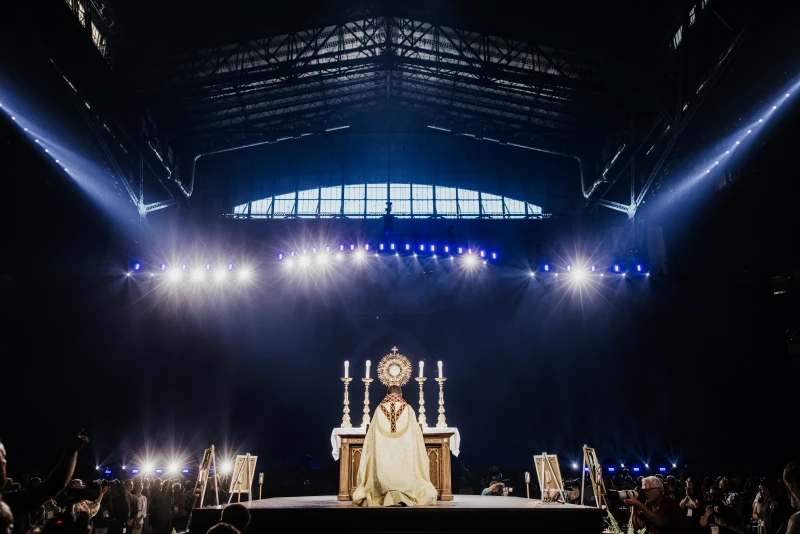
Bishop Andrew Cozzens of Crookston, Minnesota, who spearheaded the U.S. bishops’ initiative of Eucharistic Revival, adores Christ in the Eucharist with tens of thousands of people in Lucas Oil Stadium. / Credit: Casey Johnson in partnership with the National Eucharistic Congress
CNA Staff, Jul 26, 2024 / 07:00 am (CNA).
More than 50,000 Catholics filled the Indiana Convention Center and Lucas Oil Stadium July 17–21 for the National Eucharistic Congress in Indianapolis. Clergy, religious sisters and brothers, young people, the elderly, and families came together for an incredible opportunity to grow closer to Jesus in the Eucharist.
The week was filled with heartfelt moments, laughter, joy, and inspiration as the faithful in attendance experienced the fruits of years of preparation for the congress, which was a major event in the United States Bishops’ Eucharistic Revival.
Here are some of the best photos from the National Eucharistic Congress:
Attendees of the National Eucharistic Congress in Indianapolis enter the Indiana Convention Center, where a sign reads “Revival Starts Here.” Credit: Casey Johnson in partnership with the National Eucharistic Congress
Bishop Andrew Cozzens of Crookston, Minnesota, who spearheaded the U.S. bishops’ initiative of Eucharistic Revival, adores Christ in the Eucharist with tens of thousands of people in Lucas Oil Stadium. Credit: Casey Johnson in partnership with the National Eucharistic Congress
Ciboria filled with hosts await the start of Mass at the National Eucharistic Congress at Lucas Oil Stadium in Indianapolis on July 18, 2024. Credit: Jeffrey Bruno
Children spend time before the Blessed Sacrament during a special time of “family adoration” at St. John the Evangelist Church. Credit: Jeffrey Bruno
A woman at the National Eucharistic Congress kneels in prayer. Credit: Jeffrey Bruno
Attendees kneel and reach for the monstrance as it passes by them during a procession at the National Eucharistic Congress in Indianapolis. Credit: Jacob Bentzinger in partnership with the National Eucharistic Congress
A religious sister and a laywoman share a moment of joy at the expo hall at the Indiana Convention Center during the National Eucharistic Congress. Credit: Jeffrey Bruno
Bishops process in to Lucas Oil Stadium in Indianapolis on July 18, 2024. Credit: Jeffrey Bruno
Religious sisters attend the National Eucharistic Congress at Lucas Oil Stadium in Indianapolis on July 18, 2024. Credit: Jeffrey Bruno
The Eucharist and the crowd for the procession as part of the National Eucharistic Congress in Indianapolis. Credit: Jeffrey Bruno
Religious sisters pass by on the National Eucharistic Congress procession in Indianapolis. Credit: Jeffrey Bruno
The assembled faithful for the Eucharistic procession on the grassy mall in front of the Indiana War Memorial. Credit: Jeffrey BrunoBishop Andrew Cozzens holds the Eucharist over the faithful for benediction while standing on the Indiana War Memorial. Credit: Jeffrey Bruno
A young boy high fives a priest during the Eucharistic Procession through downtown Indianapolis. Credit: Jeffrey BrunoMore than 50,000 kneel in adoration of the Eucharist at the National Eucharistic Congress held at Lucas Oil Stadium in downtown Indianapolis. Credit: Jeffry Bruno
If you value the news and views Catholic World Report provides, please consider donating to support our efforts. Your contribution will help us continue to make CWR available to all readers worldwide for free, without a subscription. Thank you for your generosity!
Click here for more information on donating to CWR. Click here to sign up for our newsletter.
Randall Terry, spokesman for the Progressive Anti-Abortion Uprising, a pro-life group, speaks at a press conference on April 5, 2022. The group says it obtained the remains of more than 100 aborted babies, which included five babies the group sa… […]
Cincinnati, Ohio, Oct 24, 2019 / 03:55 pm (CNA).- A county prosecutor in Ohio walked back comments about a warning he issued to the Cincinnati archdiocese concerning a priest accused of rape, to clarify that the archdiocese was not hiding a letter that… […]
Volunteers at Mount Saint Mary College collected more than 800 toys for their annual toy drive in Newburgh, New York, in December 2024. / Credit: Lee Ferris
CNA Staff, Dec 25, 2024 / 06:00 am (CNA).
Multiple Catholic groups and organizations th… […]





Leave a Reply