


 By
By 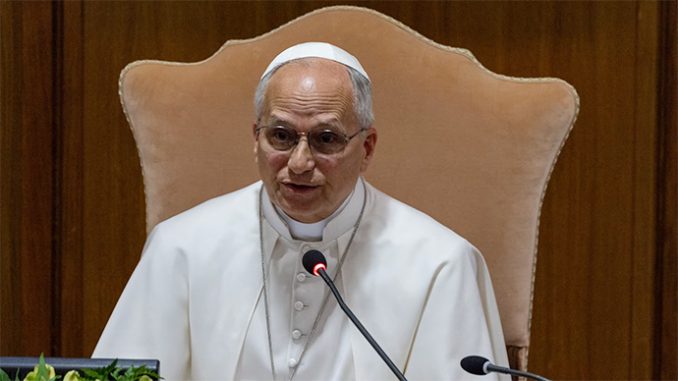
VATICAN CITY — Pope Leo XIV on Monday personally attended the presentation of his first encyclical, Magnifica Humanitas, in an uncustomary gesture. Upon his arrival at the event, held in the Vaticanʼs Synod Hall, he was greeted with sustained applause from an audience made up of members of the Roman Curia, representatives of academia, and the diplomatic corps.
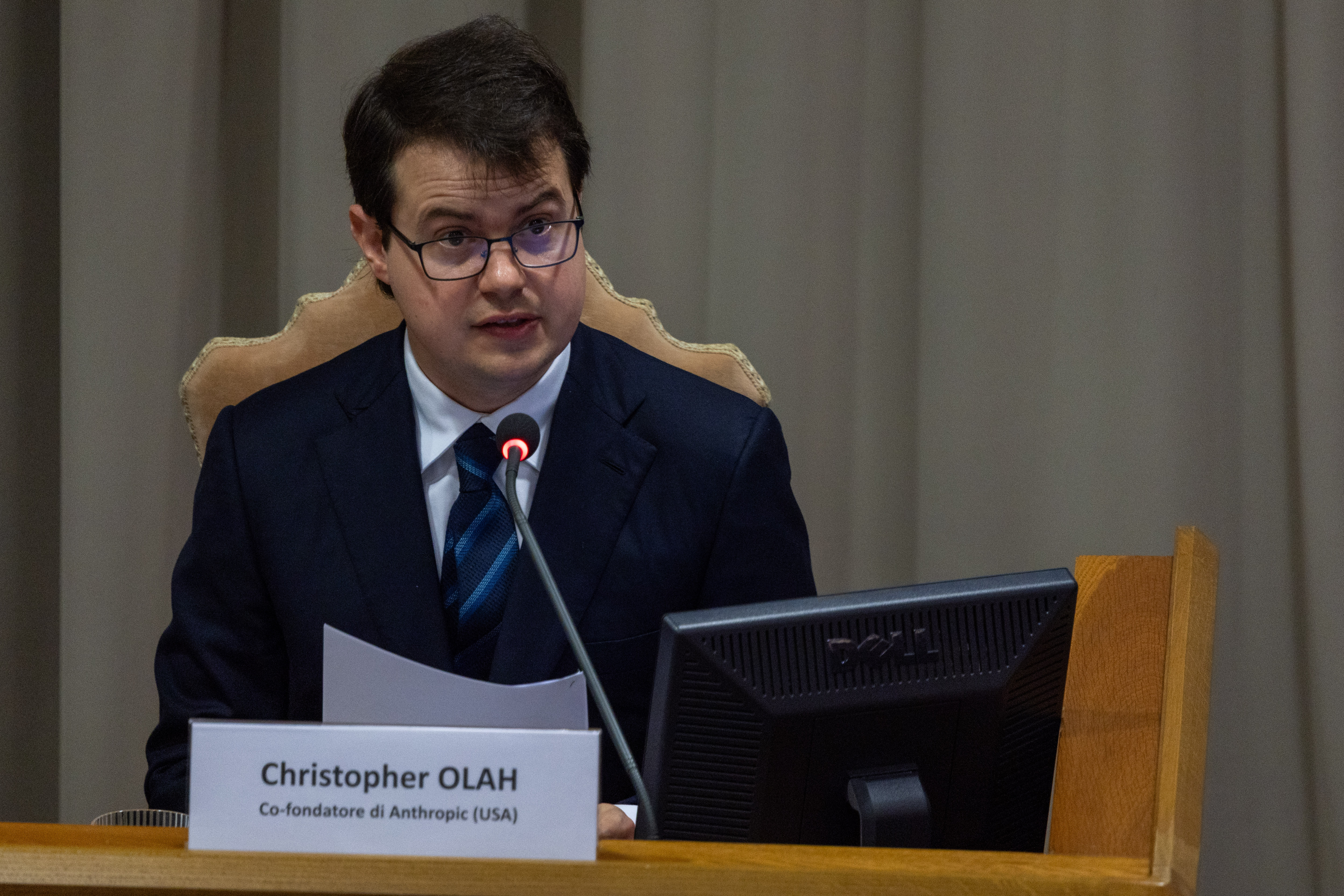
Among the speakers was Canadian Christopher Olah, co-founder of Anthropic, one of the leading artificial intelligence (AI) companies. The firm has recently had tensions with the administration of U.S. President Donald Trump after prohibiting the U.S. Department of Defense from using its software for military purposes.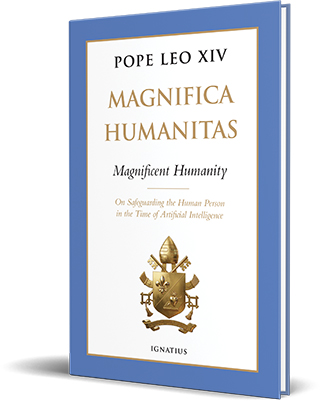
Some observers had raised concerns about including a representative of a major tech company like Anthropic in an event of this kind. The Holy Father himself dispelled any hesitation by thanking Olah for his presence: “What a great sign of hope it is that with our differences we can listen to one another,” he said in his remarks.
“This interchange clearly bespeaks the gravity of the moment, as well as confidence that together we can discern the major questions of our time, and so the future of humanity,” he added.
In his remarks prior to the pope’s address, Olah echoed the same idea: “That is why, if we want this technology to go well, it is enormously important that there be people outside those incentives — people who care about things going well and insist on safety, who are paying close attention, who are willing to say hard things, who are willing to be our earnest, thoughtful, critics. It is through dialogue and mutual effort, through the push and pull, that humanity will achieve great things. That is what I see in Magnifica Humanitas, and it is why I am grateful to His Holiness and the Church for taking up this work of discernment.”
Olah, who is not a believer, also issued a call to various sectors — religious communities, civil society, academics, and governments — to follow the pope’s example with this document: “to take this seriously, to look closely, and to push events in a better direction. We need informed critics who will tell the labs when we are failing. We need moral voices that the incentives cannot bend.”
It is no coincidence that Leo XIV signed his first encyclical on May 15, the same date on which his predecessor Leo XIII promulgated Rerum Novarum (“On New Things”) in 1891 in response to the dehumanization brought about by the Industrial Revolution. As the pope explained, the world today faces a transformation of perhaps even greater scope.
“Today we find ourselves facing a transformation of similar magnitude, with perhaps even greater consequences. Artificial intelligence already touches many areas of our lives and affects decisions that shape human coexistence,” he said.
The pope expressed particular concern about the impact of new technologies on the conduct of war, which, he warned, is changing dramatically.
“Like the earlier Leo, I feel entrusted to look upon another huge transformation with eyes of faith, with lucidity of reason, with openness to mystery, and with cries of the poor and the earth resounding in my heart,” he said.
The Holy Father also described the method behind the drafting of this magisterial document, which began in July 2025 at the papal residence in Castel Gandolfo. In it, he seeks to reaffirm what makes us human in a society shaped by technology.
He emphasized that Magnifica Humanitas was born from listening: “I have listened to scientists and engineers who work with sincere enthusiasm on technologies capable of alleviating immense suffering, to political leaders and public officials who have perseveringly sought just rules, to parents and teachers who are deeply concerned for the future of younger generations,” he said, without naming individuals.
At the same time, he acknowledged hearing “Other very troubling voices have also reached me about increasingly autonomous weapons systems practically beyond any human reach to govern them effectively.”
“I hear very troubling accounts of algorithms that can block access to healthcare, employment, and security on the basis of data tainted by prejudice and injustice. And Iʼve heard the silence of those who have no voice when decisions are made — decisions likely to generate new forms of exclusion and suffering,” he lamented.
In line with the document — which states that artificial intelligence is not morally neutral — the pope called for AI to be “disarmed.”
“The word is strong, I know, but deliberately chosen because this moment needs words capable of attracting attention, awakening consciences, and indicating paths forward for humanity,” he warned.
“The Church has long been working for nuclear disarmament, aware that every great technical power can affect peopleʼs lives, and so must be accompanied by adequate moral discernment and public control. Nuclear disarmament remains a service to peace and the dignity of the human family,” he added.
Also speaking at the presentation were three cardinals of the Roman Curia: Secretary of State Pietro Parolin; Cardinal Víctor Manuel Fernández, prefect of the Dicastery for the Doctrine of the Faith; and Cardinal Michael Czerny, SJ, prefect of the Dicastery for Promoting Integral Human Development.
Two theologians also took the floor: Anna Rowlands, a specialist in Catholic social teaching and migration ethics at Durham University, and Leocadie Lushombo, an expert in political theology and Catholic social thought at the Jesuit School of Theology of Santa Clara University in California.
This story was originally published by ACI Prensa, EWTN News’ Spanish-language news service. It has been translated and adapted by EWTN News English.
If you value the news and views Catholic World Report provides, please consider donating to support our efforts. Your contribution will help us continue to make CWR available to all readers worldwide for free, without a subscription. Thank you for your generosity!
Click here for more information on donating to CWR. Click here to sign up for our newsletter.



Indeed it does have greater consequences because as Leo XIV addresses it as an anthropic issue that has the potential to usurp the function of the intellect and dehumanize Man.
Not a laughing matter. A bizarre example was recently seen in an ambling group of praying hooded Buddhist monks, one noticeably a humanoid robot. The monks let it be known that he belonged in their community.
Apparently related to the Buddhist notion that all existence is interrelated in a form of pantheism. Does this isolated incident forebode the virtual robotization of Man having surrendered his intellectual independence to AI?
More than a little ironic when a Pope, who at times has displayed a secular humanism presupposing sociological determinism, while advocating a reengineering of the faithful from “outdated rigid moral attitudes,” would submit to the fiction of fictions that artificial intelligence, a glorified search mechanism compiling published documents, could ever have any connection to the formation of value judgments. If humanity can be conceived as socially determined how can computers not be recognized as the completely dumb devices they are and always will be?
Misgivings are not enough. Reluctant qualified acceptance is not enough. Materialism should always be condemned forcefully and unambiguously with a fervor that embraces being a fool for Christ.
Acquiescence to the mythology of AI is more the result of a declining Catholic episcopate so weakened in its witness, it cannot even explain how value judgments are exclusive to human willfulness. Our episcopate no longer knows what to acknowledge and what to reject in this wounded world. Instead, it recirculates Kamala Harris grade sentiments promoting “encounter, openness, dialogue (as in submission to liberal monologue), accompaniment, inclusion, and the grievance sin to the Holy Spirit that calls agreed upon tyrannies “discernment.” Every mindless platitude presented as thoughtful and authoritative, effectively rewarding the conceits of progressive counterparts. No specifics of meaning required, other than an increased tolerance for sin.
When the realities of a permanently unalterable human condition, in need of continuous acts of redemption through the Holy Sacrifice of the Mass, are downplayed by Catholic leaders, the devil rejoices. When ordained men concede fictions, however limited, of a new age blowing in the wind, the devil throws a party.
Where John Paul II humanized modern work by coining the phrase “global workbench,” Pope Leo gives us “men and women prepared to enter the ‘construction sites of history’. Foundationally, we also find unambiguous references to the historical and even “alarming” (said Benedict) event (!) of the Incarnation within universal human history.
Not “time is greater than space,” but rather, the Triune One is both within and above time and space.
Selected highlights:
“At the heart of everything is the mystery of the Incarnation, the Word who became flesh and dwelt among us.
“…old and new ideologies alike urge humanity to overcome limitations through technology, and to rise above others by asserting dominance. Contrary to this, the mystery of the Son of God entering into our human condition promises something quite different.
“Indeed, the Lord continues to make all things new and offers every era the possibility of becoming part of salvation history in the light of the Incarnation.
“The Church’s Social Doctrine brings us to the very heart of our faith: the mystery of the living God, revealed in Jesus Christ, who, as a communion of Persons — Father, Son and Holy Spirit — is love itself in relationship, expressed in the mutual gift of self and in sharing with the world [….] Indeed [our] deepest vocation is to enter into the Trinitarian dynamic of love received and shared.”
http://www.vatican.va/content/leo-xiv/en/encyclicals/documents/20260515-magnifica-humanitas.html
Magnifica Humanitas starts off as Christocentric and basically remains throughout. Noteworthy is Pope Leo’s effort to reinstate a continuity with Francis’ predecessors frequently quoting John Paul II.
Emphasis is placed on the common good and equanimity in the universal distribution of goods a socialist slant. Although all in all nothing is remarkably inconsistent with sound Catholic theology. Certainly a needed assessment of the dangers and benefits of AI.
I am full of admiration for the marketing genius of Christopher Olah. Refusing the Pentagon was a master stroke against the evil tech-bro meme that pervades society today. And now showing up at the unveiling of an encyclical and sharing the stage with the pope. That’s genius. Humbug, but genius-level humbug.
Of course, Olah knows perfectly well that if AI actually has military application, the US will have to deploy it, because whether they do or not, China certainly will. The threat of nuclear war has not been avoided by nobody having nuclear weapons but by every significant power having them.
I hope that Leo knows this too, because otherwise I can imagine the next encyclical being sponsored by Coca-Cola and featuring Leo taking a solo in a stirring rendition of I’d Like to Teach the World to Sing.
AI is so far proving to be an economic boondoggle that is sucking up billions of dollars with no sign of a viable business model in sight. To suggest that its impact will be greater than that of the Industrial Revolution is, to put it mildly, premature. Let’s remember that a few years ago people were saying the same thing about the metaverse. But then, AI was always first and foremost a philosophical project, designed to show that man is an automaton by building an automaton that behaves like a man. And so far, it is well short of achieving that goal.
Perhaps God will intervene again as he did long ago when he destroyed the Tower of Babel when civilization got too proud and tried to be in charge. Or perhaps AI. Is itself the very correction needed which will humble and control us. Its power and potential is so great that it is hard to see how man can tame and contain it. After more than 70 years we still have not conquered the nuclear problem.
How about paragraph 192 of Leo’s ping:
“Today, more than ever, without prejudice to the right to self-defense in the strictest sense, it is important to reaffirm that the ‘just war’ theory, which has all too often been used to justify any kind of war, is now outdated.”
Pope Leo painted himself into a corner with his dialogue with Trump, now he’s using an encyclical to justify his personal beliefs. Welcome to the new made up magesteruim.