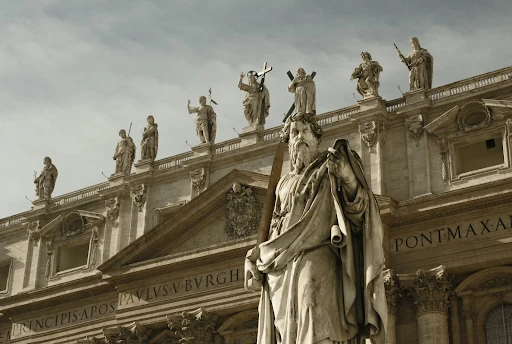
Facade of St. Peter’s Basilica / Credit: Nils Huber / Unsplash
Rome Newsroom, Jul 14, 2024 / 08:49 am (CNA).
The Holy See has condemned acts of violence in the wake of the shooting that injured former U.S. President Donald Trump and others and left one dead at a campaign rally in Pennsylvania on July 13.
A brief statement provided to CNA by Vatican spokesperson Matteo Bruni on July 14 said the Holy See expressed “concern about last night’s episode of violence, which wounds people and democracy, causing suffering and death.”
The comment also said the Holy See “is united to the prayer of the U.S. bishops for America, for the victims, and for peace in the country, that the motives of the violent may never prevail.”
Pope Francis did not comment on the incident during his weekly public appearance for the Angelus at noon on Sunday.
Political leaders from around the globehave spoken out against political violence and in support of democracy after the assassination attempt in Butler, Pennsylvania, Saturday evening.
In astatement posted to Truth Social July 13, Trump said a bullet pierced the upper part of his right ear. After receiving treatment at a nearby hospital, the former president flew to New Jersey under Secret Service protection late Saturday night.
The FBI has identified the Trump rally shooter as 20-year-old Thomas Matthew Crooks of Bethel Park, Pennsylvania. Crooks, who carried no ID and was identified with DNA analysis, was killed by a Secret Service sniper at the rally, according to officials.
If you value the news and views Catholic World Report provides, please consider donating to support our efforts. Your contribution will help us continue to make CWR available to all readers worldwide for free, without a subscription. Thank you for your generosity!
Click here for more information on donating to CWR. Click here to sign up for our newsletter.
Rome, Italy, Mar 3, 2019 / 01:30 pm (CNA).- In a visit to a Roman parish on Sunday, Pope Francis encouraged Catholics to stop gossiping and ruminating on the shortcomings of other people, and to instead focus on repenting of their own sins.
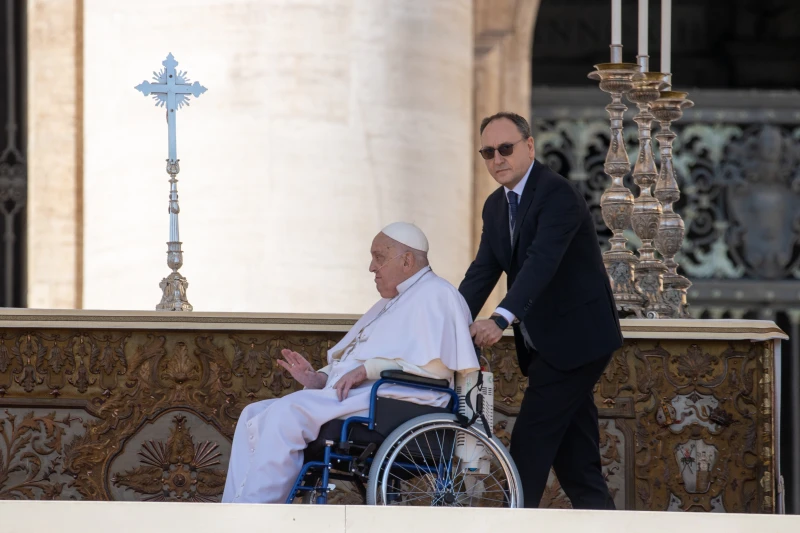
Pope Francis blesses the faithful at the Jubilee of the Sick in St. Peter’s Square, Vatican City, on April 6, 2025, as his personal nurse, Massimo Strappetti, assists him in the wheelchair. / Credit: Daniel Ibáñez/CNA
Vatican City, Apr 23, 2025 / 10:30 am (CNA).
Having cared for the aging Pope Francis as his personal nurse since 2022, Italian nurse Massimiliano Strappetti was among the few people who saw the Holy Father moments before his death on Easter Monday.
Before being appointed Pope Francis’ personal nurse in August 2022, Strappetti was the nursing coordinator for the Vatican’s health department. He started working in the Vatican in 2002 after having worked eight years in the intensive care unit of Rome’s Gemelli Hospital.
Pope Francis is seen with his personal nurse, Massimo Strappetti, at the Jubilee of the Sick in St. Peter’s Square, Vatican City, Sunday, April 6, 2025. Credit: Daniel Ibáñez/CNA
Strappetti’s appointment came very soon after he accompanied the Holy Father on a difficult apostolic journey to Canada from July 24–30, 2022. Throughout 2022, the Holy Father struggled with knee problems.
From August 2022 onward, Strappetti would be seen by the pope’s side at almost every one of the pontiff’s public appearances, including his weekly Wednesday general audiences and Sunday Angelus addresses in Rome and the Vatican as well as on his several apostolic journeys abroad.
The pope’s last words and final greetings were reportedly addressed to Strappetti, the man he trusted to care for him throughout the multiple illnesses and health emergencies he endured in the last years of his life.
“Thank you for bringing me back to the Square,” the pope is reported to have told the nurse. Stappetti, a husband and father known for his generosity toward others, brought the Holy Father in a wheelchair to the central loggia of St. Peter’s Basilica to deliver his final Easter Sunday urbi et orbi address on April 20.
After the blessing, the pope turned to Strappetti for his opinion, asking: “Do you think I can manage it?” before going down to the square to greet the 50,000 people from his popemobile, Vatican News reported.
The next day, the pope’s health began to deteriorate at around 5:30 a.m. on Easter Monday morning. An hour later, the Holy Father made a “gesture of farewell with his hand” to Strappetti before falling into a coma, after suffering a stroke, in his bed in his Casa Santa Marta apartment, Vatican News reported.
Strappetti closely accompanied the 88-year-old pope during his convalescence in the Vatican by providing round-the-clock care for the pope in his home following his March 23 release from the hospital after 38 days in Rome’s Gemelli Hospital.
In an interview with Italian newspaper Corriere della Sera, Dr. Sergio Alfieri, head of the Gemelli Hospital’s medical team that cared for the pope, said they followed the pope’s clear order, through Strappetti, to “try everything, let’s not give up” during two critical moments when they needed to decide whether to continue or stop treatment.
Prior to working more closely with the Holy Father as his personal health care assistant, Strappetti was among the medical staff who, in the summer of 2021, advised the pope to undergo testing regarding issues with his colon. On July 4 of that year, the Holy Father underwent a three-hour operation that removed part of his colon.
Later in 2021, following the colon operation and 11-day hospitalization in Gemelli, Pope Francis praised Strappetti as “a man with a lot of experience” who “saved my life,” in an interview with Spanish radio station COPE.
“Now I can eat everything, which was not possible before with the diverticula. I can eat everything. I still have the postoperative medications, because the brain has to register that it has 33 centimeters [12 inches] less intestine,” the pope quipped in the interview.
Pope Benedict XVI and Cardinal George Pell in Australia. / Credit: EWTN
CNA Newsroom, Jan 3, 2023 / 13:30 pm (CNA).
Australian Cardinal George Pell, prefect emeritus of the Vatican Secretariat for the Economy and former archbishop of Sydney, sh… […]
6 Comments
In a Nietzchean world awash with unstable personalities, it’s time for all of us to consider the inflammatory power of even a few words.
In Germany in 2006 Pope Benedict XVI made an academic reference to the views of 14th-century Manuel Paleologus II about violence within historic Islam (the Regensberg Lecture), and throughout the Muslim world there followed wild street demonstrations and even the likely-related killing of a nun in Egypt. On July 8, 2024 a presidential candidate is reported to have said: “it’s time to put Trump in the bulls-eye” (Associated Press, July 14, 2024)….
And, while we’re at it, what too about the polarizing consequences of clericalists airbrushing fellow Catholics as “backwardist, bigoted, rigid, fixistic and and ideological?”
It’s typical of the vague statements they issue when someone they could not care less about or even hate is attacked. They don’t name the victims or even really acknowledge that they were any. It’s similar to what they say after the latest routine murder of Nigerian Christians by Muslims. They simply deplore “violence”, but never mention “Islam.” If Biden or any leftist had been the target, you can bet that there would have been a clear condemnation of “nationalism” or “populism.” These people occupy the same moral plane as the media that adore them.
While I was eating brunch yesterday with my family, an African American couple ordered in front of us at the counter. They were very well dressed. Perhaps they just came from church? As the man went to get syrup and utensils for their pancakes, a mid-60s Caucasian man with a Midwest baseball team logo on his hat approached and said:
“Too bad the guy missed!”
The African American man looked shocked; wisely did not engage and walked away (I think it was Seneca who said: “Never talk to crazy people.”). The Caucasian boomer with the beer gut then insecurely quipped as the African American man walked away: “Hey man, I’m just saying, you know?” – as if the African American as an African American must have appreciated his murderous mindset. Then the boomer, eating alone (I wonder why?!), opened back up his laptop and entered again into the internet.
For my part, I stayed silent for the sake of my family. But I confessed in the car home that I was torn between confronting him and not engaging like African American man. What did I want to say?
“The assassin did not miss. Four were hit, including our former President, and one has died.”
Witness the culture of death. Abortion has brought us to this place. If it is acceptable to kill an inconvenient child in the womb, why not a political opponent?





In a Nietzchean world awash with unstable personalities, it’s time for all of us to consider the inflammatory power of even a few words.
In Germany in 2006 Pope Benedict XVI made an academic reference to the views of 14th-century Manuel Paleologus II about violence within historic Islam (the Regensberg Lecture), and throughout the Muslim world there followed wild street demonstrations and even the likely-related killing of a nun in Egypt. On July 8, 2024 a presidential candidate is reported to have said: “it’s time to put Trump in the bulls-eye” (Associated Press, July 14, 2024)….
And, while we’re at it, what too about the polarizing consequences of clericalists airbrushing fellow Catholics as “backwardist, bigoted, rigid, fixistic and and ideological?”
It’s typical of the vague statements they issue when someone they could not care less about or even hate is attacked. They don’t name the victims or even really acknowledge that they were any. It’s similar to what they say after the latest routine murder of Nigerian Christians by Muslims. They simply deplore “violence”, but never mention “Islam.” If Biden or any leftist had been the target, you can bet that there would have been a clear condemnation of “nationalism” or “populism.” These people occupy the same moral plane as the media that adore them.
“don’t acknowledge there were any at all.”
The Vatican’s comment sounds hollow.
Just sayin’.
While I was eating brunch yesterday with my family, an African American couple ordered in front of us at the counter. They were very well dressed. Perhaps they just came from church? As the man went to get syrup and utensils for their pancakes, a mid-60s Caucasian man with a Midwest baseball team logo on his hat approached and said:
“Too bad the guy missed!”
The African American man looked shocked; wisely did not engage and walked away (I think it was Seneca who said: “Never talk to crazy people.”). The Caucasian boomer with the beer gut then insecurely quipped as the African American man walked away: “Hey man, I’m just saying, you know?” – as if the African American as an African American must have appreciated his murderous mindset. Then the boomer, eating alone (I wonder why?!), opened back up his laptop and entered again into the internet.
For my part, I stayed silent for the sake of my family. But I confessed in the car home that I was torn between confronting him and not engaging like African American man. What did I want to say?
“The assassin did not miss. Four were hit, including our former President, and one has died.”
Witness the culture of death. Abortion has brought us to this place. If it is acceptable to kill an inconvenient child in the womb, why not a political opponent?
Seneca was a wise man.