Vatican City, Nov 21, 2017 / 12:00 pm (CNA/EWTN News).- Relations with mainland China have long been an interest for the Holy See, and the Vatican Museums have now partnered with a Chinese cultural institute in hopes of building stronger ties with the country through art.
Barbara Jatta, Director of the Vatican Museums, said Nov. 21 that in recent months “we have found ourselves, perhaps unexpectedly, in a shared awareness, which is the common task that is required today, even more so in the past, of a reality such as ours: to be able to speak in a universal language.”
This language, she said, “can only be that of beauty, which is a powerful appeal to harmony (and) is an extraordinary vehicle to always speak, in every latitude and longitude (and) without fear, without barriers.”
“I think beauty – in the broadest sense of the term – is needed by everyone,”she said, and voiced her believe that beauty is “the key to what the Vatican Museums calls ‘the diplomacy of art,’ which is certainly not our discovery…but which today is up to us to carry forward and creatively reinterpret in a constant confrontation with the global scene that is in front of us.”
Jatta said she believes these are the types of initiatives the museums ought to be pursuing, and is convinced “that the activities that we present today will bring an abundant harvest and will be a positive sign of hope which, looking around, we all need!”
Jatta spoke at the presentation of an initiative being launched by the Vatican Museums and the China Cultural Industrial Investment Fund, who are joining forces to promote two different exhibits which will be displayed simultaneously in the Vatican Museums and the Forbidden City palace complex in Beijing in the spring of 2018.
The exhibits mark the first time the Vatican Museums and a Chinese cultural institution have collaborated, and are the result of a joint-project between the two called “Beauty Unites Us,” aimed at creating various forms of cultural collaboration through art.
The title of the exhibit that will be shown in the Vatican is “Anima Mundi: Human, nature and harmony,” while the exhibit on display in China is titled “Beauty Unites Us: The trip in the marvelous harmony between the Chinese people and the Vatican museums.”
According to a press release on the exhibits, they are meant to witness to how art can be an instrument of dialogue and encounter between people from different cultures.
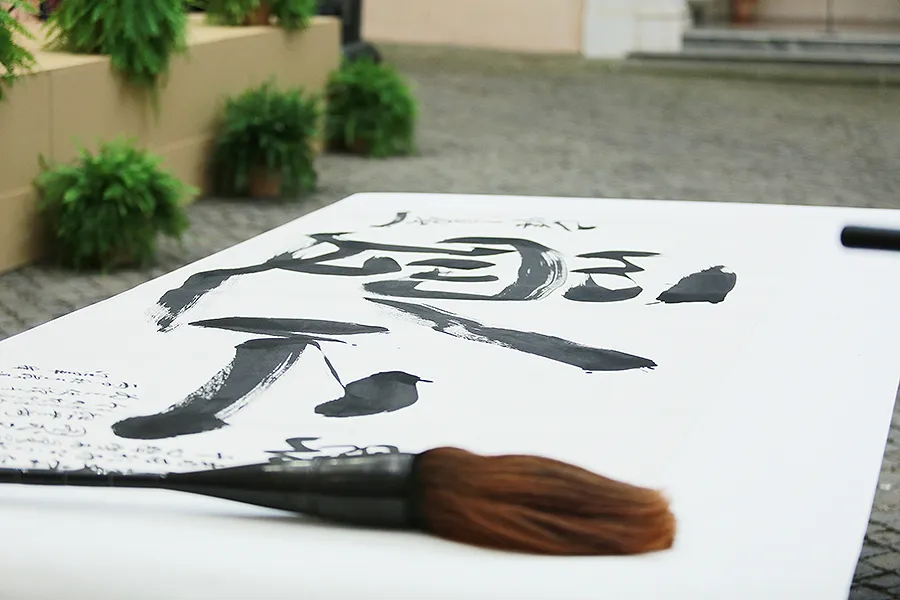
Among the pieces selected for the simultaneous exhibit are 12 paintings from Chinese artist Zhang Yan, who has donated several of his works to Pope Francis, including one that will become a permanent addition to the Vatican’s “Anima Mundi” museum.
The Vatican will send 40 works to China for the exhibit, including 38 pieces of ancient Chinese art from the “Anima Mundi” museum, and a painting by Zhang Yan that he donated to the Pope. After its debut in Beijing, the exhibit will travel to other major cities in China.
Speaking alongside Jatta at the press conference on the exhibits were Msgr. Paolo Nicolini, Administrative Delegate of the Vatican Museums; Fr. Nicola Mapelli, Curator of the “Anima Mundi” museums; Zhu Jiancheng, Secretary General of the China Culture Investment Fund; and painter Zhang Yan.
In comments to journalists, Zhu thanked the Vatican for their “scrupulous organization and warm hospitality.”
He voiced his belief that the exhibits “will open a new chapter in the cultural exchange between the Chinese people and the Vatican, so that there is a new approach and understanding between two countries with a deep cultural tradition.”
As the first of its kind, the event holds significant meaning in terms of mutual understanding and trust between the two parties, he said, and, quoting the third century BC philosopher Han Fei, said, “relations between nations depend on the closeness of peoples, and the closeness of peoples depends on the communication of hearts.”
“We all know that this is also the thought of Pope Francis,” he said, adding that “cultural exchange precedes diplomacy.”
The exhibits, then, are an event that “crosses borders, time and unites cultures, and which will further strengthen the friendship between China and the Vatican in favor of the normalization of diplomatic relations between China and the Holy See.”
In his comments, Zhang said it was “a great honor” to be at the Vatican, where there is currently an increase in the “strong commitment for the development of civil relations between China and the Vatican.”
On behalf of the 1.38 million people of Chinese nationality, Zhang expressed his “sincere homage to the true friendship of Pope Francis,” and to all those who have contributed to the cultural exchanges between China and the Vatican.
The two simultaneous exhibits, he said, “represent the two ends of a bridge of civil dialogue – as a messenger of this cultural exchange, it is my pleasure and privilege to transmit the greeting and friendship of the Chinese people.”
The artist stressed that no matter what nation we come from or what creed we profess, “nothing in the world is irrelevant with us.”
“Even Chinese culture and the Vatican need communication and exchange, as with all cultures on the earth,” he said, adding that the “disinterested friendship” between China and Pope Francis and the idea that we are all one family “push men to rethink the relationship between humanity, life, society and nature.”
“The aesthetics of art,” he said, “will reveal in us the complete awareness of the environment, benevolence and tolerance. Dialogue among us is possible and inevitable because of our common sense of benevolence.”
 […]
[…]




In a Nietzchean world awash with unstable personalities, it’s time for all of us to consider the inflammatory power of even a few words.
In Germany in 2006 Pope Benedict XVI made an academic reference to the views of 14th-century Manuel Paleologus II about violence within historic Islam (the Regensberg Lecture), and throughout the Muslim world there followed wild street demonstrations and even the likely-related killing of a nun in Egypt. On July 8, 2024 a presidential candidate is reported to have said: “it’s time to put Trump in the bulls-eye” (Associated Press, July 14, 2024)….
And, while we’re at it, what too about the polarizing consequences of clericalists airbrushing fellow Catholics as “backwardist, bigoted, rigid, fixistic and and ideological?”
It’s typical of the vague statements they issue when someone they could not care less about or even hate is attacked. They don’t name the victims or even really acknowledge that they were any. It’s similar to what they say after the latest routine murder of Nigerian Christians by Muslims. They simply deplore “violence”, but never mention “Islam.” If Biden or any leftist had been the target, you can bet that there would have been a clear condemnation of “nationalism” or “populism.” These people occupy the same moral plane as the media that adore them.
“don’t acknowledge there were any at all.”
The Vatican’s comment sounds hollow.
Just sayin’.
While I was eating brunch yesterday with my family, an African American couple ordered in front of us at the counter. They were very well dressed. Perhaps they just came from church? As the man went to get syrup and utensils for their pancakes, a mid-60s Caucasian man with a Midwest baseball team logo on his hat approached and said:
“Too bad the guy missed!”
The African American man looked shocked; wisely did not engage and walked away (I think it was Seneca who said: “Never talk to crazy people.”). The Caucasian boomer with the beer gut then insecurely quipped as the African American man walked away: “Hey man, I’m just saying, you know?” – as if the African American as an African American must have appreciated his murderous mindset. Then the boomer, eating alone (I wonder why?!), opened back up his laptop and entered again into the internet.
For my part, I stayed silent for the sake of my family. But I confessed in the car home that I was torn between confronting him and not engaging like African American man. What did I want to say?
“The assassin did not miss. Four were hit, including our former President, and one has died.”
Witness the culture of death. Abortion has brought us to this place. If it is acceptable to kill an inconvenient child in the womb, why not a political opponent?
Seneca was a wise man.