

 By
By 
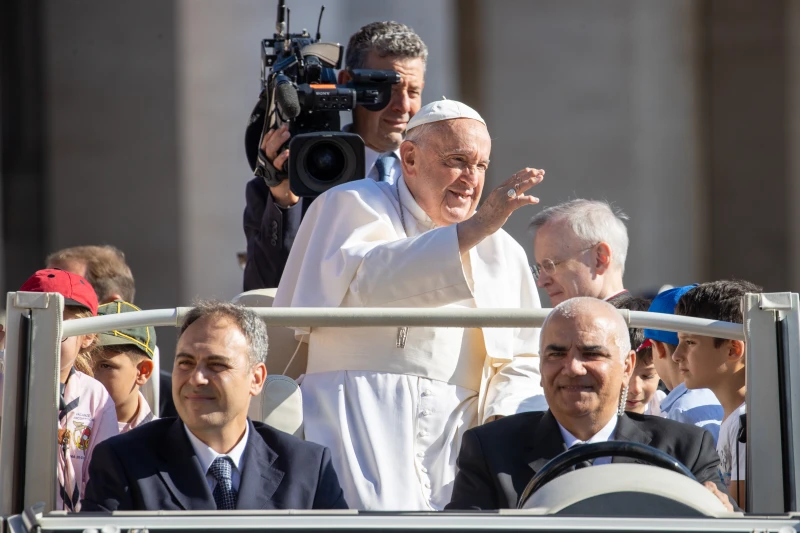
DOUALA, Cameroon — Physical food is not enough, the soul needs the nourishment of the Eucharist, which sustains us in times of fear and suffering, Pope Leo XIV said at a Mass in Douala, Cameroon, on Friday.
Celebrating Mass for more than 120,000 people outside Japoma Stadium, in Cameroon’s economic capital, the pope said in his homily that Jesus’ miracle of the multiplication of the loaves and fishes is a sign he came to serve with love, not domination.
The miracle “shows us not only how God provides humanity with the bread of life, but how we can share this sustenance with all men and women who, like ourselves, hunger for peace, freedom and justice,” Leo said.
“Each act of solidarity and forgiveness, every good effort, becomes a morsel of bread for humanity in need of care,” the pope added.
“Yet this alone is not enough: the food that sustains the body must be accompanied, with equal charity, by nourishment for the soul — a nourishment that sustains our conscience and steadies us in dark hours of fear and amid the shadows of suffering. This food is Christ himself, who always gives his Church abundant sustenance and strengthens us on our journey by giving us his Eucharistic Body,” he said.
Leo celebrated Mass in French in Douala on his third day in Cameroon. On April 18, he will celebrate Mass in the country’s capital, Yaoundé, before departing for the third country of his apostolic journey in Africa — Angola.
In his homily, delivered mostly in French, the pope reflected on miracle of the loaves and fished, comparing the crowd in the Gospel to those present at the Mass.
“The Gospel we have heard (John 6:1-15) is the word of salvation for all humanity. This Good News is proclaimed today throughout the world; for the Church in Cameroon, it resounds as a providential proclamation of God’s love and of our communion,” he said.
Describing the scene in the Gospel, Pope Leo focused on the crowd and the lack of food: “Jesus asks us today, just as he asked his disciples then: how will you solve this problem? Look at all these hungry people, weighed down by fatigue. What will you do?”
The pope stressed that this question concerns everyone: “It is posed to the fathers and mothers who care for their families. It is directed to the shepherds of the Church, who watch over the Lord’s flock, and also to those who bear social and political responsibility for the people and seek their well-being. Christ asks this question to the powerful and the weak, to the rich and the poor, to the young and the elderly, because we all hunger in the same way.”
“Our necessity reminds us that we are creatures,” he continued. “We need to eat in order to live. We are not God: but where is God in the face of people’s hunger?”
Turning to Christ’s response, Leo underlined the meaning of thanksgiving and sharing: “While awaiting our answers, Jesus gives his own: ‘Jesus took the loaves, and when he had given thanks, he distributed them to those who were seated; so also the fish, as much as they wanted.’ A serious problem was solved by blessing the little food that was present and sharing it with all who were hungry.”
He said the miracle is that “there is bread for everyone if it is given to everyone. There is bread for everyone if it is taken, not with a hand that snatches away, but with a hand that gives.”
Pointing to the Mass being celebrated, the pope highlighted its transforming power as “a source of renewed faith, because Jesus becomes present among us. The sacrament [of the Eucharist] does not merely revive a distant memory; it brings about a ‘companionship’ that transforms us because it sanctifies us.”
“This very altar, around which we gather for the Eucharist, becomes a proclamation of hope amid the trials of history and the injustices we see around us. It is a sign of God’s love; in Christ, the Father invites us to share what we have, so that it may be multiplied in ecclesial fellowship,” Leo said.
Switching to English, Pope Leo addressed young people, asking them to “be the first faces and hands that bring the bread of life to your neighbors, providing them with the food of wisdom and deliverance from all that does not nourish them, but rather obscures good desires and robs them of their dignity.”
Acknowledging the realities of poverty, he issued a warning against violence and corruption, urging them to “not give in to distrust and discouragement” and to “reject every form of abuse or violence, which deceives by promising easy gains but hardens the heart and makes it insensitive.”
“Do not forget that your people are even richer than this land, for your treasure lies in your values: faith, family, hospitality and work,” he said.
This story was originally published by ACI Stampa, EWTN News’ Italian-language sister service. It was translated and adapted by EWTN News English.
If you value the news and views Catholic World Report provides, please consider donating to support our efforts. Your contribution will help us continue to make CWR available to all readers worldwide for free, without a subscription. Thank you for your generosity!
Click here for more information on donating to CWR. Click here to sign up for our newsletter.


When I was hungry, you gave me food – says the Lord.