


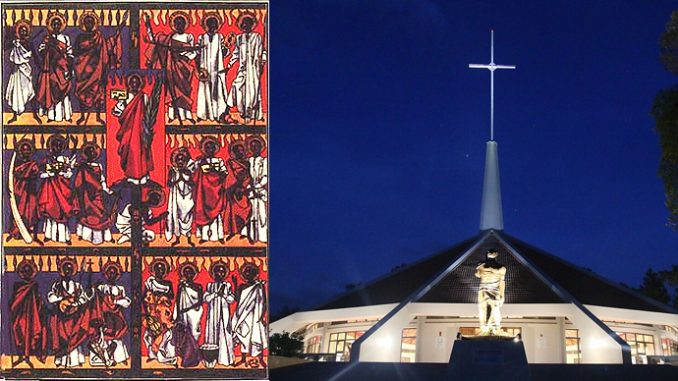
In the history of the Church, there have been many Christians who have been bluntly told that if they did not renounce their faith in Jesus Christ, they would be killed. But martyrdom is usually more complicated than denying an article of the Catholic Faith. That was certainly the case in nineteenth-century Uganda.
In the nineteenth century, European businessmen began to recognize the economic opportunities that could be found in Africa. As European nations gradually realized that Sub-Saharan Africa offered them a source of cheap labor and raw materials, the race to conquer and colonize African territory began in earnest.
It must be admitted that Europeans tended to treat the Africans like children, an attitude that saints like Italian missionary and bishop Daniel Comboni (1831-1881) publicly lamented. European nations began seeking control of different territories, which is why this period is sometimes called the “Scramble for Africa”.
On the other hand, Catholic and Protestant missionaries came to the African continent for a completely different reason: souls. Obeying Christ’s great commission, they wanted to spread the Gospel to people who had never heard of Him before. Muslims also began expanding their territories during this period.
The native leaders of central African kingdoms did not understand European history, European economic motivations, Christian evangelization, or the difference between explorers, soldiers, and missionaries. What they understood was that Europeans possessed weapons, medicines, and other goods, which they wanted.
In 1875, a British American explorer came to Buganda, the Bantu kingdom located in modern Uganda. He met the kabaka (ruler) of the Buganda, Mutesa I, and asked permission for Christian missionaries to enter his kingdom. Mutesa agreed.
Arab Muslims, English Protestant missionaries, and French Catholic missionaries thus arrived in Buganda, and each explained their beliefs to Mutesa and the members of his court. Each group made converts.
But the native pagan beliefs of the Bugandans were part of their culture, and those beliefs included the practice of polygamy. Islam’s toleration of polygamy led some men to become Muslims since it did not require them to put away their wives. Islam also tolerated pedophilia. Kakaba Mutesa was repulsed by the idea of circumcision, so he rejected Islam, but he pretended to side with each religious group in turn.

And then Mutesa died. After his death, a new leader was selected among Mutesa’s sons. Sixteen-year-old Mwanga was chosen to be the new kabaka.
A kabaka’s court typically included his many wives, family members, chiefs, and those he appointed to perform various tasks. Local chiefs regularly sent their young sons to serve as the kabaka’s pages, and those pages who demonstrated loyalty could hope to be rewarded with important positions as they grew up.
The Catholic and Protestant missionaries had already become familiar with Mwanga’s personality before he became the kabaka. They understood that he was young and inexperienced as a ruler. They worried most about his selfish, suspicious, and unpredictable behavior. They also knew that he was having sexual relations with the boy pages, that he sometimes drank too much, and that he smoked hemp.
In late 1885, a Protestant missionary told Mwanga that an Anglican bishop named Hannington was on his way to Buganda for a friendly visit. Mwanga became convinced that the bishop’s traveling route was meant to show the weakness of his kingdom’s borders. The missionary tried to explain that the trip was peaceful, and Mwanga pretended to agree. But he secretly sent a group of men to kill the missionary, along with all those who were traveling with him. When the news of the murders reached the court, Mwanga acted like he knew nothing about it. However, everyone knew the truth.
Twenty-five-year-old Joseph Mukasa Balikuddembe had grown up in the court of Kabaka Mutesa and was considered so trustworthy that he had been made the personal attendant of both Mutesa and Mwanga. He had become a Catholic, and he was deeply disturbed about the murder of the innocent clergyman and his companions, also recognizing that Mwanga’s actions would have consequences with the British. Joseph spent all night trying to explain to Mwanga that the murder had been wrong and that his father, Mutesa, would never have done such a thing.
Mwanga fumed over Joseph’s correction and the knowledge that his secret plans were not so secret. Mwanga also resented the fact that Joseph had chastised him in the past about having sexual relations with his pages. He probably realized that Joseph had sometimes sent the Christian pages away on random errands to protect them from Mwanga’s sexual propositions.
In Buganda, the kabaka was more than the head of state. He also wrote the laws, changed the laws, judged lawbreakers, and decided on all punishments. His household staff included executioners, who were called upon to torture and execute anyone who offended Mwanga, sometimes merely because Mwanga was in a bad temper. Although Mwanga had an older chancellor named Mukasa to advise him, the chancellor hated the Christians and manipulated Mwanga for his own purposes.
On November 15, 1885, the angry Mwanga publicly accused Joseph of disrespect and of trying to poison him. He ordered Joseph to be executed immediately. Without a word of complaint, Joseph repeatedly stated that he accepted that he was dying for his religion and forgave Mwanga. He was beheaded, and his body was burned to ashes.
One might think that the martyrdom of Saint Joseph Mukasa would have deterred members of Mwanga’s court from calling themselves Christians or even wanting to become Christians. Instead, dozens of people, particularly the young pages in Mwanga’s court, began coming to the Catholic missionaries’ tent at night to receive instruction about the Catholic faith so that they could be baptized. They wanted to be with God in heaven, and they were willing to die for that privilege. (Note that many also sought out baptism from the Protestant missionaries, but that is their story to tell.)
These conversions continued for months after Joseph’s death. The converts knew that Mwanga’s fickle nature could lead them to face death at any moment, but they were joyful to be Christians and were eager to outdo one another in living virtuously as followers of Christ.
In late May 1886, Mwanga found out that one of his pages had been teaching another page named Mwafu about Jesus Christ. Mwafu was Mwanga’s favorite. Enraged that Mwafu might refuse his sexual demands if the boy became a Christian, Mwanga took drastic action. He ordered the gates around his court to be locked that night so that no one could escape. Recognizing the danger, many of the Christian catechumens were secretly baptized.
The next day, Mwanga called all the pages into his court. He demanded that the Christians seat themselves on one side of the room, away from the others. He interrogated some of the pages to make sure no Christians were hiding. When he asked the seated group if they were all Christians, they replied that they were. “Are you unshaken in your resolve to remain Christians?” Mwanga asked. They replied, “Yes, quite definitely! … If you choose not to regard that as a crime, we shall be grateful to you, but we shall never cease to be Christians, whatever the outcome.”1
According to custom, when groups of people were condemned to death, they were sent to an execution site at Namugongo. Mwanga2 ordered most of the Christians to be sent to Namugongo, although he merely imprisoned and later freed others. The martyrs, ranging in age from thirty-six to fourteen, were tightly bound by their hands, feet, and necks, and painfully marched through the forest. The trip took days. According to custom, some of them were executed along the way, with their bodies left behind as a warning to others and as food for wild animals.3
On June 3, 1886, twelve men and boys, led by Saint Charles Lwanga, were greeted by shrieking, painted pagan executioners. The executioners had prepared a huge pyre to burn the victims alive. They expected the victims to be terrified, but the Christians instead encouraged one another and acted like they were on a great adventure. When the martyrs were placed in the flames, they prayed aloud until they died. The astonishing bravery—and even cheerfulness—of the Ugandan martyrs is remarkable in the history of the Church.
Twenty-two men and boys died as martyrs in Uganda during a fifteen-month-long period of persecution and are now honored as saints.
But why did they die? Contrary to contemporary narratives, they were not killed as collateral damage from colonialism.
While the moral teachings of the Church—particularly its repudiation of pedophilia—led a young, weak leader to initiate a bloody persecution, that is not the real reason they died as martyrs. Instead, they died because they believed a Christian truth that the rest of us too often take for granted: There is a God, and He is worth dying for.
Endnotes:
1 African Holocaust: The Story of the Uganda Martyrs, J. F. Faupel (New York: P. J. Kenedy & Sons, 1962), 151.
2 Mwanga was later forced into exile, returned to take power, was overthrown again, and was finally replaced as kabaka by his infant son.
3 One of the executioners killed his own son when he refused to renounce his Catholic faith.
If you value the news and views Catholic World Report provides, please consider donating to support our efforts. Your contribution will help us continue to make CWR available to all readers worldwide for free, without a subscription. Thank you for your generosity!
Click here for more information on donating to CWR. Click here to sign up for our newsletter.

No reserves, no retreats, no regrets…not a bad way to live OR die.
Thank you so much Miss Dawn. I really look forward to your articles on the Saints.
Over the years I’ve been blessed to have met several African priests – one was Ugandan, others from Zimbabwe, Cameroon, & Nigeria.
A partial list just for 2025
Gatestone Institute
https://www.gatestoneinstitute.org/21512/persecution-of-christians-february
The following are among the abuses and murders inflicted on Christians by Muslims throughout the month of February 2025.
The Muslim Slaughter of Christians
Democratic Republic of Congo: The beheaded corpses of seventy Christians—men, women, and children—were found inside a church. Earlier, on Feb. 12, Muslim militants of the Allied Democratic Forces, which is affiliated to the Islamic State, rounded up and marched 70 Christians to a Protestant church in Kasanga. There, the Christians were “tied up and decapitated with knives.” According to a regional expert, “This was not just an act of terror. It was a targeted massacre of Christians, and it will not stop here… The ADF is part of a growing extremist network that wants to wipe out Christianity in the region. If nothing is done, more attacks will follow.” For his part, a local church elder said, “We don’t know what to do or how to pray; we’ve had enough of massacres. May God’s will alone be done.” The same Muslim militants slaughtered another 355 Christians “for their faith” in 2024.
Nigeria: Some accounts of the “pure genocide” experienced by Christians at the hands of Muslims follow:
In the very early morning hours of Sunday, Feb. 2, Muslim tribesmen stormed a village, setting fire to homes and opening fire on Christians, killing at least 16. Discussing this and other recent attacks, Edwin Ochai, president of a diaspora group from the area, said the Muslim terrorists were “leaving a trail of bloodshed, destruction and despair”:
The most recent attack in Okpamaju, a hitherto peaceful community in Otukpo LGA, has claimed the lives of several innocent villagers, reduced homes to ashes, and shattered families. We condemn in the strongest terms the deafening silence and inaction of our leaders at all levels – local government chairmen, state legislators, federal representatives, and the senator representing Benue South.
On Feb. 5, Fulani herdsmen—referred to by locals as “Muslim bandits”— “killed three Christians in Kaduna state, a week after three others were slain in the same area.” They also kidnapped “dozens” of Christians. According to spokespersons,
We suffered yet another devastating attack by bandits in which lives were lost, and many more were left traumatized. We strongly condemn this heinous act, which is a blatant disregard for human rights and the safety of rural dwellers in our region. Has our government turned a deaf ear to our plight? We demand urgent action and protection for our communities!…. The killings and kidnappings by Muslim bandits have become a daily routine in Kauru Local Government Area.
On Sunday, Feb. 9, Muslims from the Boko Haram terrorist organization murdered a Christian pastor. The Rev. Bala Galadima was in his home when gunmen in black robes broke in around 1 am and shot him to death while he still lay in bed. “Our hearts are heavy, as we are left alone in a complicated world with the killing of our pastor,” said one church member to Lami Sabo. “His courage, advice, teachings and generosity will be highly missed by us his church members.”
According to a Feb. 12 report, at least 22 Christians were killed in a series of Muslim attacks on Christian villages. “We are killed because we are Christians,” one resident insisted: “Fulani are not attacking Muslim farmers in Plateau state, but Christians are attacked daily, and we don’t have guns to defend ourselves.” The report adds,
The Nigerian government has not officially attributed these attacks to any ethnic or religious group, but media analysts have drawn comparisons between these armed groups and Boko Haram, citing a pattern of violence aimed at displacing Christian communities.
On Feb. 22, Muslim herdsmen stormed into Elyon Paradise Ministry Church in Delta state, where they shot and injured Pastor Divine Omodia and kidnapped six church members.
France: On Feb. 26, Brahim Aouissaoui, a 25-year-old Muslim of Tunisian background, was sentenced to life imprisonment for the slaughter of three Christians in a church in Nice. According to one report,
On October 29 2020, Aouissaoui allegedly killed worshippers Nadine Vincent, 60, and Simone Barreto, a 44-year-old French-brazilian woman, and church worker Vincent Loques, 55. Police officers fired at the assailant as he lunged at them, shouting: ‘Allahu Akbar’ (God is great) and wielding a knife. Seriously wounded, Aouissaoui underwent two operations and was placed in intensive care. He has repeatedly told investigators that he cannot remember anything and has nothing to say. He has claimed that his parents are dead, when in fact they are not, and said he did not recognize himself on cctv footage of him entering the basilica. Expert psychiatrists and a neurologist determined that he does not suffer total memory loss.
Libya: Feb. 15 marked the tenth anniversary of the 2015 slaughter of 21 Christians at the hands of Islamic State terrorists. The United States Commission on International Religious Freedom commemorated their martyrdom in a statement:
In February 2015, ISIS published the final moments of one Ghanaian and twenty Coptic Orthodox men working in Libya. ISIS militants had kidnapped the men in separate incidents, then forcibly marched them to a beach. There, all refused to renounce their faith before the militants executed them… Today we remember the 21 young men who were brutally murdered by ISIS solely for being Christian… The U.S. government must continue to be an unrelenting voice against violence that targets religious communities, including Coptic Christians.
The Muslim Abduction, Forced Conversion, and Rape of Christian Girls
Egypt: On Feb. 28, yet another young Coptic Christian girl, 17-year-old Irene Emil, “vanished” off the streets of Cairo (Shubra district). According to her distraught parents, the high schooler was on her way to but never reached church. When they tried calling her cell phone, they discovered it was turned off. This scenario—a young Christian girl travels to or from church, school, or work, disappears, and then her phone is turned off—has played out several times in Egypt. For example, in August 2024, Christina Karim Aziz, a 20-year-old Christian girl, disappeared off the streets of Asyut, where she had gone to apply for a job. Her family immediately went to police to report the disappearance; police responded with nothing. Earlier in 2024, and also in Asyut, another Irene (Ibrahim Shehata), a 21-year-old Christian, also disappeared under very similar circumstances, including nonresponsive police, and the family crying out to Sisi. (For more on this topic, see Coptic Solidarity’s report, “Jihad of the Womb: Trafficking of Coptic Women & Girls in Egypt.”)
Pakistan: A Muslim man twice abducted a married Christian mother of three children, raped her, fraudulently converted her to Islam, and fabricated an Islamic marriage, said her Christian husband, Asif Masih (woman’s named withheld as a rape victim). The kidnapper, Muhammad, worked as a security guard where the 37-year-old mother worked as a cleaner. One day he told her of an opportunity to apply for financial aid, and she went with him to fill out what he said were governmental forms for economically challenged applicants; she also gave her thumbprint as part of the application. In fact, and unbeknownst to her, the documents she signed were marriage and conversion to Islam certificates:
I had no clue about his real intentions and trusted his offer for assistance… I’m not literate, so I had no idea that he had obtained my thumbprints to prepare false religious conversion and marriage certificates. He then forcibly took me to his house, where his wife and two children were also present. He locked me in a room where I was kept hostage for eight days.
Muhammad also called the woman’s husband, Asif, who is suffering from cancer, saying that she had willingly married him and converted to Islam:
[But when Muhammad] claimed that she had changed her faith and married him, I immediately knew that it was a lie because she was a devout Christian and could not renounce Christ even if her life was at stake. She was clearly deceived by Sadiq, who used the false conversion certificate and marriage to deter efforts to recover her.
After a council of elders pressured Muhammad to release the woman, on condition that the matter would be dropped without recourse to legal action, the kidnapper agreed—until Feb. 14, when he and two accomplices again abducted her: “[Muhammad] held me hostage in a relative’s house and repeatedly tortured and raped me on gunpoint for three days.” On Feb. 17, she managed to escape and return to her family:
I had no money with me and begged passersby to give me some so that I could board a bus to Pattoki. I was traumatized by the assaults, but the hope of seeing my husband and children again gave me the strength to reach my family.
Police were again alerted, but were reluctant to act, until an attorney got involved, helping get the woman’s statement recorded in court and facilitating a medical examination on March 4: “It is due to her support that the case has picked up pace, otherwise the police were not cooperating with us.”
Separately, on Feb. 18, another Muslim man kidnapped, also for the second time, a 15-year-old Christian girl. A year earlier, Arsalan Ali had abducted Muskan Salman, when he also forcibly converted her to Islam and coerced her into marrying her, until she managed to escape on Dec. 15. This time Ali kidnapped the girl while the family was away attending a Christian funeral for a close relative. According to her father, Salman Masih, Muskan was home with her 10-year-old cousin:
When we returned home, we saw that my niece was crying in the courtyard while Muskan was missing. The child told us that she and Muskan were playing when the two men forced their way into the house and took Muskan with them.
Although her father immediately informed police, officers refused to register his complaint:
It’s been over 10 days since Muskan was taken, but the police are not taking any action. Ali is also missing, and we have no information about their whereabouts…. We are very concerned for our daughter’s safety, and the police’s indifference to our plight is exacerbating our fears that we may not be able to see her again.
Separately, according to a Feb. 17 report,
In yet another heartbreaking case of grooming and forced conversion, a 12-year-old Christian girl from Lahore has been taken by a Muslim man nearly three times her age. The abductor transported her to Sindh, where he forcibly converted and married her—despite laws prohibiting child marriage. Her distraught parents [have been] abandoned by law enforcement and denied justice…
Finally, according to a Feb. 19, report, a 14-year-old Christian girl was
abducted by newly arrived Muslim neighbours, sparking deep concern among her family and the local Christian community. Police have arrested two suspects and uncovered their links to prostitution, leading to raids on multiple locations. However, the girl remains missing, intensifying fears that she has been trafficked. Her distraught parents continue to plead for urgent action, fearing for their daughter’s safety and well-being.
Muslim Attacks on Christian Churches
Syria: On Feb. 27 in Damascus, “locals
The Ugandan martyrs weren’t just burned alive, they were slowly roasted to death over a period of days. When Pius XII canonized the Catholic martyrs, he also praised the Anglican ones who died alongside ours.
Thank you for sharing that.
Islam is the cause of so much terror, rape, and murder because it is based on the worship of a false god.
A false prophet, not a false god: CCC 841 “The Church’s relationship with the Muslims. “The plan of salvation also includes those who acknowledge the Creator, in the first place amongst whom are the Muslims; these profess to hold the faith of Abraham, and together with us they adore the one, merciful God, mankind’s judge on the last day.””
Thank you for this reminder about the CCC. The CCC was first published in 1992. It reflects the new teachings of Lumen Gentium and Vatican II, which ended in 1965. That speaks for itself. To know the truth, one must read the word of Allah in the Qur’an. The book is available online. So anyone can see if the “voice” that speaks there accords with the voice in the Gospels and the Old Testament. The best “catechism” is the Didache, composed by the Apostles in the first century A.D. One can find it online and even in audio in youtube. On the true nature of this god see
https://www.raymondibrahim.com/03/19/2015/the-madness-of-our-age
“The CCC was first published in 1992. It reflects the new teachings of Lumen Gentium and Vatican II, which ended in 1965.” You feel free to reject the Magisterium and the Catechism because of that? I side with the Church and the Catechism, not Raymond Ibrahim.
I’m well aware of the Didache, and don’t see it’s relevance in this case. Nothing in conflicts with the idea that Muslims worship God, even if they misunderstand much about Him.
The best way to decide if it is the same God as that of the Chrsitains is to read what god says in the Qur’an. Especially passages like Sura 9: 29, which being a more recent one, abrogates earlier statements in the Qur’an as instructed by expert imams. Two bishops in Italy and Sweden do not agree with the catechism on this subject. See this report. The full article can be found in the link at the end. See also Sura 9:29 quoted below.
“Two high-profile European Catholic bishops have broken ranks with the Vatican’s policy of dialogue with Islam, instead advocating the conversion of Muslims as the only effective response to growing Islamism in Europe
The unconventional calls to evangelize Muslims and provocative warnings that Islamism constitutes a threat to Europe from Italian Bishop Antonio Suetta and Swiss Bishop Marian Eleganti—which run counter to the teachings of the Second Vatican Council, which in 1965 called for the Church to engage in dialogue with Muslims—are causing a stir in the wake of recent jihadi-style attacks in the two countries.
This is a light in the darkness.
Duane Alexander Miller
In a May 20 interview with Italian newspaper Il Giornale, four days after the Italian-Moroccan Muslim Salim El Koudri mowed down seven pedestrians with his car in the Italian city of Modena, Eleganti described Islam as “an anti-Christian religion from the beginning” that “has led to the disappearance of Christianity everywhere or decimated it to near extinction.”
Eleganti Slams Fellow-Prelates for Sanitizing Islamist Violence
Openly dissenting with Archbishop of Modena-Nonantola, Erio Castellucci, who attributed the jihadi-style attack to El Koudri’s “serious psychological distress” and “profound isolation,” Eleganti asked, “Why don’t Christians commit such terrorist acts?”
“Such Good Samaritan declarations by the bishops are made to avoid jeopardizing, at least semantically, peaceful coexistence between religions,” Eleganti explained, noting that “they are a form of denial of reality.”
Eleganti warned that bishops were making “political statements in keeping with the spirit of the times” in an attempt “to immunize themselves from the harsh reality that will not spare us and will teach us a lesson as soon as Islam gains control and becomes the majority religion.”
“Efforts are regularly made to absolve Islam in general and Muslims in particular by framing the incident as a mental disorder. But it cannot be ruled out that both are at play: Islamic fanaticism, mental disorder, and personal frustrations,” Eleganti said, lamenting the reluctance to make any “connection to Islam or Islamism as a possible cause of such terrible acts.”
https://www.meforum.org/fwi/fwi-news/two-bishops-tackle-islamism-in-europe
“Fight against those who believe not in Allah, nor in the Last Day, nor forbid that which has been forbidden by Allah and His Messenger and those who acknowledge not the religion of truth [i.e. Islam] among the people of the Book [Jews and Christians], until they pay the jizya with willing submission, and feel themselves subdued. (Sura 9:29) Kill the mushrikun [unbelievers] wherever you find them, and capture them and besiege them, and prepare for them each and every ambush. (Sura 9:5) I will cast terror into the hearts of those who have disbelieved, so strike them over the necks, and smite over all their fingers and toes. (Sura 9:29)
I can’t seem to reply to Oscar below, so I will try here. I can only once again say that between you and the Catechism, I choose the Catechism.
Thank you steveb.