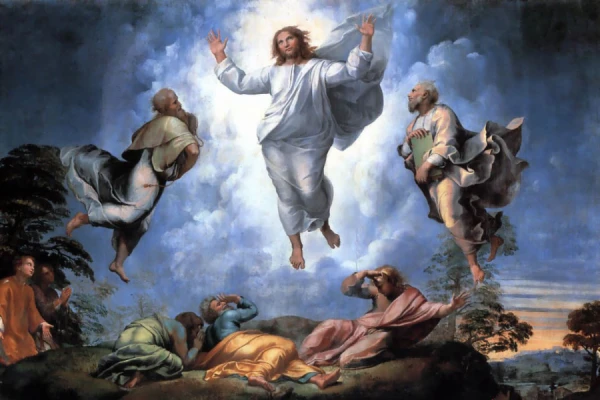
Vatican City, Apr 6, 2020 / 12:10 pm (CNA).- Monday, April 6 marks the 500th anniversary of the death of Raphael, the Renaissance painter responsible for “The School of Athens” and “The Transfiguration.”
While the Vatican Museums was due to unveil the last phase of restoration of its Raphael Rooms this week, the restored frescoes remain hidden from the public after coronavirus restrictions closed the museums a month ago. However, the Vatican is encouraging people to make virtual museum visits to “admire, even from a distance, the splendor of Raphael’s art.”
Art historian Elizabeth Lev shared with CNA her advice for Catholics who wish to spend some time contemplating Raphael’s works of art during the coronavirus quarantine.
“From his early Oddi altarpiece painted when was about 19 or 20 to the fresco of the School of Athens, to his dazzling tapestries and his architectural feat of a portico decorated with scenes from the Bible, it’s easy to understand why Raphael was hailed as an exemplar of ‘Catholic excellence,’” Lev said April 6.
“Raphael produced some very powerful altarpieces and, in some cases, even created new types of iconography, especially in the Madonna of Foligno and his St Cecilia panel in Bologna. He reinvented the ‘sacred conversation,’ which are paintings where saints dialogue with Mary and Jesus, welcoming viewers into greater prayer and contemplation,” she said.
The Vatican Museums offer a virtual tour of the Raphael Rooms with a 360 degree view of each room. Raphael was commissioned by Pope Julius II to paint the four rooms in the Apostolic Palace which formed part of the papal apartments.
The School of Athens fresco placing Plato alongside Aristotle can be viewed in the Room of the Segnatura, along with illustrations of the cardinal and theological virtues.
The Room of Constantine was the last of the Raphael Rooms to undergo restoration, a project which began in the 1980s. The virtual tour of the Room of Constantine displays paintings of Constantine’s baptism, vision of the cross, and the Battle of the Milvian Bridge before the restoration.
One room in the Vatican Museums’ Pinacoteca, or painting gallery, displays Raphael’s Crowning of the Virgin, Madonna of Foligno, and The Transfiguration.
“In this very unique week, I would propose reflecting on Raphael’s Transfiguration painted just before he died and placed upon his tomb during his funeral,” Lev said. “In this work, Raphael paints two distinct areas, the lower section where the apostles attempt to heal a boy possessed by demons (Mark 9:17-29) and then the upper section where Jesus reveals himself to Peter, James and John and God the Father announces ‘This is my dearly loved Son. Listen to him.’”
“People are afraid and confused, trying to control things they cannot and struggling pointlessly in the shadows. But lifting one’s gaze, one sees Jesus. Everything is subordinate to Him, and he appears as transfigured, a dynamic, powerful light that can repel the encroaching darkness. What an inspiring way for us to envision Jesus during these dark days,” she said.
Lev also recommends Raphael’s Madonna and Child paintings, such as The Alba Madonna in the National Gallery in Washington, D.C.
“These were small devotional works, meant for contemplation in the home, appropriate for all of us who are housebound,” she said. “He did endless variations on them, so there is something for everyone — versions where Joseph hovers protectively, others where young John and Jesus cavort.”
Born Raffaello Sanzio in 1483 in Urbino, Italy, Raphael went on to work in Rome from 1508 to 1520, serving Pope Julius II and Pope Leo X.
Raphael died at the age of 37 on Good Friday, April 6, 1520. He is buried in the Pantheon, which had already been consecrated as the Basilica of St. Mary and the Martyrs, where the artist’s tomb remains on display.
“He was brilliant and tremendously successful. When he died at the age of 37 he was already running the equivalent of a Fortune 500 company: the largest studio of the Renaissance,” Lev said.
Earlier this year, the Vatican Museums displayed 10 of Raphael’s tapestries in their original place in Sistine Chapel for one week. The tapestries, commissioned by Pope Leo X in 1515, depict the lives of St. Peter and St. Paul in the Gospels and the Acts of the Apostles.
Raphael painted the Apostolic Palace at the same time as Michaeangelo was working on the Sistine Chapel
“Michelangelo was eight years his senior and was already working in the Sistine chapel when Raphael arrived to paint the apartments of Pope Julius. The two had completely different perspectives on painting. Raphael’s was more similar to Leonardo’s, with careful backgrounds and elegant compositions, while Michelangelo’s figures were sculptural and monumental,” Lev explained.
“As these two Titans clashed stylistically, the world’s greatest works of art were born,” she said.
The Sistine Chapel, the Pio Clementino Museum, the Chiaramonti Museum, the New Wing, the Niccoline Chapel, and the Room of the Chiaroscuri can also be viewed via virtual tour on the Vatican Museums website.
Rome’s Scuderie del Quirinale museum had also opened a major exhibition on Raphael this year, which brings together 200 works of art from Louvre, the Uffizi and elsewhere. This exhibition was forced to close 72 hours after its March 5 opening due to the Italian government’s closure of all museums in response to the coronavirus outbreak.
A video posted on YouTube by the museum allows quarantined Italians and art lovers around the world to catch a glimpse of the paintings displayed in this exhibition originally scheduled to end June 2.
“Most of us lead very busy lives that were abruptly halted by the quarantines. As we are all required to exercise the virtue of patience these days, we can also rediscover the skill of looking carefully at things, appreciating details and the value of serenity. And nowhere are those qualities better expressed than in the art of Raphael,” Lev said.
 […]
[…]


 By
By 


Further unpacking the most welcome references to Augustinian theology, the three faculties of intellect, will and memory might offer ground for future dialogue with Islam, and within the Church, within the West, and within Islam.
Based on passages cited from the Qur’an, the Muslim “Common Word Between Us” (2007, the Muslim response to Benedict’s “Regensburg Lecture”) includes the remark that “souls are depicted in the Holy Qur’an [Q 3:64] as having three main faculties: the mind or the intelligence . . . the will . . . and sentiment which is made for loving the good and the beautiful. Put in another way, we could say that man’s soul knows through ‘understanding’ the truth, through ‘willing’ the good, and through virtuous emotions and ‘feeling’ love for God” (internal quotes are italics in the original).
While there is some overlap between St. Augustine and this recent Muslim statement on the faculties of intellect and will, the greatest divergence is between the naturalistic Muslim listing of love as a “sentiment” and a “feeling” love for God. In Christian theology, while supernatural grace perfects nature—charity (more than fraternity) is a theological virtue not limited to the feelings of natural religion (such as Islamic monotheism).
At some point the possibly false impression of syncretism is not sufficient in a fallen world where the Self-disclosed mystery of divine and redemptive love (“as I have loved you”) is real and ultimately sacrificial—beyond feeling. Not mere feeling nor belief, but Faith in the person of the incarnate Jesus Christ from within the Triune One.
Life is a pilgrimage, short and sweet. ‘Where are we going? Toward what goal do we wish to orient ourselves? What direction should we choose as a people and as a human community? – His Holiness Pope Leo XIV.
“At some point the possibly false impression of syncretism is not sufficient in a fallen world where the Self-disclosed mystery of divine and redemptive love (“as I have loved you”) is real and ultimately sacrificial—beyond feeling. Not mere feeling nor belief, but Faith in the person of the incarnate Jesus Christ from within the Triune One.”
No doubt, that would be the point at which one, in denying The Unity Of The Holy Ghost, and thus The Spirit Of Perfect Divine Eternal Infinite Love Between The Father And His Only Begotten Son Jesus The Christ, one exists in a state of apostasy.
An apostate counterfeit magisterium cannot subsist within Christ’s Magisterium, nor can an apostate papacy.
One cannot be in communion with Christ and His Body, while denying The Unity Of The Holy Ghost. Thus we can know through Faith and reason you can only have a Great Apostasy from The True Church of Christ, Christ’s One, Holy, Catholic, And Apostolic Church, In The Unity Of The Holy Ghost.
In your sovereign humility and near infinite wisdom and street smarts, perhaps you can specify in what exactly the Holy Spirit has revealed to you alone a formally “apostate papacy”?
Bearing in mind, of course, the 8th Commandment as delivered to the rest of us by the Triune One.
“In your sovereign humility and near infinite wisdom and street smarts, perhaps you can specify in what exactly the Holy Spirit has revealed to you alone a formally “apostate papacy.”
Certainly not to me alone for everyone who is aware that prior to his election to the Papacy, Jorge Bergoglio, condoned same sex sexual unions and thus same – sex sexual acts in direct violation of God’s Commandment regarding lust and the sin of adultery , ipso facto defected from The Catholic Church, while denying that God Is The Author of Love, of Life, and of Marriage, is certainly aware.
Peter, “Bearing in mind, of course, the 8th Commandment as delivered to the rest of us by the Triune One”, can you explain how it would be possible to condone same sex sexual unions and thus same-sex sexual acts and remain in communion with Christ And His One, Holy, Catholic, And Apostolic Church?
You ask an excellent question…but I am not here to defend ubiquitous stupidity. Regarding what Burgoglio said prior to becoming pope (and even his off-the-cuff remarks, insinuations and appointments, and photo-ops cleverly do not rise to the level of heresy)…
My observation at the time was that Bergoglio’s remark—yes, detestable—was made during a political campaign in Argentina. The question was not whether homosexual lifestyle was contrary to Christ, but whether in a world where marriages require both a Church marriage and a secular license, whether or not a “civil union” might be recognized by the civil power for civil legal reasons (e.g., inheritance).
The stupidity mentioned above was in being naive enough to think that civil unions were not a steppingstone to then dismantle “marriage” as understood from time immemorial. The provocateurs certainly lied openly about this, and many compassionate or pliable bishops and a future pope predictably sucked up to it. Seminaries do not teach “street smarts”.
A prominent lay theologian in the United States proposed that the Church should no longer recognize “marriages” as now redefined by the Secular Power. That proposal was too toxic and didn’t go anywhere, but it makes lots of sense in the large scheme of things. The great post-World War II German leader, Konrad Adenaur, stated the general problem this way: “It seems to me highly unfair that the Lord limited man’s intelligence while not also limiting his stupidity.” The stupidity of the U.S. Supreme Court fatwa to confuse real marriage and with government non-marriages highlights the depth into which we have fallen in a post-Christian world.
But, I ask you, what would happen if stupidity became the litmus test for whether one is self-expelled from communion with Christ and his One, Holy, Catholic, and Apostolic Church?”