“Fidelity to Christ’s example and commandments is the hallmark of Christian sincerity,” Varden said in his first meditation, delivered in the Pauline Chapel during the retreat for Pope Leo XIV and members of the Curia, which began Sunday afternoon.
“The extent of the peace we embody — that signal peace ‘which the world cannot give’ — indicates Jesus’ abiding presence in us,” he continued. “We must insist on this now, when the Gospel is sometimes deployed as a weapon in culture wars.”
Varden called on Christians to contest “instrumentalizations of Christian language and signs,” not merely with indignation but by teaching what real spiritual struggle looks like.
“Instrumentalizations of Christian language and signs should be challenged, not just by wan outrage but by teaching the terms of authentic spiritual warfare,” he said. “For Christian peace is not a promise of ease; it is a condition for transformed society.”
In the same meditation, Varden pointed to anger as a spiritual danger, citing St. John Climacus: “There is no greater obstacle to the presence of the Spirit in us than anger.”
He also reflected on the Church’s Lenten discipline as a “program” marked by clarity and peace: Lent “confronts us with essentials,” he said, stripping away distractions and inviting “an abstinence of the senses,” while still calling believers to battle vice and harmful passions with a straightforward “yes, yes,” and “no, no.”
Varden noted the Church’s liturgy sets that tone from the outset of Lent, pointing to the traditional chant of Psalm 90 (91), “Qui Habitat,” sung on the first Sunday of Lent as the Gospel recounts Christ’s temptation in the wilderness.
Later Monday, Varden was scheduled to deliver two additional meditations, including reflections on St. Bernard of Clairvaux and on God’s help.
This story was first published by ACI Stampa, the Italian-language sister service of EWTN News, and has been translated and adapted by EWTN News English.



 By
By 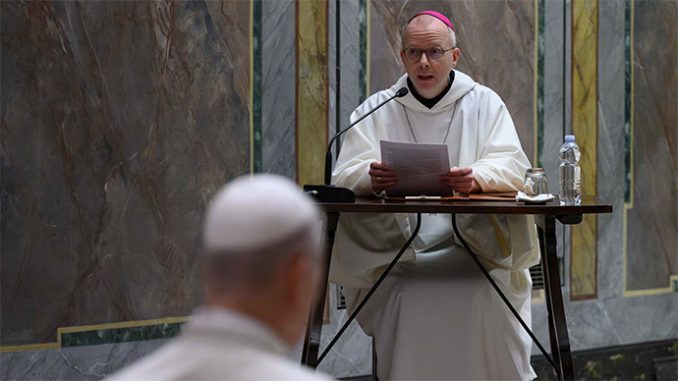
The problem is not with using the Gospel as a weapon; there are plenty of biblical reasons for doing exactly that. The problem is with trying to use it for unworthy purposes. The “name it and claim it” gospel is a false gospel regardless of whether that which is “named and claimed” is money, victory for one’s sports team, a mate, or victory for one’s political party.
Also,
“Lord, when we cry Thee far and near
And thunder through all lands unknown
The gospel in to every ear,
Lord, let us not forget our own.” — Chesterton, A Hymn for the Church Militant
Gospel informs, transforms, and offers strength and courage to pilgrims on journey.
#1. Bishops should stay out of politics altogether. They have a difficult time enough teaching the fullness of the Catholic faith as it is. Politics is the bailiwick of the LAITY in the Church and NOT THE CLERGY.
#2. Of course DO USE the Gospel as a weapon – a weapon against Satan. Jesus used Scriptures as a weapon against Satan and his ministers and so should we.
#3. How about discerning the Truth and speaking it at all times? There are matters that are subject to prudential judgment such as what to do with those who commit crimes like entering our country illegally and proceed to rape women, abduct children for the sex trade and murder our citizens. That prudential judgment is a political act and is none of the bishops’ business. Here’s a truth” Obeying the law is a good thing.
While Bishop Varden’s call for charity is well-taken, my immediate reaction was to remember that Christ himself used righteous anger in the Temple when the sacred was profaned. When the bishop warns against ‘weaponizing’ the Gospel, it raises the question: to whom is this directed?
For many of the faithful, “anger” isn’t about malice, but an appropriate reaction to how many of us observe a dilution of holy doctrine – whether that is the promotion of lifestyles contrary to scripture, the restriction of Ancient Rites, or the introduction of secularized symbols such as Pacha Mama into our sacred spaces. If the focus of the believer is to join Christ, to be in union with him, to bask in His holiness, how can we condemn or discourage defending that holiness with the same zeal Jesus showed when he overturned the tables. Anger is an appropriate response when one feels the ‘unholiness’ of the world is being invited into the Sanctuary. Simultaneously, we are and remain, through Christ, sources of peace.
A conflict arises here regarding the instrumentalization of the Gospel. Although it can be interpreted from different perspectives. Clarity.
Varden’s conversion experience is in stolidly Lutheran Norway where everyone you know including family are Lutheran, whereas here we’re mainly speaking about Catholics born Catholic who’ve had to contend with Protestant opposition. American Protestants more outsiders than insiders as in Norway.
How then do we make the comparison with Protestant converts here? There is clearly a similarity to Varden and Norway. Converts, Carl Olson, Marcus Grodi don’t instrumentalize the Gospel’s as if a brandished battle axe, rather the approach response to non Catholics is more refined in the sense of convincing argument. After all, they and others like them did the research to know, and to comprehend the wider spectrum of a doctrine. That in which many born Catholics are deficient and more apt to respond with battle axe and broadsword. Dashing. But too often ineffective. That is where I think Varden is coming from.
It should be added that American Catholics born in the faith are a minority facing a presumptively, at least from a religious belief perspective, hostile, ‘outsider’ Protestant majority. As such assertiveness can be warranted.
Whereas Bishop Varden, Carl Olson, Marc Grodi have an affinity, an insider relationship with the majority Protestant, Lutheran populace. Which, at least presumptively give them a certain advantage, and importantly a rationale for a more moderate interface. Although, there are exceptions as was the case with Cardinal Newman in Anglican England.
It should be added that American Catholics born in the faith are a minority facing a presumptively, at least from a religious belief perspective, hostile, ‘outsider’ Protestant majority.
Whereas Bishop Varden, Carl Olson, Marc Grodi have an affinity, an insider relationship with the majority Protestant, Lutheran populace. Which, at least presumptively give them a certain advantage, and importantly a rationale for a more moderate interface. Although, there are exceptions as was the case with Cardinal Newman in Anglican England.
While to date I’ve loved what Bp Varden has written, this homily (the snippets given) gives me pause. There’s not enough context, and, as is, can certainly be “weaponised” itself as a reason to push back on those who try to defend the Gospel. If Christ is quoted in defence of marriage or the pro-life cause, is that “deploying the Gospel in the culture wars”? If we hide the Gospel under a bushel basket, is that better? There’s a fine line between preaching the Gospel and weaponising it according to this admonition, and most likely in the eye of the beholder.
I try to avoid griping about poorly chosen headlines and just let them pass by, but this one does not do justice to what Bishop Varden actually said and wrote. Better to read the text of his meditation, which is linked in the second paragraph (“first meditation”) and is brief, probably shorter than the article. He doesn’t focus on delivering a message about using the Gospel as a weapon. That is an observation ohe makes on the way to making a larger point. Here is where it occurs, in context. The title of the meditation is “Entering Lent.”
“Fidelity to Christ’s example and commandments is the hallmark of Christian sincerity. The extent of the peace we embody — that signal peace ‘which the world cannot give’ — indicates Jesus’s abiding presence in us. We must insist on this now, when the Gospel is sometimes deployed as a weapon in culture wars.
Instrumentalisations of Christian language and signs should be challenged, not just by wan outrage, but by teaching the terms of authentic spiritual warfare. For Christian peace is not a promise of ease; it is a condition for transformed society.”
That, in turn, is an opening to the remainder of his reflection, which is an introduction to the series of meditations he will deliver that week, drawn from themes in a cycle of sermons by St. Bernard of Clairvaux on the “Qui Habitat,” the tract incorporating the text of Psalm 90 traditionally sung by the Church on the first Sunday of Lent.
To understand what he is saying, it’s better to read the meditation. Doesn’t take long.
I try to avoid griping about headlines and just let them pass by, but this one does not do justice to what Bishop Varden actually said and wrote. Better to read the text of his meditation, which is linked in the second paragraph (“first meditation”) and is brief, probably shorter than the article. He doesn’t focus on delivering a message about using the Gospel as a weapon. That is an observation ohe makes on the way to making a larger point. Here is where it occurs, in context. The title of the meditation is “Entering Lent.”
“Fidelity to Christ’s example and commandments is the hallmark of Christian sincerity. The extent of the peace we embody — that signal peace ‘which the world cannot give’ — indicates Jesus’s abiding presence in us. We must insist on this now, when the Gospel is sometimes deployed as a weapon in culture wars.
Instrumentalisations of Christian language and signs should be challenged, not just by wan outrage, but by teaching the terms of authentic spiritual warfare. For Christian peace is not a promise of ease; it is a condition for transformed society.”
That, in turn, is an opening to the remainder of his reflection, which is an introduction to the series of meditations he will deliver that week, drawn from themes in a cycle of sermons by St. Bernard of Clairvaux on the “Qui Habitat,” the tract incorporating the text of Psalm 90 traditionally sung by the Church on the first Sunday of Lent.
To understand what he is saying, I recommend reading the meditation. Doesn’t take long.
Does this mean that bishops should stop using “We must welcome the stranger” as justification for opposing the deportation of those who entered our country illegally?