



Initial reactions to Pope Leo XIV’s first encyclical, Magnifica Humanitas, are necessarily brief, and most have tried to focus on one or two particular aspects of the encyclical. While it is helpful to consider a general overview of the themes and topics Pope Leo discusses, the general impulse has been to seize upon a point or two for consideration.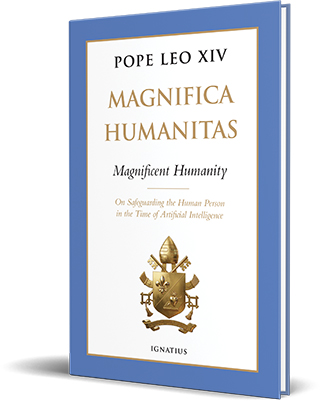
This column is no different. Having said that, however, the discussion of an “ecology of communication” in chapter four of Magnifica Humanitas can be considered something of a summary of the overall thrust of the document. After all, the entire encyclical is concerned with the title and first subtitle of the chapter: “Safeguarding Humanity at a Time of Transformation: Truth, Work, Freedom.” The call for an “ecology of communication” could be seen as the central animating theme of Magnifica Humanitas.
As Pope Leo acknowledges at the beginning of chapter four, it represents a transition from theoretical “general analysis” to a “focus on certain areas” in which the “transformations” of artificial intelligence “have particularly concrete … consequences.” Among other things, therefore, “the digital transformation invites us to rediscover truth as a common good” (131). This tees up one of the most vexing contradictions of artificial intelligence: tools that have the capacity to advance truth and human communication are often used to promulgate falsehood and hinder authentic community. This might be seen as Pope Leo’s central concern in the encyclical.
It is fitting, of course, that the Pope situates Magnifica Humanitas in the context of the Tower of Babel. In the Babel narrative, language is used not for the purpose of fostering authentic human community, but rather as an attempt to put the human person in the place of God. But, explains Leo, “When a city is built on pride and the claim to self-sufficiency, communication breaks down, languages are confused and people no longer understand each other.”
The Babel saga is less about the event in Genesis and more about the perennial habit of mankind to usurp God’s place, to exchange the creator for the creature. “Babel thus reveals the limits of any effort, Leo contends, “that … arises from self-affirmation, sacrifices human dignity for efficiency and aspires to reach heaven without God’s blessing.” As the Pope puts it, the Babel story is one in which the people sought “homogenization over communion” (7).
Pope Leo contrasts the Babel narrative with that of Nehemiah, who builds a community of discourse and cooperation to rebuild the devastated walls of Jerusalem. Nehemiah “did not impose solutions from above,” contends the Holy Father. Instead, “[h]e convened the families, assigned each of them a section of the wall to rebuild, listened to their concerns, coordinated their efforts and addressed any opposition.” Before he rebuilt the walls, Nehemiah rebuilt community through reasoned discourse. In doing so, Pope Leo explains, “ancient Jerusalem rediscovers a common language … namely the harmony that arises when all persons assume their own role and recognize that their strength comes from the Lord” (8).
The human person is the only of the earth’s creatures that has the capacity for highly sophisticated communication through speech. While other species may have rudimentary (and mysterious) ways of crude communication, only the human creature is capable of intricate communication through elaborate structures of vocabulary, grammar, and usage—in short, speech. And the purpose of this ability to communicate is, well, to create community.
We literally (see what I did there?) create communities of discourse and rationality through the function of language and speech. Building truthful communities is, indeed, the purpose of communication. Thus, the perversion of communication to promulgate falsehood or to undermine authentic community is to use the tool for communicating truth to undermine that very purpose.
The perversion of speech to undermine truth is not new, of course, and it is not created by the rise of AI. The problem appears as early as Genesis 3, when the serpent (and the woman) use speech to obfuscate, obscure, and distort, rather than to communicate the truth about man and God. Parallel violations occur in Genesis 4, where Cain uses speech for the purpose of killing his brother. And, as noted above, Pope Leo invokes the Tower of Babel account to make a similar point.
But while AI did not invent the problem, it certainly can exacerbate it. “Disinformation did not begin with AI,” notes the Holy Father, “yet today it finds a powerful amplifier in AI” (132).
Thus, the pope complains, “Tools that could foster dialogue and participation are often used to construct distorted narratives and blur the boundaries between truth and falsehood, mixing facts with opinions” (132). As a tool of effective communication, AI can be beneficial to the growth of human communication and, thus, community. As it is more often used, however, AI is used to “manipulate content, images and videos,” exposing us to “biased or misleading perspectives” (132).
This is no minor implication of the use of AI to manipulate its consumers. Going even deeper than the mere fact of misinformation, this use of AI undermines the very humanity of authentic communicative discourse. Cain’s lie to Abel (whatever it was) not only resulted in Abel’s death, but it destroyed the natural community of brotherhood. Similarly, AI, with its unprecedented ability to foster truth, is instead used to propagate falsehood.
The articulation of truthful communication for the purpose of building a flourishing human community is thus undermined by the misuse of AI communication tools. “In public discourse,” Pope Leo explains, the search for truth “is deeply relational, built through bonds of trust and shared practices, as well as an honest exchange with others and with the world” (132). It is no accident that “communication” and “community” are essentially the same word. Authentic community requires truthful communication.
Artificial intelligence tools can, when ordered toward truth, contribute to community. Too often, however, it is ordered toward disinformation and disunity, dividing what should be united. This does not merely lead to a “crisis of truth,” but is the instantiation of a regime of distortion, rather than clarity.
Put another way, “communication is not only the transmission of information, but it is also the creation of a culture,” explains Leo. The virtually immeasurable content that flows from AI chatbots and other forms of manipulation lead precisely to a culture of mistrust and disunity. It “shapes how people perceive the world.” Therefore, “those who control digital platforms and means of communication have a considerable ability to affect the collective imagination and to present a particular vision of reality” (135).
Thus, Pope Leo calls for an “ecology of communication,” in which we neither “demonize nor idolize” AI tools, but rather “utilize them based on a fundamental principle, namely that truth is a common good and not the property of those with power or influence” (137). An ecology of communication involves the totality of social structures and institutions; otherwise, it can never contribute to human flourishing. This entails the establishment of juridical rules and regulations, as well as strengthening intermediary institutions that could put a check on the proliferation of disinformation.
These include schools, universities, and—of course—the Church. An ecology of communication can never take hold if the Church is not up to the task of articulating the truth about the human person and society. “The Church’s Social Doctrine invites families, schools, Christian communities, and public institutions to form a renewed educational alliance” (147).
Magnifica Humanitas fits squarely within the Church’s tradition of social doctrine. In 1891, Leo XIII faced a crisis caused by a relatively slow-moving industrial revolution. The “new things” encountered by Leo XIV move much, much faster and, thus, have the capacity to do much more damage even than the excesses of the 19th-century revolutions.
In Magnifica Humanitas, the pope has set an agenda for the further development of Catholic Social Doctrine as it applies to digital technology. If it does not start with a commitment to truthful communication, AI is more likely to destroy human community than support it.
If you value the news and views Catholic World Report provides, please consider donating to support our efforts. Your contribution will help us continue to make CWR available to all readers worldwide for free, without a subscription. Thank you for your generosity!
Click here for more information on donating to CWR. Click here to sign up for our newsletter.

Haven’t read it yet. Several initial questions from reading this analysis: Has synodality become the CC’s Tower of Babel? Why not a title of Magnifica Deus? How much of the encyclical focused on God and Jesus Christ as necessary and central v. the fallen human and the human condition?
While Magnifica Humanitas offers a vital critique of how artificial intelligence alters the communicative faculties of the human person, a strict focus on the mechanisms of communication risks obscuring a deeper principle of Catholic Social Teaching: the ontology of communio. As the relational imagery of rebuilding Jerusalem in the encyclical reminds us, human flourishing cannot be reduced to the mere transmission of data or horizontal connectivity. True communion requires embodied, personal presence. If our reliance on AI isolates the individual by substituting artificial engagement for authentic relationality, it threatens to erode the very social fabric the Church seeks to safeguard. Therefore, a robust theological application of the text requires that we strictly limit AI’s role where it risks supplanting true, interpersonal communion.
As an aside, Bill McCormick, SJ recently released an article in The New Resourcement’s Spring 2026 publication entitled that overlaps some of these concepts – “Subsidiarity as a Way of Life: The Fundamental Vision of Catholic Social Teaching.”
The real threat of AI involves taking it seriously, a position that conveys to the willfully gullible that beliefs in value judgements that can exist outside the realm of human responses are credible, when they are not. This is what dehumanizes. The abortion holocaust only came about through judging life by material and functional worthiness.