


Back in the day, when the New Yorker set the standard for literary elegance among serious American journals, writers were driven to distraction by the fanatical fact-checking characteristic of the magazine’s gimlet-eyed editors. But the old New Yorker ain’t what she used to be.
Evidence is readily at hand in Paul Elie’s recent, sprawling article, “The Making of the First American Pope,” which included this sentence about the last years of Pope Francis’ pontificate:
The commentator George Weigel wrote a short book outlining the qualities conservatives wanted in the next Pope, and in 2020, Cardinal Timothy Dolan, the Archbishop of New York, arranged for copies to be sent to all the cardinals who were expected to vote in the next conclave.
With apologies to Elizabeth Barrett Browning: How do I correct thee? Let me count the ways:
1) How does a book calling for the pope to recognize the New Evangelization as the Church’s “grand strategy” for the twenty-first century qualify as “conservative” Catholicism, rather than mainstream, living Catholicism?
2) By the same token, how does the trigger warning about Catholic “conservatives” and their alleged longings adequately reflect the content of a book that calls on the papacy to promote Christian humanism, deepen the Church’s appropriation of the teaching of the Second Vatican Council, broaden the consultations through which bishops are selected, intensify seminary reform, empower lay men and women to be missionary disciples, undertake a root-and-branch reform of the Roman Curia, and deepen the theology of ecumenical and interreligious dialogue?
3) How is it “conservative” to urge the Bishop of Rome to keep 1.4 billion men and women focused on the person of Jesus Christ as the incarnate Son of God and the answer to the question that is every human life?
4) As to specific fact-checking: If Paul Elie or his editors had bothered to contact me, Cardinal Dolan, or Mark Brumley, the president of Ignatius Press, he would have learned that my book, The Next Pope: The Office of Peter and a Church in Mission, was sent to the members of the College of Cardinals by Ignatius Press; that Cardinal Dolan did not initiate that; and that the cardinal merely provided a cover note suggesting the book was worth reading. But no, one can only assume that the misrepresentations about this initiative concocted by Mr. Elie’s progressive Catholic contacts, which have been corrected more than once, were left unexamined. Why bother fact-checking when the facts, if ascertained, might get in the way of a good trigger-warning or a slap at a leading American churchman?
There were numerous other problems with Mr. Elie’s article, including the usual, tiresome dismissals of John Paul II and Benedict XVI as rigorists and authoritarians; the author also seems quite ignorant of the Vatican’s febrile atmosphere during the latter years of Pope Francis. I can’t quarrel much with Elie’s conclusion, though: that Pope Leo’s “mission” might be to be “an American in a position of great power who is decent and humble — a no-drama Pope whose very ordinariness is his message.”
Except to offer two more corrections.
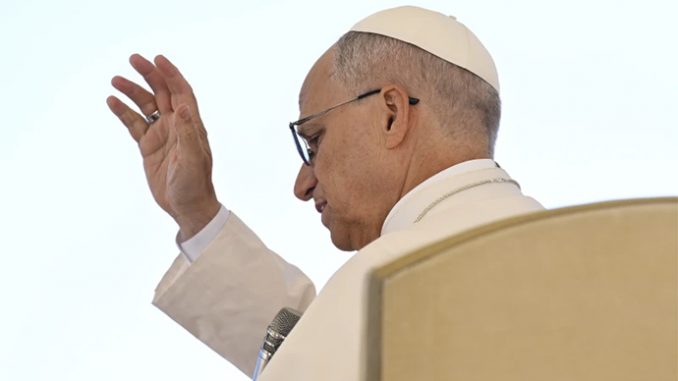
First, Pope Leo has made it clear from the night he stepped out onto the central loggia of St. Peter’s Basilica that his “message” is Jesus Christ, not himself. Elie’s description of Leo’s pre-papal career contains some interesting information (as well as some unfortunate distortions about Catholic movements and personalities in Latin America), but it tends to elide over something crucial: that the pope is a man of God, a man of prayer, and an evangelist who wants the world to know the Lord he loves and serves.
Second, it was clear to those of us in Rome during the 2025 papal interregnum that Cardinal Robert Prevost was not thought of primarily as “an American,” for if he had been, his election would have been quite unlikely. The Latin American cardinal-electors thought him one of their own, given his many years in Peru; others considered him a prominent figure in the universal Church, with broad international experience. No one was focused on the fact that he was a White Sox fan from the south suburbs of the Windy City.
Various scribblers and talking heads (and, of course, churchmen) have been spinning Pope Leo from the day of his election, the direction of the spin being dictated by the spinner’s position in Catholicism’s ongoing debates over identity and mission. Enough is enough. The Holy Father has a very tough job, and no one trying to capture him for any particular party or agenda is doing him, or the Church, any good service.
If you value the news and views Catholic World Report provides, please consider donating to support our efforts. Your contribution will help us continue to make CWR available to all readers worldwide for free, without a subscription. Thank you for your generosity!
Click here for more information on donating to CWR. Click here to sign up for our newsletter.

I’ve concluded that much of management these days is “via email.” There’s good and bad to that, namely it’s much more efficient, but the people get lazier and make the wrong decisions. Managers are not interacting even on a phone call or heaven forbid, an in person discussion. They’re missing out on the bigger picture, in many instances.
First order of business, Paul Elie earned for himself the Joseph Stalin Award for 2020, in appreciation for his character assassination of the late Ms. Flannery O’Connor, and participating in the Jesuitical Secret Police Trial where he joined his fellow assassins at the paganized Jesuit animal farm called Loyola University of Maryland, and dug up her grave, and drove a stake through her heart, as a demonstration of his callousness, cowardice, cruelty and (as one Commonweal essayist wrote) ignorance.
Article from these pages at CWR, link here:
https://www.catholicworldreport.com/2020/07/30/loyola-university-maryland-renaming-dorm-that-honored-flannery-oconnor/
Article from Commonweal, here:
https://www.commonwealmagazine.org/cancelling-flannery-oconnor
Second, the thematic tipe-rope-walker narrative about who or what it means to be “conservative” (and I assume liberal), is, at this point, more utterly meaningless than the essay hopes to convey.
I mean, why would anyone accuse the contemporary Catholic Establishment of the crime of trying to conserve anything? They have “serious-minded” business to attend to, like their secret accord with the brutal Chinese Communist Party, and their erasure of the good name and reputation of the Vatican auditor Libero Milone, and the tormenting of young and old Catholic people who love the Traditional Mass.
I forgot about the book incident, but this is a good time to be reminded of it. It may help explain why Cardinal Dolan’s resignation was accepted so quickly, while Cardinal Cupich is somewhat older and still in office. Payback sometimes takes a while, but they apparently didn’t forget.
‘Fact-checking The New Yorker’
This is a joke – right?
I am presently listening to the 4th movement of Symphony #3 by Camille Saint-Saens’ – (AKA) – ‘The Organ Symphony’. The Organ Crescendo which begins the 4th movement will stand your hair on end – if you have any hair left.
Following that – ‘La Mer’, composed by Claude Debussy.
In or around 1995 there was a movie entitled ‘The American President’. Michael Douglas gave an admirable performance in the title role. At the end of the movie he gave a speech in which he twice said:
“We have serious problems and we need serious people to solve them.”
Indeed
We are waiting
Touché
I’ve learned to trust, primarily, Mr. Weigel’s writing for the last few years in my now 30 year-long conversion to the Church that began with Flannery O’Connor’s infamous defense of the Eucharist: “Well, if it’s a symbol, to hell with it.”
Weigel and O’Connor—for me, good company.
Good company indeed – may I suggest you add Michael O’Brien to that list.
Was the New Yorker ever the standard of “journalism”? Was the NYTimes ever for the matter? I would guess like the Times, the editorial board of the New Yorker has always been quite Jewish and has done nothing but undermine actual journalism in favor of propaganda by the enemies of all humanity and against God’s church.
As a coda, I believe it is appropriate to note that any and all people who write or speak on video about what is happening in the Catholic Church (etc) are included in the broad categories of “scribblers and talking heads” offered up by author Mr. Weigel. Unless of course I misunderstand the way things are meant to be understood, and that their are higher personalities in the caste system of the commentariat, who propose that their own writing and talking is to be received as a species of sublime and pristine expression.
I’ll be spending some time rereading the New Testament. I should refresh my knowledge on the teachings regarding politics as I navigate the road to salvation. I’m turning pages looking for Conservative and Liberal Catholicism.
Give unto Ceaser….
I’m not sure The New Yorker has any value-unless you have a bird in a cage.
Addressing it confers a dignity upon it that it doesn’t merit.
Does anyone here subscribe to the New Yorker?
I get the e-edition…which allows a brief look at their content while, more importantly, not giving them even a discontinued penny ☺️.
It always pays to know what the Far Left is thinking.
And, the cartoons are occasionally humorous😉.