No Picture
News Briefs

Good Friday papal preacher: In a changing world, the cross remains the same

April 14, 2017 CNA Daily News 0

Vatican City, Apr 14, 2017 / 10:57 am (CNA/EWTN News).- Even as sinful people in a society filled with violence and increasing secularism, we have hope because Christ’s cross perdures, the papal preacher said at the Vatican’s Good Friday Service.

“The cross, then, does not ‘stand’ against the world but for the world: to give meaning to all the suffering that has been, that is, and that will be in human history,” Fr. Raniero Cantalamessa, OFM Cap., said April 14.

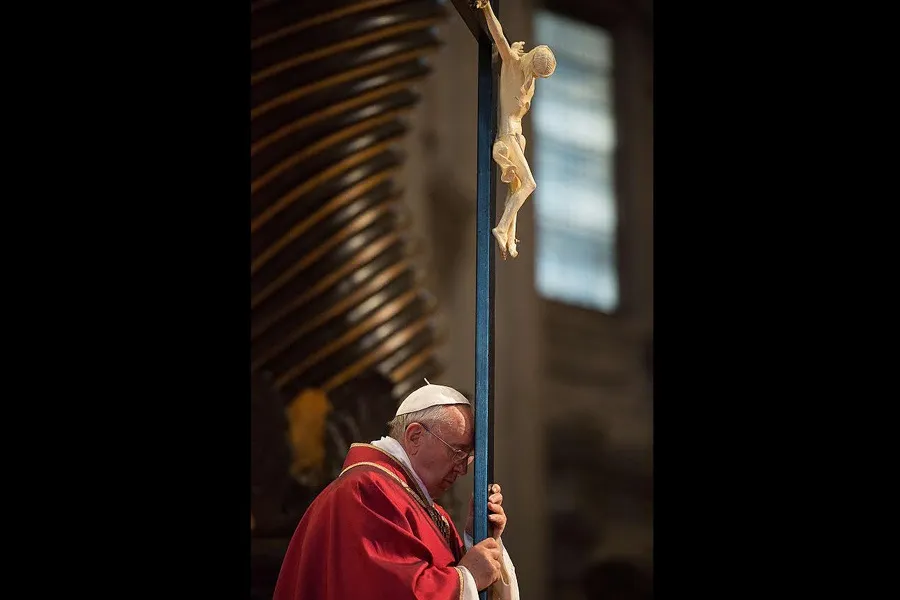
He gave the homily during the Celebration of the Lord’s Passion presided over by Pope Francis in St. Peter’s Basilica. Fr. Cantalamessa also gave the homilies at Mass at the chapel of Casa Santa Marta on Fridays throughout Lent.

Today, we are constantly hearing about death and violence, he said. “Why then are we here to recall the death of a man who lived 2,000 years ago?”

“The reason is that this death has changed forever the very face of death and given it a new meaning,” he said.

Fr. Cantalamessa preached: “The cross is the living proclamation that the final victory does not belong to the one who triumphs over others but to the one who triumphs over self; not to the one who causes suffering but to the one who is suffering.”

He explained how the Carthusian monks have adopted a coat of arms that hangs at the entrance to their monastery. It has a globe of the earth with a cross above it, and written across it: “Stat crux dum volvitur orbis,” or “The cross stands firm as the world turns.”

He described a painting by Salvador Dali, called “Christ of St. John of the Cross.” It depicts Christ on the cross as if you are looking from above. Beneath him are clouds, and below that, water.

In a way, the water beneath Christ in this image, instead of earth, is a symbol of the lack of firm foundation of values in our current society, he explained. But even though we live in this very “liquid society,” there is still hope, because “the cross of Christ stands.”

“This is what the liturgy for Good Friday has us repeat every year with the words of the poet Venanzio Fortunato: ‘O crux, ave spes unica,’ ‘Hail, O Cross, our only hope.’”

The point of Christ’s Passion, however, is not an analysis of society, he said. “Christ did not come to explain things, but to change human beings.”

In each of us, to varying degrees, is a “heart of darkness,” he said. In the Bible, it is called “a heart of stone.”

“A heart of stone is a heart that is closed to God’s will and to the suffering of brothers and sisters, a heart of someone who accumulates unlimited sums of money and remains indifferent to the desperation of the person who does not have a glass of water to give to his or her own child; it is also the heart of someone who lets himself or herself be completely dominated by impure passion and is ready to kill for that passion or to lead a double life,” he said.

He explained that even as practicing Christians we have these hearts of stone when we live fundamentally for ourselves and not for the Lord.

Quoting God’s words through the prophet Ezekiel, Fr. Cantalamessa said: “I will take out of your flesh the heart of stone, and give you a heart of flesh.”

He went on to explain how in Scripture we are told that at the moment of Christ’s death, “The curtain of the temple was torn in two, from top to bottom; and the earth shook, and the rocks were split; the tombs also were opened, and many bodies of the saints who had fallen asleep were raised.”

This description, using apocalyptic language and signs, indicates “what should happen in the heart of a person who reads and meditates on the Passion of Christ.”

“The heart of flesh, promised by God through the prophets, is now present in the world: it is the heart of Christ pierced on the cross, the heart we venerate as the “Sacred Heart,’” he said.

We believe that though he was slain, because Christ has in fact been raised from the dead, his heart has also “been raised from the dead; it is alive like the rest of his body.”

And when we receive the Eucharist, we “firmly believe” that the very heart of Christ has come to “beat inside of us” as well, he explained.

“As we are about to gaze upon the cross, let us say from the bottom of our hearts, like the tax collector in the temple, ‘God, be merciful to me a sinner!’ and then we too, like he did, will return home ‘justified’.”

[…]

No Picture
News Briefs

Pope Francis: we find hope in embracing our crosses with love

April 12, 2017 CNA Daily News 0

Vatican City, Apr 12, 2017 / 07:21 am (CNA/EWTN News).- As the Church this week reflects on Jesus’ crucifixion and death, Pope Francis said that it is the cross that gives us hope, and urged faithful to enter into the mystery of Christ’s death by contemplating the joy that comes from sacrifice.

“During these days, days of love, let us be enveloped by the mystery of Jesus who, like a grain of wheat, in dying gives us life. He is the seed of our hope,” the Pope said April 12.

“Let us contemplate the Crucified Christ, the source of hope. Little by little we realize that hope with Jesus is learning to see, indeed right now, the plant in the seed, Easter in the cross, life in death.”

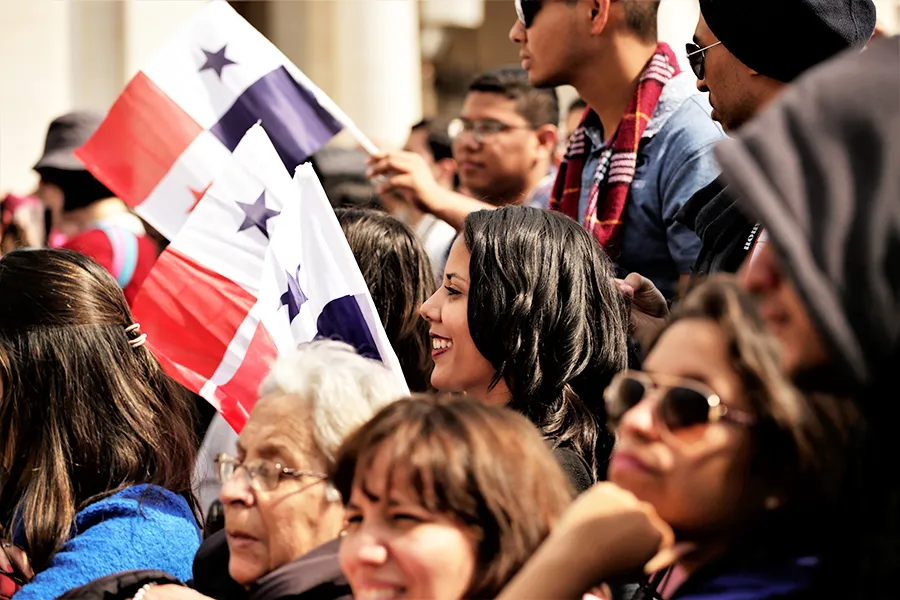
Speaking during his weekly general audience in St. Peter’s Square, Francis told pilgrims he was giving them some homework. He instructed them when they get home to stop in front the crucifix, look at Jesus and tell him: “With you, I can always hope. You are my hope.”

“Now imagine the crucifix,” he told the crowd, “and all together say to Jesus Crucified, three times: ‘You are my hope.’” When the crowd said, Francis wasn’t convinced, and had them repeat it again even louder.

“We we really believe that in the Crucified Christ our hope is reborn,” he said, but cautioned that “it is a different hope from that of the world. What hope is this? The hope that is born of the cross.”

Love and hope come together on the cross of Christ, he said, explaining that this is a cross everyone must carry at different points in their lives.

“But it’s beautiful to help others, to serve others,” he said, noting that this can get tiring at times, “but life is like that…This is love and hope together: to serve and give.”

“Of course, this love comes from the cross, from sacrifice, as it did for Jesus,” he said, stressing that the cross in itself is not the goal, but rather “a necessary step” to the ultimate goal, which is “glory, as Easter shows us,” he said.

It is in laying down one’s life, not holding onto it, that we find true joy, the Pope said, and pointed to the sacrifice of a mother, which he said is “another beautiful image that Jesus left to his disciples during the Last Supper.”

Jesus says in John 16:21 that “the woman, when giving birth, is in pain, because her hour has come; but, when she has given birth to the child, she no longer remembers the suffering, because of the joy that a child has come into the world.”

This is what mothers do, Francis said, noting that they give life to another through suffering, but then they are “joyful and happy (because) love gives birth to life and even gives meaning to pain.”

Love is the “engine” that fuels our hope, he said, and encouraged pilgrims to ask themselves: “Do I love? Have I learned to love? Am I learning every day to love more?”

“There is no other way to overcome evil and to give hope to the world,” he said, except by serving with humility and love.

“Have you thought about this?” he asked. No one likes to lose power and the logic of the seed that must die before bearing fruit is difficult to understand, he said, but stressed that this is the way of God.

He pointed to how many times in life we move forward with the mentality that the more we have the more we want. However, Jesus clearly says the opposite: “He who loves his life will lose it.”

This is why our hope is born from Christ’s transformation of death into life, he said, explaining that in the same way Jesus transforms our own sin into forgiveness, “our death into the resurrection, our fear into confidence.”

“That’s why there on the Cross, our hope is born and is always born again; that’s why with Jesus all our darkness can be transformed into light, every defeat into victory, every disappointment into hope. Every? Yes, every.”

[…]

No Picture
News Briefs

EWTN exec named consulter for Vatican communications office

April 12, 2017 CNA Daily News 0

Vatican City, Apr 12, 2017 / 04:22 am (CNA/EWTN News).- On Wednesday the Vatican announced that EWTN’s Chairman of the Board Michael Warsaw has been named by Pope Francis a consultor of the Vatican Secretariat for Communications.

The announcement of Warsaw’s appointment was made in an April 12 communique from the Vatican, along with the names of 13 other new consultors.

Warsaw was promoted to Chairman of the Board for EWTN in 2013. He has worked for EWTN since 1991, and had been named president in 2000, and CEO in 2009. He also serves as publisher of the National Catholic Register since the paper’s acquisition by EWTN in 2011.

He has worked for more than 35 years in media, and has overseen EWTN’s television, radio, and internet programming and production, as well as hosting the program “Bookmark.” He had been appointed COO in 2009.

EWTN was founded in 1981 by Mother Angelica, of the Poor Clares of Perpetual Adoration. The network today transmits programming to more than 264 million homes in 144 countries. What began with approximately 20 employees has now grown to nearly 400.

The religious network broadcasts terrestrial and shortwave radio around the world, operates a religious goods catalog and publishes the National Catholic Register and Catholic News Agency, among other publishing ventures.

In addition to Warsaw, other new consultors to the Secretariat are: Fr. Ivan Maffeis, Undersecretary of the Italian Bishops Conference; Fr. José María La Porte, Dean of the Faculty of Institutional Social Communications of the Pontifical University of Santa Croce; Fr. Peter Gonsalves, S.B.D., Dean of the Faculty of the Science of Social Communications at the Pontifical Salesian University; Fr Eric Salobir, O.P., Promoter General for Social Communications of the Order of Preachers; Fr. James Martin S.J. of America Magazine; Fr. Jacquineau Azétsop S.J., Dean of the Faculty of Social Sciences at the Pontifical Gregorian University; Paolo Peverini, Professor of Semiotics at Luiss Guido Carli University; Fernando Giménez Barriocanal, President and Managing Director of Radio Popular-Cadena COPE; Ann Carter of Rasky Baerlein Strategic Communications; Graham Ellis, Vice Director of BBC Radio; Dino Cataldo Dell’Accio, Chief ICT Auditor at the United Nations and Michael Paul Unland, Executive Director of the Catholic Media Council.

[…]

No Picture
News Briefs

Bible scholar gives inside look at Vatican’s Stations of the Cross

April 11, 2017 CNA Daily News 1

Vatican City, Apr 11, 2017 / 03:33 pm (CNA/EWTN News).- Pope Francis chose French biblical scholar, Anne-Marie Pelletier, to write the meditations for this year’s annual Good Friday Stations of the Cross at the Colosseum.

A recipient of the Ratzinger Prize in 2014, as well as a wife and mother, Pelletier’s meditations follow her own scripturally-based Stations of the Cross, or Via Crucis, based on the 14 biblical stations used by St. John Paul II in 1991.

Because the Stations of the Cross do not have a “binding form,” Pelletier told Vatican Radio, “I chose those moments that seemed particularly significant.”

Her stations are not significantly different from the traditional 14 stations followed by pilgrims walking the Via Dolorosa in Jerusalem, though the biblical stations don’t include the three falls of Jesus or Veronica wiping the face of Jesus as in the traditional devotion.

She also begins with Jesus’ condemnation, rather than his prayer in the garden of Gethsemane.

Using more than just the accounts of Christ’s Passion in the Gospels, Pelletier’s reflection weaves in Scripture and biblical references from both the Old and New Testaments as she reflects on how the entire life of Christ has been leading him, and us, to his ultimate sacrifice.

Pelletier’s meditations also reflect significantly on the perspective of the women along Jesus’ path, especially his mother, Mary.

An important scholar of contemporary French Catholicism, Pelletier has taught biblical studies at the European Institute of Religious Sciences and served as vice-president of the Jewish-Christian Documentation Information Service in Paris. She is the first woman to win the Ratzinger Prize.

The Ratzinger Prize was begun in 2011 to recognize scholars whose work demonstrates a meaningful contribution to theology in the spirit of Cardinal Joseph Ratzinger, the Bavarian theologian who became Benedict XVI.

The prize is awarded by the Ratzinger Foundation, which was founded in 2010 with Benedict XVI’s approval to study and promote his writings as a theologian, as a cardinal in charge of the Vatican’s Congregation of the Doctrine of the Faith, and as Pope.

Pelletier opens the stations with Jesus’ condemnation before the members of the Sanhedrin, who “did not need a lengthy discussion to come to a decision,” she wrote. “The matter had long been settled. Jesus must die!”

Showing how at each point of his life Jesus faced enemies, she wrote that “our recollection must go back even further,” to Bethlehem, to Jesus’ very birth, when “Herod had decreed that he must die.”

Jesus escaped that time, but “already his life hung in the balance. In the sobbing of Rachel mourning her children who are no more, we hear a prophecy of the sorrow that Simeon will foretell to Mary (cf. Mt 2:16-18; Lk 2:34-35),” she writes.

In the fourth station, when Jesus is crowned with a crown of thorns, draped in a purple cloth and mocked with the words, “Hail, King of the Jews!” the paradox of Jesus’ kingship is revealed to us “as a love that seeks only the will of his Father and his desire that all should be saved.”

In this station she prays, “Lord our God, on this holy day that brings your revelation to fulfillment, we ask you to tear down every idol in us and in our world. You know the sway they have over our minds and our hearts. Tear down in us every deceitful illusion of success and of glory.”

When Jesus meets the mourning women of the daughters of Jerusalem, at the seventh station, Pelletier reflects on the gift of tears Jesus bestows upon them, asking them not to weep for him, but for the world.

The tears “fall silently down their cheeks. And undoubtedly, even more often, they fall unseen in the heart, like the tears of blood spoken of by Catherine of Siena,” she writes. “Not that women alone should weep…” she emphasizes, though it is their grief that “embraces all those tears shed quietly and without fanfare in a world where there is much to weep for.”

The eleventh station is devoted to Jesus and his mother Mary. Throughout her son’s life, Pelletier writes, Mary had entrusted each event “to the great patience of her faith” and today, the day of his crucifixion “is the day of fulfilment.”

“The sword that pierced her Son’s side pierces her own heart. Mary too plunges into that bottomless trust whereby Jesus lives to the full his obedience to the Father. Standing there, she does not desert him. Stabat Mater. In the darkness, but with certainty, she knows that God keeps his promises.”

The reflection on the tender faithfulness of women continues in the final station, as Jesus is laid in the tomb and the women prepare to anoint his body the following morning at daybreak, after the Sabbath has ended.

“Grant too that we, who have accompanied you along this path of love to the very end, together with the women of the Gospel, may remain in expectant prayer,” Pelletier concludes.

“For we know that our prayers will be answered by the resurrection of Jesus, which your Church now prepares to celebrate in the joy of Easter night.”

[…]

No Picture
News Briefs

Consistory announced to approve Fatima children’s canonization

April 11, 2017 CNA Daily News 0

Vatican City, Apr 11, 2017 / 10:59 am (CNA/EWTN News).- Pope Francis will hold an ordinary public consistory on April 20, where the cardinals of the Church are expected to pave the way for the canonization of the Fatima visionaries.

There are five causes of canonization waiting for approval by the cardinals. Most prominent is the cause of Francesco and Jacinto Marto, two of the shepherd children who witnessed the 1917 Marian apparitions at Fatima.

The cardinals’ approval at the consistory is the final step in the process leading up to canonization. Pope Francis has already given approval for the causes to move forward. Following the consistory, canonization dates will be set.

It has been widely speculated that Pope Francis will canonize the Fatima visionaries during his trip to Fatima for the 100th anniversary of the Marian apparitions there. That trip will take place May 12-13.

Francisco, 11, and Jacinta, 10, were the youngest non-martyrs to be beatified in the history of the Church.

The brother and sister, who tended to their family’s sheep with their cousin Lucia Santo in the fields of Fatima, Portugal, witnessed the apparitions of Mary, now commonly known as Our Lady of Fatima.

During the first apparition, which took place May 13, 1917, Our Lady asked the three children to say the Rosary and to make sacrifices, offering them for the conversion of sinners. The children did, praying often, giving their lunch to beggars and going without food themselves. They offered up their daily crosses and even refrained from drinking water on hot days.

In October 1918, Francisco and Jacinta became seriously ill with the Spanish flu. Our Lady appeared to them and said she would to take them to heaven soon.

Francisco died April 4, 1919. Jacinta died the following year, Feb. 20, 1920.

Pope John Paul II beatified Francisco and Jacinta May 13, 2000, on the 83rd anniversary of the first apparition of Our Lady at Fatima.

The canonization cause for Sister Lucia Santo – the third Fatima visionary – is currently underway. Sr. Lucia lived to the age of 97, much longer than the other two visionaries, and the Vatican is currently examining information about her life that has been collected over the past eight years since her cause was officially opened.

In addition to the Fatima children, other causes of canonization set for approval at next week’s consistory are Cristóbal, Antonio, and Juan, young martyrs of Mexico in 1529; Fr. Faustino Míguez, the Spanish priest who founded the Calasanzian Institute of the Daughters of the Divine Shepherdess; Fr. Angelo da Acri, an Italian Capuchin priest who died in October 1739; and Fr. Andrea de Soveral, Fr. Ambrogio Francesco Ferro, Matteo Moreira, and their 27 companions, martyrs of Natal, Brazil in 1645.


[…]