


 By
By 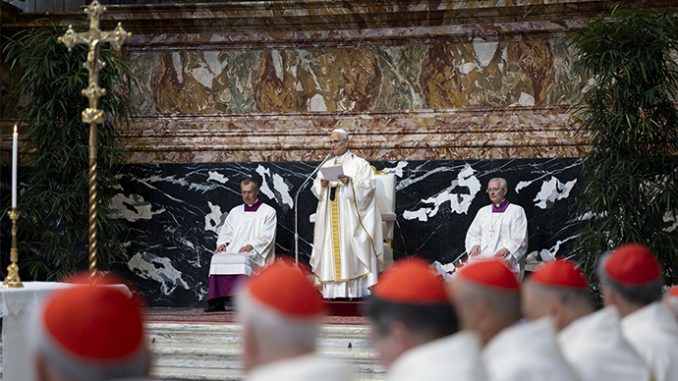
Pope Leo XIV on June 27 thanked the College of Cardinals for their work during their two-day extraordinary consistory, highlighting their reflections on war, poverty, and social fragmentation as well as deeper wounds such as loneliness and loss of meaning.
The pope said in his closing address that he was “particularly struck by the way [the cardinals] spoke about young people,” especially in their suffering that can at times lead “to the extreme despair of taking their own lives.”
“You have recognized one of the deepest wounds of our time,” he said, “yet you have also been able to recognize the work of the Holy Spirit [in their] search for authenticity, for genuine relationships, and for meaning.”
Addressing another of the world’s wounds — war — Leo XIV reiterated themes from his encyclical Magnifica Humanitas , warning that war stems from a broader “culture of power” affecting politics, economics, and even religion.
“War is born within us,” he said, but it is “precisely in the heart that peace is also decided.” It is in that same heart, he said, where Christ “continues to meet us, speak to us, and to convert us,” and he called for renewed commitment to dialogue, multilateral cooperation, and nonviolent responses rooted in the Gospel.
Although the cardinals discussed “just war,” the pope did not specifically mention the tradition in his address, noting instead the theme of self-defense in light of “profound transformations” in contemporary conflicts.
Reflection on this topic needs to be “further developed,” he said, “with necessary theological and pastoral rigor.”
Issuing a global appeal, Leo XIV declared: “God desires peace for every nation and every people,” urging the Church to help the world reject violence and rediscover the Lord’s paths of reconciliation.
Pope Leo also underscored the importance of the family, the Church’s social doctrine, and the formation of consciences, while reaffirming the role of ecumenical and inter-religious dialogue in promoting peace.
He urged the cardinals to deepen the Church’s synodal path as a “spiritual style” rooted in listening, discernment, and fidelity to the Gospel. Synodality, he said, is not primarily about structures or decision-making, but about safeguarding the Church’s mission through shared discernment.
“The question is not ‘who decides,’” he said, “but how we together safeguard the gift entrusted to the Church.”
Leo XIV encouraged the cardinals to promote active participation across local Churches, saying that authentic synodality arises from encounter and openness to the Holy Spirit.
He likened this two-day gathering — which had a distinctly synodal format of working group discussions — to the Gospel account of the disciples on the road to Emmaus in which Christ renews hope and clarifies mission.
Referring to a meeting of bishops in October to mark the 10th anniversary of Amoris Laetitia, the pope said the gathering will be part of the implementation of the Synod on Synodality — a chance to “foster spaces where the People of God can listen to one another, pray, discern and walk together.”
The pope closed by entrusting the fruits of the consistory to the intercession of Our Lady. “May she teach us to preserve unity in diversity and to serve the Gospel of peace with humility, courage, and hope,” he said.
He reiterated that these extraordinary consistories will take place annually, and said he will be announcing next year’s meeting at the end of the year.
Vatican synthesis
As the consistory took place behind closed doors, it was not possible to know exactly what the cardinals discussed during the two-day meeting.
Instead, media had to rely on syntheses provided by the Holy See Press Office which omitted some key interventions such as Cardinal Gerhard Müller’s call on the Vatican to issue a formal response to the Society of St. Pius X’s latest challenge to Rome, as reported on Saturday by Il Giornale’s Nico Spuntoni.
The syntheses also did not cover any topics raised in the free discussion at the end of the consistory. The Vatican did, however, provide full texts of four cardinals’ reflections.
Opening Friday afternoon’s session on “The Culture of Power and the Civilization of Love” was Cardinal Victor Fernández, prefect of the Dicastery for the Doctrine of the Faith, who reflected on the theme and Chapter V of Magnifica Humanitas.
Drawing on the social encyclical, he argued that a deep cultural shift had been enabling the outbreak and normalization of new wars, often sustained by AI-driven media and political manipulation.
Magnifica Humanitas, he said, marked a significant development by declaring “just war” theory outdated in practice. It insisted instead on a far stricter understanding of legitimate defense and condemning pre-emptive and disproportionate warfare as incompatible with Catholic teaching and the Second Vatican Council’s Gaudium et Spes and its rejection of indiscriminate destruction.
As examples, he highlighted military interventions in Gaza and southern Lebanon.
Relativism, cynicism, “spiteful verbal attacks by political leaders,” and geopolitical inconsistency favored violent powers, the cardinal said, adding that the Church’s social doctrine was the answer.
Alluding to a consistent life ethic, he said the teaching is coherent in its defense of life, migrants, peace, and the vulnerable, and that it is capable of resisting the culture of power and fostering a culture of fraternity and the common good.
The Vatican reported that in their working groups during the session, presided over by Filipino Cardinal Siongco David, the cardinals similarly voiced concern about a pervasive “culture of power” marked by polarization, normalization of war, and diminished sensitivity to violence.
In response, they stressed the Church’s urgent duty to witness credibly to peace through a transformed language of encounter, rooted in listening, forgiveness, and reconciliation, and through visible Christian unity.
They also urged dialogue with other religions, especially Islam, and engagement with international institutions. The Vatican said “numerous groups” called for moving beyond classical “just war” frameworks toward proportionate self-defense, while reaffirming the Gospel as the true source of peace.
The Vatican said strong support was expressed for Pope Leo XIV’s encyclical and his moral leadership, alongside renewed reflection on the Petrine ministry as a safeguard of the Church’s independence and a sign of unity.
Building the common good
Saturday morning’s session shifted focus to “Building for the Common Good,” examining the deep fractures affecting societies, families, and individuals.
Cardinal Stephen Brislin of Johannesburg presented Magnifica Humanitas as a theologically coherent vision of human “building” in an age of technological power, reading the whole encyclical through the opening contrast between Babel’s self-enclosed self-sufficiency and Jerusalem’s God-oriented rebuilding.
He noted that the introduction offered a “grammar of building” structured around desire, limitation, shared responsibility, and discernment, asking whether technological expansion, including AI, actually produced more just relationships and institutions attentive to the person.
In his reading, the conclusion showed how this grammar found its fulfilment in the theological virtues: faith reading history in the light of God’s merciful plan, charity rooted in the Eucharist grounding synodal communion, and hope directing concrete responsibility toward a “civilization of love,” all sustained by prayer exemplified in Mary’s contemplative gaze.
In the Vatican-summarized discussions that followed, presided by Tanzanian Cardinal Protase Rugambwa, the cardinals highlighted the anthropological crisis underlying these divisions, including loss of meaning, identity, and relationships, exacerbated by extreme individualism and emerging challenges such as artificial intelligence.
AI was discussed not only technologically but as a force reshaping human self-understanding, raising concerns about dignity, limitation, and the reduction of persons to data. The common good was presented as both elusive and essential, requiring a rediscovery of solidarity grounded in faith and expressed through concrete care for the poor.
The Vatican said the Church’s social doctrine and the formation of responsible political leaders were seen as vital responses to systemic inequality and fragmentation. Across interventions, the Gospel emerged as the antidote to division, calling the Church to embody a “Samaritan” presence, foster belonging, and promote synodality as a lived practice of listening and shared responsibility.
Final session
The final session of the consistory turned to the practical implementation of synodality, emphasizing spiritual elements and institutional challenges.
In his reflection, Cardinal Mario Grech, secretary general of the Synod Secretariat, described the Synod on Synodality as a profound experience “in the Spirit” and declared that it had already awakened in the Church a broad desire for participation, mutual listening, and shared discernment among bishops, clergy, religious, and laity.
He asserted that the current implementation phase was not a matter of mechanically applying decisions but of receiving, testing, and integrating synodal insights into the ordinary life of local Churches, culminating in the 2028 ecclesial assembly.
That phase, he said, depended on bishops as primary stewards of the synodal journey, adding that they needed to hold together synodality and collegiality as complementary expressions of one communion ordered to mission in a world marked by war, inequality, migration, and technological upheaval.
In their discussions that followed, presided by Cardinal Joseph Tobin of Newark, the Vatican said the cardinals agreed on the need to integrate the “ascetical and historical” dimensions of synodality while ensuring that its processes do not become overly burdensome or distract from the Church’s evangelical mission.
Particular attention was given to priestly formation, with calls for a vision of the priesthood that is dynamic, attractive, and authentically evangelical without reinforcing clericalism.
Discussion also clarified the complementary roles of hierarchy and laity in discerning the voice of “the Spirit,” highlighting synodality as a shared but differentiated responsibility within the People of God. The contribution of Eastern Catholic Churches, with their longstanding synodal traditions, was said to be especially valuable.
The Vatican synthesis noted that cardinals discussed “the risk that the complexity of the consultation process might weigh down the Church at a time when she is called to bear witness.”
If you value the news and views Catholic World Report provides, please consider donating to support our efforts. Your contribution will help us continue to make CWR available to all readers worldwide for free, without a subscription. Thank you for your generosity!
Click here for more information on donating to CWR. Click here to sign up for our newsletter.


“They also urged dialogue with other religions, especially Islam, and engagement with international institutions. The Vatican said “numerous groups” called for moving beyond classical “just war” frameworks toward proportionate self-defense, while reaffirming the Gospel as the true source of peace.”
Amen.
Prevost preaches peace but refuses to sit down with SSPX. Instead, he threatens them with the most lethal of his arsenal of weapons: EXCOMMUNICATION!!!!!
A useful lens for discerning the mixed messages of the Consistory might be this very concise and more lucid portrait of Pope Leo XIV, in Matthew Bunson’s “Portrait of the First American Pope: LEO XIV, EWTN 2025:
“It’s not hard to see in this a model of so-called synodality that simultaneously listens to concerns in a DEMOCRATIC way but decides in a HIERARCHICAL way (p. 94, caps added).”
So, consistent with “Lumen Gentium” (Chapter 3, with its Prefatory Note), the Church IS a “hierarchical communion” and NOT a communal hierarchy (an unwitting halfway house to a divided and “congregational theocracy”? which is the self-understanding of sectarian Islam).
Hold that Thought, and now four follow-up Questions and (mercifully!) a Summary:
FIRST, while the topic of “just war” needs to be “further developed with necessary theological and pastoral rigor,” outside of the Western context how will an updated theory deal with the alternative universe of radical Islam—for which jihad IS the uncomplicated and preemptive definition (!) of a just war?
SECOND, because the “grammar” for building a just world is fulfilled in the “theological virtues” how does this actually work without being so seemingly/fully conflated with doing more problematic stuff “synodally” in the world?
THIRD, Cardinal Grech attempts to square the circle by still wanting to hold together “synodality” and “collegiality” as only complementary expressions(?) of one “communion.” Complementary in a Hegelian sense? We’re tutored that bishops are “primary stewards of the synodal journey,” which simply repeats the fatal flaw of 2020 where bishops (!) were cast-rated “primarily as facilitators.” (Does anyone actually read this stuff, carefully?)
Better to simply acknowledge that synodality is, yes, a needed interpersonal “style” but within primary “collegiality”—as a vertebrate structure for governance, and within a sacramentally Eucharistic Church (CCC 1374 on the Real Presence as categorically more than a “communion”). That is, lacking the Apostolic Succession the Protestant gatherings are not churches at all but “ecclesial communions”—Dominus Iesus, 2000).
FOURTH, we read that discussion also clarified the complementary roles of hierarchy and laity in discerning the voice of “the Spirit,” highlighting synodality as a shared but differentiated (?) responsibility within the People of God. Yes, differentiated! Why do we seem to be muddling the clarity of “Lumen Gentium”—where the roles of the sacramentally ordained and the sacramentally baptized laity differ in kind (!) as well as degree?
SUMMARY: A very good sign, though, that the 2028 event is now classified as an “ecclesial assembly” or communio—no longer to be confused with distinct “synods (of bishops!),” or with restored consistories of cardinals, or even as a process seeming to replace ecumenical councils.
But, about tough times and the Church and universal call to holiness, why is it so difficult for grown men to walk and chew gum at the same time? That is, to walk in step with Pope Leo who “listens to concerns in a DEMOCRATIC way but decides in a HIERARCHICAL way.”
“May she teach us to preserve unity in diversity and to serve the Gospel of peace with humility, courage, and hope” (Leo XIV).
Thematic. We continue to hear the message unity in diversity. What comes to fore are opinions on doctrine, including lifestyles. Peace is always a pursuit of our Church. Should it be the overriding subject of the Cardinals consistory?
We have other major, more pressing matters to address. Although the prepared questions did not include issues such as the breakdown in the nature of sexual morality, the liturgy.
I agree with you 100%. It’s a matter of priorities.
We have other major, more pressing and concrete matters to address such as the serious lapse in sexual morality within the Church and culture, and the liturgy wars which are depriving the faithful of profound ways to worship that formed saints for more than a thousand years.
Synod Report No. 9—-issued by a Vatican office– brings brazenly out into the open the egregious, heretical, and severe lapse in faith and morals that has infiltrated too many in the hierarchy. And yet, there are still some who are praising this heretical report which departs from thousands of years of Judeo-Christian law and faith!
The pope’s first mission as given to Peter by Jesus is “to keep this faith from every lapse and to strengthen his brothers in it.” (CCC 552)
And unless this mission is fulfilled, everything else is spurious and a distraction from the Christ-given mission.
Indeed Maggie.
I agree with you 100%. It’s a matter of priorities.
The Church has more pressing and concrete matters to address than the amorphous topics taken up at this consistory–such as the serious lapse in sexual morality within the Church, and the liturgy wars depriving the faithful of profound ways of worship which formed saints for more than a thousand years.
Synod Report #9—-issued by a Vatican entity– brazenly brings into the open the severe lapse in faith and morals that has infiltrated many in the hierarchy. There are still some praising this heretical report which contradicts thousands of years of Judeo-Christian law!
The pope’s first mission as given to Peter by Jesus is “to keep this faith from every lapse and to strengthen his brothers in it.” (CCC 552)
Unless this mission is first fulfilled, everything else is spurious and a distraction from the Christ-given mission.
It is difficult to analyze something that has no substance, only pieces of whatever glued to that emptiness. Instead, I propose that whoever read this article also reads the following from the yesterday’s Office of Reading (from the homily of Pope Paul VI):
“All things, all history converges in Christ. A man of sorrow and hope, he knows us and loves us. As our friend he stays by us throughout our lives; at the end of time he will come to be our judge; but we also know that he will be the complete fulfillment of our lives and our great happiness for all eternity. I can never cease to speak of Christ for he is our truth and our light; he is the way, the truth and the life. He is our bread, our source of living water who allays our hunger and satisfies our thirst. He is our shepherd, our leader, our ideal, our comforter and our brother.
(…)
The image I present to you is the image of Jesus Christ. As Christians you share his name; he has already made most of you his own. So once again I repeat his name to you Christians and I proclaim to all men: Jesus Christ is the beginning and the end, the alpha and the omega, Lord of the new universe, the great hidden key to human history and the part we play in it. He is the mediator — the bridge, if you will — between heaven and earth. Above all he is the Son of man, more perfect than any man, being also the Son of God, eternal and infinite. He is the son of Mary his mother on earth, more blessed than any woman. She is also our mother in the spiritual communion of the mystical body.
Remember: |it| is Jesus Christ I preach day in and day out. His name I would see echo and re-echo for all time even to the ends of the earth.”
Now, after you washed your spirit in something real, read this quote from the article again:
“The final session of the consistory turned to the practical implementation of synodality, emphasizing spiritual elements and institutional challenges.
In his reflection, Cardinal Mario Grech, secretary general of the Synod Secretariat, described the Synod on Synodality as a profound experience “in the Spirit” and declared that it had already awakened in the Church a broad desire for participation, mutual listening, and shared discernment among bishops, clergy, religious, and laity.
He asserted that the current implementation phase was not a matter of mechanically applying decisions but of receiving, testing, and integrating synodal insights into the ordinary life of local Churches, culminating in the 2028 ecclesial assembly.
That phase, he said, depended on bishops as primary stewards of the synodal journey, adding that they needed to hold together synodality and collegiality as complementary expressions of one communion ordered to mission in a world marked by war, inequality, migration, and technological upheaval.”
Yes, and notice too that all the topics/themes are of secular/naturalistic concepts, and little to nothing about matters directly dealing with the Faith and the supernatural: poverty, social fragmentation, loneliness, loss of meaning, mass migration, etc. This sounds more like a report from the U.N. or an NGO. Is a consistory now meant to talk about psycho-social dynamics? And there’s the endless word salads and the ditching of doctrine- just war- unilatterally decided on by Leo. This is now a feature of Leo and Co.- observe that most of his homilies, talks, documents, are focused mostly on natural aims- fraternity, solidarity, togetherness, etc. Leo may even be worse than Francis in that people have let their guard down because of his nice “tone” and low key style; but the substance is the same.
David, in my opinion, consistory/the Church can talk just about anything – providing that they do so as the Church of Christ is supposed to do, verifying everything by the Person of Christ. That method would immediately burst all “NGO-type” abstractions re: mankind etc.
The crucial difference between Jesus Christ’s and the Vatican-NGO’s approaches is that Christ never spoke about humanity but he spoke about a concrete person – while the Vatican-NGO speaks of “humanity”. It swaps “a person” with the anonymous “we”. Instead of a cure for the existential loneliness of a human being that can be achieved only via a secure attachment to the other, ultimately to Christ/a close relationship with Him, it preaches “fraternity”. They throw away the very substance of Christianity: “Christ is risen and the dead in his grave is no longer alone” (an Easter hymn). I.e. anyone who is longing for a true relationship, for an attachment, for love can have that with Christ, the Bridegroom of his soul, here and now – this is the ultimate meaning and fulfillment of a human being, to be loved and to love and this is the gist of the Scriptures. This is something the world now needs to hear more than ever – and the Vatican-NGO is not preaching this, not because they do not want to but because, quite clearly, they “do not get it”. Because of a psychological make-up (that is, a narcissistic spectrum) of “S of S activists” they do not get what a true relationship with the other – a human or God – is.
I wrote in my comment of the other article re: consistory here on ‘CN’ how the synodal method is the exact opposite to a normal human psyche and thus must be considered as a psychological phenomenon. A narcissistic psyche does not “get” what an attachment is – hence it is unable to preach Christ, the real Christ in the Gospels i.e. One who always relates to a human being in an extremely personal way, never abstractly. Instead, a narcissistic psyche preaches about “the collective WE” making Christ a distant reference for soulless abstractions like “mutuality”. Instead of a fulfilling relationship with Our Lord it gives a dummy. Clinically speaking, it is covert narcissism which always uses a mask of “seeking a common good”. Bring into that “common good discourse” the living Christ (not a reference) and He will blow it off immediately because Christ the Life and life is never abstract and never “nice”.
A human being is alive only via an attachment to the other. “I am the Way, the Truth and the Life” also means “Attachment to Me/ Relationship with Me that is life in abundance”. But, instead of ceasing the day and giving people what they need i.e. preaching that abundant Life (even using the language of the modern psychology, attachment theory etc.), the Church is now preaching the Way of Covert Narcissism aka the synodal way, of “loving in general”, the fruit of a refusal/inability to engage personally with the other. This way towards the ultimate loneliness i.e. away from a relationship with the other person (Christ or a human being) towards the relationship with “humanity” = “we” = in the reality with oneself.
To simplify:
You have a relationship with Christ = you are not alone and you have relationships with others via Him (even if you are very socially inept). Via this relationship your fake = narcissistic self is being demolished (with your consent) and you become free to live fully.
You do not have a relationship with Christ but have it with some others = you are not alone but this is far less than what you can have.
You have “synodal way” = you have a relationship with oneself and while the will of the other that manipulates you via countless “others” like you. You are manipulated via those others and the one behind them playing with and inflating your fake (narcissistic) self.
Anna,
Good observation. I hadn’t noticed the use of so much abstract language. That also makes sense vis a vis the ideological, marxist bent which Leo and co. seem to have- the marxist, the materialist, the person acting from a naturalist perspective talks about abstractions like humanity, as they tend to view people as subjects for control, manipulation, absorption into ideology, or even do-gooderism/activism (as opposed to true charity). Their way of talking that you point out would seem to confirm such a bent.
One has the impression of people who don’t know what they’re doing: of whom the Lord said they too would get their level of whipping, especially on account that they are supposed to know what they are to be doing, in the first place.
Throughout history and literature, evil cloaks itself so effectively because it rarely masquerades as something outwardly horrifying. Instead, it wears the disguise of goodness, progress, or deeply held desires. This deception operates in a few common patterns: Masquerading as Light: As famously noted in 2 Corinthians 11:14, evil masquerades as an “angel of light”. It utilizes the language of virtue, justice, and righteousness to pull people onto destructive paths. Appealing to Desires: Temptation rarely arrives uninvited; it often comes dressed as everything you have ever wished for, offering quick fixes to unmet needs or promising security, status, and comfort. Incremental Erosion: The most dangerous hooks are subtle. Evil rarely demands a massive, sudden surrender. It operates through small, seemingly harmless concessions that accumulate over time. Recognizing these disguises requires looking past surface-level beauty or charm and evaluating the long-term consequences and fundamental integrity of a path or choice. 2 Corinthians 11:14, Not every soft voice carries truth. Not every kind gesture has a clean intention. The enemy does not always come dressed in darkness… Satan’s Disguise as an Angel of Light (2 Corinthians 11:14) — and although the Bible tells us he rebelled against that existence Satan disguises himself as an angel of light. “Satan cloaked himself as an angel of light,” meaning that Satan exploited and capitalized on our love of the light.
We have entered progressively a Dark Age politically, educationally and religiously. We must respond and form ourselves in communities, however small, to carry the light of authentic Catholicism forward, Christian philosophy forward in the tradition of Plato, Aristotle, the Neo-Platonists, Augustine who filtered their ideas for Christianity, Thomas Aquinas and Neo-Thomist traditions that are faithful to moderate realist positions in metaphysics, epistemology, political philosophy, moral philosophy and the natural law tradition that recognizes the equipment Christ gave us in our conscience to judge good from evil. Faith and Reason are both necessary to clearly see and respond with virtuous habits. Faithful theology depends on true philosophy, not the errors in the modern philosophy on the two extremes. Like for Thomas Aquinas, true authentic teaching in the Catholic Church’s faith tradition informs philosophy as a check mechanism. They must not conflict to reach the True Wisdom in the treasures held by Christ’s Church through the work of the Magesterium.
Look to the writings of Solzenitzyn to show us what the socialist/communist totalitarian state looks like.
We need communities of daily mental prayer to build a friendship in love with Christ as first and alone the source of our love and being. Then we can strive to live a rule of the apostolate God has called each of us to personally to strive to live out the mission Christ has for each of us. It may be martyrdom, but our hope is in Christ alone and our life in Him forever in communion with his saints and family that live on loving in Him forever.
The Dark Ages are escalating exponentially on the political, cultural and religious level. We need and loving frienship with Christ. This is not possible to attain except by His grace and the communities we form to sustain this life and truth through the Dark Ages of our times in the long run.
Christ sustain us as we thank you for the light of truth you have given us through faithful secondary cause with you as the primary cause of Truth, Love and Beauty. Let us look to the Carmelite, Dominican and the other orders of the saints can lead us to form communities in Christ in commun8on with these saints whose work continues from heaven to sustain our life living the actions of caritas in our situations.
Thankyou to Catholic World Report for being a place of light for us in an increasingly Neo-Dark Age world.
Paths?
Um, I thought Jesus was the Way, the Truth, and the Life. And He.is singular, not plural.
My Fair Lady, the musical ‘Words, Words, Words, I’m so sick of words’. What an apt caption for the consistory.
Pentin’s last paragraph: “The Vatican synthesis noted that cardinals discussed ‘the risk that the complexity of the consultation process might weigh down the Church at a time when she is called to bear witness.'”
Did this consistory discuss the Vatican synthesis?
Cardinal Tobin led some discussion “…on the need to integrate the ‘ascetical [(!)–as P. Beaulieu would note] and historical’ dimensions of synodality while ensuring that its processes do not become overly burdensome or distract from the Church’s evangelical mission.”
Awwwww… Has the cross of synodality become so heavy so soon??
The heavyweights should know.
Where in all this was the call to repentance from mortal sin? Where was the clear warning that those who die in mortal sin endanger their salvation? Where were these elementary things of the Gospel? From the days of Francis on no one seems to care for them anymore. The Church is falling prey to naturalism.
“The question is not ‘who decides,’” he said, “but how we together safeguard the gift entrusted to the Church.”
Christ Has Entrusted The Deposit of Faith, Sacred Tradition, Sacred Scripture, And The Teaching of The Church’s Magisterium grounded in Sacred Tradition and Sacred Scripture to His One, Holy, Catholic, And Apostolic Church, in The Unity of The Holy Ghost, The Spirit of Perfect Divine Eternal Infinite Love Between The Father And His Only Begotten Son, Jesus The Christ, Who Proceeds From Both The Father And His Only Begotten Son, Jesus The Christ so how can anyone, especially a man who is suppose to be a Vicar of Christ claim the question is not who decides, unless he denies The Divinity of Christ and thus believes The Word Of God is up for debate, which is nothing less than the recycled Arian Heresy, and by denying The Unity Of The Holy Ghost , is, in essence a denial of The Divinity of The Most Holy Blessed Trinity, Father, Son, And Holy Ghost, which is, in essence Apostasy.
It is not for us to decide, Christ Has Already Entrusted His One, Holy, Catholic, And Apostolic Church, in The Unity of The Holy Ghost, with The Deposit of Faith for The Salvation of Souls, and only a man who was not validly elected to the Papacy, having neither the ability or the desire to accept The Office Of The MUNUS and thus The Ministerial Office because he is simply not capable of defending The Deposit of Faith would deny that God decides, and try to replace Divine Law with a synod where men could replace Divine Law and now declare what is Good and what is evil.
J.M.J.
“The question is not ‘who decides,’” he said, “but how we together safeguard the gift entrusted to the Church.”
Christ Has Entrusted The Deposit of Faith, Sacred Tradition, Sacred Scripture, And The Teaching of The Church’s Magisterium grounded in Sacred Tradition and Sacred Scripture to His One, Holy, Catholic, And Apostolic Church, in The Unity of The Holy Ghost, The Spirit of Perfect Divine Eternal Infinite Love Between The Father And His Only Begotten Son, Jesus The Christ, Who Proceeds From Both The Father And His Only Begotten Son, Jesus The Christ so how can anyone, especially a man who is suppose to be a Vicar of Christ claim the question is not who decides, unless he denies The Divinity of Christ and thus believes The Word Of God is up for debate, which is nothing less than the recycled Arian Heresy, and by denying The Unity Of The Holy Ghost , is, in essence a denial of The Divinity of The Most Holy Blessed Trinity, Father, Son, And Holy Ghost, which is, in essence Apostasy.
It is not for us to decide, Christ Has Already Entrusted His One, Holy, Catholic, And Apostolic Church, in The Unity of The Holy Ghost, with The Deposit of Faith for The Salvation of Souls, and only a man who was not validly elected to the Papacy, having neither the ability or the desire to accept The Office Of The MUNUS and thus The Ministerial Office because he is simply not capable of defending The Deposit of Faith would deny that God decides, and try to replace Divine Law with a synod where men could replace Divine Law and now declare what is Good and what is evil.
World building is an exciting and a meaningful challenge. Pilgrims on journey displaying the power of love as they march forward is a beautiful sight. Not so if pilgrims waste their time and exhaust their energies to display the love for power on their way to the same destination.