

The internet buzzed after the U.S. bishops consecrated the nation to the Sacred Heart of Jesus in Orlando on Thursday. June 11. Catholic news outlets and bloggers mostly raved enthusiastically, while the secular media propagated slightly more restrained summaries. Even President Trump weighed in, saying the action was a “poignant reminder that America has always been guided by the loving hand of God.”
Kudos to the bishops for turning to God for help in troubling times for this nation. But we would do well to consider the many places in Scripture where the prayers of those who ignore the basic demands of justice are not heard by a Lord who hears the cries of the marginalized and forgotten. We read in Isaiah, for example, that those who tolerate hypocrisy and enable injustice will not have their prayers heard, even though they “may make many prayers” (Isa 1:15). The Book of Proverbs assures us that while the prayers of the righteous are heard, the outlook isn’t so positive to those that aren’t (Prov 15:29). In fact, we are told in the same book that “if one turns away his ear from hearing the law, even his prayer is an abomination” (Prov 28:9).
The chasm between priests and bishops
Relevant here are the exceptionally modest changes made in Orlando to the so-called Dallas Charter, that statement of purpose the bishops first adopted in 2002 as the worldwide clerical sexual abuse scandal broke. The bishops have been on notice for years that the way in which the Charter has been implemented in many dioceses has caused many faithful, hard-working, rank-and-file priests to lose faith in the bishops’ leadership.
The crippling chasm between priests and bishops in this country is even more tragic because there are so many good men on either side, with a straightforward solution in easy reach. And yet here we are.
The present atmosphere of fear and mistrust has led to a severe morale problem for those who labor to bring Christ to his people. According to a recent survey, over 80% of the nation’s priests regularly fear being falsely accused, largely because of the lack of due process they encounter the instant an allegation is made against them. Nearly the same percentage of surveyed priests suggested that their bishop would be one of the last people they would ever go to for help if they encountered a problem in their ministry. That is a particularly worrisome attitude given the close bond that is supposed to link bishops and priests in the service of the people of God.
In what other type of employment would such high percentages be seen as anything other than an all-hands-on-deck crisis that demanded immediate attention? In what other industry would CEOs who preside over such a collapse of trust among their valued mid-level leaders survive the next meeting of the board of directors?
Sadly, many of the bishops gathered in Orlando appear to have side-stepped the main issue. As a non-legal document, the Charter has no legal standing. It is only a general statement of purpose, an interpretive guide to the Essential Norms, that companion piece of legislation that had to be approved in Rome before it could be promulgated. Only the Essential Norms have the force of law, and those remained untouched in Orlando.
As a result, much of the buzz about the revisions is both misplaced and misleading.
A problematic practice goes unaddressed
So what was changed?
First, the bishops pledged themselves to observe the ancient principle that a man is innocent until proven guilty. Those are great words, but they were already in canon law to begin with, and yet have been regularly ignored for the last 25 years. Thus, who cares if they’ve been added now to a document lacking any legal force whatsoever, and in an environment where violations of the principle occur almost daily?
In many dioceses, priests who are accused of misconduct—even if only within the pages of some complaint from a plaintiff’s lawyer looking to capitalize on the crisis—are frequently subject not only to immediate removal but also to severe restrictions on their ministry, which can last many months, if not years. Long delays in handling cases, compounded by inadequate training in canon law of diocesan investigators and review board personnel, as well as violations of their right to privacy (e.g., coerced psychological evaluations and mandatory releases of HIPAA-protected records) add to the despair and confusion—not only on the part of the accused priests, but also by those family members, friends, and parishioners who suffer along with them.
And when prejudicial statements are then made about the accused by their own dioceses, how is it possible for them to ever recover their reputations?
Yes, the recently issued revisions include a few words about the value of someone’s reputation. Yet these affirmations of existing law sounded more than a little hollow given the deafening silence in Orlando about the widespread practice of publishing lists of “credibly accused” clerics. (The revisions added a glossary of terms to the Charter, but it is telling that this vague, uncanonical, overused, and damaging phrase is missing from the list.)
The odious public relations technique of publishing names of men merely accused (even those who are dead) is still used in well over half of the nation’s dioceses, despite repeated Vatican statements criticizing it as a violation of the fundamental human right to reputation required under natural law and the law of the Church (cf. canon 220). To the extent the bishops ignore direction from Rome, they should not be surprised if many people do not care too much about what their new document says.
A missed opportunity
I am personally aware of several cases in which a priest has appealed to Rome over an unjust action against him by his bishop. Even though the appropriate Vatican department has ruled in the priest’s favor, his bishop has ignored the decree from Rome.
One such bishop, when confronted with his own disobedience to the Holy See, put it bluntly: “Yes, well, but Rome doesn’t pay the bills.” In such a lawless environment, it is more than fair to view the bishop’s well-publicized prayerful appeal to God with a jaundiced eye.
How many bishops realize the depth of the crisis is an open question. Certainly, some of them do, but it takes a good deal of courage to counter the peer pressure from other bishops or the advice of their civil lawyers, ignorant of the demands of canon law.
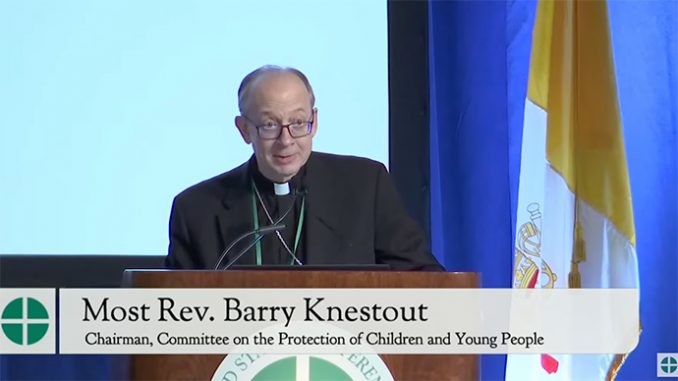
Particularly revealing are the comments made by Bishop Barry Knestout of Richmond, Virginia, on Friday, June 12. Bishop Knestout, in his capacity as chair of the bishops’ committee responsible for the revised document, was quoted as saying that when the crisis first came to light, “the bishops of 25 years ago were in the wilderness in this, without a whole lot of resources.” Bishop Knestout avers essentially that those bishops did the best they could, providing “shelter and warmth for the Church to respond to this issue, so that we [could] rebuild the trust of our people, so harmed and broken.”
These comments show a distressing lack of understanding of the long history of the Catholic Church, including its storied legal tradition, not to mention a certain vanity regarding the position of the United States. Surely it did not take The Boston Globe to inform the Church about the existence of clerical sexual misconduct, nor was the Church bereft of tools with which it could confront the problem.
Beyond that, the bishop’s comments also failed to address the litany of eminently justifiable concerns, voiced repeatedly over the last two and a half decades, over the lack of due process protections for the accused that have been made manifest time and time again, in one tragic case after another, since the Charter was first introduced.
The new document will not age well
Bishop Knestout also commented upon the way he saw U.S. priests were “navigating backlash from the abuse scandals,” saying that he thought “the clergy’s experience is still unfolding. Some are really carrying with them that experience that goes back 20 years, and some the reaction to all that unfolded in 2018. The bishops were not included in the charter up to that point; now they are through Vos Estis. But it takes time for that kind of awareness and confidence in that inclusion to unfold.”
While the bishop’s reflections here, frankly, are a bit difficult to decipher, it seems fair to conclude that he thinks priests are still smarting over the omission of the bishops from the 2002 Charter, and that their discontent will resolve itself once they realize the bishops are now “on the hook” as well, by means of a law promulgated by Pope Francis known as Vos Estis Lux Mundi.
Yet Bishop Knestout’s comments betray a certain opaqueness to the real concerns of priests—that is, the lack of due process once they stand accused, not whether or not their bishop can also be subject to arbitrary and capricious proceedings. In any event, the procedures for accused bishops are very different from those for accused priests. And the double standard is not lost on the presbyterate nor on the pool of young men who might consider the priesthood as a vocation.
The Catholic Church in the United States still has a long way to go before it recovers “the trust of our people.” It doesn’t appear that the document from Orlando will help in solving those difficulties, and in fact may compound them by pretending they aren’t there.
Years ago, many lay people complaining of real sexual misconduct—even criminal acts—were ignored by bishops in the name of protecting the institutional Church. In today’s environment, a different group of people is being ignored, again in the name of protecting the institutional Church, which is so badly scarred by the mistakes of inept governance.
Leaders cannot ignore the demands of justice and expect their people to follow (or to donate, for that matter). Neither can they paper over profound violations of the natural law and expect God to hear their prayers. The Lord is certainly merciful, but he is also just—and he cannot be fooled.
If you value the news and views Catholic World Report provides, please consider donating to support our efforts. Your contribution will help us continue to make CWR available to all readers worldwide for free, without a subscription. Thank you for your generosity!
Click here for more information on donating to CWR. Click here to sign up for our newsletter.

“”…over 80% of the nation’s priests regularly fear being falsely accused, largely because of the lack of due process they encounter the instant an allegation is made against them. Nearly the same percentage of surveyed priests suggested that their bishop would be one of the last people they would ever go to for help if they encountered a problem in their ministry. That is a particularly worrisome attitude given the close bond that is supposed to link bishops and priests in the service of the people of God.”
Clergy know that despite talking endlessly about “justice”, bishops’ execution of justice is reserved for nameless groups that they so patronizingly use for PR purposes. Priests know that bishops will always take the easy road when it’s a matter of either a bishop losing public face or a priest falsely accused. Bishops don’t hesitate to throw their priests under the bus. Why? Because bishops care more about power than Truth.
Romans 1:26-27
26 Because of this, God gave them over to shameful lusts. Even their women exchanged natural sexual relations for unnatural ones. 27 In the same way the men also abandoned natural relations with women and were inflamed with lust for one another. Men committed shameful acts with other men, and received in themselves the due penalty for their error.
1 Corinthians 6:9-11
9 Or do you not know that wrongdoers will not inherit the kingdom of God? Do not be deceived: Neither the sexually immoral nor idolaters nor adulterers nor men who have sex with men[a]
10 nor thieves nor the greedy nor drunkards nor slanderers nor swindlers will inherit the kingdom of God.
11 And that is what some of you were. But you were washed, you were sanctified, you were justified in the name of the Lord Jesus Christ and by the Spirit of our God.
“Whoever causes one of these little ones who believe in me to sin, it would be better for him to have a great millstone fastened around his neck and drowned in the depth of the sea” (Matthew 18:6).
SAINT JOHN CHRYSOSTOM
“[Certain men in church] come in gazing about at the beauty of women; others curious about the blooming youth of boys. After this, do you not marvel that [lightning] bolts are not launched [from heaven], and all these things are not plucked up from their foundations? For worthy both of thunderbolts and hell are the things that are done; but God, who is long-suffering, and of great mercy, forbears awhile his wrath, calling you to repentance and amendment” (Homilies on Matthew 3:3 [A.D. 391]).
“All of these affections [in Rom. 1:26–27] . . . were vile, but chiefly the mad lust after males; for the soul is more the sufferer in sins, and more dishonored than the body in diseases” (Homilies on Romans 4 [A.D. 391]).
“[The men] have done an insult to nature itself. And a yet more disgraceful thing than these is it, when even the women seek after these intercourses, who ought to have more shame than men” (ibid.).
Diogenes: gross generalization!
Br. Jaques: you’re just plain “gross.”
Kudos to Professor Mazza for the courage to speak the truth. “He who has ears to hear, let him hear.”(Mt 11:15)
Decades ago my cousin was accussed of sexual misconduct. I will not go into details for many reasonsl The giset is: the accusor made her charge weeks after their conversation did not go as she wanted. Two weeks later he was charged. The police officer who lead the investigation was her husband. As is well known the persons involved in any case are not supposed to be related.
Oh the fragility of man
The photo documents the brazen and unrelenting gaslighting by the “complicit bishops” of sexual disorientation.
“Excellency” Knestout is now in charge of managing sex abuse PR and Sex Abuse Charter tinkering for the USCCB. His mentor was none other than Theodore McCarrick. Knestout is accused to be an accessory after the fact, in a lawsuit by a seminarian abused by McCarrick at McCarrick’s infamous NJ beach house, and is identified as one of several st the beach house when the attack took place.
McCarrick, as prequel, was likewise tapped by the USCCB to be the crafter-in-chief of the 2002 Dallas Charter, which now passes to the “safe hands” of Knestout,
This all follows the pattern of the repulsive USCCB, which in like manner put the homosexual maniac Msgr. Burill in charge of managing sex abuse for them, before he was caught using GRNDR for his double-life of homosexual “adventures” in ecstasy.
The word LYING is apt.
CiM writes: “This all follows the pattern of the repulsive USCCB, which in like manner put the homosexual maniac Msgr. Burill in charge of managing sex abuse for them, before he was caught using GRNDR for his double-life of homosexual “adventures” in ecstasy.
The word LYING is apt.”
Has anyone discovered what the “Grindr Monseignor” is currently up to? Has he been tapped for synoidal participation in Rome with the rest of the New Age Catholics? One thing for certain, homosexual abuse of minors does not seem epidemic among SSPX priests!
“homosexual abuse of minors does not seem epidemic among SSPX priests!”
Pride goeth before every fall.
I don’t know the numbers but it’s certainly been a problem in the SSPX, too. It’s not something unique to any particular group of Catholic clergy.
Some people choose to work with minors for all the wrong reasons.
I frankly haven’t heard of lawsuits brought against. Maybe you know the stats on this and I don’t.
No, I don’t know the data but I do know an SSPX family who was affected by that. There have also been articles in secular & catholic media about *alleged* SSPX troubles in the past.
In some faith communities it’s still less likely for these things to be reported to law enforcement for fear of the damage it can do to a church’s reputation. And victims may be less likely to cooperate. It probably was a similar situation everywhere in the past.
Having respect for authority & our clergy should be a good thing but it can also backfire occasionally.
Data precedes every statistical inference.
Your response was not a refutation of the Deacon’s contention. If you have evidence to contrary, provide it. Otherwise..
You can’t know that which you don’t or haven’t tried to know. His contention is not based on facts of any sort. Refutation of a baseless claim does not require anything other than pointing out it is baseless. Your rhetoric teachers did not serve you well.
Mr. Gerard, I don’t believe there’s an *epidemic* of that behavior for any sort of Catholic clergy. It affects a very small percentage. But looking online, you can find convictions for the SSPX just as you can find that for other members of the clergy. The SSPX has far fewer members so there will be fewer instances.
Again, it’s not something unique to any religious community. It’s about fallen human nature & sin.
Gerard, your kindergarten teachers didn’t serve you well.
He claimed albeit obliquely that there are relatively fewer abuse claims against SSPX priests “does not seem epidemic”.
Not only did your (inapplicable, the Deacon isn’t SSPX) caution about pride not assert any baselessness about his claim, you made a claim of intentional ignorance “You can’t know that which you don’t or haven’t tried to know.” How do you know what efforts he made. You don’t only don’t know the nature and extent of any efforts he made ion this regard, you CAN’T know it. Project much?
Wikipedia, the reliably leftist shill has a lengthy page “Controversies surrounding the Society of Saint Pius X. They take great pains to include the claims of the corrupt SPLC, among other things. What they do not claim is any, let alone an “epidemic” of homosexual abuse, which says a great deal about their relative infrequency. If they were common, let alone “epidemic” the claims would be listed.
“Do you hear yourself, when you talk?”
-Owen Grady
You mean no one should be grateful for not having submitted to depravity?
Gerard: I also haven’t heard of any homosexual predation claims against bishops in the Orthodox Church – all of whom are celibate if I’m correct.
I think there was a case of an Romanian Orthodox bishop convicted of that recently.
Sin & human brokenness can vary per faith community & look a little different accordingly.
He’s “born again” in Wisconsin:
https://www.ncregister.com/news/questions-abound-in-the-wake-of-msgr-burrill-s-return-to-active-ministry
OK, we’re all thinking it…
Wow! Thanks for the link. BTW: Didn’t same bishop who re-hired this pedi-preacher fire a
well known orthodox priest or two?
Chris, while I applaud Mr. Mazza for rightly pointing out the serious problem of the lack of due process for accused priests, I also understand the emphasis of your comments.
We all unfortunately have become inured to the continuing scandal of Diocesan bankruptcies, the root cause of which was tha admission to seminaries and later ordination—sometimes unknowingly but other times fully understood—of men committed to a gay lifestyle.
Tragically, notwithstanding this truth, there are those in the Church like Cardinal Hollerich, Fr. Martin, the German synodalers, et al. who want to make gay OK as a matter of Church doctrine for all including, one suspects, the clergy.
I believe the right long term solution is the Church’s laicization, whether voluntarily or involuntarily, of all clerics who are practicing homosexuals. Doing so would hopefully diminish the problem of wrongly and unfairly accused priests who don’t receive due process from their bishops.
It’s always been a lot worse than “sometimes unwillingly.” In the seventies a number of seminaries actually advertized for applicants in porn magazines. The spirit of VII and the “springtime of the Church.”
“Leaders cannot ignore the demands of justice and expect their people to follow (or to donate, for that matter).”
I stopped donating to the diocesan appeal years ago when I got tired of the hundreds of millions of dollars being paid in sealed out-of-court settlements that provide absolutely no accountability to the faithful who donate their hard-earned money. As sickening as sex abuse is, there has to be some level of accountability for all that money to be paid out. Who knows how much is being paid to legitimate victims and how much is being paid to flim-flam artists? How do we know that all these sealed settlements aren’t just a more sophisticated form of embezzlement or just outright extortion? In a related vein, after Cardinal Dolan retired, Archbishop Hicks has apparently (and quietly) pivoted from trying to get Chubb to pay the archdiocese’s claims to imposing levies on all the parishes of the archdiocese. Maybe Chubb isn’t just being a cheap insurance company– perhaps its adjusters have legitimate doubts about whether the claims are justified. But how can we know when everything is secret, no public evidence is offered, and priests can’t expect a fair canonical trial much less a fair civil trial?
Like Dr. Mazza, I am not the least bit relieved or encouraged about the USCCB’s recent actions. In the current environment, the fact that we have any ordinations at all is a minor miracle. Maybe priests should form a union; if bishops want to treat them worse than employees of a big company, they may as well act like mere employees instead of valued sons.
It really is time to evaluate the utility of the national episcopal conferences; they have matured (degenerated) into a echo chamber and a bureaucracy.
“The behavior of any bureaucratic organization can best be understood by assuming that it is controlled by a secret cabal of its enemies.”
― Robert Conquest
Errata:
into echo chambers and bureaucracies.
Lowest common denominator group think is the first refuge of men refusing to accept the reality of their sins.
Dr. Mazza says: “The odious public relations technique of publishing names of men merely accused (even those who are dead) is still used in well over half of the nation’s dioceses, despite repeated Vatican statements criticizing it as a violation of the fundamental human right to reputation required under natural law and the law of the Church (cf. canon 220).”
Since Dallas, this and other injustices done to priests and deacons (but not bishops!) merely accused have frequently been dismissed as a distraction from the greater evil of the harm done to the victims. Nearly a quarter century later, the unjust treatment of “credibly accused” clergy is finally getting the attention it deserves beyond canon law circles. See my roundup of articles here:
https://frthomaskocik.substack.com/p/two-wrongs-dont-make-a-right-denying
The treatment (guilty, until proven innocent) follows the secular method of handling sexual harassment complaints.
Although I’m not a priest, I experienced how such a process could be misused.
It’s not, by any stretch of the imagination fair. Referring to something as a credible accusation only creates a popular notion of “caught red handed”.
Perhaps the much bigger mistake is to dismiss sacred tradition for the novelties of the moment. The Orthodox Church – rooted as it is in sacred tradition – is growing for precisely that reason and principally by younger generations, the very type of young people that the Pope uses “6-7” or enters an arena to the music of “Queen” or promotes ridiculous comic characters like “Luce” in an effort to attract. Perhaps, they should take seriously the words of St. Paul about the relative success of his ministry: “I preach Christ. I preach Christ crucified”. No greater embodiment of that single act of redemption than the Mass of the Ages; the Mass of ALL Times.
I thank Michael Mazza for employing his expertise in yet another brave and insightful analysis of the U.S. bishops latest foible related to the Dallas Charter. Dr. Mazza writes in the spirit of the late Father Richard John Neuhaus, who characterized the Charter thusly in the pages of First Things:
“Zero tolerance, one strike and you’re out, boot them out of ministry. Of course the victim activists are not satisfied and, sadly, may never be satisfied. The bishops have succeeded in scandalizing the faithful anew by adopting a thoroughly unbiblical, untraditional, and un-Catholic approach to sin and grace.… They ended up adopting a policy that was sans repentance, sans conversion, sans forbearance, sans prudential judgment, sans forgiveness, sans almost everything one might have hoped for from the bishops of the Church of Jesus Christ.”
— Richard John Neuhaus, “Scandal Time”, 2008, First Things
Are you the Father McRae who was the subject of a column in the Wall Street Journal by Dorothy Rabinowitz in 2013?
There is only one Father Gordon MacRae. Dorothy Rabinowitz first wrote about him in 2005. You can find her articles and other WSJ articles about him at https://beyondthesestonewalls.com/wsj
I understand that. I’m wondering if the poster is him, or somebody appropriating his name as a pseudonymic honorarium bring light to that travesty.
Notice the hierarchs of the CC soft treatment of active gay priests compared to a priest who points out that supporting the killing of millions of unborn and even born babies will stop Democrats from entering heaven:
“Questions Abound in the Wake of Msgr. Burrill’s Return to Active Ministry
In appointing him to a parish, Bishop William Callahan of La Crosse, Wisconsin, disclosed little about the priest’s alleged use of the Grindr ‘hook-up’ app, what treatment he might have received or what safeguards have been put into place.
However, although he said in a brief statement published on the parish website that Msgr. Burrill had most recently served the U.S. Conference of Catholic Bishops in Washington, HE DID NOT MENTION THE PRIEST’S RESIGNATION LAST JULY AS GENERAL SECRETARY IMMEDIATELY PRECEDING AN INVESTIGATIVE REPORT IN THE PILLAR. ACCORDING TO THAT REPORT, MSGR. BURRILL ALLEGEDLY HAD ENGAGED IN INAPPROPRIATE BEHAVIOR AND FREQUENT USE OF GRINDR, WHICH DESCRIBES ITSELF AS “THE WORLD’S LARGEST SOCIAL-NETWORKING APP FOR GAY, BI, TRANS AND QUEER PEOPLE.”
Non-parishioner Monica Mohan responded to the diocese’s post with a link to an article about the appointment from LIFESITENEWS, WHICH CONTRASTED BISHOP CALLAHAN’S SUPPORT FOR MSGR. BURRILL WITH HIS CENSURE OF FATHER JAMES ALTMAN, ANOTHER PRIEST OF THE DIOCESE. BISHOP CALLAHAN REMOVED FATHER ALTMAN AS PASTOR OF ST. JAMES THE LESS PARISH AND REMOVED HIS PRIESTLY FACULTIES LAST JULY.
ALTMAN CAME TO WIDESPREAD ATTENTION FOR HIS TEN-MINUTE AUGUST 2020 VIDEO, VIEWED MORE THAN 1.2 MILLION TIMES ON YOUTUBE. THE PRIEST CRITICIZED DEMOCRATIC PARTY SUPPORTERS, SAYING “THERE WILL BE 60 MILLION ABORTED BABIES STANDING AT THE GATES OF HEAVEN BARRING YOUR DEMOCRAT ENTRANCE.”
https://www.ncregister.com/news/questions-abound-in-the-wake-of-msgr-burrill-s-return-to-active-ministry
https://www.ewtnnews.com/world/us/la-crosse-bishop-removes-father-altman-from-ministry?redirectedfrom=cna
Dr. Mazza deserves the best respect and consideration for his undeniable courage….
May the Lord bless Dr. Mazza… we need a couple of men like him…
My deepest gratitude…!!!
Fr. Luis Corneli
In the US states I’m familiar with there’s no statute of limitation for felonies. We had a serial pedophile in a former parish prosecuted and convicted for crimes against children going back at least 20 years.
The parish and diocese may have fallen down on the job but law enforcement did not.
Well, law enforcement did fail in the beginning but a new sheriff and prosecutor changed all that.
The offender died behind bars so it turned out to be a life sentence.
These things have to immediately be turned over to the police. If that had been the policy in dioceses years ago we wouldn’t be where we are today.
Too many times in the past, law enforcement also covered up for the evildoers in the Church.
Please cite when and where.
In the case I was relating that was a problem in the beginning. The prosecuting attorney was a friend of the offender. After he was replaced the investigation went into full gear.
Thankfully these crimes are taken more seriously today.
That is the truth.
1000% agreement. If anyone assaults you, you go to the legal authority, not any other institution.
Yes, thank you, Gerard. I think NCR readers would all agree about that.
In Pennsylvania, the SoL as defined in PA Code Title 42: Only murder and felonies committed related to murder are immune to limitations on time.
Here’s one summary:
No time limit for murder offenses, felonies connected with a murder, voluntary manslaughter, vehicular homicide, or aggravated assault when the suspect knows the victim is law enforcement
12 years for rape, incest, or sexual abuse of children
Eight years for offenses committed by public employees or anytime during their employment
Five years for aggravated assault, arson, kidnapping, burglary, prostitution, intimidating a witness or victim, perjury, terrorist threats, forgery, or insurance fraud
Two years for unspecified felonies.
In the state where the I related crimes were committed there was no statute of limitations for felony sexual crimes against children. Sounds like a good idea to me. Maybe PA can work on their laws, too.
Post Script, I failed to mention, James Paul Forte is in Calvary Cemetary, Drums PA.
And if the passage of time means lost or distorted memories? Or a witness who could provide exonerating or exculpatory testimony is dead or in an Alzheimer’s care unit?
The minute a crime is committed, the potential to apprehend, prosecute and convict the prosecutors begins to erode.
Well thankfully that wasn’t the case. There was plenty of corroborating testimony from the victims, families and parishoners. Photos confirming times and places, etc.
Praise God that serial predator was removed from society and any further harm to children prevented. But it took at least 2 decades to do that.
There is only one Father Gordon MacRae. Dorothy Rabinowitz first wrote about him in 2005. You can find her articles and other WSJ articles about him at https://beyondthesestonewalls.com/wsj
In fifty words or less, can anyone describe the required qualifications and the selection process for Catholic bishops.
Enquiring minds want to know.
I almost spit up my coffee when I read that Bishop Barry Knestout of Richmond, Virginia, is now the chair of the U.S. bishops’ Committee on the Protection of Children and Young People. Knestout previously served as priest-secretary to Cardinal Theodore McCarrick. His “heavy-handed” handling of Father Mark White, an outspoken Virginia parish priest in his diocese who was critical of the Church hierarchy’s handling of the abuse crisis and the culture that allowed McCarrick’s actions, also calls into question Knestout’s loyalties and priorities. Now, I certainly can’t prove anything, but when you serve as priest-secretary, you have a very close relationship with your “boss.” I would hate to find out what Knestout knew, yet did nothing about during the sordid times of Cardinal McCarrick and the sexual abuses which occurred under him. His actions concerning Father White certainly do not bode well. I have no confidence that Knestout will identify and root-out any sexual abuse issues still ongoing in our Church.
Patrick McGinn: my guess is that no less than 1,000 bishops and priests knew about McCarrick’s homosexual predations. That’s simply how the Church operates- a rumor mill like none other and a wall of silence that would put the Iron Wall to shame.
Correction: I meant the Iron CURTAIN but was also thinking of the Great Blue Wall of silence anong police officers in NYC my hometown..!
“It’s a big club, and you’re not in it”
-George Carlin
I know a priest who was accused of “inappropriate behavior” with a lay person (not accused of sexual abuse). This occurred 9 years ago. He was removed from public ministry and is still waiting for a formal ruling on his initial appeal. The scuttlebutt is that his Order is afraid that lawsuits will bankrupt them. The Order has had few vocations in the past 3O years.
The quality of bishops says it all, the likes of cupich, Tobin and McElroy ( the ecclesial version of Curley Larry and Mo) speaks volumes! That 8 refused to back the consecration and 7 abstained too says it all!! When are we to get good and HOLY men,???
The Stooges made people forget their troubles for a few minutes. Don’t compare them.
Nyuk, Nyuk, Hyuk.
I do apologise! They did bring fun and hilarity, in very dark times; sadly,their three ecclesial alter egos just bring dark times!