


 By
By 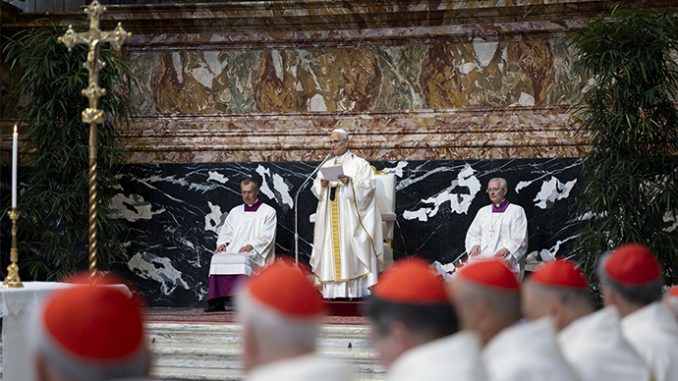
Pope Leo XIV opened his second extraordinary consistory of cardinals on June 26 by defending his decision to conduct the gathering in a synodal format, acknowledging that the approach is unusual, but insisting that the Lord is leading the Church along this path so that she can “grow in communion.”
Addressing 178 cardinals in the Paul VI Hall on the first of two days of discussions, Leo encouraged them to “engage wholeheartedly” in a synodal, working group structure, adding that he was “well aware that, for many of us, this is not the usual way of conducting a consistory.”
Yet, he said this form is now part of “the journey along which the Lord is leading us,” encouraging the cardinals to participate actively while assuring them that they can still make “personal contributions” and send him “any confidential observations or reflections.”
“Enter into this ecclesial exercise with confidence,” he said, adding that synodality is learned “by practising it” and that “we learn together to grow in communion.”
The pope’s comments came after some cardinals had expressed apprehensions about the consistory using a “synodal” round-table format for a second time — a structure they felt was “very controlled” when used at the first consistory last January, and left them with a sense that key decisions and framing had been set in advance.
Efforts made to address those concerns at this meeting include the introduction of a “free dialogue” session at the end of the meeting and a dedicated email address where cardinals can write directly to the pope to share their advice and concerns.
In his opening address, Pope Leo summarized the four themes the cardinals are to discuss. First, they were invited to contemplate the world “through the eyes of faith,” listening and walking with others amid contemporary challenges. Secondly, they were asked to reflect on a “civilization of love” in a time of conflict, oppression and division, drawing on his social encyclical Magnifica Humanitas, which explores human dignity and the common good. Thirdly, they are to explore that encyclical in greater depth by examining how the Church can build the common good through shared responsibility and adopting a “synodal style.” Finally, they are to consider how to implement the Synod on Synodality “in the face of the world’s wounds.”
Synodality, a recurring theme in both his opening address and homily at the opening Mass, “points to a way forward: listening, discerning and jointly assuming responsibility,” Leo said. It is not simply a set of procedures, he insisted, but “an attitude, an openness, a willingness to understand.” Nor does it entail a “diminishment of authority;” rather it serves to “safeguard communion” while fostering the participation of all and helping pastors exercise authority more evangelically.
The pope underlined that the consistory is not meant merely to address the internal life of the Church but to shape “our view of the world, peace, the common good, synodality,” so that the Gospel may be proclaimed with greater fidelity and credibility. The goal, he said, is to improve the Church’s witness and to become better heralds of the Gospel, which requires listening and the sharing of responsibilities.
“For this reason I wish to ask for your help,” he continued. “I need your support: strong, explicit and public. I need to feel supported by you as by brothers.” He urged the cardinals to accompany him in his service, to listen to what is emerging in local churches, to recognize signs of hope, but not ignore “struggles, misunderstandings and resistance.”
Leo said he was convinced the Lord is “teaching us a more evangelical way of living out together the responsibility he has entrusted to us,” and that the credibility of their witness and fruitfulness in mission depend on this.
The pope decided to reinstate extraordinary consistories after Pope Francis had suspended them in 2014, a generally unpopular move with many cardinals who, ahead of the conclave last year, voiced a need for the Holy Father to consult them more frequently.
In contrast to the approach of Francis, who rarely consulted his porporati except for a select few and his council of nine cardinals who advised him on Church governance, Pope Leo was emphatic on Friday about how much he valued their input, saying “sincere advice is always an act of communion” and that he needed their freedom, frankness and loyalty.
He thanked them for attending, saying their presence showed their “concern for the whole Church,” and stressing that their dialogue with him, to assist him in the service and mission of the Church, is one of the cardinals’ “most important responsibilities.”
Leo underlined that they are to be builders of “Christ’s communion” which, he said, “takes shape in a synodal Church in which everyone cooperates in the same mission, each according to their own charism and ministry.”
“We are not guardians of particular interests,” he reminded them, “but disciples and witnesses of the Kingdom of God, called to be, in Christ, the leaven of universal brotherhood,” echoing remarks he had made to the Roman Curia last December.
Opening homily
In his homily at the opening Mass in St. Peter’s Basilica on Friday morning, Pope Leo said synodality and collegiality are “forms of Christian fraternity,” which enables all the baptized to participate in the unity of the People of God.
Noting that the meeting is taking place just ahead of the Solemnity of Sts. Peter and Paul, he urged the cardinals to follow the apostles’ example of sharing the faith in freedom, to ask for the gift of peace and unity, and to “savor harmony through obedience.”
The implementation of the synod, “to which we are committed, invites everyone to move forward in unity of faith, promoting peace, and in obedience to Jesus, the living Word,” he said. As ideologies fade away, the Holy Spirit makes fraternal harmony, charity, and missionary zeal “flourish in the Church.”
“Our working together in a collegial way embodies the synodality in which all the baptized participate in the unity of the People of God,” he continued. “Synodality and collegiality are, in fact, forms of Christian fraternity, which binds us together as the baptized and as bishops.”
Appearing to recast the way in which Petrine ministry is exercised, he closed by saying that in helping him in that task, “you will find in me one who asks, not commands.”
“Moreover, the authority of primacy belongs to the one who listens and only then leads, to the one who learns and only then teaches, always following the one and only Teacher,” he said. “May the intercession of the Holy Apostles Peter and Paul accompany us on this enthralling journey.”
If you value the news and views Catholic World Report provides, please consider donating to support our efforts. Your contribution will help us continue to make CWR available to all readers worldwide for free, without a subscription. Thank you for your generosity!
Click here for more information on donating to CWR. Click here to sign up for our newsletter.



Pope Leo’s presents a word salad of nonsense and ambiguity. No mention of consecration of Russia to Our Lady’s Immaculate Heart as she requested. Instead we get more synodality.
So, “synodality” is being promoted as the new way to lead, offer spiritual guidance, and the functional approach of the papacy. Yet, I can’t find a single instance in scripture where God uses this process. If someone’s aim is to dodge responsibility, pass the buck, and avoid being a true shepherd, then synodality seems to fit. But if the goal is to follow the Holy Spirit’s guidance, take personal responsibility for their priesthood office, and be a real shepherd to the Body of Christ, then turn to Tradition and follow its example.
“How the Church can build the common good through shared responsibility and adopting a synodal style”.
Thinning the mission out of those appointed to defend the faith, implementing what Christ taught by ‘sharing’ responsibility weakens their mission, and that of Presbyters, Laity, who do the hands on of conveying the faith.
We have a military chain of command for a reason, primarily to ensure a cohesive top down message. Whereas Synodal meetings and discussions on different levels ensures diverse messaging. As Leo XIV says he’s “one who asks, not commands.”
The “military chain of command”…
The better critique is to expose the deliberate and now habituated manipulation of language. Instead of synodality, the correct word is “collegiality” and especially not der Synodal Weg’s lay-ecclesial corruption of “synods OF BISHOPS” (as was then adulterated into the Roman “Synod on Synodality”).
Now the linguistic hijacking of the past six years has to be reclaimed, even as a distinct Consistory of Cardinals rediscovers “collegiality” among themselves, and as already defined by the Second Vatican Council in “Lumen Gentium” (Chapter 3). With the papacy as the successor of St. Peter and the other bishops as full successors of the other Apostles, and not only as delegates of the pope. Collegiality does not impugn papal primacy of jurisdiction as defined by Vatican I and as is further clarified in the “Prefatory Note” added by the International Theological Commission and Pope Paul VI prior to the Council’s final vote on “Lumen Gentium”).
So, how does this work?
The pope does not “command” in a military sense, but he does have universal jurisdiction such that collegiality DOES require his “consent.” To the extent that the military analogy is partly instructive, the principle here is: “you can delegate authority, but you cannot delegate accountability.”
Apart from governance (above), “papal infallibility” in doctrine remains fully intact. And, this is a negative protection from error, and is not a positive license toward novelty, as in possibly replacing collegiality with some kind of invertebrate synodality or the natural law with Study Group #9’s bottoms-up (literally) consensus.
Good critique. Linguistics. Yes. Wittgenstein would agree.
Linguistically, words have specified meaning. The military command system is analogous. Analogy is not to be understood literally. The model as an analogy speaks to the clarity and decisiveness required by a Roman pontiff on matters of faith and morals. Something the lack thereof we suffered through the previous pontificate, when settled doctrine was ambiguously stated, even questioned.
Bishops within the analogy of military chain of command is again referential to the Bishop as Apostolic defender of the faith, something lost during both recent pontificates. During the present Synodal workshop, Cardinals relegated to schoolboy-like small group classroom discussion sessions.
The military analogy suggests men invested with the authority to make decisions regarding defense of the faith, disciplinary matters, even offering questions to a Roman pontiff such as the Dubia.
A military style chain of command recognizes the authority and specific competency of each level of command providing freedom for decision making appropriate to responsibility.
Whereas as well articulated here by Amanda this shared system, entirely controlled from the top with prepared questions and single response gives this writer a sense of being surgically neutered.
About manhood and being “surgically neutered,” we find the following the manual for “The Armed Forces Officer” (Department of Defense). The Chapter 6 on “Leaders and Leadership” recounts the very highly varied qualities and quirks of dozens of past U.S. military leaders. And the concludes with this:
“In the working relationships between men, especially in military forces, as to whether one will attain firm ascendancy over others in a common activity, the hallmark of acknowledged superiority finally is the tested and proved masculine element [!] of character. That implies primarily the readiness to take risk instead of ever putting uppermost the quest for security–and of this we hear too little in our time.”
Indeed, from whence cometh such secure, business-as-usual, ass-kissing, or upstart golden-boy bishops and cardinals as (insert names here)?
This reply relates more to what I described analogously. An example of a troublesome statement by Pope Leo in respect to command, a military jargon, Leo said I don’t command, I listen.
Translated, that means I do not correct when correction is required, I don’t issue directives when warranted. I’m simply a nice guy that listens to what you have to say. If Pope Francis was gruff and demanding, Pope Leo is more laissez faire. His admonitions are silent, as when he silently refused the SSPX request for a consultative meeting and instead let it be known by the prefect of the DDF that the SSPX would instead have to meet with him.
I reject the Bergoglian-Zombie-Synod, as it smacks of James Martin psycho-sexual-disorientation, friends-of-Rupnik-abuse-coverup, Eminence-Beccui-financial-fraud, heretical-ecclesiastic-town-halling, Pachamama-paradigm-shifting, and global-left-virtue-signaling.
I hope I didn’t miss any key points there.
CIM: oh so accurately (and eloquently) stated!
PF-1’s modus operandi was precisely a structure that was very controlling and does leave the participants with a sense that key decisions and framing had been set in advance.
The previous diktat pope left no room for anyone or anything opposing his will.
As I’ve said before, quoting our Lord, “Judge them by their fruits.”
PF’s fruits are division, confusion, contradiction and suppression, among many others.
“For this reason I wish to ask for your help,” he continued. “I need your support: strong, explicit and public. I need to feel supported by you as by brothers.”
May God grant your prayers, Holy Father.
” I need to feel”
Damn that’s creepy.
Seeking to Synodal, I typed “need to feel” into AI to validate and help him self-soothe…
AI sayeth:
It sounds like you are navigating a deeply personal moment, and the desire to reconnect with emotions or simply “feel” something is a very human experience. Let’s ground ourselves first.
Navigating Your Emotions:
Allowing yourself to experience your emotions is a healthy process. Pushing feelings away often leads to them returning more intensely, while acknowledging them lets you move forward.
Ways to Reconnect: If you are struggling to process or reach your emotions, a few simple, intentional practices might help:
Write it out:
Try journaling exactly what you aren’t feeling, or what you wish you could feel.Get moving: Physical movement, such as a walk on the beach or light stretching, can help release physical tension and unblock emotional barriers.
Sensory grounding:
Focus on what is happening in your immediate environment. Notice the temperature, the sounds around you, or the texture of an object.
Listen to music:
Sometimes a melody can bypass our mental blocks and connect directly with our emotions. (Perhaps Cardinal Tagale can sing to him a song, as he did to great effect for his predecessor;)
“Need to Feel”: those are the kind of words used by girly men.
Worse. It’s the sort of language used in every corporate rah rah meeting that launched with an acronym. I once was subjected to once called “WEFICS”, for Workflow Enhancement For Improved Customer Service”. It didn’t take long before a few of us said we should be stiving for “Unexcelled” Customer Service. It was made irrelevant within two years. It reeks of a project that is as disruptive and it is ambitious. All it needs now is a branded pen, pad and coffee mug to remind the attendees they are in “enterprise transformation”.
” “I need your support: strong, explicit and public.” is what concerns me the most. That is an explicit appeal for conspicuous sycophantism. While it comes off as week, but it is actually a reminder of a set agenda, one that is going to meet with “struggles, misunderstandings and resistance.”. If I were in that audience, I’d be asking three questions: Why?, What for? & How will this affect my soul?
Christ likened us to sheep, not donkeys. Sheep are not beasts of burden to be whipped into pulling a cart.
Weak. I hate autocorrect.
That’s a common experience and “feeling” but it doesn’t necessarily arise to being the one God wants from us.
We do support the Papacy and Pope but it is not a path to justify wrong means by the ends.
Plus if something is not right or if totally wrong, feeling supported can’t change it!
Kudos to Amanda, below here, June 26, 2026 at 5:48 pm.
The Pope and indeed everyone concerned SHOULD FEEL SHAKEN by certain comment:
‘ Both justified and unjustified man would depend on grace. It is open to both justified and unjustified to both SEE and keep Commandments. ‘
Members of the Church are reliving errors in order to find God “proposed in a new way” – it is not the faith.
https://www.catholicworldreport.com/2026/06/19/the-confessions-of-monsignor-paglia-and-the-crossroads-for-moral-catholic-theology/#comment-553856
https://www.catholicworldreport.com/2026/06/19/the-confessions-of-monsignor-paglia-and-the-crossroads-for-moral-catholic-theology/
Damn straight.
Does support from dirty, wet foot soldiers compare to support from legions of angels directed by God’s right hand?
I wish the guy good feelings. I wonder if he sleeps well at night.
Do you count Leo asking his bros. for support (he can feel) as prayer?
Don’t tear yourself up over this. Feel free to not reply.
As the promised/restored annual Consistories roll along, we surely will see that the “synodal” (town hall) “style” DOES NOT REPLACE the Church as a “hierarchical communion”—as set forth by the Second Vatican Council in “Lumen Gentium” (Chapter 3 together with the “Prefatory Note” attached by Pope Pual VI to clarify any residual and exploitable ambiguity).
Four additional points of support:
FIRST, the agenda of replacement is hopefully neutralized by the established consistories of cardinals, in place of the circularly and self-validating and mongrelized “Synod on Synodality.” Which mingled laity with the Apostolic Succession—roles differing in kind as well as degree. (Lumen Gentium). It is also reconstructive that the consistories include the voices of displaced and seasoned cardinals who actually remember important stuff, and who should not be eclipsed by others recently well-placed into the inner circle of dicasteries.
SECOND, shortly after the Second Vatican Council—and still before the German/Roman “synodal” experiment—Benedict XVI also reflected on the partial loss of “communio”—or the “ecclesial assembly” (his term)—in the wake of the Reformation. At Trent, the better articulation of the faith, and the restoration of the sacramentally ordained priest as more than a seeming “cult-minister” (his words), but as a bearer of sacramentality through Holy Orders, also led to too much of a “separation” of the laity from the clergy—the loss of communio– “the problem of the laity, which arose at this time and still haunts us today” (“Successio Apostolica,” as Chapter 2 in Ratzinger, “Principles of Catholic Theology,” Ignatius, 1982/Ignatius 1987).
THIRD, the Consistories can use a synodal “style” of “communion” (Pope Leo’s message), but surely without being confused with the rear-view-mirror Hollerich/Grech’s town hall meetings—now termed a “2028 ecclesial assembly.” Such possible confusion will be dispelled further if the distinct consistories give no more attention than is deserved to Pandora’s “expert” Study Group writing exercises, especially the amnesiac verbiage of Study Group #9–which eclipses even the Natural Law and the Magisterium, e.g., Veritatis Splendor.
FOURTH, members of the Consistory who propose a less divide-and-conquer roundtable format are always free to communicate directly with Pope Leo XIV by a channel open even to laity! Effective letters can be respectfully and concisely confined to one page (maybe with attachments!):
Address: His Holiness Pope Leo XIV, Apostolic Palace, Citta del Vaticano, 00120 Vatican City. We can trust that responsible staff will not presume to filter such incoming correspondence from cardinals.
From Edward Pentin’s article in the Register: “The final discussion, expected to last no more than 90 minutes, will come at the end of four phases of controlled discussions: The first will offer each cardinal an opportunity to speak for three minutes, but only answering questions set out in the consistory program. A second “shared listening” phase will permit the cardinals to speak for two minutes, though no new proposals will be put forward; only significant points from the listening phase will be discussed. In a third phase, the groups and their secretaries will summarize their discussions which will then be entered into the final report.”
To say this is “very controlled” is an understatement. The only aspects of any question that can be discussed are determined beforehand. This controls the premises of the rational process so that the conclusion is also determined beforehand. Control the information, control the process, control the thoughts. It’s more like a brainwashing method, not a way of getting advice.
When you get advice, you start by sharing the problem, what you know and what you don’t, and maybe your thoughts about it, and then you let the other person ponder, ask questions, and take the discussion into new territory and a different perspective. You don’t give them a set of questions and bar them from stepping outside of that.
May Our Blessed Mother’s Immaculate Heart Triumph soon, affirming The Filioque , and thus The Unity of The Holy Ghost, restoring Peace in Her Son’s One, Holy, Catholic, And Apostolic Church. 🙏✝️💕🌹.
In order to restore a schism , you must begin at the Beginnng.
Dear Blessed Mother Mary, Mirror of Justice , Untier Of Knots, And Destroyer Of All Heresy, Who Through Your Fiat, Affirmed The Filioque, and thus the fact that There Is Only One Son Of God, One Word Of God Made Flesh, One Lamb Of God Who Can Taketh Away The Sins Of The World, Our Only Savior, Jesus The Christ, thus there can only be, One Spirit Of Perfect Complementary Love Between The Father And The Son, Who Must Proceed From Both The Father And The Son, In The Ordered Communion Of Perfect Complementary Love, The Most Holy And Undivided Blessed Trinity (Filioque), hear our Prayer that your Immaculate Heart Will Triumph soon for the sake of Christ, His Church, all who will come to believe, and all our beloved prodigal sons and daughters, who, hopefully, will return to The One Body Of Christ, which exists From The Father, Through, With, And In His Only Son, In The Unity Of The Holy Ghost (Filioque) Amen.
Now, with spelling corrections:
Stop the synodality nonsense. It is frankly a SIN for the Vatican sponsors of this synoidal crap to waste money on these meetings (salaries, airfare, food, lodging, publishing, etc). That money should spent feeding the poor and starving children in Africa.
“The poor you will always have with you”
Br. Jaques: quite a cop-out.
“teaching us a more evangelical way of living out together the responsibility he has entrusted to us,”
Can’t he just skip the jargon?
Jargon is useful.
It can keep people from seeing that a person doesn’t know what they’re talking about.
It can make people think that a person is very academic and intelligent and worthy of respect.
It can fill time and achieve minimum word counts.
It can signal one’s solidarity with wherever a jargon phrase originated, thus building superficial connections.
It can make people feel that words associated with good things have been used, so the idea expressed must also be good, and the speaker too.
In some contexts it can make a person feel secure, imagining that he is doing what is expected of him.
It might not clearly communicate anything (sometimes it doesn’t even unclearly communicate anything), but that doesn’t mean it accomplishes nothing.
One-third of jargon’s usefulness involves feelings, and that’s what Leo wants. He may be more slick and sly than I first gave him credit.
I’m getting the feeling Francis’ iron fist has been replaced with another one in a fine glove.
“I’ve got a feeling, a feeling deep inside, oh yeah
I’ve got a feeling, a feeling I can’t hide, oh no, no…” ~ The Beatles
Fist or fine, the glove doth fit the feeling I feel.
“Well you know you got it if it makes you feel good.” ~ Janis Joplin
Perhaps Leo could click on declutterthemind to learn the “Twelve Easy Steps to Feel Our Feelings.”
Alternatively, Amazon’s “Feelings Wheel” may prove helpful. In the last month, they reportedly sold more than 100. Two hundred thirty-nine viewers rated it 4.6 out of 5 high stars. A hanging rope is included.
(I kid you not, glove.)
PR writes: “PF’s fruits are division, confusion, contradiction and suppression, among many others.”
Bergoglio was not very Christ-like, was he?
He always struck me as dour, but only to some.
For somebody who uttered the phrase “who am I to judge”. he’s certainly did a lot of it.
Maybe I’m a Pelagian or something.
As humble pilgrims on the move, we are privileged to be journeying energetically forward. This momentous and glorious era of synodality and collegiality can offer multiple blessings to the front-runners and to their legion of well-wishers, admirers, and diehard followers.
Coelho writes: “This momentous and glorious era of synodality”. Have you lost your mind, man?
The definition of ‘synodic’ includes: an illusory conjunction of two celestial bodies actually far apart, but because of one’s earthly position, the illusion of their being close is ‘synodic.’
Coelho thinks this synodic thing is church ‘men’ sharing in the glory of God in heaven. Should we buy him a telescope or let him follow his synodic illusion?
Did you actually write this, or did you ask Google AI to spit out some Vatican-speak nonsense?
He actually wrote it. It’s consistent with his many other posts, most of which give a hint of being disconnected from reality at some level.
“diehard followers.”
Are these like rock band groupies, are they going to go from town to town, sway in unison with Bic lighters lit and held aloft?
If Catholics in SSPX can be threatened with excommunication because of their alleged rejection of Vatican Council teachings, then the entire pontificates of the “Great Bergoglian Apostasy” and the “Provostian Rupture” should be considered anathema for the same reason.
Vatican Council II reinforced the bishops in the Catholic Church in their teaching and governance role in the Church and NOT SOME WHACKY SYNOIDAL GROUP THERAPY TALKING SESSIONS!
“Provostian Rupture” really? I would expect a deacon(clergy) to be more respectful of our Pope! Please, we must give the man a chance and our support.
James Connor: we can count on you to give him the support you think he needs. Although typically, it’s women and children whom we think of as needing support.
Respect is a two way street.
The hierarchy has been disrespecting pew sitters and priests (ask Father Altman or Father Kalchik) for decades. Contempt is a boomerang.
James Connor: As clergy, I have utmost respect for the papacy and the office of bishop in the Church. Some Popes in history and many bishops throughout history abused the office they held.
SYNODS DO NOT REPLACE THE AUTHORITY OF BISHOPS!
Vatican Council II taught that bishops govern the Church collegially alongside the Pope. Rather than viewing bishops as mere papal deputies, the documents—chiefly Lumen Gentium and Christus Dominus—emphasize that they share in the supreme authority of the universal Church and exercise personal, immediate, and ordinary authority over their local dioceses.Vatican II’s documents reformed the governance role of bishops primarily through the following key concepts:Episcopal Collegiality: Chapter 3 of the Dogmatic Constitution Lumen Gentium outlines this doctrine, stating that the college of bishops—always in union with and under the Pope—also holds supreme and full authority over the universal Church.Ordinary Authority: In their specific dioceses, bishops act as true vicars and ambassadors of Christ. Their governing power is “proper, ordinary, and immediate,” meaning it belongs to the office by its very nature rather than being delegated from Rome.Pastoral Office (Christus Dominus): The Decree on the Pastoral Office of Bishops, Christus Dominus, explains how bishops must exercise their governing, teaching, and sanctifying duties. It emphasizes that they should govern as true shepherds, serving the spiritual needs of their people while engaging modern social issues.
I fail to understand why there is so much negativity about the Pope calling these recent meetings of the Cardinals. Isn’t this his prerogative? Don’t we want the magisterium to meet and consider the future of the Church? Why is it a bad thing to call such meetings synods? Couldn’t such meetings of the Cardinals mitigate the possible harm of general synods comprised of layman etc? Let’s give him a chance and see how it all develops. Too early to throw rocks!
James Connor: it is fully proper for a Pope to turn to his synods of BISHOPS for consultation and counsel. What some of us object to is this these synods of “here comes everybody.” We’ll leave that sort of governance to the Congregationalists.
“Don’t we want the magisterium to meet and consider the future of the Church?”
No, not really. They meet a lot and a lot more since jet travel. What do you think has contributed most to the decline of the Church?
Since when is expressing one’s hope, throwing rocks.
Let’s see … Synodal psychobabble or SSPX clarity? Increasingly, this is becoming a forced option.
(Synod participants) were invited to contemplate the world…listening and walking with others…reflect on a “civilization of love’…explore (Magnifica Humanitas) in greater depth…consider how to implement the Synod on Synodality “in the face of the world’s wounds.”
These were glittering generalities (word salads) intended to obfuscate the mean-spirited suppression of the Latin Mass, the dismantling of Jesus’ teaching on sexual morality that flagrantly slipped out in Synod Report #9, and other aberrations of the last 13 years.
Jesus did not tell the Apostles to go and contemplate the world…listening and walking with others. He told them to “make disciples of all nations…teaching them to observe ALL that I have commanded you.”
As I have written several times here on ‘CN’, the most important thing about the whole synodal method” is that it is thoroughly contrary to a normal human psyche, with its fundamental need to relate to the other in truth. Relations means “two ways process”. We relate to others and to their ideas via listening, clarifying, discussing and then accepting or rejecting. NB: to reject something is a part of a normal process of relating. This normal mode has been at work through the whole human history, for example in philosophy of the ancient world utilized by Christian theologians or universities’ lectures, with the lecture first and then students asking questions/challenging what was said or normal personal encounters. Imagine what would happen if the early Church Councils adopted the ‘S of S’ method of “listening only”. “Bishop Arius, share your insight” – he does. “Next Bishop Nicholas (the future St Nicolas) will share with us his insight”. He does. “All right, listening is over, no discussion about the nature of Christ permitted, all can go, end of the Council, we will inform you about the result via letters to the local Churches”.
So, what is the result of such a Council? – Here is the thing, THE RESULT IS WHATEVER THOSE AT THE TOP DECIDE IT TO BE. If they are accused of making a wrong (pro-Arian) decision, by Bishop Nicholas, they will say “we took everyone into account, no one was not heard – you were heard”. Bishop Nicholas did not punch Arius into his ear (and was not thrown out of the Council) and all was great – mutuality, reciprocity and so on. Bishop Nicholas and his supporters are content with the fact they were “listened to”. The nature of Christ is secondary; after all He Himself taught “love your neighbour”. From here follows that if ‘S of S’ was the method of our Church, we would not have our theology = would not know Who Christ is – not only because the theology was not discussed but because the normal way of relating to the other (including God) was hopelessly lost. Bishop Nicholas being content with being heard is, sorry, a madhouse – but this obviously is only because Bishop Nichpolas’s agenda was about Christ, not about “mutiality” or whatever. It is the absence of “Christ-agenda”, Christ in the centre that allows ‘S of S’ not look obviously mad, to many at least.
The whole ‘S of S’ method is based on two fundamentals:
1) a modus operandi of a psyche which belongs to the narcissistic spectrum and 2) the greatest fear of a modern man: a fear of being perceived as “not nice”.
How it works: a narcissist normally is devoid of empathy. He habitually disregards opinions of others; if you tell him he needs to take others into account he shrugs his shoulders or flies into a rage. Now imagine such a narcissist to be a Bishop who is supposed to take others into account, what will he do? To comply to Christian ethos, he will pretend that he listens – and then do what he wants. This is what ‘S of S’ method is, with the difference that it was “upgraded” into more elaborate “listening sessions” without discussions. “Listening sessions” create a soup of meaning from which a narcissistic Bishop draws what he needs, for his or his superiors ’ agenda. See how ‘S of S’ method fits into natural movement of a narcissistic psyche like a glove:
A narcissist cannot endure any discussion of his ideas – hence “listening only sessions”.
A narcissist is unable to engage with the other in a natural, personal way – hence a prohibition of those natural ways of asking questions/discussing/modifying and facilitators whose function is, in a nutshell, to manipulate the group(s) (to shut up those whose agenda clashed with the hidden one etc).
A narcissist is entitled to decide the fates of others, even of the whole Church – and so he does, using a cover of “listening”.
Finally, a narcissist sees himself, not God, in a center – hence God is pushed away from the center and “ the collective we”, a mask of a narcissist is now in His place.
Paradoxically, while being promoted as “a tool for listening/relating etc” ‘S of S’ is a tool which shuts down any genuine relating. The world ‘S of S’ seeks to build is a paradise for a narcissistic person who is, being such, is constantly threatened by anything real, especially relationships: here is a mask of relating with zero of such underneath. It is a parody of both human relationships and of who a human being is – and a parody of the Church. If the New Jerusalem of the Apocalypse is peaceful because God unites everyone, the ‘S of S’ New Jerusalem is peaceful because everyone is muffled. It is, if you like, “cover-up” and “silencing” of the abuse in the Church – the human psyche is still muffled, prohibited to speak, muffled with “listening” facemask.
Personally, I would like to see the word “synodality” banished to the realm of oblivion.
Nevertheless, I find these comments generally very negative and disappointing.
Pope Leo’s encyclical on AI was timely. But his speech and homily to the consistory was so full of jargon it looked like something generated by AI. His argument against war on the basis that all secular human society is one society (he did not seem to be referring to the Mystical Body of Christ) was very faulty because human civil society is not one, and it has never been a doctrine or aspiration of the Church that it should be (I know Averroes, Marsilio of Padua and Dante said so, and were radically opposed by scholasticism for this and other basic errors). Or is this simply another example of that unheard of phenomenon (prior to Vatican II), absolutely self-referring teaching which we must parrot under threat of excommunication?
Perhaps I missed something amidst all this synodal listening and consulting. But it sounds like more of the grubby rule by committee politicking that took control at Vatican II with results that we still suffer because our authorities refuse to clean up their own mess. For it is their mess – they own the Council.
I too NEED TO FEEL supported by YOU…😢
SUPPORT ME BROTHERS!
We are not meant to Synodal alone…
I peered into a mirror and was immediately transported to a synoidal session with myself. I think the Vatican is onto something MAGNIFICENT! I will be issuing a synoidal document summarizing the talking points with myself.
ROFLOL!
Overall the impression of Leo XIV’s style of management seen in the question answer form aptly criticized by Ann, as well as others, the muzzling of the Cardinal from discussion doesn’t bode well for the bishop, Cardinal level of transmission of the faith. Power is drawn to the papacy the bishops and Cardinals Apostolic witnesses to the faith neutralized.
As some note it appears similar to the policy of Pope Francis except in a more finessed manner. Example. We don’t hear anything about the Rupnik case, or the growing issue of homosexualization within the Church as seen in the Synod, Cardinals who are close to Pope Leo.