Pope announces day of prayer, fasting for Congo and South Sudan

February 4, 2018 CNA Daily News 0

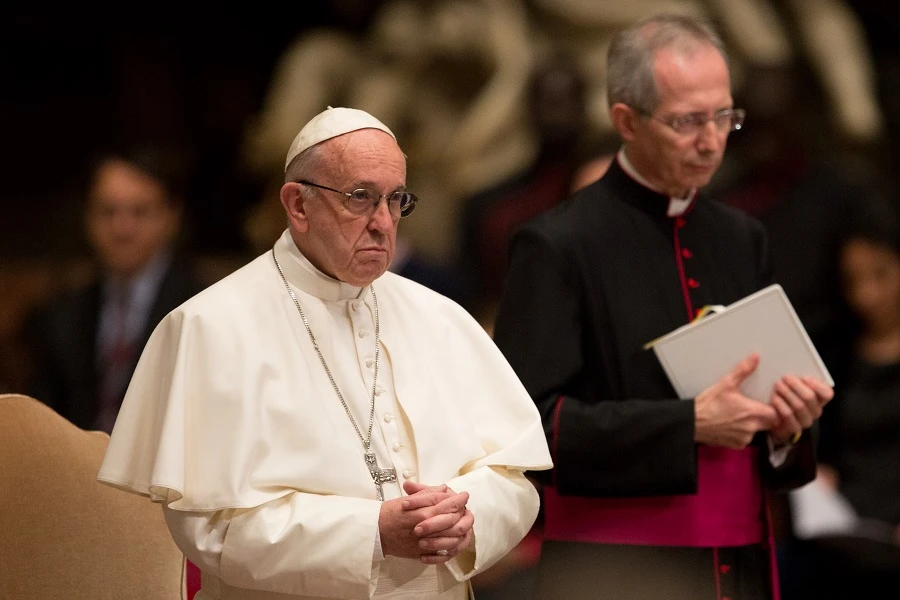
Vatican City, Feb 4, 2018 / 04:12 am (CNA/EWTN News).- On Sunday Pope Francis announced that the first Friday of Lent would be a day of prayer and fasting for peace given the many ongoing conflicts throughout the world, particularly those in the Democratic Republic of the Congo and South Sudan.

“Facing the tragic continuation of conflicts in different parts of the world, I invite all the faithful to a special day of prayer and fasting for peace Feb. 23, the Friday of the first week of Lent,” the Pope said Feb. 4.

He asked that the day be offered specifically for the people of the Democratic Republic of the Congo and South Sudan and invited both non-Catholics and non-Christians to join “in the ways they deem most appropriate.”

“Our heavenly Father always listens to his children who cry out to him in pain and anguish,” he said, and made a “heartfelt appeal” for each one of us to “hear this cry and, each one according to their own conscience, before God, ask ourselves: ‘What can I do to make peace?’”

While prayer is always an effective resolution, more can be done, Francis said, explaining that each person “can concretely say no to violence to the extent that it depends on him or herself. Because victories obtained with violence are false victories, while working for peace does good for all!”

The Pope’s appeal, which he made during his Sunday Angelus address, comes just two months after a Nov. 23 prayer vigil for peace in the two countries.

With plans to visit South Sudan and the Democratic Republic of the Congo last year thwarted by ongoing conflict, Pope Francis organized the prayer vigil in order to pray for an end to war in the two countries and to ask for comfort for victims of the violence.

He had planned to visit South Sudan last fall alongside Anglican Primate Archbishop Joseph Welby for an ecumenical trip aimed at promoting peace in the conflict-ridden country. However, due to safety concerns, the visit was postponed until the situation on the ground stabilizes.

South Sudan has been in the middle of a brutal civil war for the past three-and-a-half years, which has divided the young country between those loyal to its President Salva Kiir and those loyal to former vice president Reik Machar. The conflict has also bred various divisions of militia and opposition groups.

Since the beginning of the war, some 4 million citizens have left the violence-stricken country in hopes of finding peace, food and work. In August 2017 Uganda received the one-millionth South Sudanese refugee, highlighting the urgency of the crisis as the world’s fastest growing refugee epidemic.

For those who haven’t fled the nation, many internally displaced persons (IDPs) have sought refuge in churches for protection from violence. Most IDPs are typically women, children and those who have lost their families in the war.  

Many are too fearful to stay in their homes because they know they could be killed, tortured, raped or even forced to fight. And despite successful partnerships between the local Church, aid agencies and the government, refugees in many areas still need a proper supply of food.

On Friday the U.S. banned the export of weapons sales in South Sudan and urged other nations to do the same over growing frustration at the country’s inability to put an end to the conflict.

In the Democratic Republic of the Congo, political unrest first erupted in 2015 after a bill was proposed which would potentially delay the presidential and parliamentary elections. The bill was widely seen by the opposition as a power grab on the part of Kabila.

Relations between the government and the opposition deteriorated further when a Kasai chief was killed last August, after calling on the central government to quit meddling in the territory, insisting it be controlled by the local leaders.

Catholic bishops in the country had helped to negotiate an agreement, which hoped to prevent a renewed civil war by securing an election this year for the successor of President Kabila. However, in January of this year, the bishops said the agreement was expected to fail unless both parties were willing to compromise. In March, the bishops withdrew from mediation talks.

With a history of bloody ethnic rivalries and clashes over resources, fears have developed that the violence in Kasai, a hub for political tension, will spread to the rest of the nation and even lead to the involvement of neighboring countries.

In the past year alone, more than 3,300 people have been killed in the Democratic Republic of the Congo’s Kasai region. The death toll includes civilians caught in the crossfire of a brutal fight between the Congolese army and an opposing militia group.

According to the Guardian, violence in the east of the country in recent weeks has increased to the extent that last week alone some 7,000 people fled to neighboring Burundi and another 1,200 into Tanzania.

In terms of a humanitarian crisis, the Food and Agriculture Organization last week pointed to an “alarming food insecurity” in the country, due largely to the fact that violence has now spread into areas that were previously considered stable, such as the Kasai and Tanganyika  provinces. In the past six months alone, the number of people experiencing extreme hunger has risen by 2 million, rising to about 7.7 million people, which is roughly 10% of the population.

After reflecting on the day’s Gospel reading from Mark and leading faithful in praying the Angelus, Pope Francis also offered his prayer and closeness to the people of Madagascar, who were recently hit by a massive cyclone which so far has left at least 51 people dead and has caused extensive damage.

Francis assured of his prayer, and asked that the Lord would “comfort and sustain” all those who have died or who have been displaced.

[…]

Vatican-China bishops deal is ‘imminent’, sources say

February 3, 2018 CNA Daily News 2

Vatican City, Feb 3, 2018 / 01:25 pm (CNA/EWTN News).- Several sources familiar with a proposed deal between the Chinese government and the Holy See have said the landmark agreement is not only a possibility, but an “imminent” certainty that could come to fruition as early as this spring.

While no specific timeline has been given for the agreement, “I’ve heard that it is imminent. And in China, in many areas and environments, it is already taken as a done deal,” Henry Cappello told CNA Feb. 2.

President of the “Caritas in Veritate International” organization, Cappello travels to China on a regular basis to offer training to the country’s bishops, and has strong ties with both those approved by the Holy See and those backed by the communist government’s Chinese Patriotic Catholic Association.

Cappello was in China two weeks ago, where Joseph Ma Yinglin, the government-backed bishop of Kunming, explained the proposed deal to him.

Without the Vatican’s consent, Ma was tapped by the patriotic association to head the diocese in 2006. After his episcopal ordination, Ma’s excommunication was declared by the Vatican, because he was ordained a bishop without approval from Rome. In 2010 he was appointed president of the Chinese patriotic association’s bishops’ conference.

As part of the agreement, which has been widely reported in recent days, the Vatican is expected to officially recognize seven bishops who are out of communion with Rome, including 2-3 bishops, one of which is Ma, whose excommunications have been explicitly declared by the Vatican.

Cappello said the proposal has already been discussed in China, and he believes “this is the direction that things are going.”

In 1951 Beijing broke official diplomatic ties with the Vatican. Since the 1980s they have loosely cooperated in episcopal appointments, however, the government has also named bishops without Vatican approval.

The result has led to a complicated and tense relationship between the patriotic association and the “underground Church,” which includes priests and bishops who are not recognized by the government.

Many Catholics parishioners and priests who have rejected government control have been imprisoned, harassed and otherwise persecuted.

Currently every bishop recognized by Beijing must be a member of the patriotic association, and many bishops appointed by the Vatican who are not recognized or approved by the Chinese government have faced government persecution.

Many of the Vatican-approved bishops in China are drawing near to the age of 75, when they are required to submit their request for retirement, and many others have died, yet few successors have been named, raising questions as to whether or not a deal might be drawing near.

Regarding the seven bishops who will be recognized should a new agreement come to pass, Msgr. Anthony Figueiredo, who has worked with the seven bishops in question through the Caritas in Veritate for the past several years and was in China in July 2017, confirmed the news on the bishops’ proposed approval, saying “if the Vatican is going to accept them and an accord be reached, it’s going to be for all of them. ”

In addition to recognizing the seven bishops, the new deal would reportedly outline government and Vatican roles in future episcopal selection, with the Vatican proposing names and the Chinese government reportedly having the final say over Vatican-vetted candidates.

Figueiredo, who lives in Rome, travels to China several times a year with Caritas in Veritate, said he has worked closely with the seven bishops in question, and “they have desired this communion for years.”

He personally delivered a letter from the bishops to the Pope in 2016, which he says told the Pope they wanted communion with Rome.

“They didn’t propose the deal, certainly not in the letter they gave me, because that’s what’s come afterwards,” he said, noting that the Vatican has on several occasions sent a delegation to Beijing to discuss the details of a possible agreement.

Figueiredo said the deal could come within the next few months, saying “I think it could well come this spring, absolutely.”

For his part, Cappello said he could neither confirm nor deny any specific details of the agreement, but that as of two weeks ago during his visit to China, “we are talking in the right direction” in terms of what’s already been reported.

He said that in his view, to say China would have the final say in bishop appointments oversimplifies the matter, because the Church in China is complicated and nuanced due to its relations with a communist state.

“The Chinese bishops in China would have a big say, but knowing that the Church in China is in a communist nation, then the Church and the State, the line between them is very narrow,” he said.

“There’s really no black and white, there’s overlap there, so of course there would be an input from the government…it will be a collaboration,” Cappello said.

And as someone that has traveled back and forth to various provinces in China for the past 25 years, he said he has seen progress he calls remarkable, in terms of relations in the past decade, and during the past five years in particular.

With this deal, Pope Francis “is building bridges,” he said, adding that he believes the stronger and more vocal opponents of the accord “are on the wrong side of history.”

One of the most outspoken critics of a deal with the Chinese government has been Cardinal Joseph Zen, Archbishop Emeritus of Hong Kong.

Zen was ordained a priest in 1961 and became a bishop in 1996. He has spent a long missionary career in China, and has long been a vocal protester against human-rights abuses in China.

His concerns have grown so great that he recently traveled to Rome to meet with Pope Francis about the proposed deal, after the Vatican asked Bishop Peter Zhuang Jianjian of Shantou in southern Guangdong province and Bishop Joseph Guo Xijin from the Mindong Diocese of China’s eastern Fujian province to retire so that bishops from the patriotic association could take their place.

In a letter posted to his blog Jan. 29, Cardinal Zen said that while his meeting with the Pope last week was consoling, he believes “the Vatican is selling out the Catholic Church in China…if they go in the direction which is obvious from all what they are doing in recent years and months.”

He implied that Francis was unfamiliar with the situation, and questioned whether there could be any mutual ground with “a totalitarian regime,” comparing this to a hypothetical agreement between St. Joseph and King Herod. He said that if the agreement that comes out is a poor one, “I would be more than happy to be the obstacle.”

The Vatican immediately responded, and in a Jan. 30 statement said Francis is well-informed of the dialogue with China, so “it is therefore surprising and regrettable that the contrary is affirmed by people in the Church, thus fostering confusion and controversy.”

In a Jan. 31 interview with Italian paper La Stampa , Vatican Secretary of State Cardinal Pietro Parolin spoke of the proposed deal, and, though he didn’t mention Zen’s comments specifically, said “no one should cling to the spirit of opposition to condemn his brother or use the past as an excuse to stir up new resentments and closures.”

On the deal, he said that “if someone is asked to make a sacrifice, small or great, it must be clear to everyone that this is not the price of a political exchange, but falls within the evangelical perspective of a greater good, the good of the Church of Christ”

Figueriedo told CNA he believes the Vatican was quick to counter Zen in order to protect the deal, because “it really takes just one person on the Chinese side to say ‘you shouldn’t go ahead,’” which he says has happened in the past.

Should a deal come to fruition, Cappello said he hoped it would help normalize life for Catholic faithful and allow priests, bishops and seminarians to receive much needed formation.

China is extremely complex, he said, explaining that the Vatican has reached a point of understanding the nation which is both “encouraging and remarkable.”

However, he said there are real reasons for concern based on past events, and that any agreement is something that those on both sides will need to grow into.

CNA reached out to the Vatican for confirmation, however, they declined to comment on the situation.

[…]

Cardinal Marx endorses blessing ceremonies for same-sex couples

February 3, 2018 CNA Daily News 12

Munich, Germany, Feb 3, 2018 / 09:31 am (CNA).- The president of the German Bishops’ Conference has declared that, in his view, Catholic priests can conduct blessing ceremonies for homosexual couples.

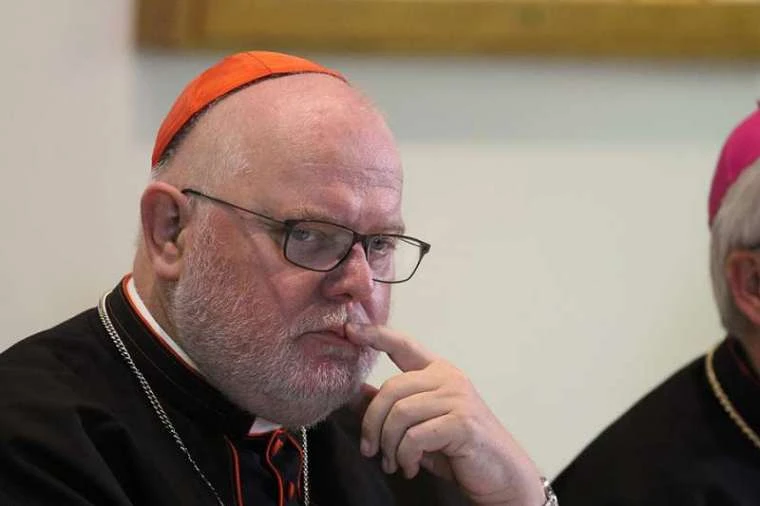
Cardinal Reinhard Marx told the Bavarian State Broadcasting’s radio service that “there can be no rules” about this question. Rather, the decision of whether a homosexual union should receive the Church’s blessing should be up to “a priest or pastoral worker” and made in each individual case, the German prelate stated.

Speaking on Feb. 3, on the occasion of his 10th anniversary as Archbishop of Munich and Freising, Cardinal Marx was asked why “the Church does not always move forward when it comes to demands from some Catholics about, for instance, the ordination of female deacons, the blessing of homosexual couples, or the abolition of compulsory [priestly] celibacy.”

Marx said that, for him, the important question to be asked regards how “the Church can meet the challenges posed by the new circumstances of life today – but also by new insights, of course,” particularly concerning pastoral care.

Describing this as a “fundamental orientation” emphasized by Pope Francis, Marx called for the Church to take “the situation of the individual, … their life-story, their biography, … their relationships” more seriously and accompany them, as individuals accordingly.

Marx has recently called for an individualized approach to pastoral care, which, he has said, is neither subject to general regulations nor is it relativism.

Such “closer pastoral care” must also apply to homosexuals, Cardinal Marx told the Bavarian State Broadcaster: “And one must also encourage priests and pastoral workers to give people in concrete situations encouragement. I do not really see any problems there.”

The specific liturgical form such blessings – or other forms of “encouragement” – should take is a quite different question, the Munich archbishop continued, and one that requires further careful consideration.

Asked whether he really was saying that he “could imagine a way to bless homosexual couples in the Catholic Church,” Marx answered, “yes” – adding however, that there could be “no general solutions.”

“It’s about pastoral care for individual cases, and that applies in other areas as well, which we can not regulate, where we have no sets of rules.”

The decision should be made by “the pastor on the ground, and the individual under pastoral care” said Marx, reiterating that, in his view, “there are things that can not be regulated.”

[…]

How this classical Catholic school welcomes children with Down syndrome

February 2, 2018 CNA Daily News 0

Louisville, Ky., Feb 2, 2018 / 03:47 pm (CNA/EWTN News).- Students with Down syndrome study Latin and logic alongside their classmates at Immaculata Classical Academy, a Catholic school in Louisville, Ky., that integrates students with special needs into each of their pre-K through 12 classrooms.

The school emphasizes “education of the heart,” along with an educational philosophy tailored to the abilities of each student. About 15 percent of student at Immaculata have special needs.

“When you look at these students with Down syndrome in a classical setting, it is truly what a classical education is all about — what it truly means to be human,” the school’s founder, Michael Michalak, told CNA.

“You can’t learn compassion in a book,” Michalak explained.  He said the students at Immaculata are gaining “the ability to give of yourself to help others” through mutual mentoring constantly taking place in the classrooms.  

Michalek founded the academy along with his wife, Penny, in 2010. The couple saw a need for a Catholic school in which students like their daughter, Elena, who has Down syndrome, would not be segregated from their siblings. They wanted to keep their children together without compromising educational quality or spiritual formation.

“A classical education is, I think, the best education for a child with special needs because it is an education in everything that is beautiful, true, and good. It is perfect for these children,” Penny told CNA.

The school’s course schedule is configured so that students can move up or down grade levels by subject at each class hour, according to individual needs. “A second-grader might go to third grade math class and a child with Down syndrome in second grade might go over to first grade or might stay in 2nd grade,” Michael Michalak explained. “Nobody is looking around and saying, ‘Oh, they are going to special classroom.’ They are just going where they need to be.”

“In the midst of all of this we are not leaving students behind,” Penny added, “We keep our high academic standards while integrating students with special needs.”

Since its founding, the independent Catholic school has grown to a student body of 160. Other Catholic schools across the country have begun looking to Immaculata as a model, the Michalaks say.

“Whenever anyone visits our school, they always say, ‘Oh my goodness the joy of this place!’” Penny told CNA.

The couple attributes the school’s sense of joy to the Holy Spirit and “the joy of belonging.” “Inclusion is more of a buzzword these days, but it is true that we all want to belong and we all want to be loved,” said Michael Michalek.

“Prayer is the air that we breathe. We start the day with prayer. Every class starts with a prayer and ends in a prayer,” said Penny, who entrusted the school to our Our Lady at the school’s founding with St. Maximilian Kolbe as its patron.

“Our whole philosophy is to teach every child as if we were teaching the Christ child, so that is how we handle each and every student,” Penny continued.

A developing religious community, the Sisters of the Fiat, also teach at Immaculata. The sisters take an additional vow to serve those with with special needs, along with the traditional vows of poverty, chastity, and obedience.

The school’s founders say they are aware of their unique witness and role in a world where many children with Down syndrome are aborted. The estimated termination rate for children prenatally diagnosed with Down syndrome in the United States is 67 percent; 77 percent in France; and Denmark, 98 percent, according to CBS News.

At the annual March for Life in Washington, DC, students from Immaculata Classical Academy hold signs that read, “Abortion is not the cure for Down syndrome.” The students are united in mission as “a pro-life school” and pray together for an end to abortion for their brothers and sisters with Down syndrome around the world, Michalak said.

The Michalaks have also adopted three children with Down syndrome.

Michael sees the founding of a school like Immaculata as the natural Catholic response at a moment in history when children with Down syndrome are especially at risk.

“Look at what the Catholic Church has done throughout history: We see orphans; we build orphanages. We see sick people; we build hospitals. It is in this particular time and place that we saw the need to take the lead on this and to start a school that incorporates the whole family.”

His wife adds, “When you are doing something that you feel called by God to do, it is a vocation, it is a mission, it is a calling…how can you not be full of joy when you know that this is the will of God. It is very rewarding.”

[…]

Cardinal Farrell nixes LGBT advocates from Vatican-hosted conference

February 2, 2018 CNA Daily News 0

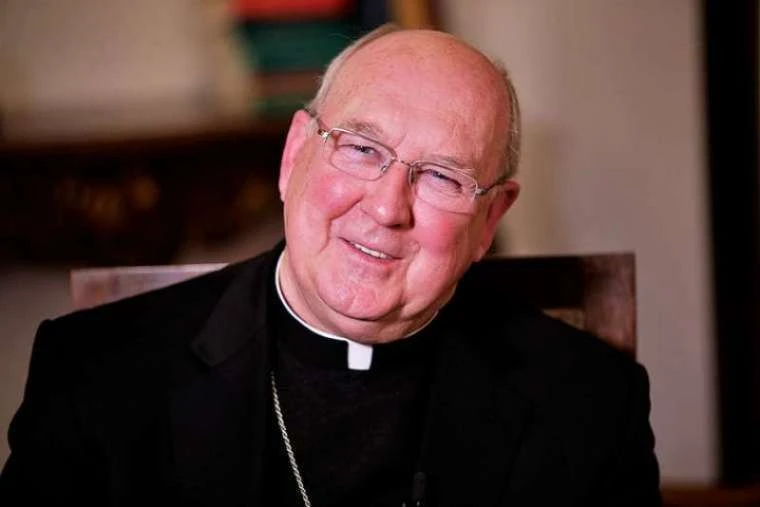
Vatican City, Feb 2, 2018 / 12:00 pm (CNA/EWTN News).- Cardinal Kevin Farrell has reportedly barred several speakers set to address an annual women’s event inside the Vatican over concerns about their LGBT positions, prompting organizers to find another venue.

First held in 2014, the “Voices of Faith” (VoF) event has taken place inside the Vatican’s Casina Pio IV, headquarters of the Pontifical Academy for Sciences, every March for the past four years.

Established in 2014 in response to Pope Francis’ call to “broaden the space within the Church for a more incisive feminine presence,” the event is scheduled each year to coincide with the March 8 celebration of International Women’s Day, and typically draws speakers from various backgrounds to give testimonies and speak on a specific theme.

Organizers have relocated the 2018 conference, titled “Why Women Matter,” to another location outside Vatican grounds, after two high-profile speakers didn’t meet Vatican approval: Mary McAleese, former president of Ireland, and Ssenfuka Juanita Warry, who runs a non-profit advocating for LGBT Catholics in Uganda.

According to Chantal Gotz, founder and managing director of VoF, the list of speakers required approval from Cardinal Farrell before they could move forward with planning. When he returned a list of approved names, McAleese and Warry were not included.

Farrell heads the Vatican Dicastery for Laity, Family and Life, the office in charge of organizing the World Meeting of Families this August and the 2019 international World Youth Day in Panama. Given the topic of this year’s Synod of Bishops, which will reflect on “Faith, young people and the discernment of vocation,” Farrell’s office is also a key player in organizing that event.

In comments to CNA, Gotz said the conference organizers were not given a reason for having the speakers barred, so “we engaged in dialogue with the cardinal and asked him for an explanation for blocking the names,” however “we were not able to go further since an explanation was not forthcoming.”

While an official reason for blocking the speakers might be lacking, it is widely believed Farrell made the decision because of the proposed speakers’ controversial stances on the question of homosexuality.

McAleese has a son who is gay, and according to the Irish Independent, at one point said her son had gone through “torture” when he learned about the Catholic Church’s position on the issue.

McAleese has previously advocated for same-sex marriage, accusing the Catholic Church of “hypocrisy” for its stance on marriage. She has also publicly advocated for the ordination of women to the priesthood, in opposition to the teachings of the Church expressed in Pope St. John Paul II’s Ordinatio Sacerdotalis.

According to a Feb. 2 press release from VoF, as the former president of Ireland McAleese “is no stranger to the Vatican, having held the highest position in public office in a predominantly Catholic country.”

“She is known for her staunch support for gay and women’s rights and has often spoken publicly about her frustrations with her Catholic faith.”

Warry is also an active campaigner on issues related to homosexuality.

Gotz told CNA she was “stunned” by Farrell’s decision, as such issues have never been a problem in the past.

In previous years the conference has invited a host of speakers who hold opposing views to the Church’s position on major issues such as abortion, contraception and women’s ordination, she said. Some of them have spoken openly about their positions during the event, however, this marks the first year that any of the speakers have been rejected.

“We have always been respectful of the viewpoints of the Church,” Gotz told CNA, “yet we, like Pope Francis, recognize there is a critical need to open the church to more dialogue.”

In the press release, the purpose of the VoF event is to “empower and advocate for Catholic women to have a seat at the table of decision making in the Catholic Church.”

The statement also voices the organization’s belief that a key solution to various problems the Church faces “lies in having a diversity of thought, expertise and education at the leadership level, skill sets they say can be brought by women and lay people if only they were more welcomed into these structures.”

The conference, she said, “allows us to not only celebrate the wonderful work Catholic women are doing across the globe, but also create discussion and dialogue on the current power and leadership structures of our Church today.”

More than anything, “we hope it will help create a bridge to dialogue between those who have feared that dialogue for too long,” she said.

“Women are willing and ready to share their faith and their gifts. They should be afforded a seat at the table so that women’s voices and perspectives become an integrated part of decision making within the Church.”

Rather than taking McAleese and Warry off of their list of speakers, organizers of VoF opted for a change of location, and the conference will now take place at the Jesuit Curia in Rome.

“The Jesuits, in true form, have welcomed us and our speakers,” Gotz told CNA, explaining that she is unsure if the rift with Cardinal Farrell will affect future VoF events.

Cardinal Farrell could not be reached for comment.

CNA’s Perry West contributed reporting for this story.

[…]

Don’t let technology replace real encounters, Francis says on Candlemas

February 2, 2018 CNA Daily News 1

Vatican City, Feb 2, 2018 / 10:50 am (CNA/EWTN News).- Pope Francis told consecrated men and women Friday that they are called to have real encounters with their brothers and sisters, and that technology should never have a higher priority than time spent with God and others.

“Today’s frantic pace leads us to close many doors to encounter, often for fear of others,” the Pope said Feb. 2. “Only shopping malls and internet connections are always open.”

“Yet that is not how it should be with consecrated life: the brother and the sister given to me by God are a part of my history, gifts to be cherished. May we never look at the screen of our cellphone more than the eyes of our brothers or sisters, or focus more on our software than on the Lord.”

Pope Francis cautioned against getting trapped by the “life of this world,” pointing out how consecrated life, and vows of poverty, chastity and obedience, are about turning away “from fleeting riches to embrace the One who endures forever.”

“The life of this world pursues selfish pleasures and desires; the consecrated life frees our affections of every possession in order fully to love God and other people,” he said. “Worldly lives aim to do whatever we want; consecrated life chooses humble obedience as the greater freedom.”

The Pope’s homily came during Mass for the Feast of the Presentation of the Lord, which also marks the 22nd World Day of Consecrated Life.

The Feast of the Presentation of the Lord is also sometimes called Candlemas. On this day, many Christians bring candles to the church to be blessed. They can then light these candles at home during prayer or difficult times as a symbol of Jesus Christ, the Light of the World.

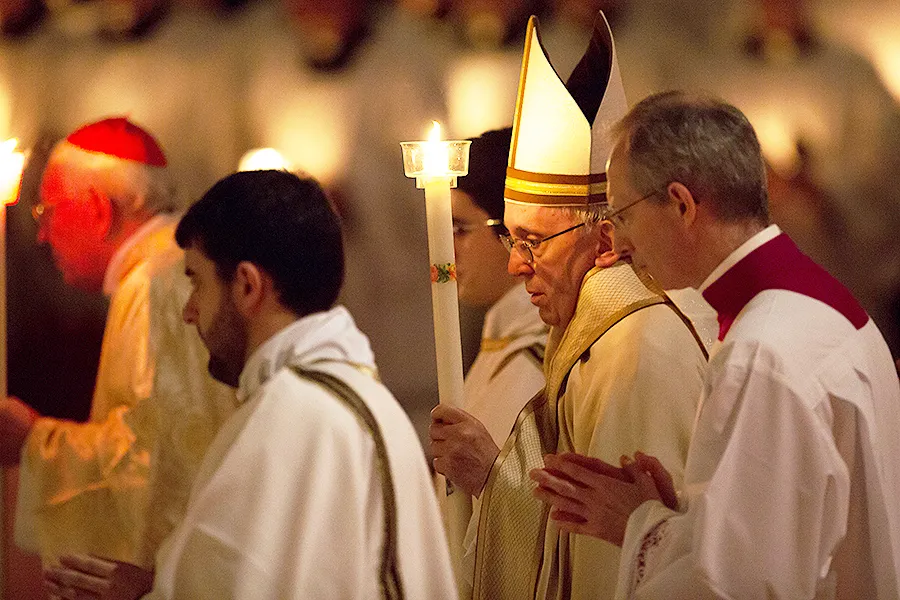
The Mass in St. Peter’s Basilica began with a blessing of the candles in the rear of the church by Pope Francis. He then processed into the darkened church with priests, bishops and cardinals carrying lit candles. Those present in the congregation also held small candles.

This feast, in the Eastern Churches, is sometimes called the “Feast of Encounter,” Francis said. Speaking to consecrated men and women, he noted that their vocation was borne of an encounter with the Lord and his call.

“We journey along a double track: on the one hand, God’s loving initiative, from which everything starts and to which we must always return; on the other, our own response, which is truly loving when it has no ‘ifs’ or ‘buts,’ when it imitates Jesus in his poverty, chastity and obedience,” he said.

Referencing the story of the presentation of Jesus in the Temple, the pontiff said that like the elderly Simeon, it is good for Catholics to also hold the Lord “in our arms.”

“Not only in our heads and in our hearts,” he explained, “but also ‘in our hands,’ in all that we do: in prayer, at work, at the table, on the telephone, at school, with the poor, everywhere.”

A genuine encounter with the Lord in this way helps to correct “saccharine piety and frazzled hyperactivity.” It also helps remedy the “paralysis of routine,” he said.

“The secret to fanning the flame of our spiritual life is a willingness to allow ourselves to encounter Jesus and to be encountered by him,” he continued. “Otherwise we fall into a stifling life, where disgruntlement, bitterness and inevitable disappointments get the better of us.”

In an encounter with Jesus and with our brothers and sisters our hearts can rest in the present moment, the Pope said, not worried about the past or the future.

He also drew attention to another encounter with Jesus from the Gospels that can inspire those in consecrated life –  that of the women who go to the tomb to anoint Jesus after his death.

“They had gone to encounter the dead; their journey seemed useless,” he said. “You too are journeying against the current; the life of the world easily rejects poverty, chastity and obedience.”

“Like those women, be the first to meet the Lord, risen and alive. Cling to him and go off immediately to tell your brothers and sisters, your eyes gleaming with joy,” he concluded.


[…]