Pope prays for victims of ‘inhumane’ Afghan terrorist attack

January 28, 2018 CNA Daily News 0

Vatican City, Jan 28, 2018 / 05:12 am (CNA/EWTN News).- Sunday, after leading the Angelus, Pope Francis prayed for victims of two recent attacks in Afghanistan, holding a moment of silent prayer for the more than 100 people who lost their lives, the more than 200 injured, and their families.

“Yesterday from Afghanistan arrived the painful news of the terrible terrorist massacre carried out in the capital Kabul, with almost a hundred dead and numerous wounded,” the Pope said Jan. 28.

“A few days ago another serious attack, still in Kabul, had sowed terror and death in a large hotel.”

“How long will the Afghan people have to endure this inhumane violence? We pray in silence for all the victims and their families; and we pray for those in that country who continue to work to build peace.”

More than 100 people were killed, and over 200 wounded, by an explosion Jan. 27 in Kabul, the capital city of Afghanistan. Attackers drove an ambulance rigged with a bomb into a crowded street, in an area of the city full of government buildings and embassies.

It was the deadliest attack the country has experienced in recent months, and follows just one week after an attack by gunmen on a hotel, also in Kabul.

Jan. 20 a group of gunmen entered the Intercontinental Hotel in Kabul, shooting at guests and detonating grenades, the BBC reports. The battle between gunmen and special forces lasted 12 hours. At least 18 people were killed, including the four gunmen.

The fundamentalist Islamist group known as the Taliban has claimed responsibility for both attacks this week.

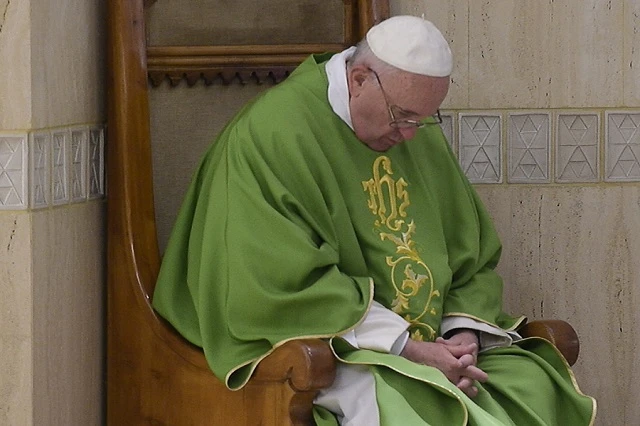
Pope Francis’ appeal for peace in Afghanistan was made after leading the usual Sunday Angelus from a window in Casa Santa Marta. In his message before the prayer, he reflected on the day’s reading from the Gospel of Mark.

In the passage, Jesus preaches in the temple, “with authority,” and performs an exorcism, driving an unclean spirit from a man with the words: “Quiet! Come out of him!”

Here we see Jesus manifest “God’s plan with words and with the power of works,” Francis said.

“In fact, in the Gospel, we see that Jesus, in his earthly mission, reveals the love of God both through preaching and with countless gestures of attention and assistance to the sick, the needy, children and sinners.”

From it we also learn how to overcome our own struggles and temptations with the grace of God. “Think of what great grace it is for us to have known this God so powerful and so good! A teacher and a friend, who shows us the way and takes care of us, especially when we are in need,” he said.

At the end of the Angelus, the Pope also referenced the day’s commemoration of the World Day for Leprosy Patients.

“Unfortunately, this disease still affects the most disadvantaged and poorest people. To these brothers and sisters, we assure our closeness and solidarity; and we also pray for those who assist them and work for their reintegration into society,” he said.

Cardinal Peter Turkson, head of the Dicastery for Promoting Integral Human Development, also released a message for the day. In it he wrote that it is worrying that despite intense efforts, humanity has not been able to definitively eradicate the “ancient” disease of leprosy.

Leprosy, also called Hansen’s Disease, continues to be a significant health problem, he stated, primarily affecting people in precarious socio-economic conditions.

In 2017, the World Health Organization found a high concentration of the disease in just 14 countries, which alone account for 95 percent of new cases. India, Brazil and Indonesia have some of the highest rates.

The social stigma surrounding the disease remains one of the difficulties, Turkson wrote, quoting Pope Francis’ words at an Angelus in January 2017, to “fight against this disease, but also against the discrimination that it generates.”

“I thank all those who, for various reasons, are committed to the sick with Hansen’s disease. May you assist and protect the Good Lord through the intercession of the numerous saints who have made the service of these sick people the reason for their life,” the message concluded.

[…]

Pope Francis: Where Mary is, ‘the devil does not enter’

January 28, 2018 CNA Daily News 0

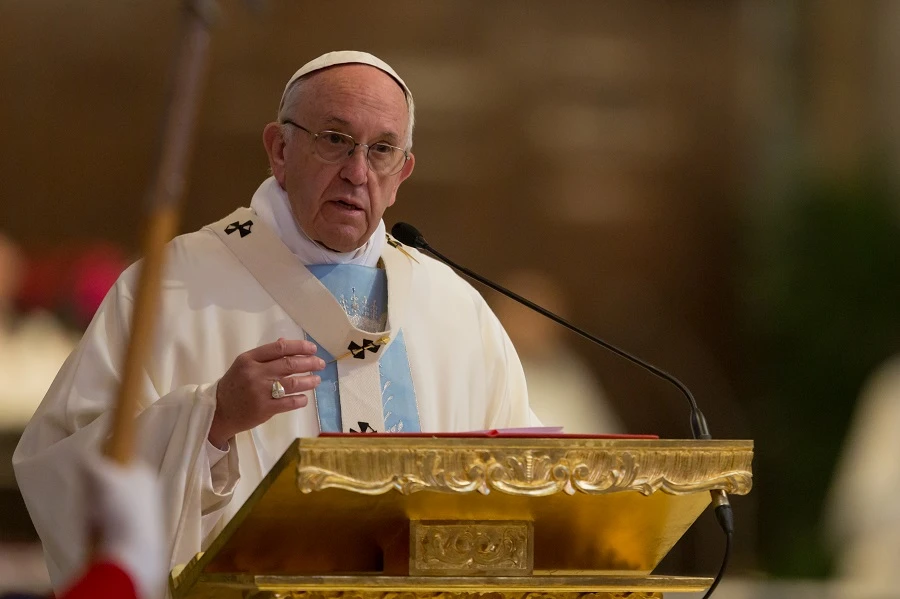
Vatican City, Jan 28, 2018 / 04:09 am (CNA/EWTN News).- At Mass in the Basilica of St. Mary Major Sunday, Pope Francis said that when we go through difficult times or have problems or worries, Mary is our shield, guarding our faith and protecting us from evil.

“Where the Madonna is at home the devil does not enter; where there is the Mother disturbance does not prevail, fear does not win,” the Pope said Jan. 28.

“Who of us does not need this, who of us is not sometimes upset or restless? How often the heart is a stormy sea, where the waves of problems overlap, and the winds of worry do not cease to blow! Mary is the sure ark in the midst of the flood.”

Pope Francis celebrated a special Mass at the Basilica of St. Mary Major for the Feast of the transfer of the icon of Salus Populi Romani.

Salus Populi Romani (Protectress of the Roman People) is the title of an ancient Byzantine icon of Mary and the Child Jesus, traditionally held to be painted by St. Luke the Evangelist and to have arrived in Rome in the 6th century.

It was first canonically crowned in 1838 by Pope Gregory XVI and a second time in 1954 by Pope Pius XII. It has a long history of devotion by the Roman people, as well as by popes. It resides in the Pauline, also called Borghese, Chapel in St. Mary Major.

Francis has a special devotion to the image. His first visit as pontiff was to the Basilica of St. Mary Major to pray before the image following his election.

The image has been undergoing extensive restoration in the Vatican Museums, and the Mass also served as the image’s official unveiling following the work.

In his homily, Pope Francis said that it is “a great danger to faith, to live without a mother, without protection, letting ourselves be carried away by life like leaves by the wind.”

Just like persecuted people once took refuge under the cloak of the noble, high-ranking women of their village, in “turbulent moments” we must take shelter under the mantle of Mary, “the highest woman of mankind,” for our own protection.

“Her coat is always open to welcome us and gather us,” he said. “The Mother guards faith, protects relationships, saves in bad weather and preserves from evil.”

As Christians, we cannot be neutral or detached from our Mother, he continued. “Because without a Mother we cannot be children. And we are, first of all, children, beloved children, who have God for a Father and the Madonna for a Mother.”

To illustrate his point, Francis recalled a story of a woman who sat beside the bed of her son in the hospital. He was in pain after an accident, and the mother remained by his bed day and night.

Once she complained to a visiting priest that God never allowed one thing to a mother, which is to suffer in place of her child.

“Here is the mother’s heart,” the Pope said. “She is not ashamed of the wounds, of the weaknesses of her children, but she wants (to take) them on herself.”

And this is how it happens every time, he said. Whether we lack hope, or joy, or our strength is exhausted; whatever our problem, our Mother intervenes.

“And she never, never despises our prayers; she does not let even one fall. She is a Mother, she is never ashamed of us, she only waits to be able to help her children.”

“Let’s make the Mother the guest of our daily life, the constant presence in our home, our safe haven,” he concluded. “Let’s entrust (ourselves) to her every day. Let’s invoke her in every turbulence. And let’s not forget to come back to her to thank her.”

[…]

Vatican stamp honors priest martyred by Mafia 25 years ago

January 28, 2018 CNA Daily News 0

Vatican City, Jan 28, 2018 / 03:55 am (CNA).- “I’ve been expecting you.”

These were reportedly the foreboding last words of Blessed Giuseppe “Pino” Puglisi, an Italian priest who was shot and killed by the Italian mafia in 1993.

Declared a martyr by Pope Benedict XVI in 2012 and beatified in 2013, the priest is being honored once again by the Vatican, which has just released a commemorative stamp in his honor on the 25th anniversary of his martyrdom.


#Vatican issues stamp commemorating 25th anniversary of the assassination of anti-mafia priest Don Pino Puglisi pic.twitter.com/06bLMCtBHE

— Edward Pentin (@EdwardPentin) January 23, 2018


Blessed Puglisi was born on Sept. 15, 1937 to a modest working-class family in Palermo, Italy. He entered the seminary at the age of 16, and was ordained a priest in 1960 at the age of 22.

Throughout his priesthood, he was known for being outspoken against injustices – including Communism, the Mafia, and problems within the Church.

He was also passionately involved in youth ministry and in promoting vocations.

Archbishop Salvatore Di Cristina, a fellow priest and friend of Puglisi, recalled to the National Catholic Register in 2013 the transformative effect that Puglisi had on the whole town of Godrano.

Once an entangled mob town with an unspoken curfew and neighbors that were afraid of each other, Puglisi’s pastoral approach “won over the kids of the town, and after the kids, he won over the families. After his departure, Godrano was completely transformed,” he said.

While there are some who “would define him as a social-action priest or some kind of ‘anti-Mafia’ professional,” Archbishop Di Cristina said that was not really the case.

“He just deeply lived his vocation,” he said.

In 1990, Puglisi was transferred to San Gaetano’s parish in Brancaccio, another mob-ridden town in Palermo. His approach was the same – to win over the youth and be a pastor to his flock.

“Father Puglisi was not a typical anti-Mafia priest. He did not organize rallies or make public condemnation of Mafia,” Archbishop Michele Pennisi told the National Catholic Register in 2013. “[The] Mafia does not see that kind of priest as dangerous.”

Puglisi was actually considered more dangerous “because he educated young people,” Archbishop Pennisi said. He would convince youth not to steal or quit school and encouraged them away from the Mafia, who would often use children to help them traffic drugs and other illicit materials.

Puglisi preached against the Mafia, ignored their threats, banned them from leading religious processions and even stealthily gave clues to the authorities about their latest activities in his homilies. Consequently, his life was threatened by the mob numerous times, unbeknownst to even those closest to him until after his death.

Just months prior to his murder, while the Italian state was in peak conflict against the mob, Pope John Paul II blasted the Mafia in an impromptu speech during a visit to Sicily in May 1993.

“You must understand that you cannot kill the innocent. God once said, ‘Thou shalt not kill.’ No man, no human organization, no mafia can kill or stamp out this most holy right of God!” John Paul II declared. In later comments to EWTN, Archbishop Giancarlo Maria Bregantini said the powerful speech was one of the rare times he saw the Holy Father truly angry. The fiery speech, coupled with government crackdowns, prompted the Mafia to plant several car bombs throughout Italy that spring, leaving at least 10 people dead.

On September 15, 1993, having received numerous warnings and death threats, Fr. Puglisi was shot in the neck at point-blank range by Mafia hitmen under the direction of local Mafia bosses, the brothers Filippo and Giuseppe Graviano. It was the priest’s 56th birthday.

Although he was taken to the hospital, Puglisi was unable to be revived and died of his injuries.

“This is a Mafia crime,” Lorenzo Matassa, an investigating magistrate with broad anti-Mafia experience, told the New York Times in 1993. “Cosa Nostra could not stand that priest’s teaching the kids in the neighborhood about an anti-Mafia culture.”

The uproar in Italy was strong – it was the first time the Mafia had dared to kill a man of the cloth since 1979. His martyrdom also further galvanized the Church to act and speak out against the mob in Italy.

“After [Father Puglisi’s] murder, bishops made a public condemnation of the Mafia, and they maintained that whoever is part of this criminal organization cannot consider himself a Christian,” Bishop Salvatore Cuttitta, who had been an altar boy serving under Fr. Puglisi, told the National Catholic Register in 2013.

Father Puglisi was beatified on May 25, 2013. The following Sunday, Pope Francis called Puglisi “an exemplary priest, especially dedicated to the pastoral care of youth.”

He also condemned the continuation of Mafia activities and prayed for the conversion of those involved.

“Let us pray the Lord to convert the heart of these people. They cannot do this! They cannot make slaves of us, brothers and sisters! We must pray (to) the Lord! Let us pray that these members of the Mafia be converted to God and let us praise God for the luminous witness borne by Fr. Giuseppe Puglisi, and let us set store by his example!”

[…]

In Nigeria, brutal attacks and a story of survival

January 27, 2018 CNA Daily News 0

Kaduna, Nigeria, Jan 27, 2018 / 06:01 am (Aid to the Church in Need).- It is common in Nigeria that nomadic herdsmen clash with farmers over the use of land. However, in the past year in particular, raids by Muslim Fulani herdsmen have become more violent and have targeted Christians.

Mysteriously, the herdsmen carry sophisticated weaponry, which has led to speculation that assaults are financed, planned and instigated by anti-Christian elements.

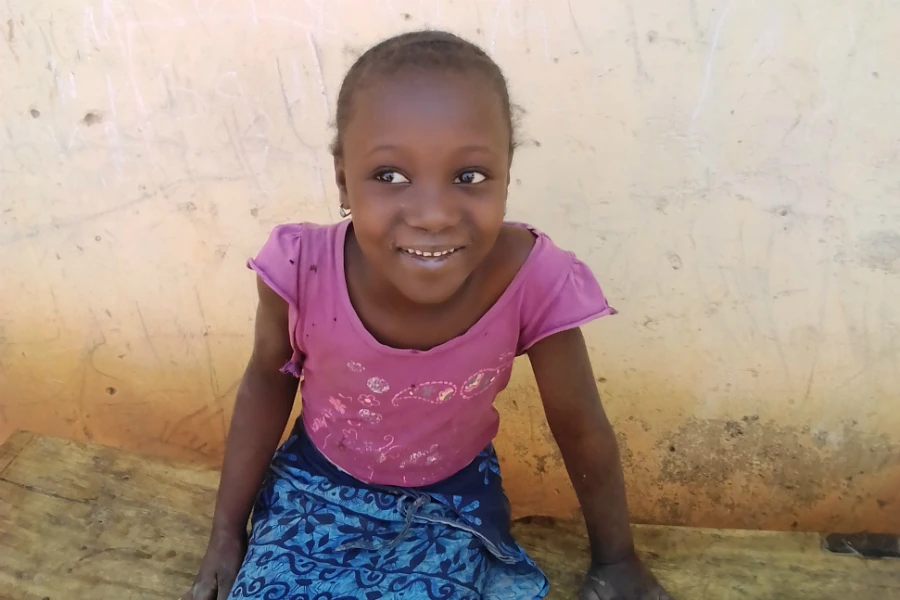
Fourteen-year-old Rejoice James, a Catholic student at St. Kizito’s primary and secondary school in Samaru Kataf, Kaduna State, tells the story of two such attacks:

“It was a Thursday morning, March 16, 2017 at exactly 1:30am; I heard people shouting ‘fire! fire!’ My mother and father and my two siblings rushed out of the house. Fulani herdsmen had come to our village, killing some people and setting houses on fire, including ours. It was burned to ashes. We couldn’t do anything to stop the fire; we lost everything. It felt like God was really silent and life was not fair. Still, we were unharmed.

“As we stood around, wondering what to do, God sent us a helper, a Muslim man who ran toward us and shouted: ‘run for your lives! You people were good to me and I decided to reciprocate. Run, I say, as fast as your legs can carry you – the Fulani herdsmen are already on their way to kill you.’ I came close to see who the man was and was shocked to discover it was my school’s security guard.

“So we ran. In the bush everyone was selfish; we ran as if there was a competition; we were exhausted and absolutely afraid, but we kept on running and later found ourselves in Samaru Kataf, which is almost 80 miles from where we lived. We seemed to have gotten there in a twinkle of an eye and I wondered how; it was a mystery that I can’t explain.

“We went to a Catholic church where we were fed and clothed for few days. Afterward, we moved into the home of my father’s cousin. My parents could no longer afford to send my siblings and me to Catholic school, so I began attending a state school.

“One early morning, May 9, 2017, my principal sent a message to my dad, telling him we should not come to school that day, that all was not well in the community. That afternoon, my dad took his bicycle to go to the marketplace; it was market day. A few hours later, I saw people screaming, shouting – some were crying – and running all over. Women ran to our house and yelled out: ‘we are doomed again.’

“We heard that Fulani herdsmen had come to the marketplace and killed three Christians, and badly wounded four others. The violence had been triggered by the killing of a Fulani taxi driver by some our youth, who were taking revenge for the attack on Fanda Kaje. I began to shiver, thinking of my dad who had gone to the marketplace; my mother was shaking, as we both wondered if my father would still be alive.

“My mother held my hand and we began to run toward the marketplace. We found chaos; tomatoes, peppers, onions and other food stuffs were scattered everywhere; some shops were burned down. I was very scared; we did not know where to look for my dad. Then we heard a voice: ‘if you move, I will shoot you.’ We ran away along with other people; my mother carried me in her arms and ran as fast as her legs could carry her; a woman pushed her and she tripped, injuring her leg. But the pain did not stop her.

“Just as we were about to get back into our house, there came cries of young people, screaming. We turned around and saw my dad on the ground, lifeless. The boys had carried his body from the marketplace. They rushed over to my mother, who had fainted; they poured water on her face and she regained consciousness; she began to shout and cry at the top of her voice. I could feel my mother’s pain as she held my siblings and me very tightly; we all cried our eyes out. I wondered why God remained silent.

“After my father’s burial, I helped my mother sell tomatoes for six months. Thanks to my uncle I am now attending a Catholic school again. I am happy because I made new friends and because my two sisters, my mother and I survived the attack.

“We finally are enjoying peace in the community; the army has stepped in to protect us. The hatred between Christians and the Fulani herdsmen is unbearable – but I still thank God there is a bit of sunshine after the rain in our community.”


Patience Nibile writes for Aid to the Church in Need, an international Catholic charity under the guidance of the Holy See, providing assistance to the suffering and persecuted Church in more than 140 countries.

[…]

Chilean legislators pass gender-identity bill

January 26, 2018 CNA Daily News 0

Santiago, Chile, Jan 27, 2018 / 12:00 am (CNA/EWTN News).- The Chilean House of Representatives has passed a bill that “recognizes and gives protection to gender identity,” an initiative considered a priority by the government of President … […]