


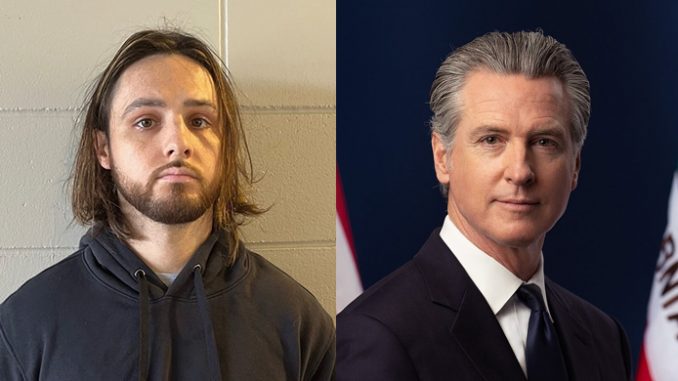
California has always sold itself as the place where people can invent or reinvent who they are. And it is within that culture of “borrowed selves” that both the man accused of starting the deadly Palisades fire and the state’s own Governor Newsom have recently admitted to modeling themselves on figures they believed radiated the powerful and carefully curated persona they lacked on their own.
Federal prosecutors have described the alleged Palisades Firestarter, Jonathan Rinderknecht—the Uber driver charged with setting the blaze that killed twelve people and destroyed thousands of homes—as someone who had become obsessed with Luigi Mangione, the accused killer of Brian Thompson, the CEO of UnitedHealthcare.
According to media reports, Rinderknecht viewed the murderous Mangione—who has himself become viewed as a heroic avenger defending the poor from vicious capitalism—as someone to emulate. Absorbing the Mangione playbook so completely, Rinderknecht began echoing its language in his Google searches by asking for information on “free Luigi Mangione” and “take down all the billionaires.” The New York Times reported that Rinderknecht told investigators that torching the Palisades would be a “symbolic strike against the rich.”
Although extreme, the imitation of a murderous avenger by the man accused of setting the Palisades on fire lies on the same cultural continuum as the mimetic anxieties on display in Governor Newsom’s newly released memoir.
In it, Newsom reveals that in an effort to avoid bullying in high school, he constructed a new persona by echoing the confidence of a handsome and impeccably dressed television character played by Pierce Brosnan. Both Newsom and Rinderknecht, operating at opposite ends of California’s social hierarchy, turned outward to find the models they believed would provide the power they lacked.
The firestarter became obsessed with the murderous Marxist avenger while the governor reached for the cool confidence embodied by Brosnan’s fictional creation, the Eighties television detective, Remington Steele.
In his book, Newsom writes that he was an awkward teen and the target of a bully who called him “Newscum”–the same nickname President Trump has used to mock the governor. Inspired by television detective Remington Steele’s suit-wearing character, the teenage Newsom began to slick back his hair with gel and wear a full-dress suit to high school.
He recalls that the “transformation” changed his reputation and claims that the bullying stopped “almost overnight.”
While their choices differ in scale and consequence, the underlying impulse of both men is the same—an attempt to inhabit a more powerful and commanding persona by modeling oneself on someone who seems to possess the qualities one lacks. In this sense, the distance between arson and ambition is not as wide as it appears, as both are shaped by the same cultural habit of looking outward to decide who to become.
While these dramatic examples are from California, the mimetic impulse is hardly confined to that state. This impulse, which involves “borrowing” a self from someone else, was once a practice of aspiring Hollywood stars. But today it has become a global condition. In a world saturated with TikTok influencers, reality TV stars, and popular podcasters, people everywhere are increasingly looking outward to decide who they should be, what they should desire, and how they should appear.
The late-French theorist, René Girard, warned that modern societies, having lost shared sources of meaning, drift toward a state in which individuals imitate one another with growing intensity, each seeking a model who seems to possess that which they lack. The result is a culture in which identity becomes derivative and purely performative.
What we see in Rinderknecht and Newsom is simply a California version of a much wider crisis.
In places where traditional structures of meaning—including religion—have eroded, people increasingly turn to societal models to fill the void. Some choose the personas offered by celebrities and political figures, but others gravitate toward darker models who promise vengeance or promote transcendence through destruction.
The common thread is a deepening soullessness and a loss of interior life that leaves individuals vulnerable to whatever figure appears to provide purpose in their increasingly meaningless lives.
Girard would say that when societies no longer know what they are for, they begin to imitate whoever seems to know what they want. The consequences can be as ordinary and harmless as an ambitious politician modeling himself on a television detective, or as catastrophic as a man setting fire to a community in an attempt to continue the crusade that was waged by a make-believe vigilante whose violent righteousness became a model he wanted to emulate.
The real lesson is not about California, but about a culture that has forgotten how to form character. What begins as imitation ends as substitution—as a kind of “borrowed self.” This false persona slowly displaces the real one.
And in a culture that prizes superficiality and performance over authentic depth and interiority, the danger is not only that people will choose the wrong models, but that they will forget how to choose at all.
If you value the news and views Catholic World Report provides, please consider donating to support our efforts. Your contribution will help us continue to make CWR available to all readers worldwide for free, without a subscription. Thank you for your generosity!
Click here for more information on donating to CWR. Click here to sign up for our newsletter.

I mentioned in a post on another article on this site that it all comes down to Good vs Evil. Modern Man refuses to acknowledge this dichotomy as having empirical referents in our culture. Worse than that are those who call Good Evil and Evil Good. And those who are supposed to be the moral bellwethers of the culture – the clergy – refuse time and time again to name the Good and name the Evil. Satan is pleased with his handiwork.
California has that reputation for a reason. It’s the final stop westward and Hollywood’s history is based upon folks reinventing and renaming themselves.
Reinvention was a common theme for the US also. If you search through the layers of American families’ histories you can find the same sort of thing. Differing reasons at times but lots of reinvention , renaming, and assimilation.
Hey, can you mimick James Cagney? In Stalag 17, two new prisoners arrive and one of them demonstrates how he can do so, for the entertainment starved allied prisoners. The one character called animal is in love with Betty Grable from thousands of miles away. His friend has a cousin who works for the LA gas company, and promises to use him to get animal a date with her when they get out of the camp.
Millions of people probably have tried to sound like a currently popular actor or actress at one time or another, eh?
One of the elderly local farmers who started in the depression and became wealthy used to tell people who suggested he take his wife to Hawaii, “I’m going to go as soon as I can find someone to drive us there.” Neither of the midwesterners drove much at that point…
Seeking to emulate role models is not necessarily bad and perhaps needed more in our culture. The problem is who to pick. In times past children were guided towards the saints- a very good place to start, I think.
When taking courses on pastoral care [Clinical Pastoral Education] the instructress recommended selective modelling on the attributes of successful persons.
There is from experience some benefit if this is done selectively and with qualification.
For example, good habits some persons possess which we find lacking in ourselves. Part of this clinical ideology stems from a group of New England Protestant ministers who invented CPE as a means of improving care of the sick, of persons struggling with their inner demons, alcoholism among many.
CPE works if a participant absorbs characteristics that are universally beneficial such as we would find in Christ. For the cleric or anyone for that matter there’s a line of demarcation which separates striving to become like, and the delusional becoming that person. The latter presuming one is always correct, deserves privileged respect. For a priest or any religious minister there is a measure of truth found in this, the correct side of the dividing line that separates a valid imitation of Christ from Clericalism.
A clear giveaway of which side is seen in Newsom’s bust of himself. Another is president Trump’s envisioned gold statue of himself in his proposed presidential library. Mine is an old photo hanging in my bedroom holding a very large rainbow trout envisioning myself as Brad Pitt in A River Runs Through It.
Henderschott cites Newsom’s modeling himself after Pierce Brosnan. Pres Trump has said he surpasses George Washington, Teddy Roosevelt and so on. Perhaps his envisioned gold statue of himself represents the Gold Standard.
If Trump’s “gold statue” represents the Gold Standard, then Trump should reverse President Nixon’s removal of the American dollar from the gold standard.
As the “value” of gold then is cashed in for $3,500/ounce instead of the $35/ounce that it was in 1971, we would discover the real value of printing-press-money, and that cumulative “inflation” is just a euphemism for long-term currency devaluation. And, we would discover what it means to be $37 Trillion in debt due to client-grabbing politics and Provider State deficit spending.
With this existential budgetary specter threatening our routinized economic ecology, the worried devaluation of the supporting natural ecology (Laudato Si) also is just another routine day at the office.
Once the world figures our dollar isn’t the best anymore, it ain’t gonna be pretty. Then who would qualify?
If we returned to the gold standard, the military industrial complex would fold in 20 seconds. You’d see some real swords beat into plough shares right quick.
I wonder if part of the problem is that people who run for President (from both parties) are malignant narcissists who have out of control egos? The kind of person we might want as President, a virtuous, modest person would not likely want to run for President.
Oddly, perhaps not, in response to your query Victor Davis Hanson Senior Fellow at the Hoover Institution mused that it might take a person afflicted with extreme grandiosity to take the risks required for an effective presidency.
Or they might turn out an ineffective president -like the late Jimmy Carter, RIP, who in his own way was virtuous & modest.
Ditto.
Being President is a little bit like being a surgeon. To be an effective surgeon, you have to be confident, even a little cocky. Otherwise, you cannot cut into living tissue. Confidence is not arrogance, which seems to afflict recent occupants of the White House.
True.
Money, money, money, it s so funny, in a rich man s world…
Many years ago I reinvented myself as an orthodox Catholic when I had been raised in a non-religious household.
Does his bust have a mask on it?
Surely the Catholic Church recognised and put to good use the human characteristic that is the basis of the article many centuries ago. Saints? Surely they are ‘authorised’ role models?