

A few days after Pope Francis died, I drove from Alabama to Wyoming.
The ostensible reason for the journey was not to sit mobile shiva for the dead pontiff, but simply the delivery of my 2019 Mazda 3 to the college student son. He gets a vehicle; I would then “need to” purchase a new one: everyone wins.
So it began: a mid-morning in late April as I headed north from Birmingham on I-65. Usually, I road warrior this trip. My preferred time frame: a day and a half. Oh, yes, it can be done, even for a late middle-aged gal like me.
This would be different, though. It would probably be the last time I’d make this particular drive, so I decided I should carpe diem, meander, and see things. The Atlas Obscura and Roadside America sites gave me enough reasons to pull off onto side roads and countryside corners, far more than the five days I was allowing myself. Some were quirky: Buddy Holly’s crash site, and a church where Dvorak played organ for Mass one summer. Some were tourist givens: the Corn Palace, the Devil’s Tower. Others were simply necessary for life, with no notes: Flannery O’Connor’s ghost in Iowa City.
I don’t mind driving long distances, and might even be a little weird about it, as my introverted, solitary self can move along in that wheeled tube for hours, taking in the world alone, with no conversation, podcasts, audiobooks, or even music, content with her own thoughts. Which are, frankly, the best thoughts.
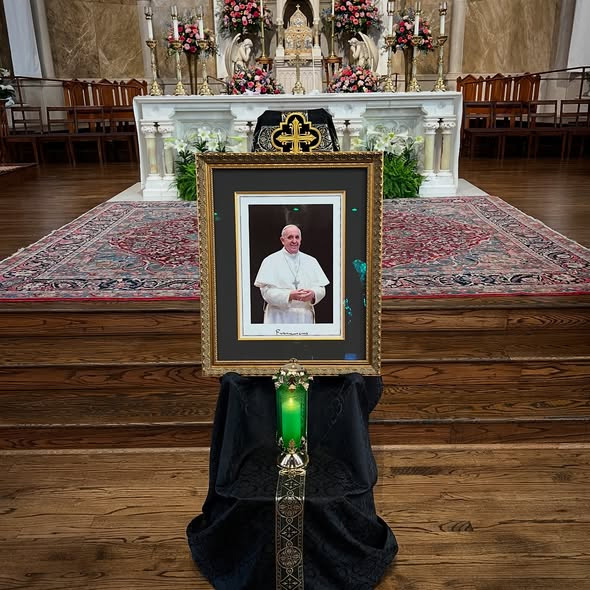
Thoughts which, on those days, were quite a bit about popes. Dead popes, possible popes, new popes. That first day was a Sunday, and I had left Mass at my own parish, where I’d entered through a portal that told a story of both death and life in a glance that morning, in a single step: Doors decked out with wreaths of bright Easter blooms—draped in solemn black. Inside, amid the explosion of white and gold, lilies and Alleluias, the long face of the dead pope gazed at us from a framed photo standing on a black pall, a candle burning in front.
As I’d prepped for this journey, I noted something most normal people probably–definitely—wouldn’t: how many diocesan sees I could hit on the way. Counting my own (Birmingham), I could conceivably pass through at least ten: Nashville, Louisville, Springfield and Peoria (Illinois), Davenport, Cedar Rapids and Dubuque (Iowa), then Sioux Falls and finally Rapid City (South Dakota). With some extra driving–a couple of hours here, an hour there—I could probably work in Evansville and Des Moines, too (I didn’t).
And so the Catholic side quest emerged: See every one of those cathedrals. Then, in the wake of that Sunday Mass in my own cathedral, a secondary quest developed somewhere between Huntsville and the always insanely, screamingly busy Buc-ee’s right before the Tennessee state line: speaking of a dead pope, let’s see, just to see, what everyone’s doing about that.
—————
Traveling as a Catholic can be a pain if you’re even half serious about the faith stuff. Make all the excuses you like, but in the end, there’s no avoiding a particular kind of Sunday scaries: Got to find a Mass.
You search Masstimes.org, rearrange your itinerary, argue with the family and your worst, lazy self about it, figure out distances, check the parish website for your personal definition of craziness: rainbow flag or priest in a biretta? Comic Sans or densely spaced Gothic? Oh, you’ll go no matter what because, well, you have to, but at least you’ll have been warned.
Rushing everyone out to the car, you spy the agnostics, the Nones, and the Protestants enjoying their hotel waffles, unbothered by such hassle, such ridiculous scrambling to go sit somewhere new and strange for an hour on vacation. Are you envious? Maybe. Resentful that you have this thing called an obligation, and they don’t?
And it’s true. They don’t have that obligation, but as you keep mulling this, as you move on down the road, you see the other side—you see that they don’t have the next part, either. The part where you arrive, walk into a place that could be anywhere in the world, and you find yourself at home.
Maybe you’re in the back, sliding in late because you made some wrong turns, or you started in Arizona, and here you are in Utah, and there’s a time difference, who knew? But you’re there. The faces are different, and maybe the language isn’t yours, and the music isn’t to your taste or isn’t familiar.
Everything else is, though. Mary’s there. Joseph. An altar. Holy water on the tips of your fingers. A priest floating down the aisle in the same colors that priests are wearing all over the world today. There’s bread. There’s wine.
And over there: a black-draped pope.
—————
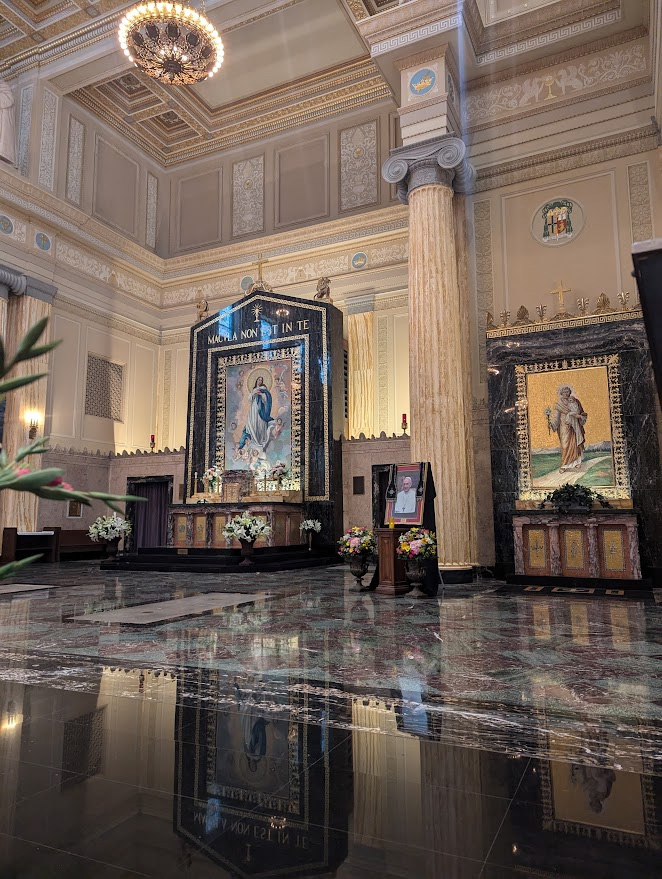
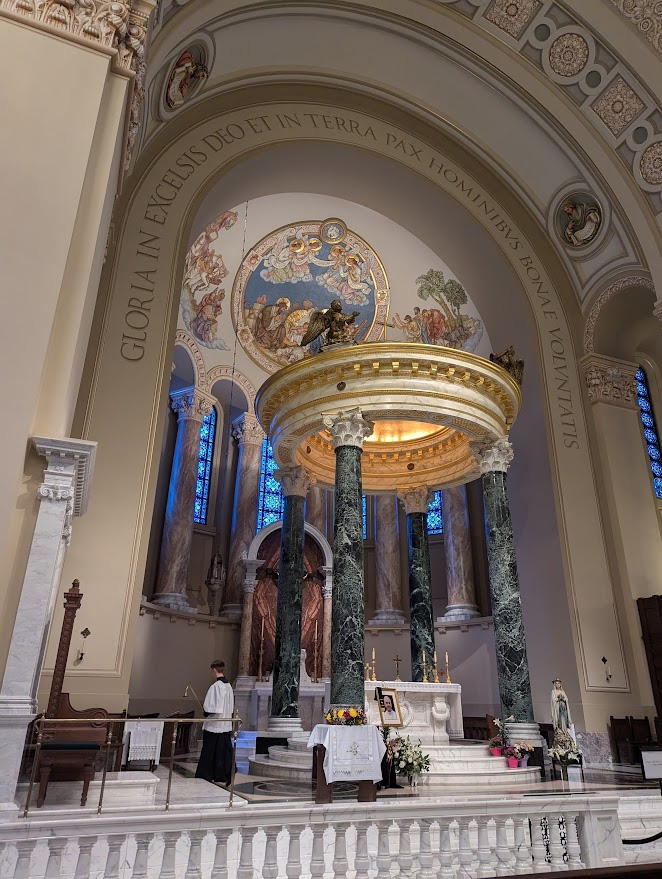
The cathedrals I popped into over those days were solid, as a cathedral should be, and varied—as they also should be, as they are. In Peoria, a soaring Gothic vaulted ceiling glowed blue and glittered with stars. Springfield’s cathedral is not-so colorful Greek Revival, evoking not just Greeks but a classical American, monumental spirit, appropriate for the Land of Lincoln. The stained glass windows told tales of the Church and civil society—including Lincoln commissioning Archbishop Hughes of New York to visit Napoleon III of France, to convince him to not recognize the Confederacy. Politics and religion, indeed.
Dubuque was locked—the only one that was on the whole trip. But the Methodists there had their famed Tiffany windows downtown locked up, too, so that was just the ecumenical theme of that morning, I supposed. Down the Mississippi River, Davenport stood high on a hill above the city, unlocked, but quiet, almost eerily so. Prayer cards for the conclave and pamphlets about “What happens when a Pope Dies” were stacked on a table outside the sanctuary. In the enormous, gleaming Renaissance Revival edifice in Sioux Falls, I made it to a May 1 Mass in honor of the cathedral’s patron, St. Joseph (on one of his feast days) and listened to schoolchildren sing Bruckner—and sing it very well. Across the state in Rapid City, I found daily Mass, along with a few dozen other gray-hairs, in the chapel of the mid-century space, a rectangular block softened by the slightest curves and lightened by cubes of jewel-like glass.
And in every one of those places, Francis gazed from the sanctuary, framed by black bunting, fronted by flowers, possibly a candle. Everywhere I went to Mass, he was there; he was in our prayers.
What a thing, I marveled on the road between these beautiful churches, built through the sweat and sacrifice of thousands of ordinary Catholics, strangers in this strange American land, over decades, over a century: I could jet to Mumbai or Kyoto, Bogata, London or Abuja today and there was absolutely no doubt that if I walked into a Catholic church in any of them, I’d see and hear the same thing: a picture of a dead pope and prayers for his soul. We all knew him—he was on our mind, and we were praying.
All of this, everywhere, no matter what—and here’s the tricky part, here’s the part where we set aside the warm vagaries: we pass over the inspirational memes—all of this, prayer and memorial, this black, these candles—everyone had them, everyone honored the moment, no matter what they might have thought of the man.
For if the thousands of parishioners and scores of priests of those parishes and maybe even the bishops sitting in those cathedras reflect the general Catholic demographic, which I’m sure they did, their views on the papacy of Pope Francis would be, well, varied. Any single congregation would have its share of superfans, as well as those irritated, confused, or angered by his papacy, with the rest—most of them—probably affectionate as to a kindly-seeming elder, a touch sad, curious about what comes next, but largely indifferent.
Which is probably close to the Catholic demographic. On anything and everything.
But in the wake of the death of the Holy Father, the Vicar of Christ, Peter’s successor, differences are set aside, and everyone gets it. It’s time to pray.
And wait.
—————
It was the end of the week, 1600 miles later. The car was parked at the dorm, and the dorm room was re-provisioned from a Wal-Mart run. It was Sunday morning in smalltown, Wyoming, with my flight leaving in the early afternoon, arriving back in Alabama that evening. I checked the news. The conclave to elect the new pope would begin that same week. I scrolled through the feeds, the socials. A lot of folks I knew to varying degrees from the world of Catholic journalism, commentary, and just Catholic Life were apparently on the way to Rome. A lot of them.
Wait. Why not me?
I looked at airfare. Not bad, especially since I had a New York City trip already planned for the next weekend (long story involving a year-old and long, deeply regretted commitment to listen to a Hilton time share sales pitch). I looked at accommodations. Totally doable, and with a cute balcony.
It was a gamble, for sure. I couldn’t stay past Saturday, and the cardinals, much less the Holy Spirit, would not agree to operate on my schedule. I could spend all this money…for what?
Well, I’d be in Rome, which is never a bad thing. I’d meet up with friends, and even if I didn’t see white smoke, I’d see some black, and I’d never even seen that. History, of a sort, no matter what.
It was something I probably wouldn’t ever see again. And it occurred to me while sitting in the Pronghorn Inn that morning, that no matter what the color of the smoke. I’d be turning 65 in a couple of months. And even if the new pope reigned for, say, fifteen years, chances were good that 80-year old me, if she still existed on earth, wouldn’t be up for road-tripping to Conclave 2040. I’d never been present for one, and I’d probably never be able to again.
This might be… my last pope.
So I pushed “purchase” and “reserve,” emailed both my surprised (but also not all that surprised) kids, got back to Birmingham around nine that night, was flying to New York by six the next morning, and was in Rome on Tuesday morning.
You know the rest of that part of the story. The whole thing didn’t take very long after all. The cardinals cooperated. It only took two days. On the first day, Wednesday, thousands of us stood in the square until evening after that first ballot, only to see black smoke, with the same happening on Thursday, in the early afternoon, after the morning votes.
And then, after lunch, which means very late afternoon, in fact early evening in Rome, it happened. And standing there in the crowd, surrounded by Koreans and Mexicans, Poles and Italians, after having a few very Catholic, very weird experiences of running into people from across the world right there in the middle of St. Peter’s Square, I saw it. And for a moment, it didn’t seem real, that trail of smoke. And then we couldn’t figure out the color. It didn’t seem black, but it also seemed kind of darkish, not quite white.
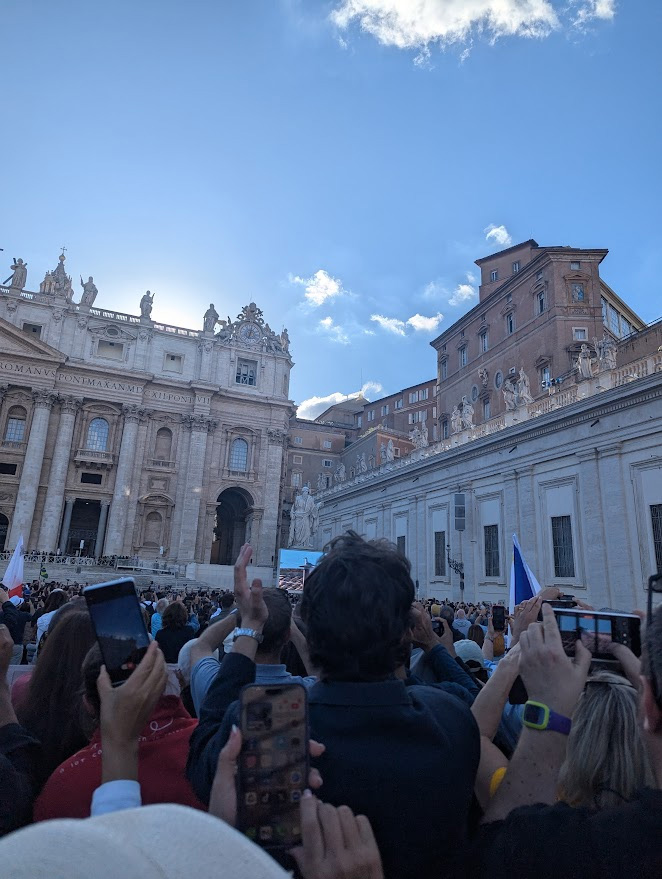
But then, the bells.
They started moving, just a little. The enormous bells hanging high on St. Peter’s façade inched, then swung so slightly, and then more, and then it was unmistakable. The smoke poured out, it was white as a cloud, and those great bells rang and rang and rang.
At the sight of what was certainly white smoke and the pealing bells, tens of thousands of people cheered. The bells rang, smoke poured, and they laughed. They wept. They hugged, they told each other how wonderful it was, and they cried to God: Gracias and thank you and grazie.
But here’s the thing about those several minutes of grateful joy: We didn’t even know who this new pope was.
We had absolutely no idea. In earthly terms, the form in Peter’s chair was a shadow to us. And we wouldn’t know for a few minutes more, not until the cardinal stepped out on the balcony and we strained and listened and picked through the Latin for a name as his voice rolled over us:
Annuntio vobis gaudium magnum; habemus Papam: (cheers and more cheers) Eminentissimum ac Reverendissimum Dominum Robertum Franciscum
Sanctae Romane Ecclesiae Cardinalem Prevost qui sibi nomen imposuit Leo XIV
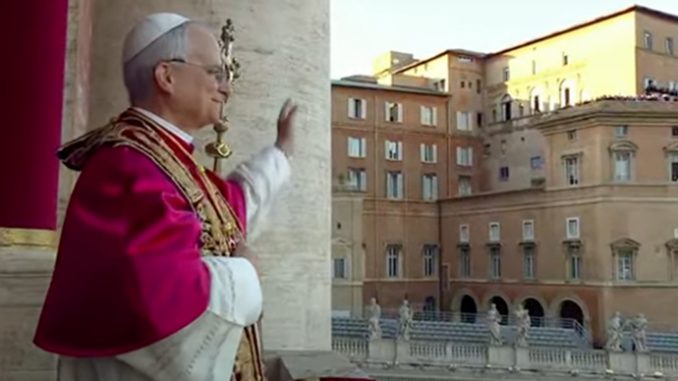
He came out in his mozetta, the cheering surged again, people clung to each other and waved at the man on the balcony who was waving to them. Tears flowed, even down the cheeks of a jaded, spiritually fatigued cynic or two.
But even then, when we knew his name, that was all. We knew nothing, but we were still so very glad.
—————
A week or so later, I was back in the USA. I’d returned through New York City, survived the stupid Hilton time share pitch, seen my two sons who were living in the city, and then on my way to the airport, stopped in a bakery in Astoria my friend had told me about and bought a couple of cookies decorated with images of the new pope.
He was not such an absolute mystery to us anymore, that American from Chicago: Pope Leo
(Editor’s note: Part Two of this essay will be posted on May 14th.)
If you value the news and views Catholic World Report provides, please consider donating to support our efforts. Your contribution will help us continue to make CWR available to all readers worldwide for free, without a subscription. Thank you for your generosity!
Click here for more information on donating to CWR. Click here to sign up for our newsletter.

Thank you for a very interesting article.
Thank you for a delightful, moving, and very human travelogue of a very special time.
Thank you for journaling your Pilgrimage and sharing, Amy. Reminded me of our 5 days in New Orleans last May packing up our niece from grad school. We ventured out each day for Daily Mass and take in new experience, whether it be the St. Louis Cathedral, Our Lady of Succor, or a Latin Mass, etc. In hindsight, it was a mini-Pilgrimage just as spiritually enriching as a planned one with 24 other like-minded Catholics traveling from Paris to Rome on a motor coach for 16 days! Whenever we can encounter our faith through the Saints, first class relics, beautiful architecture, and sacred grounds, we are drawn closer to the Heavenly realm of the Father, Son, and Holy Spirit; the joyful remembrance in every Mass! Holy Fathers, pray for us!
Thank you so much. That was a great story.
How did you like Buccee’s?
Amy – wow! Complete awesome article. We can relate. Been in most of those same Cathedrals on road trips and certainly much time in Wyoming. You wrote precisely the feelings and thoughts I’ve experienced. Praise our Savior for His Church. Holy Spirit, we pray for Pope Leo.
No time to read it all (since I’ve got to get READY).
So far, I LIKED THIS VERY MUCH: “… but in the end, there’s no avoiding a particular kind of Sunday scaries: Got to find a Mass.”
My favorite story about the mourning of Bergoglio features a Midwestern pastor who said the departed pope’s memorial Mass…
…In Latin!
(Emoji laughing hysterically.)
Oh, I like Buc-ee’s (or however you spell it). We’ve had one outside of Birmingham for a few years. It’s chaotic, but the gas prices are usually better, the restrooms of course are spotless, and they have a smoked-turkey cubed cheese cup that is my go-to travel snack!
(I avoid it on weekends, of course, if I can)
My one *huge* pet peeve is how people leave their cars at the gas pumps while they go inside and shop. Drive me CRAZY. I want people arrested for it.
Thank you Miss Amy. Jalapeno peanut brittle and BBQ are my favorite things at Bucee’s . And of course the beautiful restrooms with art on the walls. My grandchildren consider Bucees a destination in itself.
I didn’t realize that about people taking up spaces at the gas pumps. That’s a shame.
Road trips can be great fun. Keeping an open mind to opportunities that arise can be both fun and educational. It also helps to have a decent vehicle.
My less than decent vehicle for a solo cross country motorcycle trip in the mid-seventies, from NY to Tucson, was an antique Harley Davidson. The carburetor was from 1910, for which I had to reach down and keep readjusting the fuel mixture with elevation changes passing through mountainous areas. No instruments except an oil pressure gauge I placed at the base of the crankcase.
Passing through the desert areas inspired to play in my mind the rock song “A Horse With No Name” (In the desert you can remember your own name because there ain’t no one to give you no pain.)
I battled bad weather and mechanical breakdowns there and back, making roadside repairs with a strategic assembly of tools preprepared in my knapsack. But there were many moments to appreciate the landscape and think about the God I was just beginning to believe in at that point in my life, a few years before my eventual conversion to Catholicism. An extreme grueling journey. Not exaggerating, I slept 16 hours the night after I got back home.
Wow, Mr. Baker. That must have been some road trip. You must have met interesting people along the way.
Many years ago my brave mother took me & my little brother on a pre-interstate, cross country road trip in an old, disreputable station wagon. It was something I’ll never forget.
To stretch the patience of the editors by making this a personal epilog, I’ll recount one memory of one encounter despite a small separation. From Amarillo, I headed south to connect with Interstate 10, which for a stretch runs parallel with tracks for what was then the Santa Fe RR. It was around sunset and the road was completely absent of other vehicles when I was cruising along at about 70 overtaking a long freight travelling around 40 or 50.
When I reached the point near the locomotive, I exchanged waves with the engineer. He then made a pointing gesture towards the twilight sky. We both appreciated the spectacular sunset. The proverbial two ships passing in the night. I traveled on for a while, rode off-road into the desert and set a small campsite to rest overnight before my next day’s push on to Tucson. The event inspired me to compose a poem before turning to sleep.
One of the fleeting connections you make in life and wonder about the encounter for the rest of your life. I hope I meet that engineer in eternity.
Bedded down with one RSV virus following another, I watched the 1981 11-episode (16 hour) series of Brideshead Revisited starring Jeremy Irons, with Laurence Olivier earning an Emmy. Read the novel or see the series for a worthwhile treat.
Re Mass-going by Catholics on Sunday, without spoiling alert, I will say this: The story revolves around a few upper-class aesthetes at interwar Oxford. The group dally with decadence, the ‘langour of youth’ and perhaps homosexuality. Yet, the influence of religion is not beyond their notice with their sinful lives are not beyond God’s grace. In one scene, one observes those practicing and fulfilling the Sunday obligation. [Evelyn Waugh, author of Brideshead, converted to Catholicism in his lifetime.]
The narrator describes what he sees in an 11 AM Sunday morning at term’s end. “Corporate Communion” was practiced by Oxford students. [I had to look that up what that meant.] This scene followed fast upon the narrator’s night of debauchery and inability to sleep until dawn.
First, the frequency of bells passes from “change-ringing” to a single chime. Then, “None but church-goers seemed abroad that morning; undergraduates and graduates and wives and tradespeople, walking with that unmistakable English church-going pace which eschewed equally both haste and idle sauntering; holding, bound in black lamb-skin and white celluloid, the liturgies of half a dozen conflicting sects; on their way to St. Barnabas, St. Columba, St. Aloysius, St. Mary’s, Pusey House, Blackfriars and heaven knows where besides; to restored Norman and revived Gothic, to travesties of Venice and Athens; all in the summer sunshine going to the temples of their race. Four proud infidels alone proclaimed their dissent,…” He describes “a troop of Boy Scouts, church-bound too, bright with coloured ribbons and badges,” and “the Mayor and corporation, in scarlet gowns and gold chains, preceded by wand bearers…in procession to the preaching at the City Church.” He passes “a crocodile of choir-boys, in starched collars and peculiar caps, on their way to Tom Gate and the Cathedral. So through a world of piety I made my way to Sebastian.” [This is near the end of Ch. 2, p. 59 of the Little Brown edition.]
[The novel is particularly humorous, reminding me of PG Wodehouse. The TV series only hints at humor. Then I learned that Wodehouse influenced Waugh.] Brilliant!
The novel is my second all-time favorite, Werfel’s The Song of Bernadette my first. But I have to warn anyone seeking the movie version to find the original.
A trashy film rendition was made in the two thousands with no connection at all to the art and Catholic insights of Waugh.
The theme was altered into another exercise in anti-Catholcism.
If I had watched that 2000 trash film, I likely would never have taken up the book.
For some 50+ years, professors and friends had recommended Brideshead, but the title offput. Chesterton, Knox, Belloc, other contemporaneous Interwar and Edwardian writers I found capacious and portentous. I was ignorant and stupid!
Imagine my DELIGHT at discovering Waugh. His eye for observation and charm at description almost overwhelms. For instance, he likened the distinct tastes of drinking a special port “like swallowing a spectrum”! He scatters little gems like these throughout. Sebastian’s speech is a burst of soap bubbles, catching and reflecting rays of light, then gone in an immemorable poof. Plot and theme? Entrancing. Characters? Well drawn and round, yet so universal it seems I’ve known each and every one, now alive with me in a reading room! I am enthralled. Of course there is that ineffable thing in Waugh’s writing that surprises in unexpected ways. In Brideshead, Waugh knows and communicates well its ingenuous, inenarrable existence. We Catholics recognize it as grace.
THANK YOU FOR BECOMING MY LITERARY FAMILY MEMBER, EDWARD!
meiron: I agree with all you say, except I am a fan of ChesterBelloc.
By intention Waugh made all the Catholic characters fit an arch type of Catholicism, but with pity for each of them. The stern mother, a disobedient daughter, a pixyish but devout daughter, later to become self-sacrificing and wise, a prim, proper, and boring elder son, and a decadent, wounded son whose suffering led to his redemption. And then the outsider, a soft cynic, but honest enough to respond to the “tug on a string” after a youth of futility when privileged to witness grace in the dying father that stripped away his tower of denials.
I occasionally run into someone who says, when is someone going to write the great Catholic novel, to which I say, I guess you never heard of Brideshead Revisited.
Regards,
Ed
I revised my youthful idiocy on Belloc in my third decade and Chesterton in my fourth. Thank God he grants a longer lifetime—the idiocy of our youth doesn’t remain forever.
You have to be on a watch there meiron, considering the full title of the book and this scoop in WIKIPEDIA. The purpley prose is tailored. He wrote this long after he had “converted”.
‘ David Higdon argued that “[I]t is impossible to regard Sebastian as other than gay; [and] Charles is so homoerotic he must at least be cheerful”; and that the attempt of some critics to downplay the homoerotic dimension of Brideshead is part of “a much larger and more important sexual war being fought as entrenched heterosexuality strives to maintain its hegemony over important twentieth century works”. In 2008 Christopher Hitchens derided “the ridiculous word ‘platonic’ that for some peculiar reason still crops up in discussion of the story”.
The phrase “our naughtiness [was] high on the catalogue of grave sins” is also seen as a suggestion that their relationship is homosexual, because this is a mortal sin in Roman Catholic doctrine. Attention has also been drawn to the fact that Charles impatiently awaits Sebastian’s letters, and the suggestion in the novel that one of the reasons Charles is later in love with Julia is her physical similarity to Sebastian. When the two become a couple in the novel’s third part, Julia asks Charles, “You loved him, didn’t you?” to which Charles replies, “Oh yes. He was the forerunner.” Charles does, however, when looking back, also think that maybe it was Julia he saw in Sebastian. Moreover, he considers his first feeling of sexuality to be the moment when he lights Julia a cigarette and places it between her lips.
Waugh wrote in 1947 that “Charles’s romantic affection for Sebastian is part due to the glitter of the new world Sebastian represents, part to the protective feeling of a strong towards a weak character, and part a foreshadowing of the love for Julia which is to be the consuming passion of his mature years.” In the novel, Cara, Lord Marchmain’s mistress, says to Charles that his romantic relationship with Sebastian forms part of a process of emotional development typical of “the English and the Germans”. This passage is quoted at the beginning of Paul M. Buccio’s essay on the Victorian and Edwardian tradition of romantic male friendships.
…..
Waugh wrote that the novel “deals with what is theologically termed ‘the operation of Grace’, that is to say, the unmerited and unilateral act of love by which God continually calls souls to Himself”. This is achieved by an examination of the Roman Catholic aristocratic Flyte family as seen by the narrator, Charles Ryder.
In various letters, Waugh refers to the novel a number of times as his magnum opus; however, in 1950 he wrote to Graham Greene stating “I re-read Brideshead Revisited and was appalled.” In Waugh’s preface to his revised edition of Brideshead (1959), the author explained the circumstances in which the novel was written, following a minor parachute accident in the six months between December 1943 and June 1944. He was mildly disparaging of the novel, stating; “It was a bleak period of present privation and threatening disaster – the period of soya beans and Basic English – and in consequence the book is infused with a kind of gluttony, for food and wine, for the splendours of the recent past, and for rhetorical and ornamental language which now, with a full stomach, I find distasteful.” ‘
https://en.wikipedia.org/wiki/Brideshead_Revisited
Recommending the book is not recommending homosexuality. If the book deals with homosexuality, it (and the 1980 movie) does so in a totally unstated way and merely suggestive way.
It has been only within the past 20 years in the US that homosexuality has been legalized and celebrated by some. Prior to the past couple decades, many localities carried laws on the books which could land a homosexual in jail. It existed but was not much talked about. Waugh treats it quietly and only hints at it, never outrightly saying so.
But it seems we always need to remember that God’s grace works in mysterious ways, and that is demonstrated throughout the novel. Without my giving away any spoils, please know that.
I will continue to recommend the novel and I will continue to enjoy the writing for its charm and its obsessive skill at observing and describing the world and its people, sinners all. If you’ve never read Bernanos’ Diary of a Country Priest, you would likely be scandalized at all the sin in one little French village. You’d likely be in awe at the power of grace there too. Remember that where sin it, grace abounds the more.
GBY.
GBY, God be with you, God bless you.
When the tv series came out my peers avoided the chance to watch tv when this was showing. Wasn’t popular. The feeling it evoked was homosexuals in a quandary for which the Church was to blame, all “unjust” importunate; they shouldn’t settle for melancholia and the bucolic and staying in lane (as with the Church-going described/acted out that you recounted), just get on with it. Terrible! The Church being singled out there, the RC, wouldn’t you know. The title over-arching everything.
You have to pay attention to what the young generations say you know. Don’t oppress them either. It’s “adult” material and it spoils the sunshine and the rain and the mist haha!
As a former atheist, I can attest that conversion is a gradual process, usually spanning years, and Wikipedia is not a very reliable source for any subject, not even science and technology.
Only ideological left wing homosexualists would interpret cultural suppression of homosexual content in art. It has always been overt.
Brideshead was partly biographical and was composed by a man with a Catholic mind. And a Catholic mind never regards habits of decadence, including homosexuality, as permanent. Perceptions about the meaning of everything that matters can shift with moods, especially while looking back on life from the perch of a long life. The brilliant, not “purple prose”, writing of Brideshead captured moods of youthful explorations that can easily embarrass those who first put them to paper viewed from their later life. Yet, they still tell a story that reveals the process of gradual turning to holiness by those who are not life long saints.
Okey Dokey! I checked bits of the Wikipedia article. The original source for the Higdon quote shows his argument against any binary sexuality. IOW, he mentions and spins or asserts homosexual attraction or acts in every scrap of literature that suggests in any tangential way an affection between two persons of the same sex. THAT is a pro-homosexual piece as Higdon sees it everywhere. He seems to be quite happy to report that this most Catholic of Catholic novels celebrates ‘gay.’ In point of authentic fact, it does NOT.
The title? First, it is not used. Does anyone today refer to it? I had to look it up. Here one sees what one wants to see. The word SACRED is part of the subtitle as well as the word PROFANE. In a world of sin, grace abounds more. Characters in the novel have a mix of both. Only Jesus and Mary are perfect. And absolute grace wins in the end of the novel.
Christopher Hitchens has an inherent bias. He is a well-known atheist, advocating for atheism, and he admits to homosexual relationships/s in his youth. He is on record advocating for gay rights, etc. His brother Peter is high Anglican and sees homosexuality as immoral. (All this gleaned in AI sources.)
AI corrected “Buccio” to Puccio whose 1995 dissertation did not discuss Brideshead AT ALL. Rather, the dissertation, titled, “Brothers of the Heart: Friendship in the Victorian and Edwardian Schoolboy Narrative” is described as “one of the most detailed studies of:
1) how Victorian/Edwardian culture constructed male intimacy;
2) how literature encoded romantic but non‑sexualized male bonds;
3)how shifting norms of masculinity reshaped the emotional vocabulary”
Finally, I noted someone somewhere saying: “It is reward enough to teach the novel’s conflict between materialism and spiritualism, between free will and fate, but first its characters’ sexual identities must be won back from frightened criticism.” In addition to “frightened” I would add “misconstrued.” Many in our culture today are only too happy to say that the main characters in this Catholic of Catholic novels show our Church teaching to be so ‘fossilized’ that it dates Sodom and Gomorrah, a place and a story made up of whole cloth.
There is more going on than just the appreciative circle of thought Waugh and those who wish to cherish him, might like to prefer should surround some of his writing. Maybe all of his writing. Thus I did say we should listen to the younger generations and not oppress them. They should not be made to have to take sides with particular “literary cultural perspective”. Impressing on youngsters to have to uphold particular cultural iconography is bad and the opposite of good education. Worse, of course, when it is so mingled up with evils. Worst when it comes on them as obligatory/mandated. Waugh himself said he was appalled; and this can oppress too since as far as is known he made no actual retraction. Banal material working like a hazing without proper instruction and with misguided instruction endorsed from on high is the antithesis of academic pursuit. Purpley prose gone mad and gone to depravity.
Waugh used the language of vice to describe HIS desires for writing what he did. Deliberately contrived. He might have gotten a forgiveness -maybe; but it does not retroactively cleanse the product or qualify the product for education of youth! If he even meant it that he was appalled.
Recently, Bishop Strickland was touching on the areas for forging unity among different ecumenical groups.
“If we look at media of all kinds it isn’t anything clear and direct we get, but a mockery. It all gets flipped …. insidious undermining …. lowered to something that has no value.”
Bishop Strickland
Isaiah 5:20 and words that distort
https://www.lifesitenews.com/episodes/stand-strong-bp-strickland-inspires-pro-life-activists-to-continue-heroic-work-on-front-lines/?utm_source=featured_video
Bishop Barron
Clash of the meta-narratives
https://www.catholicworldreport.com/2014/07/30/hercules-n-t-wright-and-the-modern-meta-narrative/
I have to admit I’ve never read Brideshead Revisited but I’ve watched the movie & visited the location where it was filmed. The SSA undercurrent was disturbing but it probably reflects what UK male boarding school students could experience. Most went on to have normal marriages & families but others could be really scarred.
I did read “The Loved One” though, & it was super funny in a dark way.There was a film adaptation, too.
The ‘redeeming’ of the homosexual undercurrent in the Brideshead novel is that characters choose to have their scars and their pain healed.
There is a good amount of subtle humor in Brideshead too. I never read ANY Waugh until this spring. After numerous failed attempts to read his bio of R. Knox, I finally gave the book to charity.
Could it be that the book in which Pope Francis declared that Benedict Emeritus had come to “agree with him” to “legalize homosexual civil union”; was a deliberate alteration of text or an insertion contrary to anything intended by the author?
Perhaps. But one would expect in that case that Pope Francis would have said something about it, to clarify, which he had time to do before he passed.
And if it is an alteration or insertion it would mean there is devilry going on inside the publishing house.
On the other hand, if it is true that THAT declaration is Pope Francis’ own real intention, then had the publishing house extracted it and hidden it, it would have made it much harder to get at the fact.
If it is to be overlooked for whatever reason, there will be problems coming from it for a long time to come. Not right for such things to be placed upon the faithful.
It is going to have to be addressed in a most dispassionate manner, I think.
Bp. Schneider: Synod Report is “Unequivocal Heresy” & Pope Leo XIV Must Act or Face Christ’s Rebuke!
https://www.lifesitenews.com/episodes/1131078/?utm_source=most_recent
Doesn’t sound like a gas…
It’s not. It’s a destination.
🙂
Thank you for this insightful and entertaining rendition of your travels and your decision to go to Rome. Hopefully, being present when Pope Leo XIV was elected will be one of your favorite memories! God bless
This is a wonderful piece, I loved the part about being in the square with people all over the world, all happy and cheering for the pope… whoever he was! I remember turning the TV on to see if there was a pope yet during the conclave after St. John Paul II died… and BOOM! White smoke! I had reverted to the Church only a few years earlier and had no idea that I would feel anything at all. Instead I jumped up and down with excitement. And when he came out on the balcony I thought he looked a bit familiar. I understood the Latin well enough to understand “Joseph Cardinal Ratzinger” and my first thought was (I kid you not)–“The guy on my mug!” I had bought a “Cardinal Ratzinger Fan Club” mug from our seminary bookstore a year or two before, because I thought it was so funny. And now he was pope! What a great Church.
I extend apologies to Ms. Welborn. This highjacking of a great article was not intentional. Your article sparkled with a brilliant vibrancy and brought to mind that scene in the novel of people wending their way to Oxford’s end-of-term Sunday Mass.
Thanks for including the photo of St. Joseph Cathedral in Sioux Falls. Did you notice how it sits atop the hill so all the sky is above and behind it. Did you climb its magnificent spiral staircase? Dizz-i-fying!
I also loved the pictures of the Cathedrals.
Well, I was reminded of the disciples on the walk to Emmaus and how the charismatics love to eat it up; and how the Lord went looking for them and hijacked them. Maybe something will come in view in the second part of the travelogue that would allow me to elaborate!