No Picture
News Briefs

Cardinal Pell’s Easter message: ‘We can redeem our suffering by joining it to His’
April 10, 2020 CNA Daily News 0

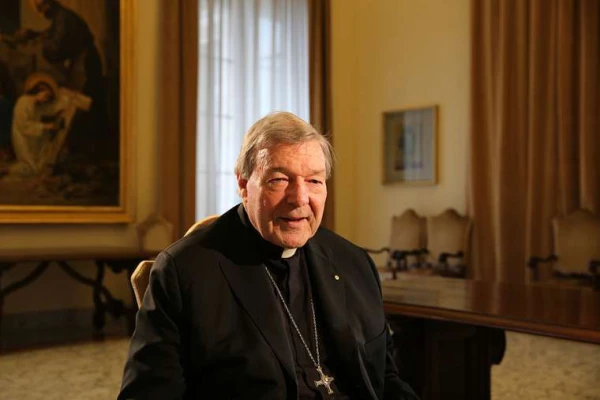
CNA Staff, Apr 10, 2020 / 03:35 pm (CNA).- Cardinal George Pell said Friday that suffering can be offered to God for good, and that Christians see Christ in the suffering, and are obliged to help them. His message came days after his release from prison, and amid the global coronavirus pandemic.

“The sexual abuse crisis damaged thousands of victims. From many points of view the crisis is also bad for the Catholic Church, but we have painfully cut out a moral cancer and this is good. So too some would see COVID-19 as a bad time for those who claim to believe in a good and rational God, the Supreme Love and Intelligence, the Creator of the universe,”  Pell wrote in an Easter message published by The Australian April 10.

“It is a mystery; all suffering, but especially the massive number of deaths through plagues and wars. But Christians can cope with suffering better than the atheists can explain the beauty and happiness of life,” the cardinal added.

Pell was convicted in December 2018 of sexually assaulting two choirboys at the Melbourne Cathedral in 1996. On April 7, the Australian High Court unanimously ruled that the evidence presented during the trial would not have allowed the jury to avoid reasonable doubt and ordered Pell’s acquittal and release after more than 400 days in prison.

The High Court’s Tuesday decision marked the end of a nearly three-year legal process which began in June 2017, when the cardinal was charged with several counts of sexual assault dating back decades. The majority of these charges were dropped before they could be brought to trial.

Pell, who was most recently the Archbishop of Sydney before he left Australia in 2014 for a Vatican position as prefect of the Secretariat of the Economy, has returned to Sydney after his release from prison.

In his message, the cardinal acknowledged his incarceration, writing that “I have just spent 13 months in jail for a crime I didn’t commit, one disappointment after another. I knew God was with me, but I didn’t know what He was up to, although I realised He has left all of us free. But with every blow it was a consolation to know I could offer it to God for some good purpose like turning the mass of suffering into spiritual energy.”

“The only Son of God did not have an easy run and suffered more than his share. Jesus redeemed us and we can redeem our suffering by joining it to His and offering it to God,” Pell added.

In a reference to the challenges of the coronavirus pandemic, Pell noted that in times of plague and difficulty, Christians were unique in the ancient world for their commitment to nurse and care for the sick.

“Too often the irreligious want to eliminate the cause of the suffering, through abortion, euthanasia, or exclude it from sight, leaving our loved ones unvisited in nursing homes. Christians see Christ in everyone who suffers — victims, the sick, the elderly — and are obliged to help,” he wrote.

The Easter message of Sydney’s current leader, Archbishop Anthony Fisher, also addressed hope and the coronavirus pandemic.

“Dare we hope in a world that is suffering? It can seem impossible, even insensitive, to talk of hope when people are sick or dying, anxious or isolated, unemployed or otherwise burdened,” Fisher’s message said.

There is, however, reason for hope, the archbishop wrote.

“Think of the countless acts of selfless service we’ve witnessed of late from health workers, neighbours, families, pastors. Think of the novel pastoral responses to this novel coronavirus. In times like these people of faith and ideals really shine.”

“On Easter night the new Easter candle is normally lit and carried into the Church as a symbol of Christ, our light returned and hope restored. This year there’ll be no congregation to light their own candles from it. But already people are demonstrating Easter light in their works of mercy and prayer,“ Fisher wrote.

Cardinald Pell’s release from prison this week has been controversial, and was met with protest in Australia.

Hours after Pell was exonerated, St. Patrick’s Cathedral in Melbourne was vandalized. The cathedral’s door was spray-painted with a cartoon image of a devil, along with the message “ROT IN HELL, PELL.” Other doors were daubed with upside-down crosses and the words “NO JUSTICE,” “PAEDO RAPIST,” and: “The law protects the powerful.”

Archbishop Peter Comensoli of Melbourne told Australian media that while he was upset about the vandalism, he was “not entirely surprised.”

“There remains such strong emotions around all of these matters,” Comensoli told Australian news network 3AW.

The cardinal’s Easter message included a proclamation of the Gospel: that Jesus of Nazareth died, and was resurrected bodily. “It was a return of his entire person from death, breaking the rules of health and physics, as Christians believe this young man was the only Son of God, divine, the Messiah…who redeems us, enables us to receive forgiveness and enter into a happy eternity.”

On April 7, the day he was released from prison, the cardinal told CNA that “prayer has been the great source of strength to me throughout these times, including the prayers of others, and I am incredibly grateful to all those people who have prayed for me and helped me during this really challenging time.”


[…]

No Picture
News Briefs

Gomez, and Catholics across the US, look to the Sacred Heart in Good Friday litany

April 10, 2020 CNA Daily News 0

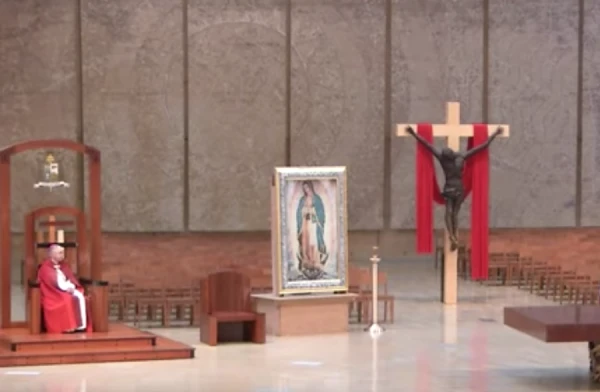
Denver, Colo., Apr 10, 2020 / 12:46 pm (CNA).- Isolated in their homes on a Good Friday unlike any other, Catholics across America tuned in April 10 for a litany to the Sacred Heart of Jesus, led by the president of the U.S. bishops’ conference, who himself stood nearly alone in a cathedral built to welcome thousands.

Archbishop Jose Gomez of Los Angeles said Friday that amid the questions raised by Christ’s death, and by the global pandemic, the most important answer is God’s love.

“We stand today at the foot of the cross with Mary, our Blessed Mother, and we look upon her Son, crucified. And we ask God: Why did he have to die? Couldn’t there be some other way?”

“Today we are also asking God: Why this coronavirus? Why have you allowed this disease and death to descend on our world?”

“We know that Jesus on the cross is the only answer,” Gomez said, in a homily he preached both in English and Spanish, while at least 10,000 people tuned in to a livestreamed broadcast of a liturgy of the Word, and a moment of prayer to the Sacred Heart of Jesus Christ.

“In the heart of Christ — wounded by the soldier’s spear, pierced by our sins — we see how much God loves the world. We see how precious we are in our Father’s eyes,” Gomez said.

“Jesus has opened his heart for us. He has given his life out of love for us. Now he calls us to entrust our lives to him — our whole heart, our whole mind; all our feelings and thoughts, our words and actions.”

“In this moment, Jesus is inviting every one of us in the Church to take up our cross and to follow him along the path of humble love, the path of reverence for God and service to our neighbors,” the archbishop added.

After his homily, Gomez led a litany, in which Catholics expressed their faith in the mercy of God. “Jesus, I trust in you,” Archbishop Gomez repeated, “¡Sagrado Corazón de Jesús, en ti confío!

In Wilmington, Delaware, Colin Stapleton-Bradley, 26, was consoled by the archbishop’s words.

“I thought that the litany helped me deal with the uncertainty of suffering, especially in light of the coronavirus, why it happens, and how we can use our own suffering to, in some small way, relate to Christ’s passion,” he told CNA.

Robert and Jess Nayden watched the archbishop’s litany while their children, ages 3 and 1, ate lunch in Bridgeport, Connecticut.

“I really appreciated that Archbishop Gomez organized this. It was simple and prayerful, and his homily about trusting the Sacred Heart of Jesus spoke to a lot of what I’ve been praying about recently,” Robert told CNA.

“We’ve also struggled to get into live-streamed liturgies these past few weeks, but this was a moment where I felt united in prayer with people across the country,” he added.

Seminarian Ryan Mau of San Jose expressed a similar sentiment. 

“I was very happy to join other American Catholics in this,” he told CNA.

“I haven’t been able to attend Mass since I was sent home from the seminary so to join in on a service like this reminds me how much I miss community and we can still be unified by prayer, even though most of us are not physically able to,” Mau said.

The seminarian mentioned gratitude for the witness of Gomez.

“I felt a sense of leadership and the guidance that really only a father can give me. I felt like he has been a great example especially in this odd time that we are all currently experiencing.”

Of a liturgy that switched between English and Spanish, Mau expressed support. “We need to reach out to all of God’s children and need to be able to speak the languages necessary to do it,” he said.

Bo Bonner of Des Moines, Iowa watched the litany with his five children. He said he had a bit of difficulty with the livestream, and he wasn’t sure what he needed to do to obtain the plenary indulgence attached to the litany. But, he said, “I thought the recitation by the archbishop was good and that is most important, and his words were timely and appreciated.”

While he said he appreciated more the optics of the Urbi et Orbi blessing offered by Pope Francis March 27 than those of LA’s cathedral, “I am very glad we did it as a nation.” 

“I appreciate the opportunity to earn an indulgence during such a singular Good Friday,” he added.

Claire Breux of Washington, DC, also watched online. Family members in Louisiana and Salt Lake City alo tuned in, while they met together in a Zoom meeting to pray as a family, along with the archbishop.

Breux said praying with her family over Zoom has been edifying in a time of difficulty.

“We’ve done night prayer together this way a couple times already.  We all agree it gives the prayers an added richness- we feel closer to each other and more united and encouraged in growing in holiness while we are apart,” she told CNA.

“My whole prayer through this weird time has been for an outpouring of grace for holiness, that we see how much we need God- which of course is easier to miss when life is good- and that [God] has already provided everything we need.”

“Certainly on Good Friday I look at the cross and see that it’s all been accomplished for us,” she added.

In LA, Gomez, too, looked to the cross.

“Let us love one another, joining our sufferings to the heart of Christ, open for us on the cross. Let us sacrifice for one another, take care of one another, forgive one another,” the archbishop said at the conclusion of his homily.

“May our Blessed Mother Mary intercede for us in her sorrows today.”

“May she help us to be meek and humble of heart, and to persevere in this Good Friday of disease and death, to hasten to the Easter morning of the resurrection.”


[…]

No Picture
News Briefs

Full text: Fr. Cantalamessa’s homily for Good Friday

April 10, 2020 CNA Daily News 4

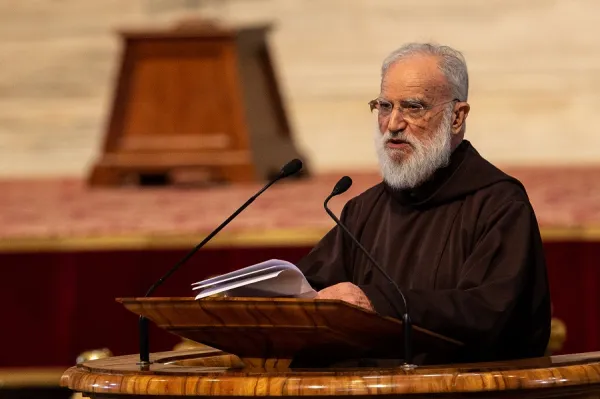
Vatican City, Apr 10, 2020 / 11:23 am (CNA).- Here is the full text of the Good Friday homily of Fr. Raniero Cantalamessa, OFM Cap., delivered April 10 at St. Peter’s Basilica.

“I have plans for your welfare and not for woe”

St. Gregory the Great said that Scripture “grows with its readers”, cum legentibus crescit. [1] It reveals meanings always new according to the questions people have in their hearts as they read it. And this year we read the account of the Passion with a question—rather with a cry—in our hearts that is rising up over the whole earth. We need to seek the answer that the word of God gives it.

The Gospel reading we have just listened to is the account of the objectively greatest evil committed on earth. We can look at it from two different angles: either from the front or from the back, that is, either from its causes or from its effects. If we stop at the historical causes of Christ’s death, we get confused and everyone will be tempted to say, as Pilate did, “I am innocent of this man’s blood” (Mt 27:24). The cross is better understood by its effects than by its causes. And what were the effects of Christ’s death? Being justified through faith in him, being reconciled and at peace with God, and being filled with the hope of eternal life! (see Rom 53:1-5).

But there is one effect that the current situation can help us to grasp in particular. The cross of Christ has changed the meaning of pain and human suffering—of every kind of suffering, physical and moral. It is no longer punishment, a curse. It was redeemed at its root when the Son of God took it upon himself. What is the surest proof that the drink someone offers you is not poisoned? It is if that person drinks from the same cup before you do. This is what God has done: on the cross he drank, in front of the whole world, the cup of pain down to its dregs. This is how he showed us it is not poisoned, but that there is a pearl at the bottom of this chalice.

And not only the pain of those who have faith, but of every human pain. He died for all human beings: “And when I am lifted up from the earth,” he said, “I will draw everyone to myself” (Jn 12:32).

Everyone, not just some! St. John Paul II wrote from his hospital bed after his attempted assassination, “To suffer means to become particularly susceptible, particularly open to the working of the salvific powers of God, offered to humanity in Christ.”[2] Thanks to the cross of Christ, suffering has also become in its own way a kind of “universal sacrament of salvation” for the human race.

What light does all of this shed on the dramatic situation that the world is going through now? Here too we need to look at the effects more than at the causes—not just the negative ones we hear about every day in heart-wrenching reports but also the positive ones that only a more careful observation can help us grasp.

The pandemic of Coronavirus has abruptly roused us from the greatest danger individuals and humanity have always been susceptible to: the delusion of omnipotence. A Jewish rabbi has written that we have the opportunity to celebrate a very special paschal exodus this year, that “from the exile of consciousness” [3]. It took merely the smallest and most formless element of nature, a virus, to remind us that we are mortal, that military power and technology are not sufficient to save us. As a psalm says, “In his prime, man does not understand. / He is like the beasts—they perish” (Ps 49:21). How true that is!

While he was painting frescoes in St. Paul’s Cathedral in London, the artist James Thornhill became so excited at a certain point about his fresco that he stepped back to see it better and was unaware he was about to fall over the edge of the scaffolding. A horrified assistant understood that crying out to him would have only hastened the disaster. Without thinking twice, he dipped a brush in paint and hurled it at the middle of the fresco. The master, appalled, sprang forward. His work was damaged, but he was saved.

God does this with us sometimes: he disrupts our projects and our calm to save us from the abyss we don’t see. But we need to be careful not to be deceived. God is not the one who hurled the brush at the sparkling fresco of our technological society. God is our ally, not the ally of the virus! He himself says in the Bible, “I have . . . plans for your welfare and not for woe” (Jer 29:11). If these scourges were punishments of God, it would not be explained why they strike equally good and bad, and why the poor usually bring the worst consequences of them. Are they more sinners than others?

No! The one who cried one day for Lazarus’ death cries today for the scourge that has fallen on humanity. Yes, God “suffers”, like every father and like every mother. When we will find out this one day, we will be ashamed of all the accusations we made against him in life. God participates in our pain to overcome it. “Being supremely good” – wrote St. Augustine – “God would not allow any evil in his works, unless in his omnipotence and goodness, he is able to bring forth good out of evil.”[4]

Did God the Father possibly desire the death of his Son in order to draw good out of it? No, he simply permitted human freedom to take its course, making it serve, however, his own purposes and not those of human beings. This is also the case for natural disasters like earthquakes and plagues. He does not bring them about. He has given nature a kind of freedom as well, qualitatively different of course than that of human beings, but still a form of freedom—freedom to evolve according to its own laws of development. He did not create a world as a programmed clock whose movements could all be anticipated. It is what some call “chance” but the Bible calls instead “the wisdom of God.”

The other positive fruit of the present health crisis is the feeling of solidarity. When, in human memory, have the people of all nations ever felt themselves so united, so equal, so less in conflict than at this moment of pain? Never so much as now have we experienced the truth of the words of a great Italian poet: “Peace, you peoples! Too deep is the mystery of the prostrate earth.”[5] We have forgotten about building walls. The virus knows no borders. In an instant it has broken down all the barriers and distinctions of race, nation, religion, wealth, and power. We should not revert to that prior time when this moment has passed. As the Holy Father has exhorted us, we should not waste this opportunity. Let us not allow so much pain, so many deaths, and so much heroic engagement on the part of health workers to have been in vain. Returning to the way things were is the “recession” of which we should have the most fear.

“They shall beat their swords into plowshares and their spears into pruning hooks; One nation shall not raise the sword against another, nor shall they train for war again.” (Is 2:4)

This is the moment to put into practice something of the prophecy of Isaiah whose fulfillment humanity has long been waiting for. Let us say “Enough!” to the tragic race toward arms. Say it with all your might, you young people, because it is above all your destiny that is at stake. Let us devote the unlimited resources committed to weapons to the goals that we now realize are most necessary and urgent: health, hygiene, food, the poverty fight, stewardship of creation. Let us leave to the next generation a world poorer in goods and money, if need be, but richer in its humanity.

The word of God tells us the first thing we should do at times like these is to cry out to God. He himself is the one who puts on people’s lips the words to cry out to him, at times harsh words and almost of accusation: “Awake! Why do you sleep, O Lord? / Rise up! Do not reject us forever! . . . Rise up, help us! / Redeem us in your mercy” (Ps 44, 24, 27). “Teacher, do you not care that we are perishing?” (Mk 4:38).

Does God perhaps like to be petitioned so that he can grant his benefits? Can our prayer perhaps make God change his plans? No, but there are things, St. Matthew explains, that God has decided to grant us as the fruit both of his grace and of our prayer, almost as though sharing with his creatures the credit for the benefit received.[6] God is the one who prompts us to do it: “Seek and you will find,” Jesus said; “knock and the door will be opened to you” (Mt 7:7).

When the Israelites were bitten by poisonous serpents in the desert, God commanded Moses to lift up a serpent of bronze on a pole, and whoever looked at it would not die. Jesus appropriated this symbol to himself when he told Nicodemus, “Just as Moses lifted up the serpent in the desert, so must the Son of Man be lifted up, so that everyone who believes in him may have eternal life” (Jn 3:14-15). We too at this moment have been bitten by an invisible, poisonous “serpent.” Let us gaze upon the one who was “lifted up” for us on the cross. Let us adore him on behalf of ourselves and of the whole human race. The one who looks on him with faith does not die. And if that person dies, it will be to enter eternal life.

“After three days I will rise”, Jesus had foretold (cf. Mt 9:31). We too, after these days that we hope will be short, shall rise and come out of the tombs our homes have become. Not however to return to the former life like Lazarus, but to a new life, like Jesus. A more fraternal, more human, more Christian life!


Footnotes:
[1] Moralia in Job, XX, 1. [2] John Paul II, Salvifici doloris [On the Meaning of Human Suffering], n. 23. [3] https://blogs.timesofisrael.com/coronavirus-a-spiritual-message-from-brooklyn (Yaakov Yitzhak Biderman). [4] See St. Augustine, Enchiridion 11, 3; PL 40, 236. [5] Giovanni Pascoli, “I due fanciulli” [“The Two Children”]. [6] See St. Thomas Aquinas, Summa Theologicae, II-IIae, q. 83, a. 2


[…]

No Picture
News Briefs

How 5,000 relics found a home in a Pittsburgh chapel

April 10, 2020 CNA Daily News 1

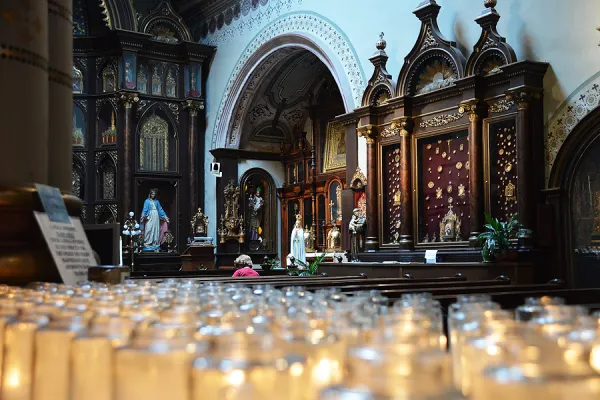
Pittsburgh, Pa., Apr 10, 2020 / 09:00 am (CNA).- Nestled in a sleepy neighborhood in the hills rising over Pittsburgh lies a small chapel. Inside St. Anthony’s Chapel lies a piece from the Crown of Thorns, a tooth of St. Anthony of Padua, and more than 5,000 other verified relics, or remains, of saints from around the world.

Indeed for the fragments from the bodies and scraps of the belongings of countless saints, these relics continued to have earthly adventures long after the saints’ deaths. Many of the relics traveled across the world to escape war, confiscation, and desecration to make it into the safe hands of a Belgian-born physician and priest, Fr. Suitbert Mollinger, who founded the chapel.

The chapel now holds the largest collection of relics outside of Rome.

“Fr. Stewart Mollinger, well, he had an unusual hobby in which he liked to acquire relics of the saints,” Carole Brueckner, chairperson of the committee for St. Anthony’s Chapel, explained to CNA.

But in the midst of the political and social turmoil which Europe experienced at the end of the 19th century, this curious hobby was crucial to saving relics from across the continent.

Since the second century, Catholics have honored the relics of saints- either pieces of body parts or cherished belongings of holy men and women. While theologians and Church documents clarify that relics are not to be worshiped, nor do they hold magical powers, the teaching adds that relics must be treated with respect, as they belong to persons now in heaven. While relics do not have power in and of themselves, God can continue to work miracles in the presence of the saint’s body even after death, the Church teaches. Relics are present in, or below, many Catholic altars.

Because of their important place in Catholic devotion as well as their presence at Mass, relics became a target of anti-Catholic persecution in Europe.  

“It was a very chaotic time, in a sense, for Catholics, because people were fighting for territories and countries,” Brueckner said. During the mid- to late- 19th century the political boundaries – and also religious identities – of regions across Europe shifted as the modern nation-states of Germany, Italy, France, and Belgium formed, the power of the nobility and the Church ebbed, and secular governments arose.

Many nobles and religious “were afraid that their governments or the monarchies under which they lived would commit and confiscate the relics from them,” she explained. In some regions, Brueckner continued, authorities even “desecrated the relics and on occasion they would put someone in prison for having a relic in their possession.”

“Due to what was happening in Europe, this was an opportune time for Father to enrich upon his own personal collection of relics of the saints,” she elaborated. While it is forbidden for Catholics to sell or purchase relics, Fr. Mollinger was loaned or granted relics from friends in his home country of Belgium, as well as from his travels in the Netherlands, Italy, and elsewhere.

“Many times, his friends, who are also religious, would write and ask him if he could take some of their relics and keep them in safekeeping, until their countries or monarchies became stable, and Father always responded ‘yes’,” she explained. “Father also had agents that he had throughout Europe that were looking for the relics, because in essence, he would try to rescue them from being destroyed by governments and monarchies that existed in Europe at this time.”

Initially, Fr. Mollinger kept the growing relic collection in his rectory. Medical patients as well as faithful Catholics would visit the doctor-priest for both spiritual and physical treatment, and “they had the opportunity to venerate them those relics when they were there.”

Many pilgrims, Brueckner said, “were cured of their anomaly or disability” after receiving physical or spiritual aid in the presence of the relics. As a result, “Father was gaining the reputation as a priest-physician-healer,” she elaborated. Records of local Pittsburgh newspapers of the time documented Fr. Mollinger’s treatments, as well as the thousands of people who traveled to venerate the relics.

Fr. Mollinger, however, “thought they belonged in a beautiful church so that everybody could visit and venerate the relics,” and thus built with his own funds a chapel to house them.

The first section of the chapel was completed on the feast of St. Anthony in 1883, and houses the thousands of relics collected by Fr. Mollinger at the time. The second section was also completed on the feast of St. Anthony, nine years later in 1892, and contains the Stations of the Cross and relics collected after the chapel’s completion. Fr. Mollinger died two days after the last section of the chapel was completed.

Among the relics the chapel currently claims are splinters from the True Cross and the Column of Flagellation; stone from the Garden of Gethsemane; a nail that held Christ to the Cross; material from Jesus, Mary and Joseph’s clothing; a “piece of bone from all of the apostles”; and relics from St Therese of Liseux, St. Rose of Lima, St. Faustina, St. Kateri Tekawitha.

“If I had to name all the saints, we’d be here forever,” Brueckner exclaimed.

Nearly all these relics have been verified, as well.  

“When a relic is placed within that reliquary, it is sealed and it can never be opened again,” Brueckner said, explaining that the Church’s strict rules guard against tampering and forgery of relics. “For a relic to be venerated, you do need to have a document, and the document comes from the hierarchy in the Church. That document will tell you who the saint is, what the relic is, and it is saying that the Catholic Church has done their research and we can say what the relic is.”

“We do have the certificates of authenticity for almost all of our relics here within the chapel.”

While belief in the authenticity of the relics relies on a trust that “the Catholic Church has done their research, and I’m going to believe what the Catholic Church is saying,” Brueckner said, visitors still experience the same presence documented by the first pilgrims to the collection of saintly relics. “Many times when people come into the chapel they will say that they actually feel a presence.”

“I say that it’s like stepping into a little piece of heaven, because you are surrounded by so many people that our Church tells us are in heaven,” she remarked.


This story was originally published on CNA Aug. 20, 2015.

[…]

No Picture
News Briefs

How Catholics can be inspired by art during Holy Week

April 9, 2020 CNA Daily News 2

Denver, Colo., Apr 9, 2020 / 02:01 pm (CNA).- As churches and museums remain closed, Catholic artists have encouraged people to be inspired this Holy Week by finding beauty online or even attempting to create projects themselves.

Andrew Julo is the director and curator for the Verostko Center for the Arts at Saint Vincent College in Latrobe, Pennsylvania. He told CNA that Catholics should look for both familiar and new pieces of art that flow with the narrative of Holy Week.

He said, for example, Catholics should dwell on art that relates to Christ washing the disciples’ feet, the Passion of Good Friday, or the Resurrection on Easter. He said people may also find art depicting pandemics to express solidarity with those who have died of COVID-19.

“Find images that correspond with the days of Holy Week, assemble your own digital exhibition and share it online. While the majority of these digital reproductions can never substitute the experience of seeing the original work in person, they still possess an ability to move our minds and hearts,” he said.

According to the New York Times, the coronavirus has infected over 1.4 million people and killed over 83,000. In response, many international leaders have placed their countries on lockdown, halting church services, artistic entertainment, and numerous businesses.

He pointed to the recent actions from museums around the world who have begun to offer virtual tours online to engage people in art. He suggested viewers take their time in viewing the art and expand the images to the maximum space on the screen to minimize the distractions from ads and other pictures.

“There’s lots of museums throughout the world that are looking to connect with their audiences by sharing their exhibitions, posing questions on social media, and asking folks at home to spend more time looking closely at works of art in their collections,” he said.

Virtual tours of Catholic art, such as pieces by Raphael, Botticelli, da Vinci, Crivelli, and Caravaggio, are being offered for free online through several museums. Among others, a virtual tour may be accessed to view paintings within the Metropolitan Museum in New York, Uffizi Gallery in Florence, Musée d’Orsay in Paris, and National Gallery in London.

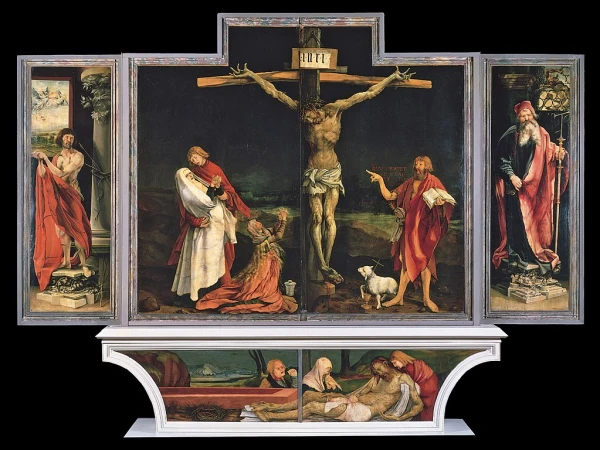
For Holy Week, Julo suggested that Catholics view Ford Brown’s Jesus Washing Peter’s Feet; Matthias Grünewald’s Isenheim Altarpiece, which depicts a mangled Christ; and Exsultet scrolls. He said the website of the British Library includes a beautiful example used at the Benedictine Abbey of Montecassino during the 11th century.

“Grünewald imaged Christ with the same lesions that afflicted patients who were dying from the disfiguring disease of ergotism. Here, Christ’s body reminds us of the importance and fragility of our physical being. With so many individuals throughout the world suffering from COVID-19, an image of the crucifixion this year prompts us to remember these infirmities with greater attention,” he said.

David Clayton, an artist and a writer who runs The Way of Beauty, has emphasized the importance of using images in collaboration with prayer. He told CNA that visio divina, “divine seeing,” is a powerful tool alongside liturgical readings, scripture, and the daily office.

“I think the experience that’s going to bear fruit is one of prayer and a pattern of prayer that has the liturgical piety at its heart,” he said. “Then have satellites around that of Catholic devotions, many of which engage with visual imagery.”

He stressed three periods of art that promote authentic beauty – iconography, Gothic, and the Baroque.

He pointed to pieces by Gregory Kroug, a Russian monk and early 20th-century iconographer of the Eastern Orthodox Church; the Madonna and Child by the Gothic painter Duccio; and The Virgin in Prayer by Sassoferrato. He also drew attention to Princeton University, which has recently cataloged images online of icons from Saint Catherine’s Monastery at Mount Sinai.

Gwyneth Thompson-Briggs, a sacred artist who creates custom religious art for homes and churches, discussed with CNA the importance of sacred art as a means to more fully engage in truth. She said art is particularly impactful because humans are both physical and spiritual beings.

“We’re made of body and spirit, and, so because of that, the things that we come in contact within a physical world really do affect our soul,” she said.

“It’s through the visible that we are able to approach the invisible. So the experience of tactile beauty is a hint of the supernatural beauty that we’ll be encountering in heaven. I think Thomas Aquinas says that beauty is the attractive power of truth.”

She suggested that images be viewed slowly and alongside prayer, noting that it is important to allow the art time to open up to the viewer. She said, during the last Palm Sunday, she brought out books of Western art to help engage her children and herself.

“I was grabbing art history books in our living room and looking at great images of Western art from the Baroque and Renaissance and following through the entire Passion. Then looking at images of the agony in the garden or Christ before Pilate or the crowning of thorns,” she said.

“Don’t be in a rush. It takes a while for beauty to unfold itself,” she said. “Making space to really focus on a single painting or a single work of music, [it] really draw[s] all of your attentive powers to experiencing it. I think that can lead to a much more profound understanding and engagement with it.”

She also suggested that Catholics participate in creativity themselves, whether through painting, woodworking, gardening, or knitting.

She said domestic practices may also become transformed into something more valuable for the holiday. She suggested using foods depicted in the Passion, like lamb and unleavened bread, or symbolic dishes, like Good Friday’s hot cross buns, which are topped with a cross and cooked with spices used to signify Christ’s burial.

“These days of quarantine … you find yourself with a bit more time on your hands, but also maybe feeling a bit more anxious and needing to find some constructive way to occupy yourself and find outlets for hope,” she said.

“I think that personal experiences of creativity or making something beautiful is a really great blessing.”

Julo also emphasized the value of creativity. He said that the domestic Church is where Christianity began and he stressed the value of fostering an opportunity to honor the Sacred Triduum. He said people should mark Easter with a special action, whether that is through music, poetry, or even a simple walk.

“It’s helpful to remember that church began in people’s homes. So we in some ways are participating in something that is also very ancient in the domestic space,” he said.

“I would encourage people to try to be creative about how they honor the Sacred Triduum. Gather flowers, branches, or greenery for inside. Light candles. Set up a corner in your home with sacred images including members of your family you’re not able to share physical space with right now. Before meals, make your dining area festive with a table cloth and your nicest place settings …Whether alone or with others, ritualize your meals.”

[…]