

The year was 1985. A nun in a zip-up velour robe was demonstrating liturgical dance at my all-girls high school. Spotlighted onstage in the darkened auditorium, she swayed and bowed, long grey hair falling to her waist, feet bare. The performance was punctuated with mostly forgettable snippets of wisdom focused on Mother God and patriarchal structures.
But one unforgettable moment came at the end of her performance, when she asked, “What is God’s greatest gift to woman?” With one voice, my schoolmates shouted back, ‘MEN!'”
The same year, Donna Steichen sat demurely on the sidelines of a conference in Mankato, Minnesota, as women circled a smoking cauldron.
Many of the participants were current or former Catholic nuns. They had spent the weekend discussing women and spirituality; this service “in the Dianic Wiccan tradition” was a highlight of the event.
Never mind that the smoke rising from the cauldron was dry ice; the women were deadly serious as they invoked the four directions to send malevolent thoughts to Washington. Their object: to kill a certain bill that was making its way through Congress.
“Mom was sitting on the sidelines with her tape recorder and her notebook, writing down everything she was observing and hearing,” Steichen’s daughter Laura Berquist recalls. “The facilitator of the workshop was not happy. She came over to Mom and told her that everyone was required to participate.
“My mother smiled at her and said, ‘No, I am perfectly happy sitting right here watching.’ She stayed right where she was with her tape recorder on, and she went on taking notes. Mom was not a person who was intimidated.”
That incident, Berquist said, perfectly illustrates the feisty spirit that made her tiny, ladylike mother—who died Oct. 21 at 97—a force to be reckoned with.
The 1991 book that came out of the Mankato conference and similar events was instrumental in exposing the radical feminist infiltration of the Catholic Church in America.
That infiltration was in full flower in the 1980s, when things were getting really weird at my high school, run by the Incarnate Word Sisters. When I read Steichen’s book a few years later, it put many things in perspective for me.
Defecting in place
A mother of four from Minnesota, Steichen had been active in the pro-life movement, Catholic religious education, and other causes before a speech by Catholic feminist theologian Rosemary Radford Ruether impelled her to investigate what Berquist called “the heresy and malevolence” behind Ruether’s radical position.
A gifted artist, Steichen had realized early on that she could do one thing well, along with raising her children: paint or write. She decided she could do more for the Church by writing, so write she did, publishing in her diocesan newspaper and writing pro-life pamphlets. From 1980 to 1986, she served as vice-president and then president of the Catholic League in Minnesota. She also had a long-running local television program, which she used as a platform to defend life and discuss Catholic issues.
But Ruether’s keynote address at Minnesota’s International Women’s Year meeting in 1977—explicitly identifying feminist theology as a branch of Marxist liberation theology—marked a new focus.
It led Steichen to devote a dozen years to researching and writing about feminism and, in particular, Catholic involvement in the feminist spirituality movement. In the process, she uncovered ties to Marxism, abortion, paganism, and the occult.
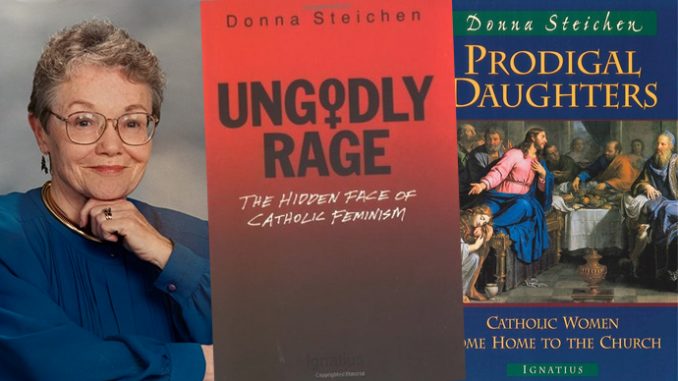
Her research culminated in Ungodly Rage: The Hidden Face of Catholic Feminism, published by Ignatius Press in 1991.
The book was “groundbreaking,” Berquist told me, “because it exposed the intention of the feminist movement to ‘defect in place’.”
“Mom was attending international woman’s year conferences, and she was dumbfounded to hear these various ladies say so explicitly that they were opposed to the Church and her doctrine, but that they would not leave the Church. Rather, they would try to dismantle her from within.”
Secular feminists had in large part become less strident by the 1980s, Steichen observed. But religious feminists—often well-funded by their religious orders—were a last holdout. They saw themselves as “change agents, engaged in a ‘long march through the institutions'” that [would] change the church to conform to their new vision,” Steichen wrote.
Steichen was careful to quote exact words and tried to back them up with written documentation that said the same thing. The radical feminists she was investigating “hated her,” Berquist remembers, but “they couldn’t do anything about it, because she was so careful about sticking to the observed facts and the written word.”
When she was refused entrance to conferences she was covering, Steichen took to wearing a wig and using her maiden name on her press badge.
She reported from the Mankato conference, “There were tee shirts and bumper stickers bearing the slogans ‘I (love) the Goddess’ and ‘Ankh if you love Isis.'” Elsewhere, she spotted “advertising buttons with such messages as ‘Nothin’ Says Lovin’ like Something From the Coven.'”
And “despite the unanimous denial of any association between witchcraft and satanism, an advertisement for a series of five ‘altar posters’ included two depicting ‘the God,’ a horned and bearded male figure indistinguishable from traditional images of Satan.”
‘A prairie fire from hell’
Although she spiced her reporting with humor, Steichen was clear-eyed about the evils she was exposing and their consequences.
“Catholic feminism is sweeping across the American Catholic Church like a prairie fire from hell,” she wrote.
She had already seen the societal damage wreaked by a movement that was all about “overthrowing the structure of the family and society,” as she told Catholic World Report.
“Most people interpret [feminism] as meaning that you’re for women, or that you believe women have a right to be educated or are just as smart as men,” she said. “But that’s not what it is about at all.” Marx and Engels “saw that the family was at odds with their vision of society … you can’t change society unless you get rid of the family.” And what better way to get rid of the family than to remove mothers from the home?
Steichen saw a host of evils accompanying and following radical feminism: abortion, contraception, divorce, poverty, neglect, homosexuality, damage to societal and religious institutions.
At the heart of it was the “ungodly rage” of her title, and now that rage was running rampant in the Church. “Religious feminists, and even secular feminists, want to overthrow God,” she said.
As agents of change, Catholic feminists were remarkably successful in subverting parishes, liturgies, and parochial education.
“To view the devastation all at once is almost overwhelming,” Steichen wrote in her book. “Where, we ask, are our shepherds? How could God let this happen?”
She answered her own question in a typically blunt manner: “The immediate disorders are not God’s doing. They follow from the encounter between religious revolutionaries who reject authority and ecclesiastical leaders who decline to exercise it.
” … Because those designated to guard the truth have allowed error to spread unchecked, it has grown and metastasized to its current catastrophic proportions.”
Ungodly Rage was a surprise hit, and over the next 35 years, Steichen was a sought-after speaker on the international lecture circuit. She contributed to numerous publications, including Catholic World Report, Latin Mass, and LifeSite News.
She wrote and edited two more books, both published by Ignatius. 1999’s Prodigal Daughters: Catholic Women Come Home to the Church was a hope-filled follow-up to Ungodly Rage, with portraits of seventeen women of the Baby Boom generation who left and returned to the Church.
And 2009’s Chosen: How Christ Sent Twenty-Three Surprised Converts to Replant His Vineyard, included profiles of Elizabeth Fox-Genovese, Steven Mosher, and Joseph Pearce, among others.
“Donna was a great author to work with,” said Ignatius Press co-founder Carolyn Lemon. “I have good memories of working with her, especially on Ungodly Rage, although the subject of her book was very disturbing.
“I was reviewing the copy editing on that book while we were on a working vacation up in Oregon, on the Imnaha River,” Lemon recalled. “At one point, I went out and sat on a rock in the river and let it wash away the distress I felt that these things were going on in the Church. Her book—books really—did a lot of good.”
The pro-life movement continued to be a fundamental priority for her. “Throughout her life, Donna was a tireless advocate for social reform, especially in defense of the defenseless,” daughter Peggy O’Reilly said. “She used her gifts as a writer and public speaker to promote the rights of the unborn, the handicapped, and the elderly.
“Never reticent to point out error, and always zealous for truth, Donna wrote with clarity and conviction on a wide range of issues bearing on human life, Catholic theology, catechetics, education, and especially pro-life policies.”
Steichen continued writing and speaking into her 90s. As recently as July, she was a guest on Berquist’s “Light of Faith” podcast, discussing as eloquently as ever the role of women in today’s world—a role that, she says, goes far beyond “living as an eminently successful man.”
Surviving
The last section of Ungodly Rage is titled “How Can We Survive as Catholics Until Order is Restored?”
Steichen’s solution: the Rosary, homeschooling, and faithful Catholic education.
She and her husband, LeRoy (who died in 2022 at age 99), were early supporters of Thomas Aquinas College in Santa Paula, California, sending their daughter Laura to the Great Books school when it opened in the fall of 1971. Ultimately, they would send three children and 15 grandchildren to the school, which currently counts two Steichen great-grandchildren as students. Son-in-law Paul O’Reilly currently heads the college.
“She fully believed that education that respects the meaning of truth under the guidance of the Catholic Church was and will always be the antidote for moral and intellectual decline,” Peggy O’Reilly said.
“Donna was one of Thomas Aquinas College’s first unofficial PR spokesmen. Through articles, speaking engagements, and word of mouth, she advocated for the classical liberal arts Great Books program at the college. She always said she would have loved to attend if only it had come along earlier.”
Steichen became a fervent supporter of the homeschooling movement as well. She “kept suggesting to us that we homeschool our children,” Berquist wrote last year. “I am forever grateful to my mother for guiding us in that direction.”
Steichen wrote the introduction to Berquist’s “Designing Your Own Classical Curriculum” in 1994. The following year, Berquist founded Mother of Divine Grace homeschool, which would become a nationwide program to support homeschoolers with online classes, counselors, and lesson plans.
Emerging from the catacombs
Almost 40 years after the publication of Ungodly Rage, faithful Catholic education—Steichen’s antidote to the raging wildfire of feminist, Marxist-inspired influence in the Church—is booming, even as public school enrollment continues to decline.
Mother of Divine Grace now enrolls more than 2,500 families. The homeschooling organization and others like it support over 3.4 million homeschoolers in the United States today.
Meanwhile, hundreds of Catholic classical schools are forming young students in truth.
Students from these twin traditions are filling Catholic colleges, graduating, and contributing to a rebirth of Catholic family life as they marry and raise families of their own.
It would seem that faithful Catholic life is coming out of “the catacombs,” as Steichen put it.
Catholic author and philosopher Carrie Gress read Steichen’s book in the 90s. “It was an eye-opener,” Gress said, “and helped me understand the terrible trends in the Church at that time.”
Gress has written extensively about feminism, which she has called “more harmful than Communism.”
Her books include The Anti-Mary Exposed: Rescuing the Culture from Toxic Femininity (2016), The End of Woman: How Smashing the Patriarchy Has Destroyed Us (2023), and Something Wicked: Why Feminism Can’t Be Fused With Christianity, published in January.
But she said when she re-read Ungodly Rage in 2016, “I was so wonderfully surprised that everything she wrote about was all but gone.”
“The radical leftism, the women wanting to be priests was so uncompelling and so sterile, that it had simply dropped off the map in most places.”
More relevant than ever
But just a decade later, Gress says that “some of it is resurfacing again.”
As evidence, she points to an Oct. 18 feature in the Chicago Tribune, running to more than 5,000 words, titled “What the Church Needs to Be: Women Defy the Catholic Hierarchy to Become Priests.”
“Much of this is because of the confusion about feminism in the Church today,” Gress said. “I suspect we will see more of it as time goes on if the Church continues to waver on the question of feminism.”
That makes Ungodly Rage more relevant than ever, she said. “Being familiar with what Steichen wrote is a great place to start to help women from falling back into this trap.”
Berquist agrees. “I frequently run into young Catholics, often young Catholic parents, who didn’t know that the Church had a position on Sunday Mass attendance or contraception. They didn’t have the most fundamental doctrines of the Church taught to them in their Catholic schools or religious education programs.”
For those Catholics and ex-Catholics, the book “explains how we got to this place. And shows what we need to do for the future,” she said.
Steichen’s approach was to “stay and fight,” rather than leave the Church in discouragement. The advice she gave three decades ago is still valid, she said in July. In fact, “the situation is even worse—much worse,” she warned, citing the “grave peril” to the family posed by transgender ideology.
The valiant woman
Speaking on the Light of Faith podcast, Steichen’s voice was strong, despite her failing health. She was characteristically witty as she discussed a variety of topics, from motherhood to abortion to Amy Coney Barrett.
Berquist introduced her mother—her voice catching—by comparing her to Scripture’s “valiant woman”: “A woman who fears the Lord is to be praised. Give her of the fruit of her hands and let her works praise her in the gates.” (Proverbs 31: 30-31)
“My, there’s nobody I’d rather be compared to than the valiant woman of Proverbs. Now, perhaps, I should just say goodbye,” Steichen quipped.
When Donna Steichen said her final goodbye last week, Regina Magazine commented simply, “A great woman has passed.”
If you value the news and views Catholic World Report provides, please consider donating to support our efforts. Your contribution will help us continue to make CWR available to all readers worldwide for free, without a subscription. Thank you for your generosity!
Click here for more information on donating to CWR. Click here to sign up for our newsletter.


A synonyms for “radical feminist nun” is lesbian.
A wonderful woman and great account by Monica Seeley. The best line for me was when Seeley’s girls school classmates shouted out MEN.
Yes, the satanic plays a large part in Feminism. The resurrection of ancient gods linked to the demon naturally corresponds to a revolt against the natural order, which Satan hates. Why sexual perversion has pervaded our culture.
Combined is the refusal of men to be men. Fearful of being castigated, willing to be cowed. Then the overreaction by some men and the crazy label toxic masculinity. Rather however we remain men and called toxic.
That Feminists seek to dismantle the Church from within is increasingly revealed. An issue that must be reckoned with, unfortunately encouraged by a feminized hierarchy. We need more Donna Steichens and true successors of the Apostles.
‘O Jesus , break the chains ..where The Spirit of The Lord is ,there is liberty ..’ beautiful song ..
https://www.youtube.com/watch?v=6BP_OO6jzws&list=RD6BP_OO6jzws&start_radio=1
A very special gift to celebrate the Eve of all Hallows- beatification of the
Ga Martyrs on Oct 31 St, 2026 , for standing up for protection of marriage and thus dignity of woman.
We are also given an occasion to marvel at the subtle Godly wisdom of things in such order –
we just had the Feasts of Sts Simon and Jude – St.Simon said to have been the person in charge of the cellar at the wedding at Cana who thus witnessed the miracle of water to wine; St.Jude , Patron of impossible situations – The Spirit whispering to us of need to have the Divine Love and holiness from God to live in peace , letting Him with our Mother& those with her to do the ‘impossible’ !
Nov 2nd for all souls – good day to also remember the many ( poor ) souls narrated in the article above who lost faith in spite of asking our Lord to heal the soul at every Holy Mass – yet without trust & gratitude that His healing is to free us & others -our soul connections and generations from the chains of rebellions, its effects- which gives the power for The Lord to act & touch all of humanity through such persons who stand for Him in the many choices we are given in our life here ! Glory be !
Never heard of her.
Thanks for this article!
WE READ: [Stiechen] and her husband, LeRoy (who died in 2022 at age 99), were early supporters of Thomas Aquinas College [TAQ] in Santa Paula, California…”
A chaplain at TAQ during the 1980s was the very un-confused professor, Fr. Gerard Steckler, S.J. (2017-2015)—a long-time correspondent and mentor to yours truly.
Extracts from Steckler’s correspondence:
“The greatest triumph of Hellenic speculative genius, the neo-platonism of Plotinus, was finally rationalism; it was the last ancient attempt to have man, and only a few such men, reach toward God. Christianity had already defeated it three centuries earlier by the introduction of ‘the Word made flesh’ [Jn 1:14], but it took until the end of the fourth century for the Roman State to capitulate to the Christian truth or principles. Now we are engaged in a civil war which involves the whole world” (1973).
“When the liberal stops looking for mankind or humanity, when the conservative stops divinizing all the past as infallible, when men realize that baptism plunges them into Christ and that that means suffering and death, and tears in between, with lots of joy cementing all three, then we shall return to the kind of cultural Christianity envisioned by Piers Plowman” (1973).
“When times are chaotic, a Plato or an Augustine is there to make us look beyond the stars [….] In our days we must continue to apply pressure on the state to change its immoral unnatural stance on contraception, abortion, sterilization, euthanasia” (1974).
“My historical analysis of how the State rose to its omnipotence would go like this. At Westphalia, ending the Thirty Years’ War in the middle of the 17th century, men stopped killing each other over the one subject worthy of death, religious revealed truth. Since the Christian God no longer informed earthlings what reality is all about, Thomas Hobbes suggested that an artificial man be created, the state (three years after Westphalia). In the meantime, puking infantile humanity was being born in the latter half of the 17th century. In the 18th century the boy became a man [….]” (in the “Spectator”, student paper at Gonzaga University, 1974).
“Some contemporary Churchmen have been subverted by the evolutionary, naturalistic, and even historicist attempts to invest time, space, and consciousness with ontological dimensions. Witness the recent ‘fantastica fornicatio’ [Augustine: the prostitution of the mind to its own fancies] that permitted Gloria Steinam to deliver a pair of homilies in a Minneapolis Catholic Church on feminine freedom of reproduction, a recent euphemism for murder, on the grounds, explained the pastor, that all points of view should be aired, even from the pulpit (The Kairos Foundation, Fall 1978).”
“I read Trochu’s Cure d’Ars years ago and am sure that it helped lead to the Catholic faith several years after ordination as a Jesuit priest” (1979).
“In 1965 [Jesuit General Pedro] Arrupe decided to do battle with Pope Paul VI [….] At General Council 31 [1964-5] the Jesuits decided to transform Paul VI’s commission to fight atheism into the socio-political struggle of the masses. The spiritual and supernatural element in Jesuit Catholicism had been excised [….] General Council 32 [1974-5] converted the Society of Jesus from an arm of the Church engaged in indispensable apostolic works to ‘faith in the service of justice,’ i.e., revolution against the socio-economic-political structure of the capitalist West [….] They succeeded in amalgamating nature with revelation” (1979).
“Hans Kung and many of this type reject what theologians call ‘Christology from above’ in favor of ‘Christology from below.’ Having themselves been taught Christology from above, they have rejected it in favor of opinion from below, a kind of presbyterian synodal approach [this wording over thirty years ago!] to truth based on numbers and questionnaires [….] How does one converse with those who are striving to create a new ethic based on the murder of the unborn and the aged, on the supremacy of feeling over thought, on the substitution of agreement by consensus for divine and objective truth” (Address to the Mindszenty Foundation General Meeting, 1986).
So disturbing, so many weak US bishops who lack the courage and will to speak out against the obvious evils daily attacking the authentic teachings of Jesus Christ. It’s appalling, the infiltration.